

Ethereum ETFs Now Hold 6,069 Million ETH, Setting a New Record
- Ethereum ETF holdings reached 6.069M ETH, marking a major shift in institutional accumulation behavior.
- Rapid ETF inflows locking 6.069M ETH reduce exchange liquidity and increase volatility risk.
The massive accumulation of Ethereum (ETH) by ETF custodians appears to be showing no signs of slowing down.
According to data from analyst CryptoOnchain at CryptoQuant, total ETH holdings by ETFs reached a record high on August 19th, at 6.069 million ETH.
Six weeks earlier, that figure was around 4.15 million. This means that approximately 1.9 million ETH moved from the spot market to institutional vaults in less than two months. This raises an important question: where will the price go if most of the ETH starts to be locked outside of exchanges?
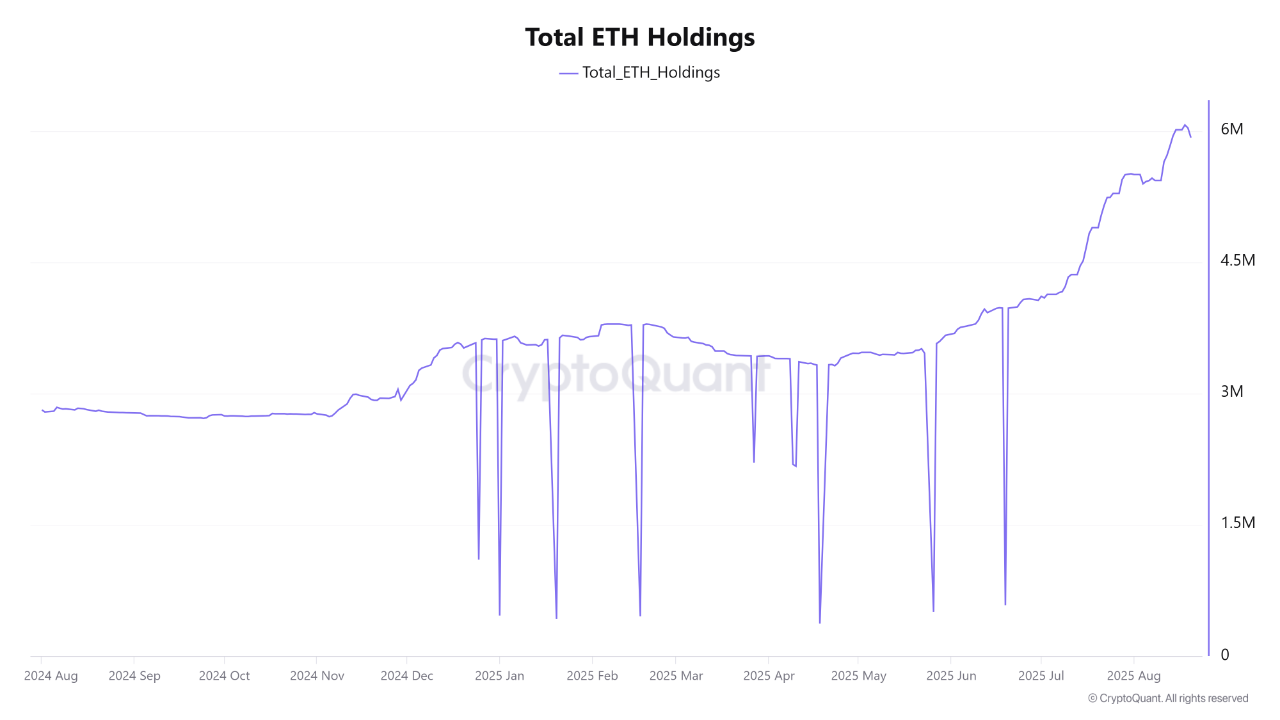 Source: CryptoQuant
On the one hand, this surge in institutional demand shows that ETH remains a favorite, at least among large investors. Every unit entered into an ETF reduces spot market liquidity.
With thinner order books, price movements can be more easily shaken by large transactions. The inflow of ETF funds can indeed provide a price buffer, but at the same time, it can also be a double-edged sword. What if the funds suddenly leave? The market could crash sooner than expected.
Volume Drops, Open Interest Rises: A Tense Market Standoff
While institutional investors are locking up millions of ETH, data from the derivatives market is showing a different tone.
According to CoinGlass, daily trading volume dropped sharply by 22.83%, leaving $114.33 billion. Options volume was also sluggish, falling 13.06% to $1.40 billion.
Surprisingly, open interest actually rose slightly to $61.11 billion. This means that despite the reduced volume, many positions are still open—as if the market is waiting for something.
 Source: CoinGlass
Perhaps because of this, on-chain analysts like Ali Martinez are starting to highlight important levels. He states that the current support zone is around $4,260, where around 690,000 ETH have accumulated.
But if this area fails to hold, the next target could drop to $3,700. It doesn’t sound pleasant, but it’s realistic.
 Source: Ali Martinez on X
From $7.5K Dreams to Dump Fears: ETH Walks a Fine Line
Furthermore, the CNF also previously observed that ETH had entered a “final pump and dump” phase. In this scenario, a brief rally typically occurs, followed by a sharp correction. Bitcoin’s dominance is even said to be poised to take over again, putting additional pressure on altcoins like ETH.
However, in mid-August, Standard Chartered raised its Ethereum price target to $7,500.
The major bank attributed this prediction to increased investor interest and the growing adoption of stablecoins. In fact, their long-term projections suggest ETH could reach $25,000 by 2028. Too ambitious? Perhaps. But after all, many also said $1,000 was impossible.
Not only that, this surge in ETF accumulation is changing the way the market views ETH. The demand structure is no longer solely controlled by retail traders or exchange whales, but increasingly relies on slower but more stable institutional fund flows.
As a result, volatility could decrease if inflows persist. But what if institutional funds suddenly withdraw? Volatility could explode in the opposite direction.
Besides that, as of the writing time, ETH is trading at about $4,309, up 1.01% over the last 24 hours, with $35.84 billion in daily trading volume.


You May Also Like

Solana Foundation to Help Secure DeFi Protocols Following $285 Million Drift Hack

LDO Price Prediction: Neutral Consolidation Targets $0.33 Resistance Retest by Mid-April




