Bitcoin’s Drop Reveals Panic Selling But Long-Term Holders Stay Calm
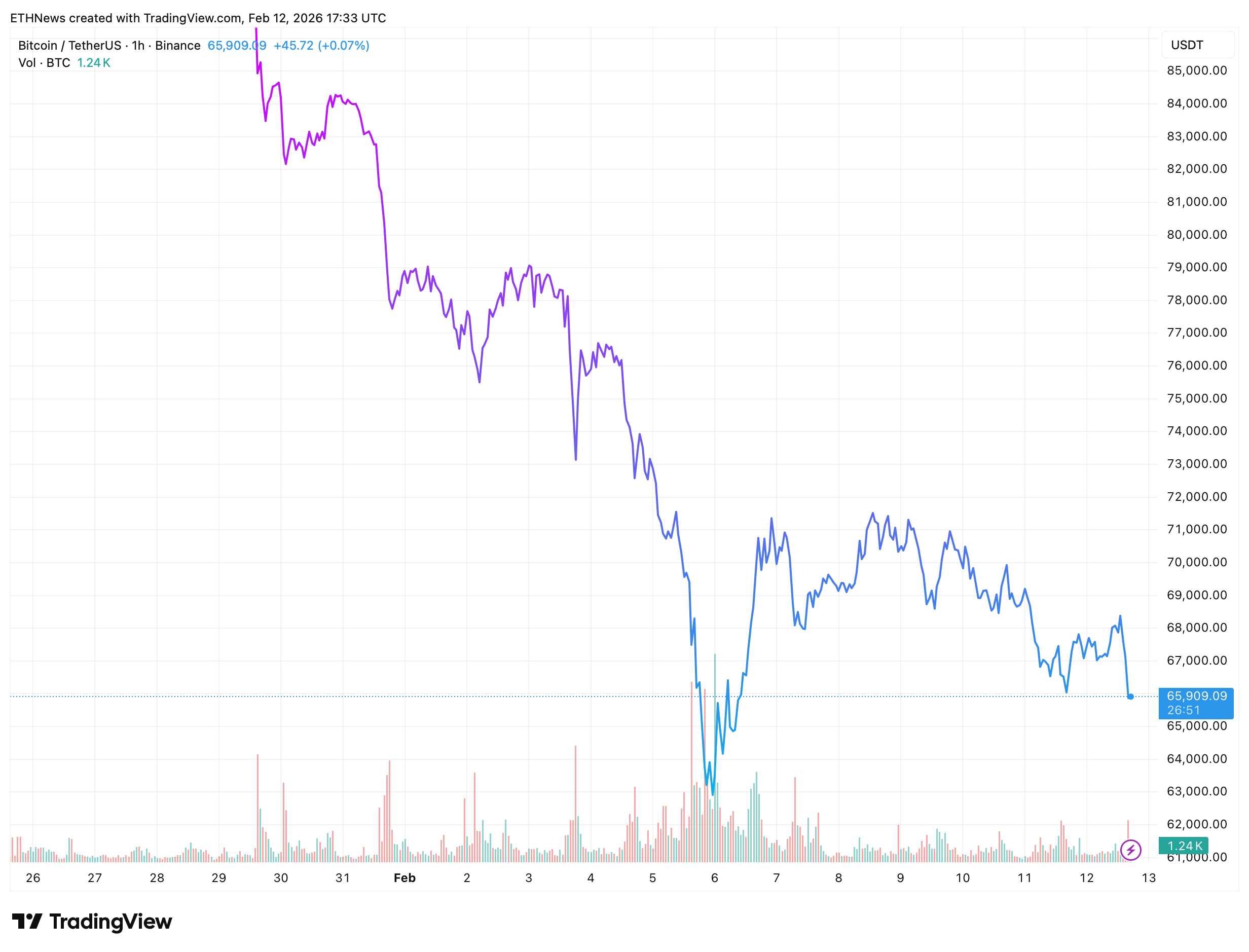
According to a report shared by CryptoQuant, Bitcoin’s decline from $124,000 to low $60,000s reflects a clear divergence between short-term traders and long-term holders.
While headlines emphasize fear, on-chain data suggests a more nuanced market structure beneath the surface.
The correction has triggered visible capitulation among recent buyers. However, structural conviction among seasoned holders appears largely intact.
Short-Term Holders Are Capitulating
At the October peak, short-term holders (STHs) aggressively realized profits. In a single week, more than $8.3 billion in gains flowed to exchanges. That euphoric distribution phase has now reversed.
By mid-February, loss-driven inflows from STHs surged. On February 11, roughly $399 million worth of Bitcoin was deposited at a loss. On several recent days, up to 99% of STH deposits were underwater.
This pattern fits classic capitulation behavior, panic selling during sharp drawdowns. However, context is critical. The magnitude remains smaller than previous stress events. For example, in August 2024, a single day saw approximately $1.5 billion in realized losses. Current losses, while meaningful, are less severe in scale.
Fear is elevated, but not historically extreme.
Long-Term Holders Remain Structurally Stable
Long-term holders (LTHs) present a contrasting picture. Even as Bitcoin retraced nearly $57,000, their exchange inflows stayed muted.
On February 11, when STHs realized nearly $399 million in losses, LTHs only sent around $23.8 million worth of coins at a loss.
Compared to prior cycle stress periods, such as early 2024, when LTH realized losses exceeded $225 millionin a single event, current behavior suggests restraint rather than capitulation.
Most LTH coins moved during this phase remain in profit, reinforcing the idea that experienced holders are not distributing aggressively into weakness.
Market Structure vs. Market Emotion
The divergence between short-term panic and long-term conviction is structurally significant.
In the 2022 bear market, long-term holders absorbed sustained losses over multiple months. That broad-based surrender defined deeper cycle bottoms. In contrast, the current correction shows stress concentrated primarily among recent entrants.
Short-term fear is loud. Long-term conviction is quiet.
If long-term holders continue to resist loss-driven distribution, the probability of structural stabilization increases. While volatility remains elevated near the $67,000 region, on-chain positioning suggests this drawdown more closely resembles a cyclical reset than a systemic breakdown.
The market may still be correcting, but the data does not yet reflect the kind of long-term holder capitulation typically associated with prolonged bear markets.
The post Bitcoin’s Drop Reveals Panic Selling But Long-Term Holders Stay Calm appeared first on ETHNews.


You May Also Like

Next Crypto to Explode: Altcoin Season Jumps as Pepeto Targets 100x

Solana Price Prediction as Exchange Supply Surges