Binance Buys $1B in Bitcoin, US Inflation Lower-Than-Expected, but BTC Price Still Suffers: Weekly Crypto Recap
Although bitcoin and most altcoins have recovered from the massive losses charted at the end of the previous business week, the past seven days weren’t exactly positive for the asset class, as it remains miles from the Q4 2025 peaks.
Before we examine the developments that took place in the past week, let’s quickly recap the latest crash that culminated on February 6 when BTC plunged to $60,000 for the first time in well over a year. Many altcoins collapsed by 20-30% daily, reaching new local lows.
Nevertheless, BTC bounced off on that day by $12,000 and tapped $72,000 in what became one of its most impressive single-day recovery attempts. However, the predominant bearish trend resumed rapidly, and BTC was stopped and driven down to $68,000 during the weekend.
It spent the next several days trading sideways between that lower boundary and $72,000. After the latest rejection at the upper boundary, the bears initiated another leg down, pushing the cryptocurrency south to $66,000 on Wednesday and $65,000 on Thursday.
The past few hours were slightly more positive for bitcoin, especially since the US CPI numbers for January came out and showed that inflation has actually cooled off. BTC jumped to $67,600 but was stopped there and now trades inches above $66,000. This means that BTC now sits at approximately the same spot as last week, but many alts have produced more substantial volatility.
On the one hand, XRP, BNB, HYPE, and SOL are deep in the red, but on the other, BCH, XMR, and HBAR have surged by up to 9.5%.
Market Data
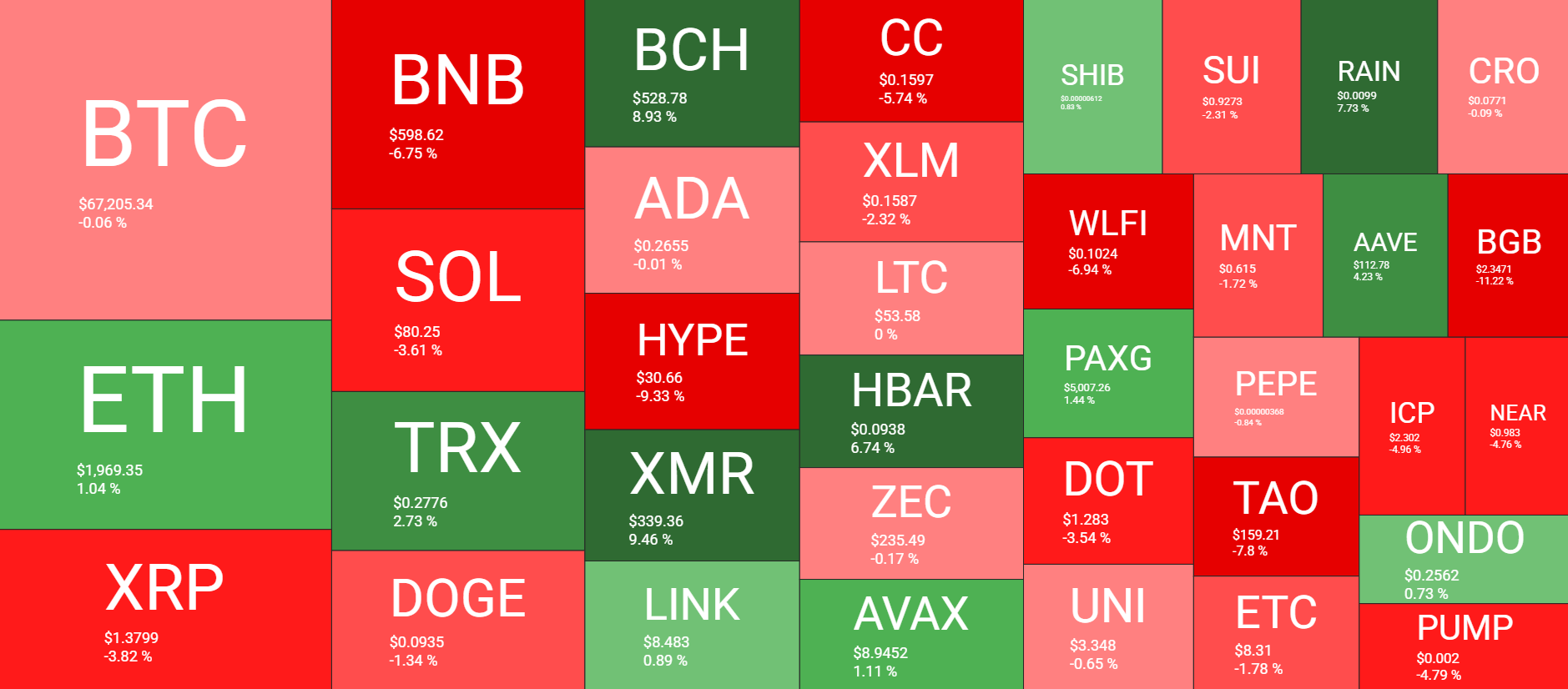 Cryptocurrency Market Overview Weekly Feb 13. Source: QuantifyCrypto
Market Cap: $2.37T | 24H Vol: $110B | BTC Dominance: 56.7%
BTC: $67,200 (-0.06%) | ETH: $1,970 (+1%) | XRP: $1.38 (-3.7%)
This Week’s Crypto Headlines You Can’t Miss
Binance Completes $1B SAFU Fund Shift to Bitcoin. The most significant news in terms of BTC acquisition this week came from Binance as the exchange completed the conversion of its entire $1 billion SAFU fund to bitcoin. The company bought a total of 15,000 BTC in the span of just a few weeks.
BlackRock’s BUIDL Fund Hits Uniswap as UNI Jumped 40%. The largest decentralized exchange partnered with Securitize to make BlackRock’s USD Institutional Digital Liquidity Fund available for trading via UniswapX. The news sent shockwaves through the UNI community, with the token surging by up to 40% within minutes.
Banks Take Hard Line on Stablecoin Yields as White House Talks Stall. Although the March 1 deadline is approaching fast, the crypto industry and banks clashed again over stablecoin rewards without a clear agreement. No compromise was reached, said sources, but the session was described as “productive.”
Robinhood Enters Layer 2 Race With Public Testnet Launch of Robinhood Chain. The US-based trading platform noted earlier this week that it has launched the public testnet for Robinhood Chain, an Ethereum Layer 2 network built on Arbitrum, designed to accelerate the development of tokenized real-world and digital assets.
Miner Offloads $305M Bitcoin as Network Difficulty Sees Sharp Decline. The past few weeks have been tough on miners as well, especially in some regions due to severe weather. One of the larger entities in the field, Cango, disclosed that it had sold over $300 million worth of BTC amid rising pressure and falling profitability metrics.
Robert Kiyosaki Says Bitcoin Is a Better Investment Than Gold – Here’s Why. The best-selling author, who recently came under fire by the crypto community because of some controversial statements, believes bitcoin is a better investment than gold. Although he would rather hold both, if having to choose, he would opt for BTC due to its proven limited supply.
Charts
This week, we have a chart analysis of Ethereum, Ripple, Cardano, Binance Coin, and Hyperliquid – click here for the complete price analysis.
The post Binance Buys $1B in Bitcoin, US Inflation Lower-Than-Expected, but BTC Price Still Suffers: Weekly Crypto Recap appeared first on CryptoPotato.


You May Also Like

Polymarket Reveals Exchange Upgrade and Native Stablecoin

OpenAI CEO urges U.S. to prepare for AI ‘superintelligence’ risks and gains