Binance has strongly denied allegations that it processed more than one billion dollars in transactions tied to Iranian entities, as the exchange faces renewed Binance has strongly denied allegations that it processed more than one billion dollars in transactions tied to Iranian entities, as the exchange faces renewed

BNB Drops After Binance Denies Iran Linked USDT Transfers

2026/02/17 05:22
4 min read

Binance has strongly denied allegations that it processed more than one billion dollars in transactions tied to Iranian entities, as the exchange faces renewed scrutiny and a market reaction that pushed BNB lower.

Key Takeaways

  • Binance rejected claims that it facilitated over $1 billion in Iran linked USDT transfers.
  • Richard Teng said no sanctions violations were found and no investigators were dismissed for raising concerns.
  • BNB fell around 3 percent following the media report and public response.
  • The controversy comes as Binance remains under heightened regulatory monitoring after its 2023 US settlement.

What Happened?

A February 13 report by Fortune alleged that internal compliance investigators at Binance identified more than $1 billion in transactions connected to Iranian businesses between March 2024 and August 2025. The report claimed the transfers involved Tether USDT on the Tron network and suggested that several investigators were dismissed after raising sanctions related concerns.

Binance leadership quickly pushed back. Co Chief Executive Officer Richard Teng publicly denied the allegations, stating that the report contained serious inaccuracies and misleading implications.

Binance Denies Sanctions Breaches

In a public statement, Richard Teng said:

The record must be clear. No sanctions violations were found, no investigators were fired for raising concerns, and Binance continues to meet its regulatory commitments. We’ve asked for corrections to recent reporting.

The company said it conducted a full internal review with external legal counsel and found no evidence of sanctions violations tied to the transactions referenced in the report. Binance also rejected claims that employees were punished for flagging compliance concerns.

Teng emphasized that Binance maintains strict internal policies, whistleblower protections, and employment safeguards. He questioned the suggestion that dismissals were linked to sanctions investigations and described those claims as unfounded.

The exchange further highlighted that it operates under regulatory oversight in multiple jurisdictions, including Abu Dhabi, and complies with laws in 21 other regions.

Ongoing Scrutiny After 2023 Settlement

The allegations are particularly sensitive because Binance remains under monitoring following its $4.3 billion settlement with US authorities in 2023 over anti money laundering and sanctions violations. As part of that agreement, founder Changpeng Zhao stepped down as Chief Executive Officer and later served a four month prison sentence.

Since then, Binance has stated that it has significantly strengthened its compliance systems, staffing levels, transaction monitoring tools, and sanctions screening processes.

Teng also criticized what he described as irresponsible reporting based on anonymous sources. He said such coverage undermines the work of more than 1,300 compliance professionals at the company.

Stablecoins and Global Sanctions Focus

The controversy also draws attention to the broader use of stablecoins such as USDT in cross border transactions. Blockchain analytics firms including TRM Labs, Chainalysis, and Elliptic have previously reported that Iranian linked entities have increasingly used stablecoins to bypass traditional financial systems.

Regulatory focus on stablecoins has intensified in recent months. Earlier, the US Treasury Office of Foreign Assets Control sanctioned two United Kingdom based exchanges for processing nearly $1 billion in transactions tied to the Islamic Revolutionary Guard Corps. A significant share of those transfers reportedly involved USDT on the Tron network.

Separately, reports noted that the Central Bank of Iran purchased more than $500 million in USDT to support liquidity amid pressure on the Iranian rial. These developments have added to global concerns about digital assets and sanctions enforcement.

Market Reaction and BNB Price Movement

Following the report and Binance’s denial, BNB dropped roughly 3 percent, trading near $616. Investors appear sensitive to any compliance related headlines involving the world’s largest crypto exchange by trading volume.
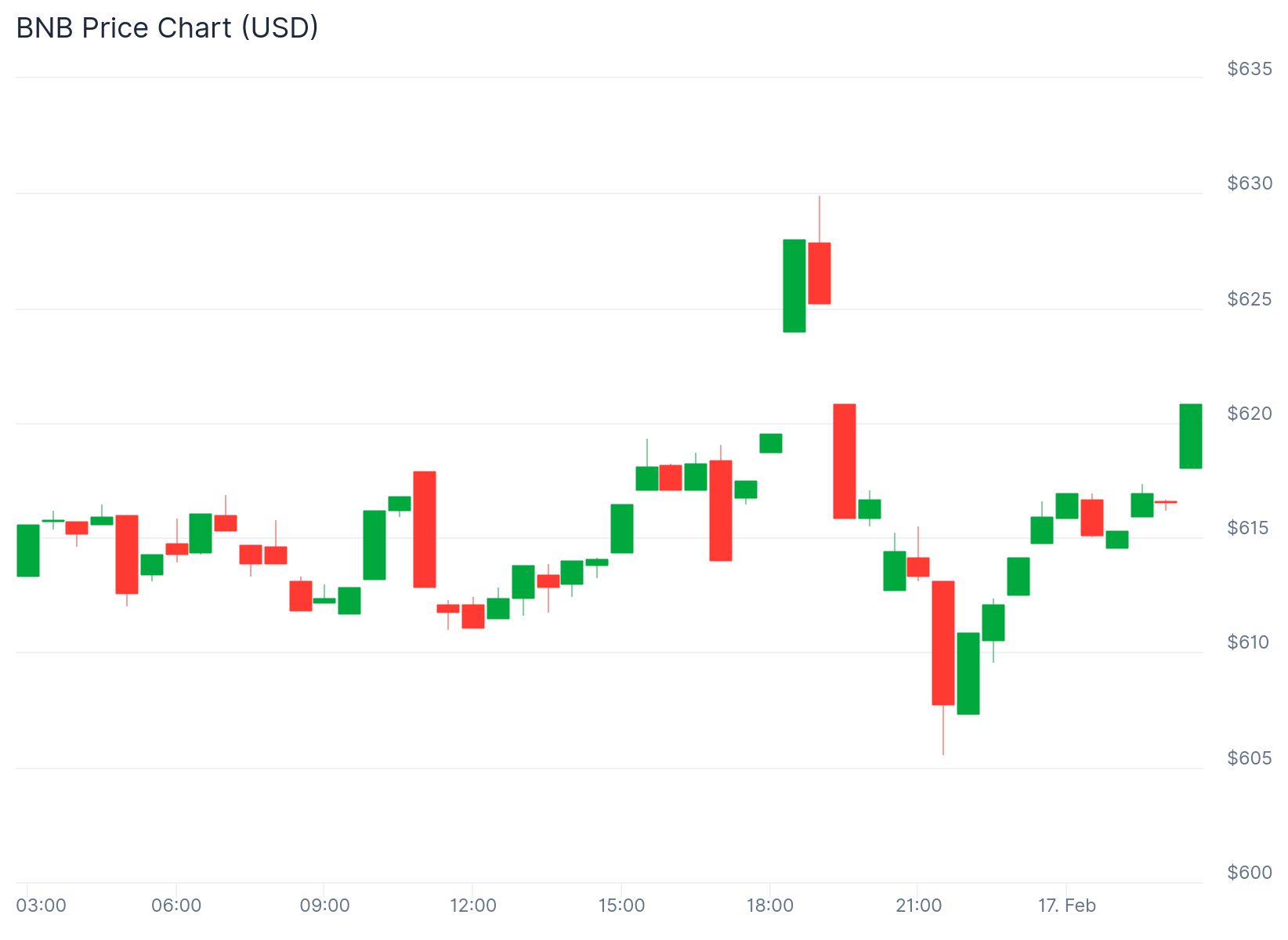
Bnb Price 17th FebImage Credit – CoinGecko.com

Technical indicators show that BNB remains in a consolidation phase after recent volatility. Analysts note potential resistance around the $630 level, while support remains near $600. Market sentiment could shift quickly depending on regulatory clarity and further disclosures.

CoinLaw’s Takeaway

In my experience, when it comes to major exchanges like Binance, reputation risk moves markets almost instantly. Even unproven allegations can shake investor confidence. I found it telling that Binance responded so quickly and directly, which shows how serious compliance optics are in today’s crypto environment.

At the same time, regulators globally are tightening oversight of stablecoins and cross border flows. Whether or not the allegations hold weight, this episode reminds investors that compliance headlines can impact token prices just as much as fundamentals.

The post BNB Drops After Binance Denies Iran Linked USDT Transfers appeared first on CoinLaw.

Market Opportunity
Binance Coin Logo
Binance Coin Price(BNB)
$627,46
$627,46$627,46
+3,28%
USD
Binance Coin (BNB) Live Price Chart
Disclaimer: The articles reposted on this site are sourced from public platforms and are provided for informational purposes only. They do not necessarily reflect the views of MEXC. All rights remain with the original authors. If you believe any content infringes on third-party rights, please contact service@support.mexc.com for removal. MEXC makes no guarantees regarding the accuracy, completeness, or timeliness of the content and is not responsible for any actions taken based on the information provided. The content does not constitute financial, legal, or other professional advice, nor should it be considered a recommendation or endorsement by MEXC.

You May Also Like

Crucial ETH Unstaking Period: Vitalik Buterin’s Unwavering Defense for Network Security

Crucial ETH Unstaking Period: Vitalik Buterin’s Unwavering Defense for Network Security

BitcoinWorld Crucial ETH Unstaking Period: Vitalik Buterin’s Unwavering Defense for Network Security Ever wondered why withdrawing your staked Ethereum (ETH) isn’t an instant process? It’s a question that often sparks debate within the crypto community. Ethereum founder Vitalik Buterin recently stepped forward to defend the network’s approximately 45-day ETH unstaking period, asserting its crucial role in safeguarding the network’s integrity. This lengthy waiting time, while sometimes seen as an inconvenience, is a deliberate design choice with profound implications for security. Why is the ETH Unstaking Period a Vital Security Measure? Vitalik Buterin’s defense comes amidst comparisons to other networks, like Solana, which boast significantly shorter unstaking times. He drew a compelling parallel to military operations, explaining that an army cannot function effectively if its soldiers can simply abandon their posts at a moment’s notice. Similarly, a blockchain network requires a stable and committed validator set to maintain its security. The current ETH unstaking period isn’t merely an arbitrary delay. It acts as a critical buffer, providing the network with sufficient time to detect and respond to potential malicious activities. If validators could instantly exit, it would open doors for sophisticated attacks, jeopardizing the entire system. Currently, Ethereum boasts over one million active validators, collectively staking approximately 35.6 million ETH, representing about 30% of the total supply. This massive commitment underpins the network’s robust security model, and the unstaking period helps preserve this stability. Network Security: Ethereum’s Paramount Concern A shorter ETH unstaking period might seem appealing for liquidity, but it introduces significant risks. Imagine a scenario where a large number of validators, potentially colluding, could quickly withdraw their stake after committing a malicious act. Without a substantial delay, the network would have limited time to penalize them or mitigate the damage. This “exit queue” mechanism is designed to prevent sudden validator exodus, which could lead to: Reduced decentralization: A rapid drop in active validators could concentrate power among fewer participants. Increased vulnerability to attacks: A smaller, less stable validator set is easier to compromise. Network instability: Frequent and unpredictable changes in validator numbers can lead to performance issues and consensus failures. Therefore, the extended period is not a bug; it’s a feature. It’s a calculated trade-off between immediate liquidity for stakers and the foundational security of the entire Ethereum ecosystem. Ethereum vs. Solana: Different Approaches to Unstaking When discussing the ETH unstaking period, many point to networks like Solana, which offers a much quicker two-day unstaking process. While this might seem like an advantage for stakers seeking rapid access to their funds, it reflects fundamental differences in network architecture and security philosophies. Solana’s design prioritizes speed and immediate liquidity, often relying on different consensus mechanisms and validator economics to manage security risks. Ethereum, on the other hand, with its proof-of-stake evolution from proof-of-work, has adopted a more cautious approach to ensure its transition and long-term stability are uncompromised. Each network makes design choices based on its unique goals and threat models. Ethereum’s substantial value and its role as a foundational layer for countless dApps necessitate an extremely robust security posture, making the current unstaking duration a deliberate and necessary component. What Does the ETH Unstaking Period Mean for Stakers? For individuals and institutions staking ETH, understanding the ETH unstaking period is crucial for managing expectations and investment strategies. It means that while staking offers attractive rewards, it also comes with a commitment to the network’s long-term health. Here are key considerations for stakers: Liquidity Planning: Stakers should view their staked ETH as a longer-term commitment, not immediately liquid capital. Risk Management: The delay inherently reduces the ability to react quickly to market volatility with staked assets. Network Contribution: By participating, stakers contribute directly to the security and decentralization of Ethereum, reinforcing its value proposition. While the current waiting period may not be “optimal” in every sense, as Buterin acknowledged, simply shortening it without addressing the underlying security implications would be a dangerous gamble for the network’s reliability. In conclusion, Vitalik Buterin’s defense of the lengthy ETH unstaking period underscores a fundamental principle: network security cannot be compromised for the sake of convenience. It is a vital mechanism that protects Ethereum’s integrity, ensuring its stability and trustworthiness as a leading blockchain platform. This deliberate design choice, while requiring patience from stakers, ultimately fortifies the entire ecosystem against potential threats, paving the way for a more secure and reliable decentralized future. Frequently Asked Questions (FAQs) Q1: What is the main reason for Ethereum’s long unstaking period? A1: The primary reason is network security. A lengthy ETH unstaking period prevents malicious actors from quickly withdrawing their stake after an attack, giving the network time to detect and penalize them, thus maintaining stability and integrity. Q2: How long is the current ETH unstaking period? A2: The current ETH unstaking period is approximately 45 days. This duration can fluctuate based on network conditions and the number of validators in the exit queue. Q3: How does Ethereum’s unstaking period compare to other blockchains? A3: Ethereum’s unstaking period is notably longer than some other networks, such as Solana, which has a two-day period. This difference reflects varying network architectures and security priorities. Q4: Does the unstaking period affect ETH stakers? A4: Yes, it means stakers need to plan their liquidity carefully, as their staked ETH is not immediately accessible. It encourages a longer-term commitment to the network, aligning staker interests with Ethereum’s stability. Q5: Could the ETH unstaking period be shortened in the future? A5: While Vitalik Buterin acknowledged the current period might not be “optimal,” any significant shortening would likely require extensive research and network upgrades to ensure security isn’t compromised. For now, the focus remains on maintaining robust network defenses. Found this article insightful? Share it with your friends and fellow crypto enthusiasts on social media to spread awareness about the critical role of the ETH unstaking period in Ethereum’s security! To learn more about the latest Ethereum trends, explore our article on key developments shaping Ethereum’s institutional adoption. This post Crucial ETH Unstaking Period: Vitalik Buterin’s Unwavering Defense for Network Security first appeared on BitcoinWorld.
Share
Coinstats2025/09/18 15:30
XRP holders hit new high, but THIS keeps pressure on price

XRP holders hit new high, but THIS keeps pressure on price

The post XRP holders hit new high, but THIS keeps pressure on price appeared on BitcoinEthereumNews.com. Ripple [XRP] remains one of the top five cryptocurrencies
Share
BitcoinEthereumNews2026/02/17 08:49
Will Bitcoin Price Drop to $50,000 by March 2026?

Will Bitcoin Price Drop to $50,000 by March 2026?

The post Will Bitcoin Price Drop to $50,000 by March 2026? appeared on BitcoinEthereumNews.com. Bitcoin is trading around $68,700, down nearly 22% year to date
Share
BitcoinEthereumNews2026/02/17 08:59