Probabilistic Circuits (PCs) offer a unified framework for tractable probability distributions, enabling efficient probabilistic inference through structured computation graphs. Researchers are advancing their speed and scalability via GPU parallelization, tensorized designs, and even custom hardware like DAG Processing Units. With applications ranging from explainability and data compression to neuro-symbolic AI and large language model detoxification, PCs are emerging as a powerful foundation for the next wave of efficient, interpretable AI.Probabilistic Circuits (PCs) offer a unified framework for tractable probability distributions, enabling efficient probabilistic inference through structured computation graphs. Researchers are advancing their speed and scalability via GPU parallelization, tensorized designs, and even custom hardware like DAG Processing Units. With applications ranging from explainability and data compression to neuro-symbolic AI and large language model detoxification, PCs are emerging as a powerful foundation for the next wave of efficient, interpretable AI.

Why Researchers Are Betting on PCs to Power the Next Wave of AI

Abstract and 1. Introduction

  1. Preliminaries and Related Work

  2. Key Bottlenecks in PC Parallelization

  3. Harnessing Block-Based PC Parallelization

    4.1. Fully Connected Sum Layers

    4.2. Generalizing To Practical Sum Layers

    4.3. Efficient Implementations by Compiling PC Layers

    4.4. Analysis: IO and Computation Overhead

  4. Optimizing Backpropagation with PC Flows

  5. Experiments

    6.1. Faster Models with PyJuice

    6.2. Better PCs At Scale

    6.3. Benchmarking Existing PCs

  6. Conclusion, Acknowledgements, Impact Statement, and References

A. Algorithm Details

B. Additional Technical Details

C. Experimental Details

D. Additional Experiments

\

2. Preliminaries and Related Work

Many probabilistic inference tasks can be cast into computing sums of products. By viewing them from a computation graph standpoint, PCs provide a unified perspective on many bespoke representations of tractable probability distributions, including Arithmetic Circuits (Darwiche, 2002; 2003), Sum-Product Networks (Poon & Domingos, 2011), Cutset Networks (Rahman et al., 2014), and Hidden Markov Models (Rabiner & Juang, 1986). Specifically, PCs define distributions with computation graphs consisting of sum and product operations, as elaborated below.

\
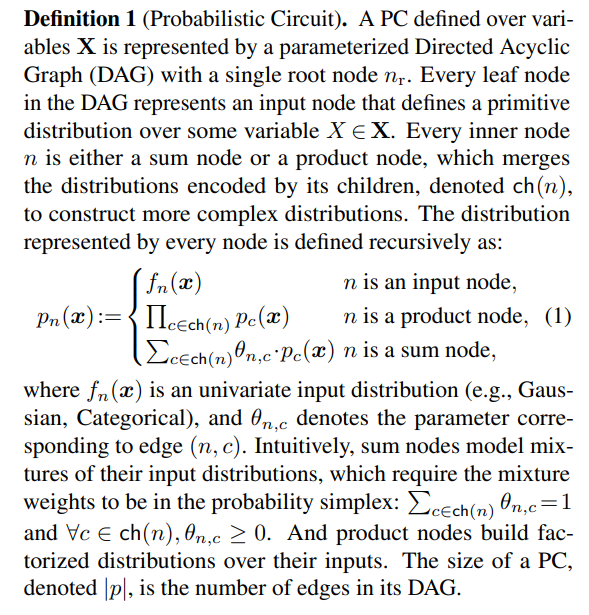
\ The key to guaranteeing exact and efficient computation of various probabilistic queries is to impose proper structural constraints on the DAG of the PC. As an example, with smoothness and decomposability (Poon & Domingos, 2011), computing any marginal probability amounts to a forward pass (children before parents) following Equation (1), with the only exception that we set the value of input nodes defined on marginalized variables to be 1. Please refer to Choi et al. (2020) for a comprehensive overview of different structural constraints and what queries they enable.

\
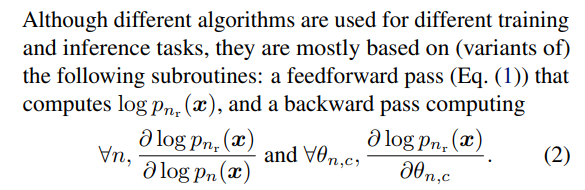
\ For example, Peharz et al. (2020a) demonstrate how the above parameter gradients can be used to apply ExpectationMaximization (EM) updates, and Vergari et al. (2021) elaborates how the forward pass can be used to compute various probabilistic and information-theoretic queries when coupled with PC structure transformation algorithms. Therefore, the speed and memory efficiency of these two procedures largely determine the overall efficiency of PCs.

\ Figure 1. Layering a PC by grouping nodes with the same topological depth (as indicated by the colors) into disjoint subsets. Both the forward and the backward computation can be carried out independently on nodes within the same layer.
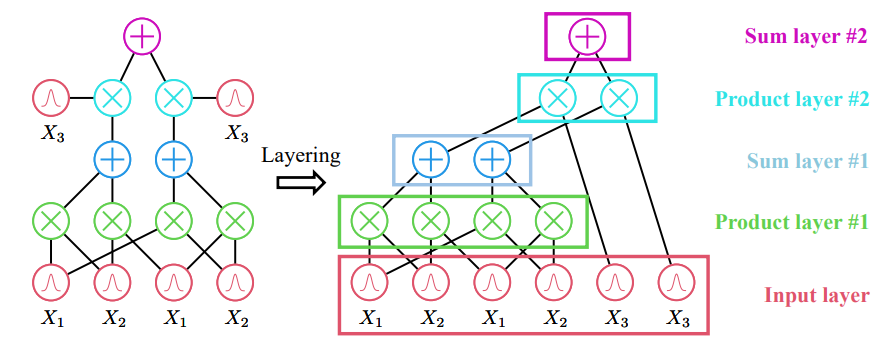
\ Related work on accelerating PCs. There has been a great amount of effort put into speeding up training and inference for PCs. One of the initial attempts performs nodebased computations on both CPUs (Lowd & Rooshenas, 2015) and GPUs (Pronobis et al., 2017; Molina et al., 2019), i.e., by computing the outputs for a mini-batch of inputs (data) recursively for every node. Despite its simplicity, it fails to fully exploit the parallel computation capability possessed by modern GPUs since it can only parallelize over a batch of samples. This problem is mitigated by also parallelizing topologically independent nodes (Peharz et al., 2020a; Dang et al., 2021). Specifically, a PC is chunked into topological layers, where nodes in the same layer can be computed in parallel. This leads to 1-2 orders of magnitude speedup compared to node-based computation.

\ The regularity of edge connection patterns is another key factor influencing the design choices. Specifically, EiNets (Peharz et al., 2020a) leverage off-the-shelf Einsum operations to parallelize dense PCs where every layer contains groups of densely connected sum and product/input nodes. Mari et al. (2023) generalize the notion of dense PCs to tensorized PCs, which greatly expands the scope of EiNets. Dang et al. (2021) instead focus on speeding up sparse PCs, where different nodes could have drastically different numbers of edges. They use custom CUDA kernels to balance the workload of different GPU threads and achieve decent speedup on both sparse and dense PCs.

\ Another thread of work focuses on designing computation hardware that is more suitable for PCs. Specifically, Shah et al. (2021) propose DAG Processing Units (DPUs) that can efficiently traverse sparse PCs, Dadu et al. (2019) introduce an indirect read reorder-buffer to improve the efficiency of data-dependent memory accesses in PCs, and Yao et al. (2023) use addition-as-int multiplications to significantly improve the energy efficiency of PC inference algorithms.

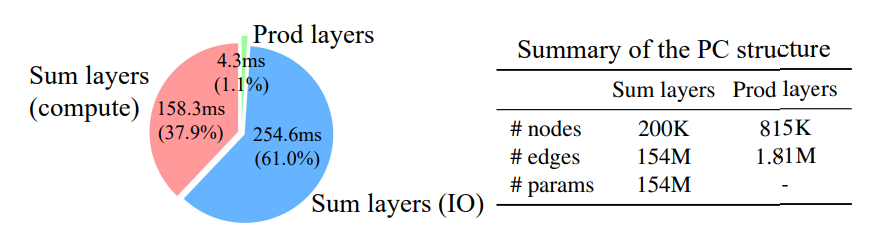
\ Figure 2. Runtime breakdown of the feedforward pass of a PC with ∼150M edges. Both the IO and the computation overhead of the sum layers are significantly larger than the total runtime of product layers. Detailed configurations of the PC are shown in the table.
\ Applications of PCs. PCs have been applied to many domains such as explainability and causality (Correia et al., 2020; Wang & Kwiatkowska, 2023), graph link prediction (Loconte et al., 2023), lossless data compression (Liu et al., 2022), neuro-symbolic AI (Xu et al., 2018; Manhaeve et al., 2018; Ahmed et al., 2022a;b), gradient estimation (Ahmed et al., 2023b), graph neural networks rewiring (Qian et al., 2023), and even large language model detoxification (Ahmed et al., 2023a).

\

:::info Authors:

(1) Anji Liu, Department of Computer Science, University of California, Los Angeles, USA (liuanji@cs.ucla.edu);

(2) Kareem Ahmed, Department of Computer Science, University of California, Los Angeles, USA;

(3) Guy Van den Broeck, Department of Computer Science, University of California, Los Angeles, USA;

:::


:::info This paper is available on arxiv under CC BY 4.0 DEED license.

:::

\

Market Opportunity
NeuroWeb AI Logo
NeuroWeb AI Price(NEURO)
$0.01
$0.01$0.01
0.00%
USD
NeuroWeb AI (NEURO) Live Price Chart
Disclaimer: The articles reposted on this site are sourced from public platforms and are provided for informational purposes only. They do not necessarily reflect the views of MEXC. All rights remain with the original authors. If you believe any content infringes on third-party rights, please contact service@support.mexc.com for removal. MEXC makes no guarantees regarding the accuracy, completeness, or timeliness of the content and is not responsible for any actions taken based on the information provided. The content does not constitute financial, legal, or other professional advice, nor should it be considered a recommendation or endorsement by MEXC.

You May Also Like

How Yieldfund’s Market-Neutral Strategy Delivers Reliable Weekly Crypto Payouts

How Yieldfund’s Market-Neutral Strategy Delivers Reliable Weekly Crypto Payouts

Discover how Yieldfund’s market-neutral strategy uses algorithmic trading to deliver reliable weekly crypto payouts with consistent returns.
Share
Blockchainreporter2025/09/19 17:40
Navi Protocol: An Unforgettable Success at KBW 2025 Side Event

Navi Protocol: An Unforgettable Success at KBW 2025 Side Event

BitcoinWorld Navi Protocol: An Unforgettable Success at KBW 2025 Side Event The cryptocurrency world thrives on innovation and community, and nowhere was this more evident than at Korea Blockchain Week (KBW) 2025. Among the many exciting announcements, Navi Protocol, a leading force in the Sui ecosystem, recently celebrated a monumental achievement: the successful conclusion of its Astros Night side event. This gathering was not just another industry meetup; it was a vibrant hub designed to unite the brightest minds shaping the future of decentralized finance (DeFi) on Sui. What Made Navi Protocol’s Astros Night a Stellar Success? Navi Protocol (NAVX), renowned as the largest DeFi protocol within the Sui (SUI) ecosystem, truly outdid itself with the Astros Night event. Held in strategic partnership with its affiliated decentralized exchange (DEX) aggregator, Astros, the event aimed to create unparalleled networking opportunities. Imagine a room buzzing with energy, filled with: Founders and visionary builders pushing the boundaries of DeFi. Key Opinion Leaders (KOLs) sharing invaluable insights and shaping narratives. Strategic partners forging alliances that will drive future innovation. Savvy investors seeking the next big opportunity within the Sui-native DeFi landscape. This carefully curated environment fostered genuine connections, sparking discussions that are crucial for ecosystem growth. It underscored Navi Protocol’s commitment not just to its own development, but to the collective advancement of the entire Sui DeFi community. Why is Community Building Crucial for DeFi Protocols Like Navi Protocol? In the fast-paced world of decentralized finance, community is everything. A strong, engaged community is the bedrock upon which successful protocols are built. For Navi Protocol, events like Astros Night are more than just social gatherings; they are vital strategic initiatives that: Foster Collaboration: Bringing diverse talents together encourages cross-pollination of ideas and joint ventures. Enhance Trust and Transparency: Direct interaction builds rapport and strengthens confidence among stakeholders. Drive Innovation: Open dialogue can spark new solutions to existing challenges and inspire groundbreaking features. Attract Talent and Investment: A vibrant community is a magnet for skilled developers and discerning investors. By prioritizing these interactions, Navi Protocol demonstrates a forward-thinking approach, understanding that collective strength ultimately benefits individual protocols and the broader ecosystem. Navi Protocol’s Strategic Vision: Empowering Sui DeFi The success of Astros Night at KBW 2025 is a testament to Navi Protocol’s strategic vision and its integral role within the Sui ecosystem. As the largest DeFi protocol on Sui, Navi provides essential lending and borrowing services, forming a critical financial primitive for the network. Its partnership with Astros further solidifies its position, offering users a comprehensive and efficient DeFi experience. The event served as a powerful platform to: Showcase the robust potential of Sui-native DeFi. Highlight the innovation happening within the ecosystem. Reinforce Navi Protocol’s leadership and commitment to growth. Looking ahead, such initiatives are crucial for sustained development. They not only put Sui DeFi on the global stage but also ensure that the protocols within it, like Navi Protocol, remain at the forefront of innovation and user adoption. What Does This Mean for the Future of Sui DeFi? The successful conclusion of the Astros Night side event paints a promising picture for the future of Sui DeFi. It signifies a maturing ecosystem where collaboration and community engagement are paramount. As Navi Protocol continues to host and participate in such impactful events, it strengthens the bonds within the Sui community, paving the way for: Increased adoption of Sui-native protocols. Development of more sophisticated and user-friendly DeFi applications. Greater visibility and recognition for the Sui blockchain as a whole. This success story from KBW 2025 is a clear indicator that Navi Protocol is not just building a product, but a thriving ecosystem. FAQs About Navi Protocol and KBW 2025 Q1: What is Navi Protocol? Navi Protocol (NAVX) is currently the largest decentralized finance (DeFi) protocol operating on the Sui blockchain, offering essential lending and borrowing services to users within the Sui ecosystem. Q2: What was the Astros Night side event? Astros Night was a networking event hosted by Navi Protocol in partnership with its affiliated DEX aggregator, Astros, during Korea Blockchain Week (KBW) 2025. It aimed to connect key stakeholders in Sui-native DeFi. Q3: Who attended the Astros Night event? The event brought together founders, builders, key opinion leaders (KOLs), strategic partners, and investors who are actively involved in the Sui-native DeFi space. Q4: Why are events like Astros Night important for the Sui ecosystem? Such events are crucial for fostering collaboration, building community trust, driving innovation, and attracting talent and investment, all of which contribute to the overall growth and success of the Sui DeFi ecosystem. Q5: What is the significance of Navi Protocol being the largest DeFi protocol on Sui? Being the largest signifies Navi Protocol’s substantial user base, liquidity, and importance as a foundational financial primitive within the Sui network, making it a key player in the ecosystem’s development. Share the Success Story! Was this article insightful? If you found this information about Navi Protocol’s successful KBW 2025 side event valuable, consider sharing it with your network! Help us spread the word about the exciting developments in the Sui DeFi ecosystem by sharing this article on your favorite social media platforms. To learn more about the latest crypto market trends, explore our article on key developments shaping the Sui blockchain’s institutional adoption. This post Navi Protocol: An Unforgettable Success at KBW 2025 Side Event first appeared on BitcoinWorld.
Share
Coinstats2025/09/23 17:30
Whales Dump 200 Million XRP in Just 2 Weeks – Is XRP’s Price on the Verge of Collapse?

Whales Dump 200 Million XRP in Just 2 Weeks – Is XRP’s Price on the Verge of Collapse?

Whales offload 200 million XRP leaving market uncertainty behind. XRP faces potential collapse as whales drive major price shifts. Is XRP’s future in danger after massive sell-off by whales? XRP’s price has been under intense pressure recently as whales reportedly offloaded a staggering 200 million XRP over the past two weeks. This massive sell-off has raised alarms across the cryptocurrency community, as many wonder if the market is on the brink of collapse or just undergoing a temporary correction. According to crypto analyst Ali (@ali_charts), this surge in whale activity correlates directly with the price fluctuations seen in the past few weeks. XRP experienced a sharp spike in late July and early August, but the price quickly reversed as whales began to sell their holdings in large quantities. The increased volume during this period highlights the intensity of the sell-off, leaving many traders to question the future of XRP’s value. Whales have offloaded around 200 million $XRP in the last two weeks! pic.twitter.com/MiSQPpDwZM — Ali (@ali_charts) September 17, 2025 Also Read: Shiba Inu’s Price Is at a Tipping Point: Will It Break or Crash Soon? Can XRP Recover or Is a Bigger Decline Ahead? As the market absorbs the effects of the whale offload, technical indicators suggest that XRP may be facing a period of consolidation. The Relative Strength Index (RSI), currently sitting at 53.05, signals a neutral market stance, indicating that XRP could move in either direction. This leaves traders uncertain whether the XRP will break above its current resistance levels or continue to fall as more whales sell off their holdings. Source: Tradingview Additionally, the Bollinger Bands, suggest that XRP is nearing the upper limits of its range. This often points to a potential slowdown or pullback in price, further raising concerns about the future direction of the XRP. With the price currently around $3.02, many are questioning whether XRP can regain its footing or if it will continue to decline. The Aftermath of Whale Activity: Is XRP’s Future in Danger? Despite the large sell-off, XRP is not yet showing signs of total collapse. However, the market remains fragile, and the price is likely to remain volatile in the coming days. With whales continuing to influence price movements, many investors are watching closely to see if this trend will reverse or intensify. The coming weeks will be critical for determining whether XRP can stabilize or face further declines. The combination of whale offloading and technical indicators suggest that XRP’s price is at a crossroads. Traders and investors alike are waiting for clear signals to determine if the XRP will bounce back or continue its downward trajectory. Also Read: Metaplanet’s Bold Move: $15M U.S. Subsidiary to Supercharge Bitcoin Strategy The post Whales Dump 200 Million XRP in Just 2 Weeks – Is XRP’s Price on the Verge of Collapse? appeared first on 36Crypto.
Share
Coinstats2025/09/17 23:42