

Coin Center Urges Senate to Save Crypto Developer Protection Bill
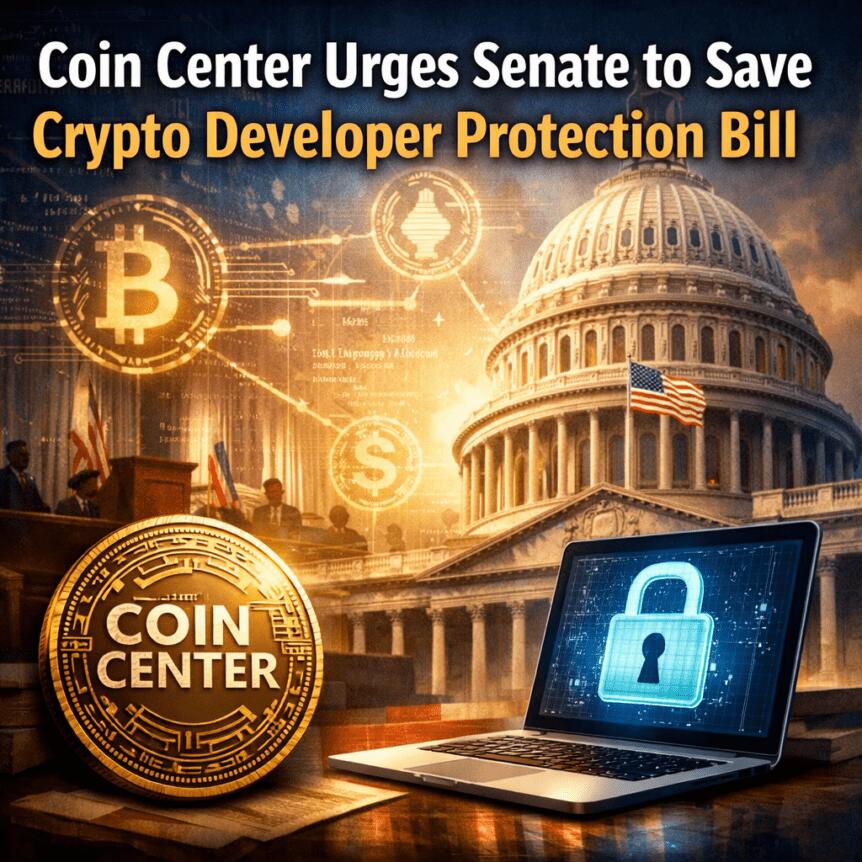
A prominent US crypto-policy group is urging lawmakers to press ahead with a bill designed to protect developers from criminal exposure as the industry seeks a clearer regulatory path. Coin Center sent a letter to the Senate Banking Committee in support of the Blockchain Regulatory Certainty Act (BRCA). The measure, first introduced in September 2018 by Rep. Tom Emmer, would be refined in a new draft authored by Senators Cynthia Lummis and Ron Wyden to clarify that software developers and infrastructure providers who do not handle user funds are not money transmitters under federal law. The advocacy comes as several developers faced legal action last year, underscoring the tension between innovation and enforcement. The letter, circulated publicly last week, argues that a robust, predictable framework is essential for the next wave of crypto engineering to thrive in the United States.
Key takeaways
- The BRCA aims to shield non-custodial software developers and infrastructure providers from money-transmitter penalties, reducing chilling effects on innovation.
- The latest BRCA draft, authored by Senators Lummis and Wyden, seeks alignment with existing internet-era protections by treating non-custodial actors as outside the money transmitter regime.
- Coin Center argues that prosecutorial risk without clarity deters builders and pushes talent offshore, threatening domestic development of blockchain technologies.
- The Senate Banking Committee is reviewing the BRCA draft but has not yet marked it up or advanced it to a vote, keeping the proposal in a transitional stage.
- High-profile convictions of crypto developers last year—spanning Tornado Cash and Samourai Wallet-related cases—underscore the urgency of predictable, legislative safeguards.
Tickers mentioned: $BTC, $ETH
Sentiment: Neutral
Price impact: Neutral. The policy discussion does not present an immediate price move, though clearer rules could influence risk sentiment and capital flows over time.
Market context: The BRCA debate sits within a broader regulatory framework taking shape in Washington, where lawmakers balance innovation incentives with consumer protection, enforcement precedence, and the evolving stance on decentralized technologies amid ongoing CLARITY Act discussions.
Why it matters
For the crypto ecosystem, the central question is whether the United States can provide a stable, predictable environment that encourages experimentation without inviting endless prosecutions against developers. The Coin Center letter frames BRCA as a legal shield for the “invisible engine” of blockchain innovation—the developers who build protocols, tooling, wallets, and infrastructure without directly controlling users’ funds. If enacted with clear limitations, BRCA could prevent well-intentioned creators from facing criminal exposure merely for building software that operates on open networks.
From a policy perspective, the tension is palpable. Proponents argue that clear exemptions are necessary to prevent a chilling effect on innovation and to maintain the United States as a hub for software development and crypto entrepreneurship. Opponents, and some lawmakers, worry that broad protections might erode consumer protections and create loopholes for illicit activity. The CLARITY Act framework referenced in the discourse adds another layer to the conversation, signaling that congressional interest in crypto regulation remains active and multi-faceted.
The heightened attention to BRCA also comes against the backdrop of a handful of courtroom outcomes tied to crypto activity. The conviction of Tornado Cash developer Roman Storm, along with Samourai Wallet founders Keonne Rodriguez and Will Lonergan Hill, illustrates how prosecutors are approaching unhosted or non-custodial ecosystems. Those cases—concerning conspiracy to operate an unlicensed money-transmitting business—have prompted industry voices to call for clearer, legislature-backed guardrails rather than relying solely on prosecutorial discretion. The outcomes to date, including prison sentences for Rodriguez (five years) and Lonergan Hill (four years), with Storm awaiting sentencing, have become reference points for lawmakers debating BRCA and related initiatives.
In practical terms, BRCA seeks to harmonize crypto development with mainstream internet policy norms, where service providers, cloud hosts, and developer ecosystems enjoy certain shielding protections as long as they do not exert direct control over user funds. As policymakers assess the BRCA draft, the central question remains: can non-custodial innovation be safeguarded without compromising accountability and legitimate enforcement? The discussions reflect a broader global trend toward regulatory clarity, with other jurisdictions pursuing similar guardrails for open networks and decentralized tooling, and the U.S. now weighing where to draw the line between risk and opportunity for builders.
Looking ahead, the dynamic between enforcement actions and legislative safeguards will likely continue shaping the posture of developers, exchanges, wallet providers, and infrastructure projects. The BRCA debate is not occurring in a vacuum; it sits at the intersection of evolving governance, enforcement clarity, and the practical needs of teams building on top of open networks that increasingly underpin real-world financial ecosystems.
As the narrative evolves, the crypto industry will monitor whether the BRCA language will be refined to balance innovation with risk controls, and whether the Senate will move from committee review toward a formal vote that could set a precedent for how future blockchain-led technologies are treated under federal law. In the meantime, the industry remains watchful of parallel legislative efforts, including ongoing discussions around the CLARITY Act framework and related regulatory initiatives, which could influence how developers and service providers plan and deploy new products in the months ahead.
What to watch next
- Keep an eye on whether the Senate Banking Committee marks up and votes on the BRCA draft in the near term.
- Monitor any amendments that define the scope of “non-custodial” roles and whether certain infrastructure providers receive wider exemptions.
- Watch for any official statements from lawmakers about the CLARITY Act framework and potential alignment with BRCA protections.
- Track outcomes of related enforcement actions and how they influence legislative tempo or sentiment among policymakers.
Sources & verification
- Coin Center’s letter to the Senate Banking Committee outlining the case for BRCA protections. View the letter
- The BRCA’s revised framework discussed by Senators Cynthia Lummis and Ron Wyden (new version of the bill).
- Convictions in 2025 related to Tornado Cash and Samourai Wallet founders, including sentencing details.
- Context on the CLARITY Act and ongoing crypto-law discussions in the United States.
Regulatory push for blockchain developer protections advances amid prosecutions
The Blockchain Regulatory Certainty Act (BRCA) is at the center of a renewed dialogue about how to safeguard the people who write the software and build the networks that power crypto ecosystems. The latest iteration, crafted by Senators Cynthia Lummis and Ron Wyden, seeks to codify a clear exemption for developers and infrastructure providers who do not control user funds, positioning them outside the federal money-transmitter framework. The argument is that such protections would not only align with the way other internet-era actors operate but also ensure that the United States remains a leading hub for blockchain innovation and engineering.
Coin Center’s policy director, Jason Somensatto, emphasized in the letter that the same logic used to shield everyday internet service providers—routers, browsers, hosting services—should apply to blockchain developers. He argued that granting these protections would foster a healthy environment for experimentation, enabling future builders to pursue ambitious projects without the constant shadow of criminal liability. The letter’s tone reflects a broader desire to avoid the “chilling effect” that a lack of regulatory clarity can produce, especially for small teams and startups that frequently operate with limited legal certainty.
The discussions occur as a pair of converging realities shape the regulatory landscape. On one hand, professional risk management and consumer protection remain priorities for lawmakers. On the other, a number of developers have already faced serious penalties in high-profile cases, underscoring the need for a stable policy framework that distinguishes core technology development from illicit misuse. The BRCA proposal, and the CLARITY Act framework that informs many conversations around this topic, aim to create a predictable baseline that reduces ambiguity for builders while preserving guardrails for behavior that breaches the law.
In markets terms, this is not a direct price catalyst but a policy stance with potential longer-term implications for liquidity and risk sentiment. If BRCA provides a credible shield for legitimate development, it could alleviate some regulatory risk concerns that have weighed on ambitious blockchain projects seeking to deploy on U.S. soil. Conversely, if lawmakers pare back protections or push for tighter controls, the calculus for new projects may shift toward offshore jurisdictions or alternative engineering partnerships, influencing where teams choose to locate their operations and how they allocate capital and talent.
As the Senate continues to vet the BRCA draft, industry observers will be watching for two key signals: (1) whether non-custodial definitions are sharpened to prevent circumvention, and (2) whether the bill coexists with, or diverges from, existing enforcement precedents. The outcomes will likely inform not only domestic innovation pipelines but also how international developers view the United States as a base of operations. With major debates ongoing and high-stakes enforcement cases fresh in the public narrative, the push for regulatory clarity remains a defining feature of the current crypto policy environment.
https://platform.twitter.com/widgets.js
This article was originally published as Coin Center Urges Senate to Save Crypto Developer Protection Bill on Crypto Breaking News – your trusted source for crypto news, Bitcoin news, and blockchain updates.


You May Also Like
Trump Ceasefire Stance: A Decisive Shift in US Foreign Policy

USD/CAD gains ground above 1.3700 while outlook remains uncertain amid Iran optimism




