Solana Reclaims $80 as Network Transactions Hit Record High The post SOL USD Reclaims $80 as Network Transaction Activity Hits Record High appeared first on CoinspeakerSolana Reclaims $80 as Network Transactions Hit Record High The post SOL USD Reclaims $80 as Network Transaction Activity Hits Record High appeared first on Coinspeaker

SOL USD Reclaims $80 as Network Transaction Activity Hits Record High

2026/02/18 16:21
3 min read

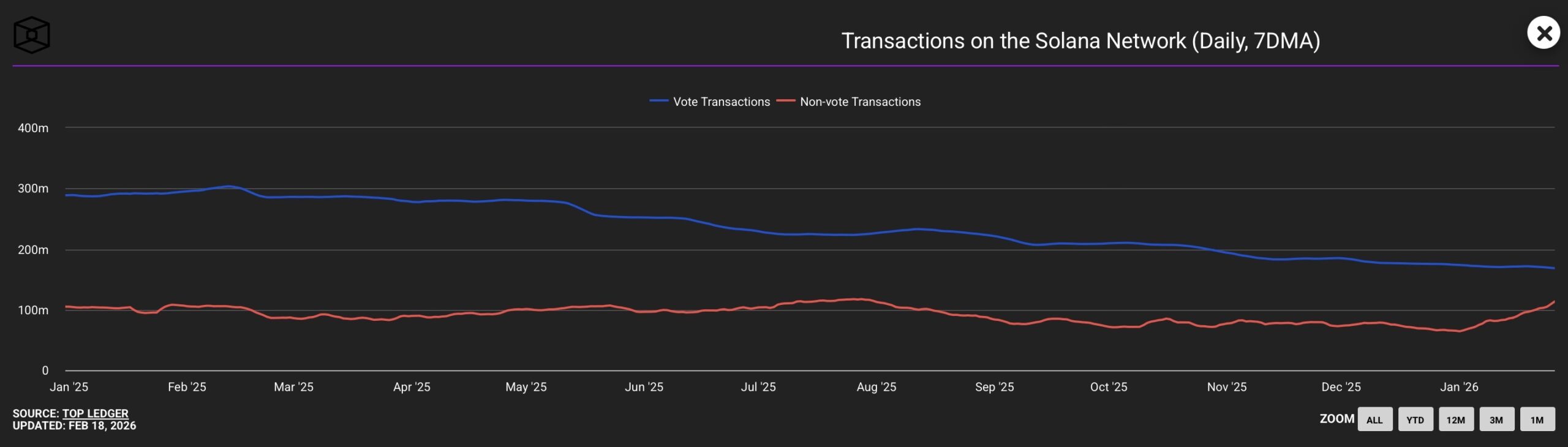
SOL $82.22 24h volatility: 2.5% Market cap: $46.75 B Vol. 24h: $3.45 B successfully claimed the critical $80 support level on Tuesday, trading now around $82 as network fundamentals surged to unprecedented levels. The SOL USD price recovery coincides with a historic spike in on-chain engagement, where daily non-vote transactions recently peaked at a record 148 million. A non-vote transaction involves transferring Solana to the network and collecting it into blocks.

The parallel rise suggests that genuine network utility, rather than just speculative trading, may be establishing a solid floor for the asset.
A non-vote transaction involves transferring Solana to the network and collecting it into blocks.

Transactions on the Solana Network (Daily, 7DMA) Source: The Block

EXPLORE: What is the Next Crypto to Explode in 2026?

What’s Driving the Transaction Surge?

Data indicates that Solana’s network is undergoing a massive stress test, validating its high-throughput design. The network exceeded 116 billion total transactions over the last year, with daily non-vote transactions hitting 148 million in late January. This volume represents a significant divergence from previous cycles.

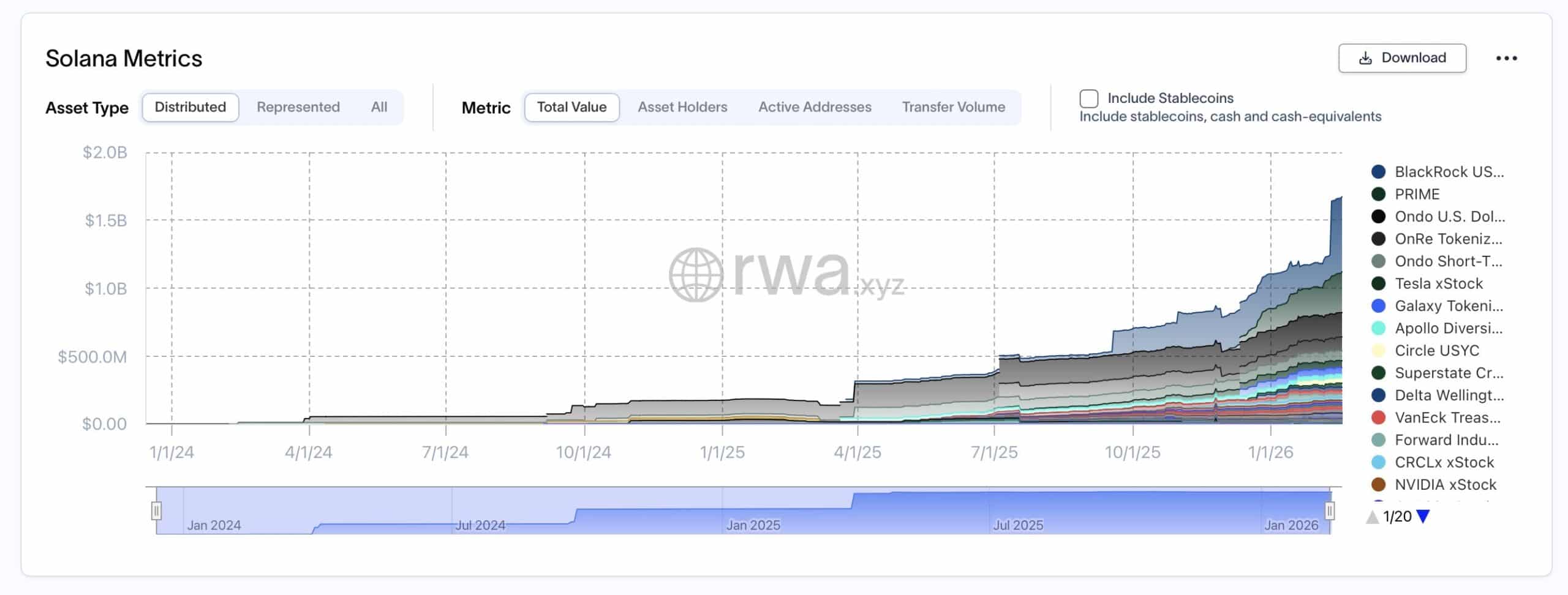
What is fueling this intense volume? While memecoins continue to contribute to network traffic, there is a distinct shift toward sustainable finance. As Solana moves beyond its meme coin phase, decentralized exchange (DEX) volumes have rivaled Ethereum’s, driven by sub-cent fees and faster finality. Furthermore, the rise in real-world asset (RWA) tokenization hitting record values suggests that institutional adoption and stablecoin settlements are playing a larger role in these on-chain metrics than in previous years.
Solana RWAs

Solana Metrics Source: RWAs

EXPLORE: 10 New Upcoming Binance Listings to Watch in February 2026

SOL USD Price Analysis: Technical Levels to Watch
SOL USD Price Analysis

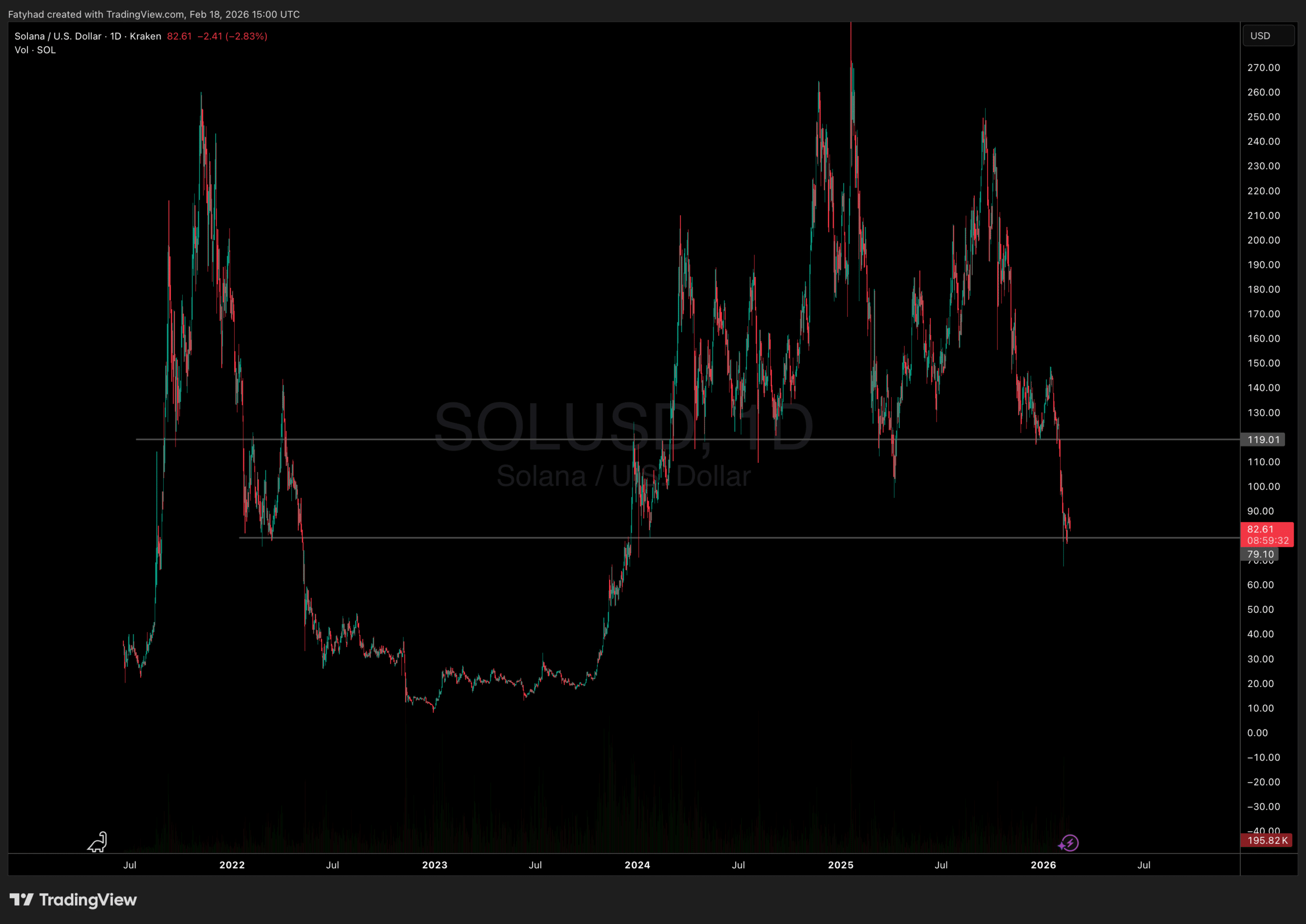
SOL USD Price Analysis Source: TradingView

Solana is currently changing hands at $87.16, marking a 1.65% increase over the last 24 hours. The primary focus for traders has been defending the $80 mark, a level that previously served as a strong demand zone. Market analysts note that holding this region is vital for preventing a slide toward lower liquidity zones. While the asset has formed a logical base here, it still faces resistance overhead.

Some price predictions suggest the dip below $100 may have been a final capitulation event, but bulls must reclaim the psychological three-digit barrier to confirm a definitive trend reversal. Conversely, a failure to hold $80 could expose the asset to deeper downside, as broader crypto market sentiment remains fragile.

DISCOVER: Best Solana Meme Coins By Market Cap 2026

Can Network Growth Sustain SOL’s Recovery?

The divergence between high network usage and suppressed price action often precedes a valuation realignment. Institutional confidence appears to be returning alongside retail activity; for instance, key ecosystem player Jupiter recently announced a major investment deal to further settle in JupUSD, highlighting the capital flowing into Solana’s infrastructure despite price volatility.

However, risks remain. On-chain analytics from Nansen suggest that while user adoption is real, evidenced by active addresses doubling recently, maintaining this momentum requires the fee market to stabilize against potential congestion. Can the fundamentals finally force a decoupling from broader market corrections? The coming weeks will likely determine if record-breaking usage can translate into sustained price appreciation.

next

The post SOL USD Reclaims $80 as Network Transaction Activity Hits Record High appeared first on Coinspeaker.


Market Opportunity
Solana Logo
Solana Price(SOL)
$81.29
$81.29$81.29
-2.08%
USD
Solana (SOL) Live Price Chart
Disclaimer: The articles reposted on this site are sourced from public platforms and are provided for informational purposes only. They do not necessarily reflect the views of MEXC. All rights remain with the original authors. If you believe any content infringes on third-party rights, please contact service@support.mexc.com for removal. MEXC makes no guarantees regarding the accuracy, completeness, or timeliness of the content and is not responsible for any actions taken based on the information provided. The content does not constitute financial, legal, or other professional advice, nor should it be considered a recommendation or endorsement by MEXC.

You May Also Like

Structural job strain caps rand gains – Commerzbank

Structural job strain caps rand gains – Commerzbank

The post Structural job strain caps rand gains – Commerzbank appeared on BitcoinEthereumNews.com. Commerzbank’s Volkmar Baur highlights that South Africa’s unemployment
Share
BitcoinEthereumNews2026/02/19 05:27
Trump gushes over Nicki Minaj's skin to mark Black History Month: 'So beautiful'

Trump gushes over Nicki Minaj's skin to mark Black History Month: 'So beautiful'

President Donald Trump used an event marking Black History Month to remark on Nicki Minaj's complexion."I love Nikki Minaj," the president told the audience. "She
Share
Rawstory2026/02/19 05:07
Google's AP2 protocol has been released. Does encrypted AI still have a chance?

Google's AP2 protocol has been released. Does encrypted AI still have a chance?

Following the MCP and A2A protocols, the AI Agent market has seen another blockbuster arrival: the Agent Payments Protocol (AP2), developed by Google. This will clearly further enhance AI Agents' autonomous multi-tasking capabilities, but the unfortunate reality is that it has little to do with web3AI. Let's take a closer look: What problem does AP2 solve? Simply put, the MCP protocol is like a universal hook, enabling AI agents to connect to various external tools and data sources; A2A is a team collaboration communication protocol that allows multiple AI agents to cooperate with each other to complete complex tasks; AP2 completes the last piece of the puzzle - payment capability. In other words, MCP opens up connectivity, A2A promotes collaboration efficiency, and AP2 achieves value exchange. The arrival of AP2 truly injects "soul" into the autonomous collaboration and task execution of Multi-Agents. Imagine AI Agents connecting Qunar, Meituan, and Didi to complete the booking of flights, hotels, and car rentals, but then getting stuck at the point of "self-payment." What's the point of all that multitasking? So, remember this: AP2 is an extension of MCP+A2A, solving the last mile problem of AI Agent automated execution. What are the technical highlights of AP2? The core innovation of AP2 is the Mandates mechanism, which is divided into real-time authorization mode and delegated authorization mode. Real-time authorization is easy to understand. The AI Agent finds the product and shows it to you. The operation can only be performed after the user signs. Delegated authorization requires the user to set rules in advance, such as only buying the iPhone 17 when the price drops to 5,000. The AI Agent monitors the trigger conditions and executes automatically. The implementation logic is cryptographically signed using Verifiable Credentials (VCs). Users can set complex commission conditions, including price ranges, time limits, and payment method priorities, forming a tamper-proof digital contract. Once signed, the AI Agent executes according to the conditions, with VCs ensuring auditability and security at every step. Of particular note is the "A2A x402" extension, a technical component developed by Google specifically for crypto payments, developed in collaboration with Coinbase and the Ethereum Foundation. This extension enables AI Agents to seamlessly process stablecoins, ETH, and other blockchain assets, supporting native payment scenarios within the Web3 ecosystem. What kind of imagination space can AP2 bring? After analyzing the technical principles, do you think that's it? Yes, in fact, the AP2 is boring when it is disassembled alone. Its real charm lies in connecting and opening up the "MCP+A2A+AP2" technology stack, completely opening up the complete link of AI Agent's autonomous analysis+execution+payment. From now on, AI Agents can open up many application scenarios. For example, AI Agents for stock investment and financial management can help us monitor the market 24/7 and conduct independent transactions. Enterprise procurement AI Agents can automatically replenish and renew without human intervention. AP2's complementary payment capabilities will further expand the penetration of the Agent-to-Agent economy into more scenarios. Google obviously understands that after the technical framework is established, the ecological implementation must be relied upon, so it has brought in more than 60 partners to develop it, almost covering the entire payment and business ecosystem. Interestingly, it also involves major Crypto players such as Ethereum, Coinbase, MetaMask, and Sui. Combined with the current trend of currency and stock integration, the imagination space has been doubled. Is web3 AI really dead? Not entirely. Google's AP2 looks complete, but it only achieves technical compatibility with Crypto payments. It can only be regarded as an extension of the traditional authorization framework and belongs to the category of automated execution. There is a "paradigm" difference between it and the autonomous asset management pursued by pure Crypto native solutions. The Crypto-native solutions under exploration are taking the "decentralized custody + on-chain verification" route, including AI Agent autonomous asset management, AI Agent autonomous transactions (DeFAI), AI Agent digital identity and on-chain reputation system (ERC-8004...), AI Agent on-chain governance DAO framework, AI Agent NPC and digital avatars, and many other interesting and fun directions. Ultimately, once users get used to AI Agent payments in traditional fields, their acceptance of AI Agents autonomously owning digital assets will also increase. And for those scenarios that AP2 cannot reach, such as anonymous transactions, censorship-resistant payments, and decentralized asset management, there will always be a time for crypto-native solutions to show their strength? The two are more likely to be complementary rather than competitive, but to be honest, the key technological advancements behind AI Agents currently all come from web2AI, and web3AI still needs to keep up the good work!
Share
PANews2025/09/18 07:00



