The LIFAGU algorithm transfers potentials from known to unknown factors via structural symmetry, generalizing colour passing and enabling lifted inference.The LIFAGU algorithm transfers potentials from known to unknown factors via structural symmetry, generalizing colour passing and enabling lifted inference.

When Some Factors Go Missing, LIFAGU Finds the Symmetries

Abstract and 1. Introduction

  1. Preliminaries and 2.1 Factor Graphs and Parameterised Factor Graphs

    2.2 The Colour Passing Algorithm

  2. The LIFAGU Algorithm

  3. Empirical Evaluation

  4. Conclusion, Acknowledgements, and References

3 The LIFAGU Algorithm

As our goal is to perform lifted inference, we have to obtain a PFG where all potentials are known. To transform an FG containing unknown factors into a PFG without unknown factors, we transfer potentials from known factors to unknown factors. For example, consider again the FG depicted in Fig. 1 and assume that another individual, say eve, is added to the model. Like alice and bob, eve can travel, be sick, and be treated and hence, four new randvars with three new corresponding factors are attached to the model. However, as we might have limited data, we might not always know the exact potentials for the newly introduced factors when a new individual is added to the model and thus, we end up with a model containing unknown factors. In this example, we can transfer the potentials of the known factors f1 and f2 to the newly introduced unknown factors, as it is reasonable to assume that eve behaves the same as alice and bob as long as no evidence suggesting the contrary is available.

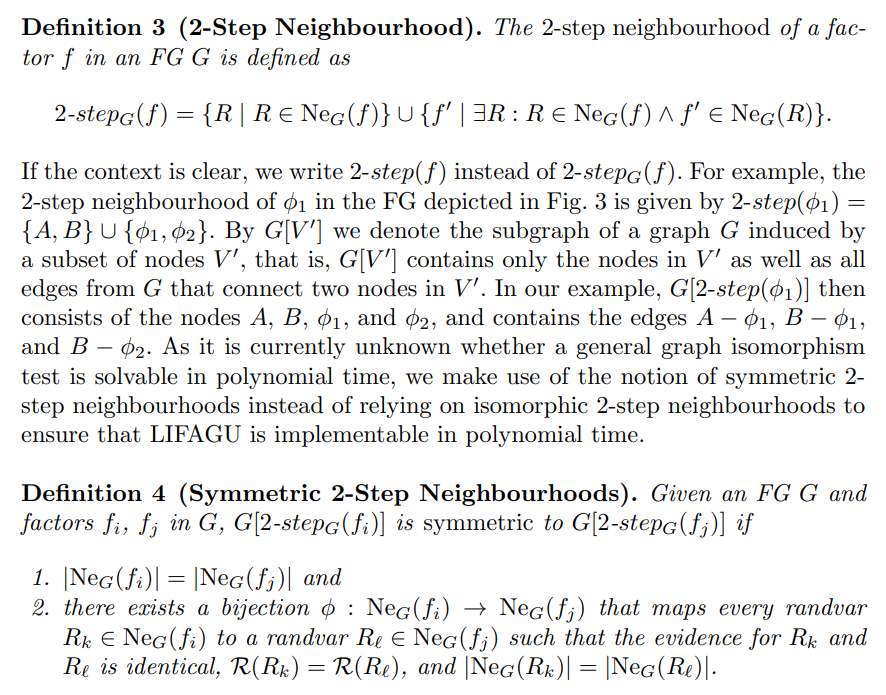
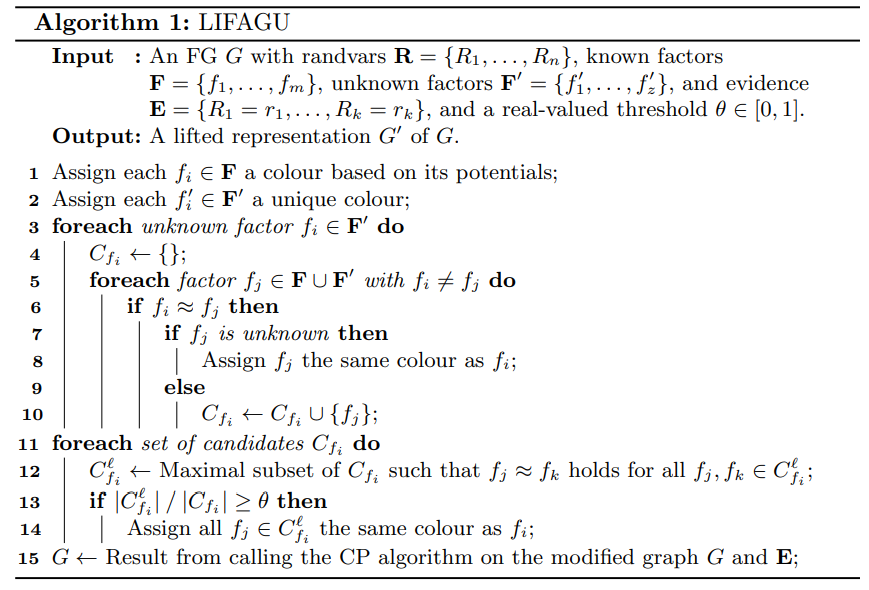
\ In an FG containing unknown factors, the only information available to measure the similarity of factors is the neighbouring graph structure of the factors. For the upcoming definitions, let NeG(v) denote the set of neighbours of a node v (variable node or factor node) in G, i.e., NeG(f) contains all randvars connected to a factor f in G and NeG(R) contains all factors connected to a randvar R in G. If the context is clear, we omit the subscript from NeG(v) and write Ne(v) for simplification. We start by defining the 2-step neighbourhood of a factor f as the set containing all randvars that are connected to f as well as all factors connected to a randvar that is connected to f. The concept of taking into account all nodes with a maximal distance of two is based on the idea of a single iteration of the colour passing procedure.

\
\
\
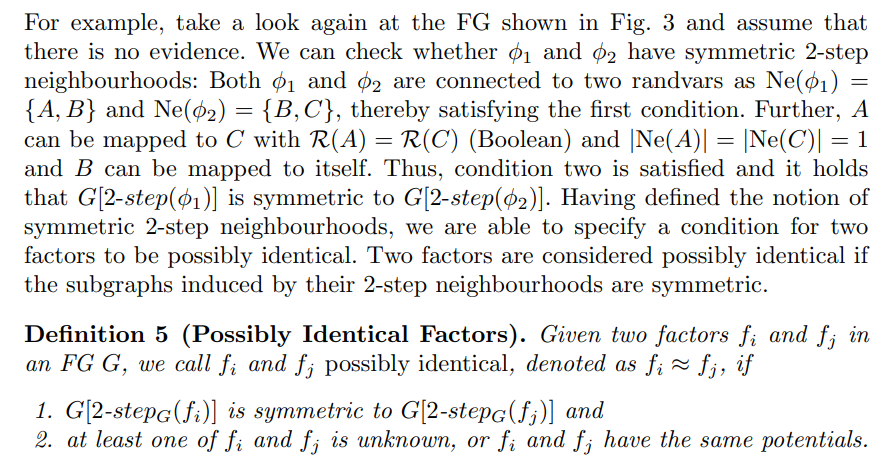
\ The second condition serves to ensure consistency as two factors with different potentials can obviously not be identical. Applying the definition of possibly identical factors to ϕ1 and ϕ2 from Fig. 3, we can verify that ϕ1 and ϕ2 are indeed possibly identical because they have symmetric 2-step neighbourhoods and identical potentials. Next, we describe the entire LIFAGU algorithm, which is illustrated in Algorithm 1.

\
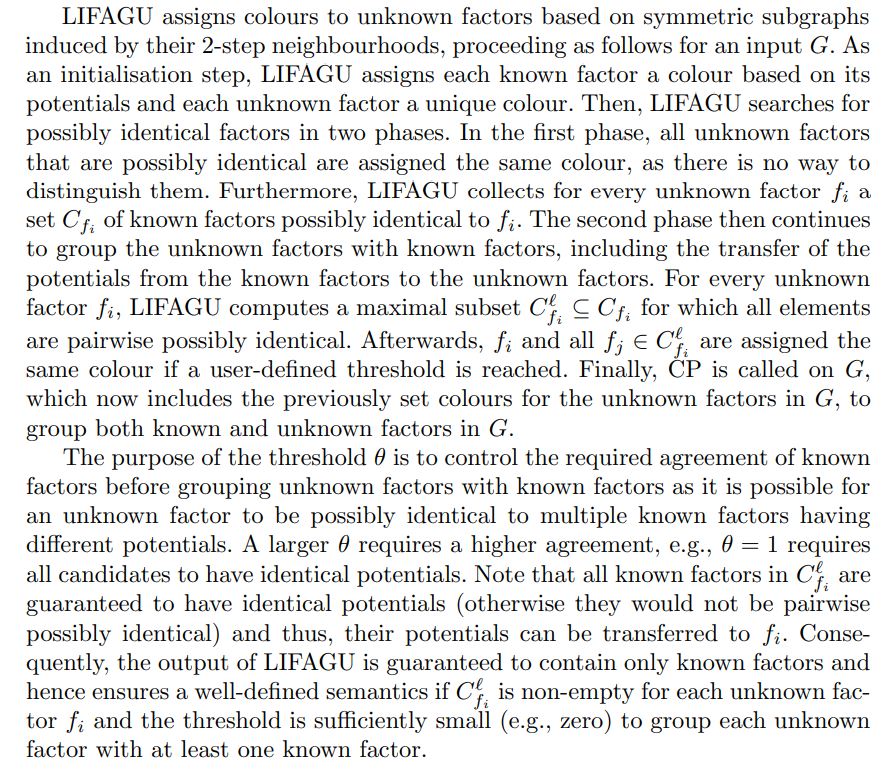
\ Corollary 1. Given that for every unknown factor fi there is at least one known factor that is possibly identical to fi in an FG G, LIFAGU is able to replace all unknown potentials in G by known potentials.

\ It is easy to see that LIFAGU is a generalisation of CP, meaning that both algorithms compute the same result for input FGs containing only known factors (if an input FG G contains no unknown factors, only the first line and the last line of Algorithm 1 are executed—which is equivalent to calling CP on G).

\ Corollary 2. Given an FG that contains only known factors, CP and LIFAGU output identical groupings of randvars and factors, respectively.

\ Next, we investigate the practical performance of LIFAGU in our evaluation.

\

:::info Authors:

(1) Malte Luttermann[0009 −0005 −8591 −6839], Institute of Information Systems, University of Lubeck, Germany and German Research Center for Artificial Intelligence (DFKI), Lubeck, Germany (luttermann@ifis.uni-luebeck.de);

(2) Ralf Moller[0000 −0002 −1174 −3323], Institute of Information Systems, University of Lubeck, Germany and German Research Center for Artificial Intelligence (DFKI), Lubeck, Germany (moeller@ifis.uni-luebeck.de);

(3) Marcel Gehrke[0000 −0001 −9056 −7673], Institute of Information Systems, University of Lubeck, Germany (gehrke@ifis.uni-luebeck.de).

:::


:::info This paper is available on arxiv under ATTRIBUTION-SHAREALIKE 4.0 INTERNATIONAL license.

:::

\

Market Opportunity
Octavia Logo
Octavia Price(VIA)
$0.017
$0.017$0.017
+3.03%
USD
Octavia (VIA) Live Price Chart
Disclaimer: The articles reposted on this site are sourced from public platforms and are provided for informational purposes only. They do not necessarily reflect the views of MEXC. All rights remain with the original authors. If you believe any content infringes on third-party rights, please contact service@support.mexc.com for removal. MEXC makes no guarantees regarding the accuracy, completeness, or timeliness of the content and is not responsible for any actions taken based on the information provided. The content does not constitute financial, legal, or other professional advice, nor should it be considered a recommendation or endorsement by MEXC.

You May Also Like

From XRP to Flare: Seasoned Enthusiast Shares What’s Next for Ecosystem

From XRP to Flare: Seasoned Enthusiast Shares What’s Next for Ecosystem

The post From XRP to Flare: Seasoned Enthusiast Shares What’s Next for Ecosystem appeared on BitcoinEthereumNews.com. Flare’s power is in community, infrastructure developer Tim Rowley says “FAssets are imminent” Tim Rowley, one of the earliest enthusiasts of the Flare (FLR) ecosystem, reflects on what makes the blockchain special and what might be next for Flare (FLR) and its adoption workloads. Flare’s power is in community, infrastructure developer Tim Rowley says Tim Rowley, an Australian blockchain educationist and passionate Flare (FLR) ecosystem contributor, shared a reflection on his journey in the ecosystem. He recalled the early days when he became involved because of his father participating in a Spark (the predecessor of FLR) airdrop to the holders of XRP. Image via X While Flare was still in its very nascent stage of an EVM blockchain, Rowley admitted that the passionate community was its strength from the very beginning. Then, he started learning the concept of FTSO, a Flare-specific design of blockchain oracles. Rowley launched FTSO.AU, the first Flare oracle infrastructure provider. Expanding his involvement with the ecosystem, Rowley contributed to Flare Metrics, a data tracker for Flare’s validators, and Flare Builders, a developer experience resource for Flare and its canary network Songbird. The primary motivation was bringing new community members to both ecosystems: This is the very reason we have Flare Metrics and Flare Builders. Our aim is to provide unbiased information such as network statistics and other projects among us that make Flare great. Instead of answering individual questions, we have put this information in a format that can reach a larger audience (this is also the same reason I started making YouTube videos, it’s easier to share a single video that answers the same question many have). Flare (FLR) is a unique Layer-1 blockchain focused on data-heavy use cases. It was introduced in late Q4, 2020, as a “utility fork” of XRP Ledger. “FAssets are…
Share
BitcoinEthereumNews2025/09/21 03:43
TD Cowen cuts Strategy price target to $440, cites lower bitcoin yield outlook

TD Cowen cuts Strategy price target to $440, cites lower bitcoin yield outlook

Despite the target cut, TD Cowen said Strategy remains an attractive vehicle for investors seeking bitcoin exposure.
Share
Coinstats2026/01/15 07:29
How to earn from cloud mining: IeByte’s upgraded auto-cloud mining platform unlocks genuine passive earnings

How to earn from cloud mining: IeByte’s upgraded auto-cloud mining platform unlocks genuine passive earnings

The post How to earn from cloud mining: IeByte’s upgraded auto-cloud mining platform unlocks genuine passive earnings appeared on BitcoinEthereumNews.com. contributor Posted: September 17, 2025 As digital assets continue to reshape global finance, cloud mining has become one of the most effective ways for investors to generate stable passive income. Addressing the growing demand for simplicity, security, and profitability, IeByte has officially upgraded its fully automated cloud mining platform, empowering both beginners and experienced investors to earn Bitcoin, Dogecoin, and other mainstream cryptocurrencies without the need for hardware or technical expertise. Why cloud mining in 2025? Traditional crypto mining requires expensive hardware, high electricity costs, and constant maintenance. In 2025, with blockchain networks becoming more competitive, these barriers have grown even higher. Cloud mining solves this by allowing users to lease professional mining power remotely, eliminating the upfront costs and complexity. IeByte stands at the forefront of this transformation, offering investors a transparent and seamless path to daily earnings. IeByte’s upgraded auto-cloud mining platform With its latest upgrade, IeByte introduces: Full Automation: Mining contracts can be activated in just one click, with all processes handled by IeByte’s servers. Enhanced Security: Bank-grade encryption, cold wallets, and real-time monitoring protect every transaction. Scalable Options: From starter packages to high-level investment contracts, investors can choose the plan that matches their goals. Global Reach: Already trusted by users in over 100 countries. Mining contracts for 2025 IeByte offers a wide range of contracts tailored for every investor level. From entry-level plans with daily returns to premium high-yield packages, the platform ensures maximum accessibility. Contract Type Duration Price Daily Reward Total Earnings (Principal + Profit) Starter Contract 1 Day $200 $6 $200 + $6 + $10 bonus Bronze Basic Contract 2 Days $500 $13.5 $500 + $27 Bronze Basic Contract 3 Days $1,200 $36 $1,200 + $108 Silver Advanced Contract 1 Day $5,000 $175 $5,000 + $175 Silver Advanced Contract 2 Days $8,000 $320 $8,000 + $640 Silver…
Share
BitcoinEthereumNews2025/09/17 23:48