

77% of Crypto Users Want Stablecoins Inside Their Bank Apps, Survey Shows
A new global survey suggests stablecoins are moving firmly into the financial mainstream. The Stablecoin Utility Report 2026, commissioned by Coinbase and BVNK and conducted by YouGov, surveyed 4,658 crypto-active individuals and found a strong preference for integrating stablecoins directly into traditional banking platforms.
Rather than emphasizing ideological decentralization, respondents prioritized convenience, efficiency, and trust, signaling a shift from early crypto narratives toward practical financial use.
Banking Integration Takes Center Stage
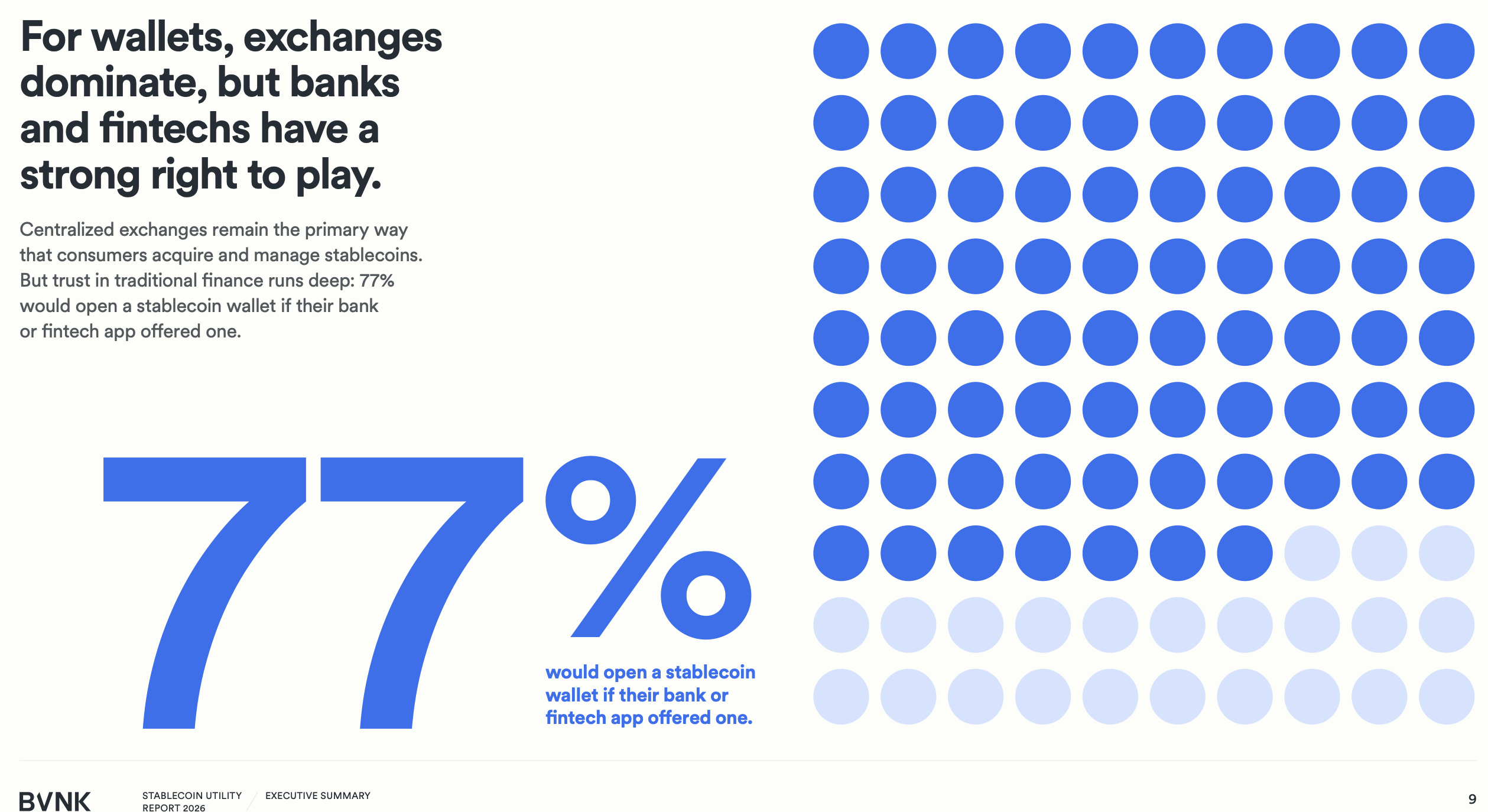
One of the most striking findings is that 77% of respondents said they would open a stablecoin or crypto wallet directly within their existing bank or fintech app if given the option.
 Source: https://info.bvnk.com/utility
Spending interest is also high. About 71% indicated they would use a stablecoin-linked debit card to spend their tokens for everyday transactions.
Stablecoins are no longer just a trading tool. Among respondents, 39% already receive part of their income in stablecoins, and for that group, stablecoins account for roughly 35% of their annual earnings. This suggests a growing reliance on digital dollars not only for payments but also for salary distribution.
Freelancers and contractors are particularly active users. Around 73% said stablecoins have improved their ability to work with international clients by reducing friction and delays in cross-border payments.
Adoption Patterns Across Regions
The data shows a sharp contrast between emerging and high-income markets.
In lower- and middle-income economies, adoption rates are significantly higher. In Africa, ownership reaches 79%, and 95% of Nigerian respondents said they prefer stablecoin payments over the local naira, citing inflation and inefficient banking rails.
In wealthier economies, ownership sits closer to 45%, but average balances are much larger. Users in high-income regions hold around $1,000 on average, compared to just $85 in emerging markets.
Demographically, ownership skews younger and entrepreneurial. Globally, men are more likely to hold stablecoins (60%), although in Africa ownership is evenly split between men and women.
Why Users Choose Stablecoins
The primary motivations are practical rather than ideological. Lower fees (30%), improved security (28%), and global accessibility (27%) were cited as the main reasons for using stablecoins.
However, barriers remain. Around 30% of respondents identified the irreversible nature of transactions as a major concern, while many pointed to complexity in user experience as an obstacle to wider adoption.
There is also a noticeable spending gap. While 42% say they want to use stablecoins for larger purchases, only 28% currently do, reflecting limited merchant acceptance.
Overall, the findings suggest stablecoins are transitioning from a niche crypto instrument to a mainstream financial tool, provided banks and fintech platforms are willing to integrate them directly into everyday financial services.
The post 77% of Crypto Users Want Stablecoins Inside Their Bank Apps, Survey Shows appeared first on ETHNews.


You May Also Like

Top 3 Crypto Presales 2026: Solo Miner Bags $210K BTC Reward While Pepeto Hints Explosive Potential and Outpaces Every Competitor

Critical Security Upgrade Halts Cardano Transactions




