On-chain data shows Bitcoin network metrics have diverged recently, with active addresses falling even as transaction volume shoots up. Bitcoin Activity Metrics Are Showing A Mixed Picture In its latest Market Pulse report, on-chain analytics firm Glassnode has talked about how a few different activity-related Bitcoin indicators have changed during the past week. The first […]On-chain data shows Bitcoin network metrics have diverged recently, with active addresses falling even as transaction volume shoots up. Bitcoin Activity Metrics Are Showing A Mixed Picture In its latest Market Pulse report, on-chain analytics firm Glassnode has talked about how a few different activity-related Bitcoin indicators have changed during the past week. The first […]

Bitcoin Network Shows Split: Active Users Fall, While Volume Surges 8%

2025/08/27 12:00
3 min read

On-chain data shows Bitcoin network metrics have diverged recently, with active addresses falling even as transaction volume shoots up.

Bitcoin Activity Metrics Are Showing A Mixed Picture

In its latest Market Pulse report, on-chain analytics firm Glassnode has talked about how a few different activity-related Bitcoin indicators have changed during the past week.

The first metric of interest is the “Active Address Count,” which measures, as its name suggests, the unique total number of addresses that are becoming involved in some kind of transaction activity on the blockchain every day.

Now, here is a chart that shows the trend in the Bitcoin Active Address Count over the last couple of years:
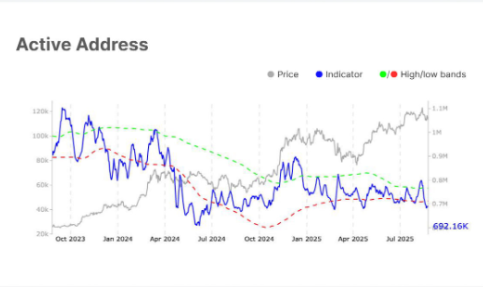
Bitcoin Active Addresses

As displayed in the above graph, the Bitcoin Active Address Count spiked above the high statistical band earlier in the month when the cryptocurrency’s price set a new all-time high (ATH) above $124,000. This suggests user participation rose with the rally.

With the price decline that has followed the peak, however, the indicator’s value has plummeted. The metric is currently sitting at 692,000, which is down 2.2% compared to last week. This value is also below the 712,000 low statistical band, indicating that trader attention in the cryptocurrency has taken an especially big hit.

While the Active Address Count has plunged, another metric, the On-Chain Transfer Volume, has gone up instead.
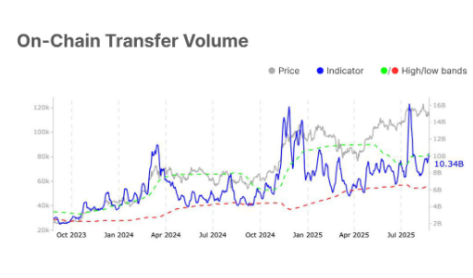
Bitcoin On-Chain Volume

From the chart, it’s visible that the Bitcoin On-Chain Transfer Volume saw an uptick alongside the ATH break this month, but instead of cooling off with the price, the metric has only climbed higher since then.

The indicator has surged by 7.8% to $10.3 billion, which is above the high statistical band of $10.15 billion. But one question arises: if the number of users taking part in transfer activity has gone down as suggested by the trend in the Active Address Count, why has the On-Chain Transfer Volume gone up?

The answer is that, although both of these metrics relate to network activity, they correspond to different segments of the investors. Small hands significantly outweigh large entities in population, so the Active Address Count reflects the activity of the retail investors. On the other hand, whale transactions eclipse retail moves, so the On-Chain Transfer Volume is usually dominated by moves from big-money holders.

The divergence that has cropped up between the two Bitcoin indicators could signal that retail speculation has become muted after the price decline, while whales have ramped up activity to reposition themselves.

BTC Price

Bearish momentum has continued for Bitcoin during the last 24 hours as its price has slipped to $109,900.


Bitcoin Price Chart

Disclaimer: The articles reposted on this site are sourced from public platforms and are provided for informational purposes only. They do not necessarily reflect the views of MEXC. All rights remain with the original authors. If you believe any content infringes on third-party rights, please contact crypto.news@mexc.com for removal. MEXC makes no guarantees regarding the accuracy, completeness, or timeliness of the content and is not responsible for any actions taken based on the information provided. The content does not constitute financial, legal, or other professional advice, nor should it be considered a recommendation or endorsement by MEXC.

You May Also Like

Which Altcoins Stand to Gain from the SEC’s New ETF Listing Standards?

Which Altcoins Stand to Gain from the SEC’s New ETF Listing Standards?

On Wednesday, the US SEC (Securities and Exchange Commission) took a landmark step in crypto regulation, approving generic listing standards for spot crypto ETFs (exchange-traded funds). This new framework eliminates the case-by-case 19b-4 approval process, streamlining the path for multiple digital asset ETFs to enter the market in the coming weeks. Grayscale’s Multi-Crypto Milestone Grayscale secured a first-mover advantage as its Digital Large Cap Fund (GDLC) received approval under the new listing standards. Products that will be traded under the ticker GDLC include Bitcoin, Ethereum, XRP, Solana, and Cardano. “Grayscale Digital Large Cap Fund $GDLC was just approved for trading along with the Generic Listing Standards. The Grayscale team is working expeditiously to bring the FIRST multi-crypto asset ETP to market with Bitcoin, Ethereum, XRP, Solana, and Cardano,” wrote Grayscale CEO Peter Mintzberg. The approval marks the US’s first diversified, multi-crypto ETP, signaling a shift toward broader portfolio products rather than single-asset ETFs. Bloomberg’s Eric Balchunas explained that around 12–15 cryptocurrencies now qualify for spot ETF consideration. However, this is contingent on the altcoins having established futures trading on Coinbase Derivatives for at least six months. This includes well-known altcoins like Dogecoin (DOGE), Litecoin (LTC), and Chainlink (LINK), alongside the majors already included in Grayscale’s GDLC. Altcoins in the Spotlight Amid New Era of ETF Eligibility Several assets have already met the key condition, regulated futures trading on Coinbase. For example, Solana futures launched in February 2024, making the token eligible as of August 19. “The SEC approved generic ETF listing standards. Assets with a regulated futures contract trading for 6 months qualify for a spot ETF. Solana met this criterion on Aug 19, 6 months after SOL futures launched on Coinbase Derivatives,” SolanaFloor indicated. Crypto investors and communities also identified which tokens stand to gain. Chainlink community liaison Zach Rynes highlighted that LINK could soon see its own ETF. He noted that both Bitwise and Grayscale have already filed applications. Meanwhile, the Litecoin Foundation indicated that the new standards provide the regulatory framework for LTC to be listed on US exchanges. Hedera is also in the spotlight, with digital asset investor Mark anticipating an HBAR ETF. Market observers see the decision as a potential turning point for broader adoption, bringing the much-needed clarity and accessibility for investors. At the same time, it boosts confidence in the market’s maturity. The general sentiment is that with the SEC’s approval, the next phase of crypto ETFs is no longer a question of ‘if,’ but ‘when.’ The shift to generic listing standards could expand the US-listed digital asset ETFs roster beyond Bitcoin and Ethereum. Such a move would usher in new investment vehicles covering a dozen or more altcoins. This represents the clearest path yet toward mainstream, regulated access to diversified crypto exposure. More importantly, it comes without the friction of direct custody. “We’re gonna be off to the races in a matter of weeks,” ETF analyst James Seyffart quipped.
Share
Coinstats2025/09/18 12:57
Telegram Turns DeFi With New Yield Options for BTC and ETH

Telegram Turns DeFi With New Yield Options for BTC and ETH

The post Telegram Turns DeFi With New Yield Options for BTC and ETH appeared on BitcoinEthereumNews.com. The yield feature is powered by DeFi protocols like Morpho
Share
BitcoinEthereumNews2026/02/27 05:17
Shiba Inu Price Struggles Below 26-Day EMA — Is a Breakdown or Breakout Next?

Shiba Inu Price Struggles Below 26-Day EMA — Is a Breakdown or Breakout Next?

Shiba Inu is once again testing a familiar ceiling. The 26-day exponential moving average (EMA) remains dynamic resistance, blocking what has been a fragile recovery
Share
Coinstats2026/02/27 04:39