U.S. stocks bounced back into positive territory as crude prices plunged more than 4% in the past 24 hours and have now slid 8.74% since June 12. Analysts at Deutsche Bank note that oil’s trajectory could oscillate unpredictably in the months ahead. $76 to $70: Crude Collapses as Nuclear Talks Stall While much attention remains […]U.S. stocks bounced back into positive territory as crude prices plunged more than 4% in the past 24 hours and have now slid 8.74% since June 12. Analysts at Deutsche Bank note that oil’s trajectory could oscillate unpredictably in the months ahead. $76 to $70: Crude Collapses as Nuclear Talks Stall While much attention remains […]

Oil Crashes 8.7% From Last Week’s Peak as Middle East Tensions Rattle Markets

U.S. stocks bounced back into positive territory as crude prices plunged more than 4% in the past 24 hours and have now slid 8.74% since June 12. Analysts at Deutsche Bank note that oil’s trajectory could oscillate unpredictably in the months ahead.

$76 to $70: Crude Collapses as Nuclear Talks Stall

While much attention remains fixed on equities, precious metals, and digital assets, traders and analysts are equally fixated on bond yields and the fluctuating price of crude. Last week, tensions escalated between Israel and Iran, with Israeli forces striking what they claimed were nuclear sites in Tehran. In response, Iran launched a barrage of missiles targeting Tel Aviv and Jerusalem.

Now, emerging reports suggest Iran may be looking to revive diplomatic dialogue concerning its nuclear ambitions. The recent tensions have caused earlier nuclear negotiations between Iran and the United States to be paused on June 15. When the military attacks first started, the price of crude oil swelled to $76.76 per barrel but today it is down 8.74% lower and trading at $70.05. The drop came even as Israel’s Haifa Oil Refinery was partly damaged.
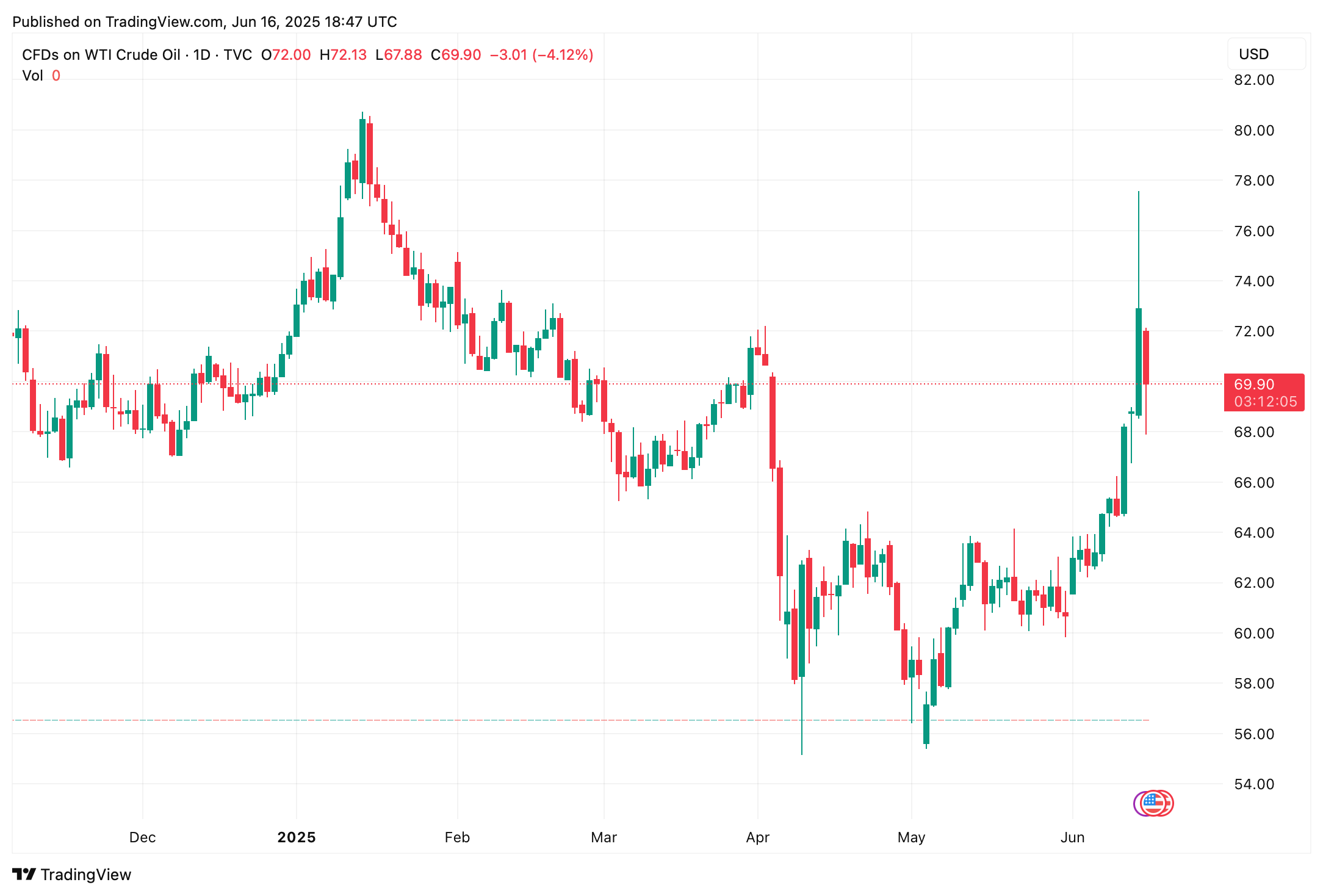
Oil Crashes 8.7% From Last Week’s Peak as Middle East Tensions Rattle Markets

An editorial from the New York Times (NYT) highlights insights from Deutsche Bank analysts, who suggest crude oil prices may fluctuate unpredictably from this point forward. The analysts outline a broad spectrum of potential scenarios, with extremes ranging from prices exceeding $120 per barrel to a slide toward $50 by next year. NYT journalist Stanley Reed, based in London, also spoke with an executive from the commodities research firm Argus Media.

The senior energy markets analyst at Argus Media, Bachar El-Halabi, told Reed:

According to prediction market Polymarket, the probability of Iran shutting the Strait of Hormuz in 2025 stands at 25%, down from the 40% range observed last week. Even a brief closure of the strait could jolt global oil prices upward almost instantly. As a strategic artery, it channels around 20% of the world’s seaborne oil—carrying exports from Saudi Arabia, the UAE, Kuwait, and Iraq. Any blockage would rattle energy markets, provoking a scramble as traders and governments brace for potential shortages and logistical snarls.

Brent crude and West Texas Intermediate (WTI) futures would likely leap as investors bake in geopolitical risk premiums. The magnitude of the price response would depend entirely on how long and how extensively the flow is interrupted. At present, equities continue their upward drift, while the crypto economy has advanced 2.62% over the past 24 hours. Meanwhile, gold slipped 1.26% on Monday, stabilizing around $3,389 per troy ounce.

Longer-term U.S. bond yields remain elevated relative to historical norms, a reflection of persistent economic and fiscal ambiguity in the air. During the session, the yield on the 10-year Treasury note fluctuated between roughly 4.42% and 4.55%. Recent benchmarks and comparable durations for the 30-year yield indicate it’s been hovering near 4.90% to 4.93%, with the latest 30-year issuance carrying a 4.75% coupon as of June 16.

The financial pulse now hinges not only on volatility in the oil trade but on a delicate geopolitical détente that could recalibrate risk sentiment overnight. Investors are navigating a matrix of uncertainty—sensitive to even whispers of escalation or diplomacy. Whether calm or conflict prevails, the balance of power in energy, equities, and fixed income will likely reflect every subtle shift on the global stage.


Market Opportunity
Moonveil Logo
Moonveil Price(MORE)
$0.0006397
$0.0006397$0.0006397
+9.31%
USD
Moonveil (MORE) Live Price Chart
Disclaimer: The articles reposted on this site are sourced from public platforms and are provided for informational purposes only. They do not necessarily reflect the views of MEXC. All rights remain with the original authors. If you believe any content infringes on third-party rights, please contact service@support.mexc.com for removal. MEXC makes no guarantees regarding the accuracy, completeness, or timeliness of the content and is not responsible for any actions taken based on the information provided. The content does not constitute financial, legal, or other professional advice, nor should it be considered a recommendation or endorsement by MEXC.

You May Also Like

Unlock Opportunities with Coinbase Careers

Unlock Opportunities with Coinbase Careers

Cryptsy - Latest Cryptocurrency News and Predictions Cryptsy - Latest Cryptocurrency News and Predictions - Experts in Crypto Casinos Did you know the global cryptocurrency
Share
Cryptsy2026/02/12 03:36
Franklin Templeton CEO Dismisses 50bps Rate Cut Ahead FOMC

Franklin Templeton CEO Dismisses 50bps Rate Cut Ahead FOMC

The post Franklin Templeton CEO Dismisses 50bps Rate Cut Ahead FOMC appeared on BitcoinEthereumNews.com. Franklin Templeton CEO Jenny Johnson has weighed in on whether the Federal Reserve should make a 25 basis points (bps) Fed rate cut or 50 bps cut. This comes ahead of the Fed decision today at today’s FOMC meeting, with the market pricing in a 25 bps cut. Bitcoin and the broader crypto market are currently trading flat ahead of the rate cut decision. Franklin Templeton CEO Weighs In On Potential FOMC Decision In a CNBC interview, Jenny Johnson said that she expects the Fed to make a 25 bps cut today instead of a 50 bps cut. She acknowledged the jobs data, which suggested that the labor market is weakening. However, she noted that this data is backward-looking, indicating that it doesn’t show the current state of the economy. She alluded to the wage growth, which she remarked is an indication of a robust labor market. She added that retail sales are up and that consumers are still spending, despite inflation being sticky at 3%, which makes a case for why the FOMC should opt against a 50-basis-point Fed rate cut. In line with this, the Franklin Templeton CEO said that she would go with a 25 bps rate cut if she were Jerome Powell. She remarked that the Fed still has the October and December FOMC meetings to make further cuts if the incoming data warrants it. Johnson also asserted that the data show a robust economy. However, she noted that there can’t be an argument for no Fed rate cut since Powell already signaled at Jackson Hole that they were likely to lower interest rates at this meeting due to concerns over a weakening labor market. Notably, her comment comes as experts argue for both sides on why the Fed should make a 25 bps cut or…
Share
BitcoinEthereumNews2025/09/18 00:36
SAUDI ARABIA LAUNCHES THE HUMAN CAPABILITY INITIATIVE CONFERENCE 2026 THEMED “THE HUMAN CODE,” UNITED KINGDOM NAMED COUNTRY OF HONOR

SAUDI ARABIA LAUNCHES THE HUMAN CAPABILITY INITIATIVE CONFERENCE 2026 THEMED “THE HUMAN CODE,” UNITED KINGDOM NAMED COUNTRY OF HONOR

The Human Capability Initiative Conference will return to Riyadh from 03–04 May, convening more than 15,000 global leaders to drive future human capability development
Share
AI Journal2026/02/12 03:30