The AI content flood is here, and tools like ZeroGPT are fighting to bring back academic integrity
Disclosure: This article does not represent investment advice. The content and materials featured on this page are for educational purposes only.
As AI-generated content overtakes human-written material online, tools like ZeroGPT are becoming essential for education, journalism, and enterprise to safeguard authenticity.
- Studies show AI-generated content now accounts for over 50% of online material, raising concerns about misinformation, disinformation, and academic misconduct.
- Educational institutions face rising cases of AI-assisted cheating, with discipline rates climbing globally, driving demand for reliable AI-detection tools.
- Platforms like ZeroGPT offer high-accuracy AI detection, multilingual support, and accessible integrations via WhatsApp, Telegram, and APIs to help organizations protect integrity while reducing operational costs.
The internet continues to be inundated with massive machine-generated content ever since the launch of ChatGPT in 2022. AI-generated content has spread like wildfire, and a new category of detection tools like ZeroGPT are racing to keep up.
The numbers are striking. In November 2024, the number of AI-generated content published on the web had surpassed the volume written by humans. This milestone, uncovered by growth agency Graphite in an analysis of 65,000 English web pages, found that 50.8% of articles published that month were AI-generated.
Graphite’s discovery was no anomaly. In April 2025, SEO and marketing intelligence platform Ahrefs reported that 74.2% of content spanning 900,000 English-language URLs had some element of AI.
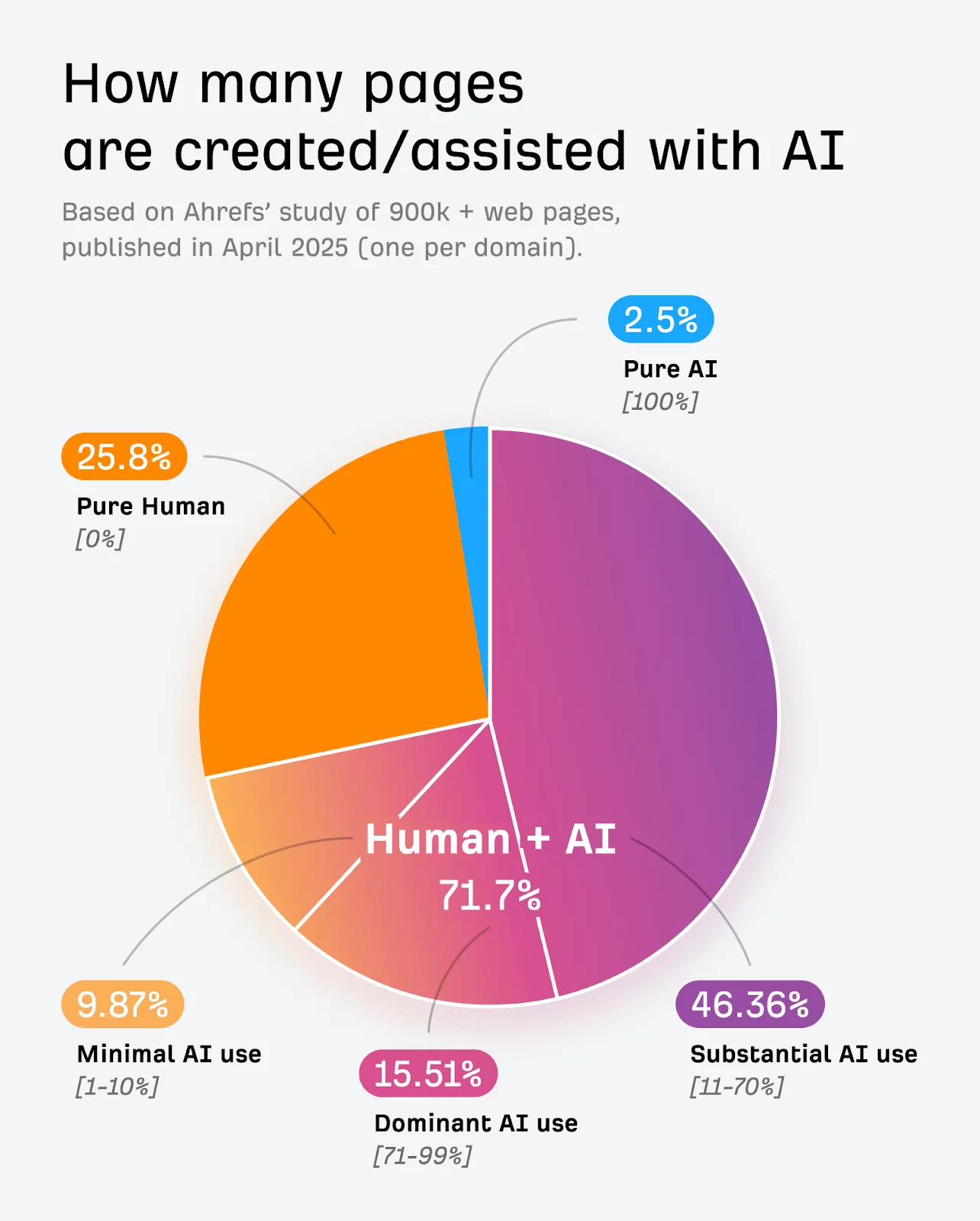 Image source: Ahrefs
But volume is only part of the problem. What’s more concerning is that this sheer volume is fueling misinformation and disinformation campaigns and eroding academic integrity. The harder question that everyone is grappling with right now is: how can someone know what’s real?
The academic integrity crisis
The AI content surge has landed harder in education — a sector where the authenticity of written work is key. According to an investigation by Gurdian, 7,000 university students in the UK were caught cheating using AI tools in the 2023-24 academic year. This translates to 5.1 out of 1,000 students, up from 1.6 in the previous academic year. In the 2024-25 academic calendar, the number had gone up to 7.5 cases per 1,000 students.
Globally, student discipline rate for AI-related academic misconduct climbed from 48% in 2022–23 to 64% in 2024–25. Approximately 90% of students have confessed to knowing about ChatGPT, and 89% have used it for homework. The weight of the matter has pushed many institutions to impose strict regulations on AI use and adopt robust detection tools.
But having the will to detect AI content and having reliable tools to do it are two different things.
Enter the AI-content detectors
The detection market has grown in tandem with the problem it’s trying to solve. Tools like Turnitin, GPTZero, and Originality have moved from niche utilities to essential institutional infrastructure. Each takes a different approach to the same fundamental challenge of identifying the statistical and linguistic patterns that AI language models leave behind.
AI detector ZeroGPT, one of the most widely used tools on the market, has built its product on accessibility and accuracy. The platform was trained on massive text data collected from the internet, educational data, and its in-house AI datasets, and can detect content generated by ChatGPT, Google Gemini, Claude, DeepSeek, and many other major large language models with up 98% accuracy.
The platform also offers a plagiarism checker, a built-in paraphraser, grammar checker, summarizer, humanize AI, and translator, making it a multi-purpose writing toolkit rather than a single-use scanner.
What sets ZeroGPT apart from other detectors is its availability on WhatsApp and Telegram. Anyone can access ChatGPT’s features, such as AI detection, paraphrasing, and grammar error checking via a chatbot right inside WhatsApp and Telegram, without having to visit the official website.
Perhaps most striking is that ZeroGPT requires no sign-up for basic use. In a market where many competitors gate core features behind registration walls or paywalls, that accessibility has helped it reach millions of users across education, marketing, journalism, and enterprise compliance.
For organizations that need to embed detection into their existing workflows, ZeroGPT offers an API built around RESTful architecture with fast response times. The API can be integrated with learning management systems, editorial platforms, HR tools for reviewing application materials, and compliance monitoring systems.
The platform also supports multilingual detection across different languages. This feature matters the most in global academic settings where non-English AI content is equally prevalent.
The cost to keep academic integrity
The cost to keep academic integrity is placing a substantial financial burden on institutions. It is estimated that the administrative effort, legal review, and academic committee proceedings associated with one misconduct case cost an average of $3,200 to $8,500.
And that cost is just the tip of the iceberg because institutions are spending at least $50,000 per year to train their staff on how to identify AI-generated content. Institutions also suffer from enrolment declines when cases of academic scandals break out to the public.
The need for AI-content detectors in academia is no longer a luxury; it is a necessity. Tools like ZeroGPT are helping institutions safeguard academic honesty, while at the same time significantly cutting the expenses linked to academic misconduct investigations.
On a larger scale, AI detectors are helping to prevent what the researcher Aviv Ovadya calls infocalypse: an internet where synthetic media reduces public trust, as no one knows who created what they are looking at or the intent.
Disclosure: This content is provided by a third party. Neither crypto.news nor the author of this article endorses any product mentioned on this page. Users should conduct their own research before taking any action related to the company.


You May Also Like

ADA Faces Fresh Downside Risk After Rejection At Channel Resistance
XRP ecosystem eyes privacy shift as Flare tests confidential cross-chain transactions