Re-ranking in information retrieval improves search accuracy by reordering initial results using methods like relevance feedback, learning-to-rank models, and contextual embeddings. This article explores ColBERT’s contextualized late interaction framework and extends it into a two-stage re-ranking method for image retrieval. By combining filtering, similarity scoring, and localization, the approach enhances not only the precision of retrieved results but also the ability to identify anatomical regions of interest in complex datasets.Re-ranking in information retrieval improves search accuracy by reordering initial results using methods like relevance feedback, learning-to-rank models, and contextual embeddings. This article explores ColBERT’s contextualized late interaction framework and extends it into a two-stage re-ranking method for image retrieval. By combining filtering, similarity scoring, and localization, the approach enhances not only the precision of retrieved results but also the ability to identify anatomical regions of interest in complex datasets.

Embedding Similarity Scoring for Smarter Image Retrieval Systems

2025/08/27 19:00
4 min read
For feedback or concerns regarding this content, please contact us at crypto.news@mexc.com

Abstract and 1. Introduction

  1. Materials and Methods

    2.1 Vector Database and Indexing

    2.2 Feature Extractors

    2.3 Dataset and Pre-processing

    2.4 Search and Retrieval

    2.5 Re-ranking retrieval and evaluation

  2. Evaluation and 3.1 Search and Retrieval

    3.2 Re-ranking

  3. Discussion

    4.1 Dataset and 4.2 Re-ranking

    4.3 Embeddings

    4.4 Volume-based, Region-based and Localized Retrieval and 4.5 Localization-ratio

  4. Conclusion, Acknowledgement, and References

2.5 Re-ranking retrieval and evaluation

Re-ranking in information retrieval involves the process of re-ordering the initially retrieved results to better align with the user’s information needs. This can be achieved through different methods such as relevance feedback, learning to rank algorithms, or incorporating contextual information [Ai et al., 2018, Guo et al., 2020, MacAvaney et al., 2019]. Relevance feedback allows users to provide input on the initial results, which is then used to adjust the ranking [Ai et al., 2018]. Learning to rank algorithms utilizes machine learning techniques to re-rank results based on relevant features [Guo et al., 2020]. Additionally, re-ranking methods may also consider contextual information such as user behavior, temporal relevance, or other relevant factors to better reflect the user’s current information needs, ultimately enhancing the overall quality of retrieved results [MacAvaney et al., 2019]. A method based on contextualized information proposed in Khattab and Zaharia [2020] called ColBERT (Contextualized Late Interaction over BERT). ColBERT operates by generating contextualized representations of the query and the documents using BERT [Devlin et al., 2018]. In this method, queries and documents are encoded into more detailed multi-vector representations, and relevance is gauged through comprehensive yet scalable interactions between these sets of vectors. ColBERT creates an embedding

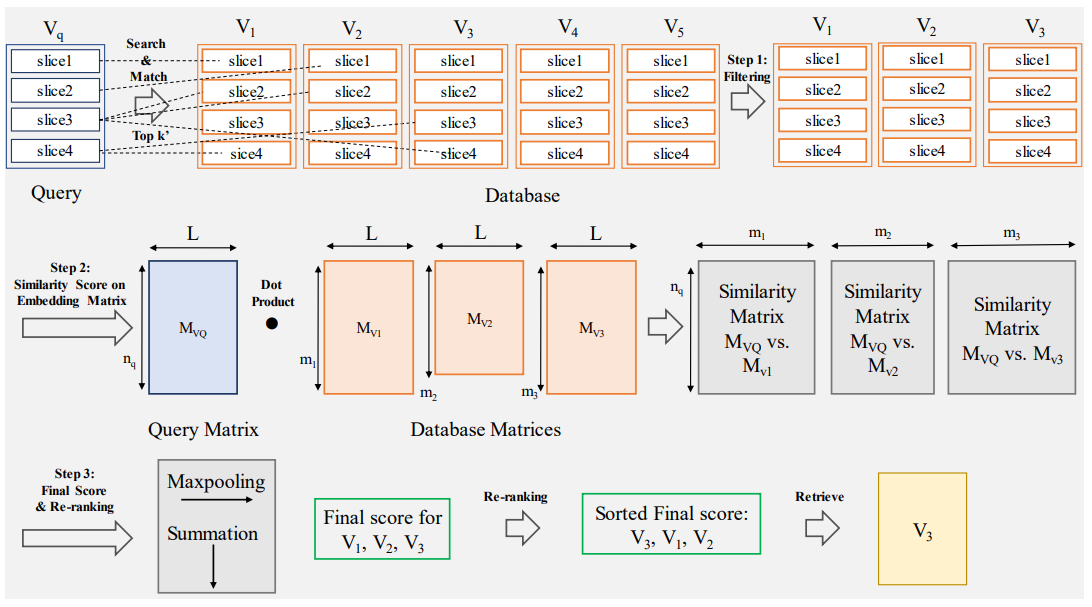
\ Figure 5: Overview of re-ranking. Step 1: Filtering based on at least one similar slice leads to the selection of candidate volumes Step 2: followed by similarity score computation using dot product on the normalized embedding matrices. Step 3: The final step involves max-pooling and summation to determine the top-scoring volumes for retrieval.
\ for each token in the query and document, and it measures relevance as the total of maximum similarities between each query vector and all vectors within the document [Santhanam et al., 2021]. This late interaction approach allows for a more refined and contextually aware retrieval process, thereby enhancing the quality of information retrieval.

\ Inspired by ColBERT we introduce a two-stage method in which filtering of the search space is performed and the total similarity of the entire target volume is considered to re-rank and score the retrieved volumes. To create an analogy to the ColBERT method each word can be considered as one slice and each passage of the database or each question of the query can be considered as one volume. Instead of the BERT encoder for the image retrieval task, the pre-trained vision models can be used to create the embeddings as discussed in Section 2.2.

\ An overview of the proposed method is shown in Figure 5. The method consists of the following steps:

\ 2.5.1 Step 1: Filtering

\

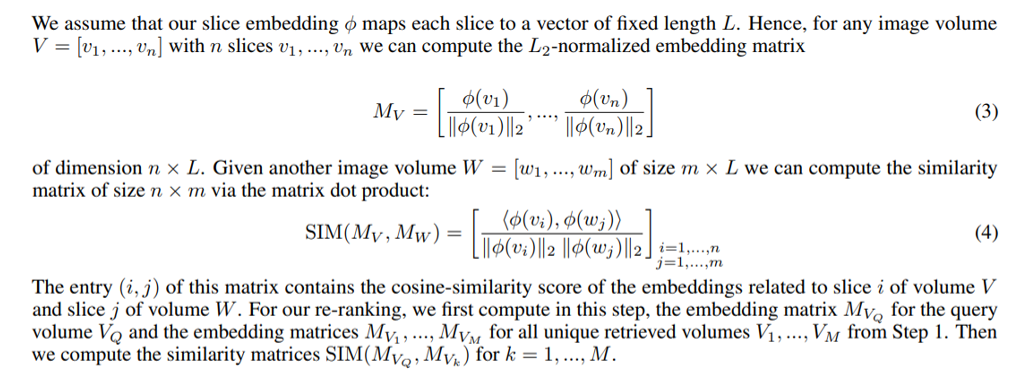
\ 2.5.2 Step 2: Similarity Score on Embedding Matrix

\
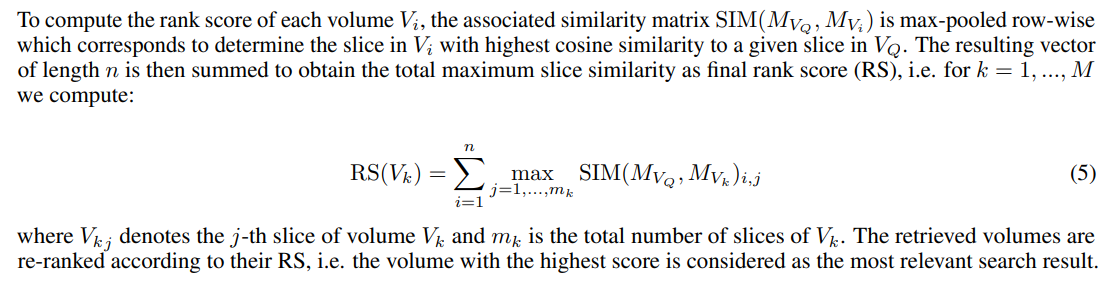
\ 2.5.3 Step 3: Final Score and Re-ranking

\
\ 2.5.4 Localization with Re-ranking

\ In section 2.4.3 we proposed a measure for assessing the capabilities of the search system to localize anatomical regions of interest. This localization measure relied on the hit slices that were finally retrieved by count-based aggregation. As described above, re-ranking may select a volume with a lower total hit count as the final search result based on a more fine-grained similarity measure. We propose to utilize this similarity information to identify slices of maximal similarity with the query data in order to localize the anatomical region of interest.

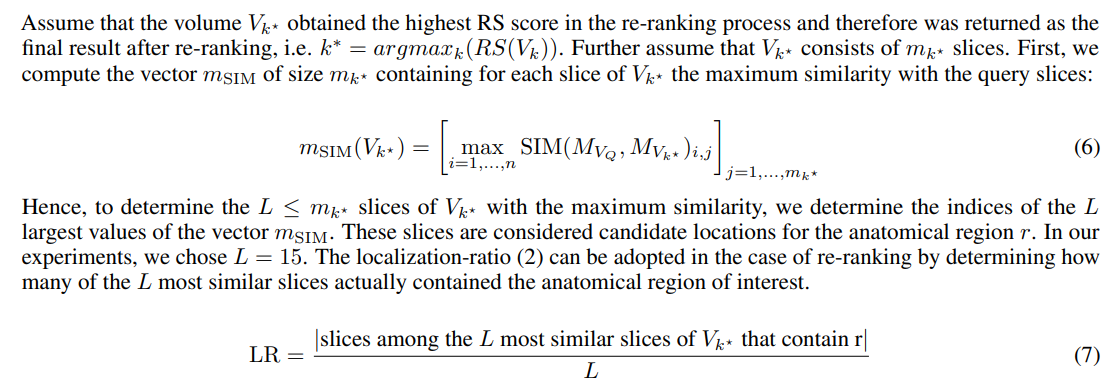
\ In detail, after having obtained the most relevant search result via re-ranking, we need to identify the most relevant slices that could contain the anatomical region of interest r. To this end, we consider the slices that highly contribute to the final RS score (5). Since the full similarity matrices (4) for all candidates from the first search stage are available, we can utilize these to identify the locations of maximum similarity between the query and candidate slices.

\
\

:::info Authors:

(1) Farnaz Khun Jush, Bayer AG, Berlin, Germany (farnaz.khunjush@bayer.com);

(2) Steffen Vogler, Bayer AG, Berlin, Germany (steffen.vogler@bayer.com);

(3) Tuan Truong, Bayer AG, Berlin, Germany (tuan.truong@bayer.com);

(4) Matthias Lenga, Bayer AG, Berlin, Germany (matthias.lenga@bayer.com).

:::


:::info This paper is available on arxiv under CC BY 4.0 DEED license.

:::

\

Market Opportunity
Notcoin Logo
Notcoin Price(NOT)
$0.0003807
$0.0003807$0.0003807
-0.93%
USD
Notcoin (NOT) Live Price Chart

World Cup Combo: Aim for 200x

World Cup Combo: Aim for 200xWorld Cup Combo: Aim for 200x

Combine up to 20 World Cup matches in one order

Disclaimer: The articles reposted on this site are sourced from public platforms and are provided for informational purposes only. They do not necessarily reflect the views of MEXC. All rights remain with the original authors. If you believe any content infringes on third-party rights, please contact crypto.news@mexc.com for removal. MEXC makes no guarantees regarding the accuracy, completeness, or timeliness of the content and is not responsible for any actions taken based on the information provided. The content does not constitute financial, legal, or other professional advice, nor should it be considered a recommendation or endorsement by MEXC.

You May Also Like

[Rear View] The President needs to reclaim the narrative

[Rear View] The President needs to reclaim the narrative

The President is not merely in trouble after his administration’s near-total failure to own the narrative of its presidency. At this point, he has lost control
Share
Rappler2026/06/30 08:00
CME Group to launch Solana and XRP futures options in October

CME Group to launch Solana and XRP futures options in October

The post CME Group to launch Solana and XRP futures options in October appeared on BitcoinEthereumNews.com. CME Group is preparing to launch options on SOL and XRP futures next month, giving traders new ways to manage exposure to the two assets.  The contracts are set to go live on October 13, pending regulatory approval, and will come in both standard and micro sizes with expiries offered daily, monthly and quarterly. The new listings mark a major step for CME, which first brought bitcoin futures to market in 2017 and added ether contracts in 2021. Solana and XRP futures have quickly gained traction since their debut earlier this year. CME says more than 540,000 Solana contracts (worth about $22.3 billion), and 370,000 XRP contracts (worth $16.2 billion), have already been traded. Both products hit record trading activity and open interest in August. Market makers including Cumberland and FalconX plan to support the new contracts, arguing that institutional investors want hedging tools beyond bitcoin and ether. CME’s move also highlights the growing demand for regulated ways to access a broader set of digital assets. The launch, which still needs the green light from regulators, follows the end of XRP’s years-long legal fight with the US Securities and Exchange Commission. A federal court ruling in 2023 found that institutional sales of XRP violated securities laws, but programmatic exchange sales did not. The case officially closed in August 2025 after Ripple agreed to pay a $125 million fine, removing one of the biggest uncertainties hanging over the token. This is a developing story. This article was generated with the assistance of AI and reviewed by editor Jeffrey Albus before publication. Get the news in your inbox. Explore Blockworks newsletters: Source: https://blockworks.co/news/cme-group-solana-xrp-futures
Share
BitcoinEthereumNews2025/09/17 23:55
Gold Slips Toward $4,000 as Persistent Inflation Data Bolsters Higher Rate Expectations

Gold Slips Toward $4,000 as Persistent Inflation Data Bolsters Higher Rate Expectations

BitcoinWorld Gold Slips Toward $4,000 as Persistent Inflation Data Bolsters Higher Rate Expectations Gold prices edged lower in early trading, approaching the
Share
bitcoinworld2026/06/30 07:50