Car Insurance Industry Statistics 2026: Shocking Trends & Growth Data
Car insurance is one of those essential expenses most drivers in the US need to factor into their budget. Whether you’re a seasoned driver or just getting your license, the costs, coverage, and trends of car insurance can vary significantly depending on where you live and your driving profile. Today, the car insurance industry continues to evolve, driven by technological advancements, regulatory changes, and shifts in consumer behavior.
In this article, we’ll explore the latest statistics and trends shaping the car insurance landscape, offering a data-driven perspective to help drivers and industry stakeholders make informed decisions.
Editor’s Choice
- The global car insurance market size stands at $2.13 trillion in 2026 and is projected to reach $2.86 trillion by 2031 at a 6.05% CAGR.
- The global motor insurance market was valued at $976.1 billion in 2025 and is expected to reach $1.75 trillion by 2034, expanding at a 6.70% CAGR from 2026 onward.
- Full coverage car insurance in California costs an average of $3,004 per year in 2026, while the cheapest full coverage option is around $2,813.
- IoT-enabled claims automation can cut claims processing time by up to 50%, while sensor data improves validation accuracy by roughly 35% and reduces disputes.
- Remote inspection tools and AI image or video analysis support more than 35% of property claims assessments, reducing on-site inspections by about 50%.
Recent Developments
- Global AI in insurance revenue is around $26.3 billion this year and projected to hit $114.52 billion by 2031, growing at a 34.2% CAGR.
- Industry surveys suggest that a majority of large insurers are piloting or implementing AI tools in underwriting and claims workflows, though full-scale adoption varies by market and company size.
- AI-powered virtual agents and chatbots handle 60–80% of initial claims-related customer contacts.
- The global usage-based insurance market is also projected to reach about $243.32 billion by 2030, growing at roughly 23.1% annually as adoption accelerates.
Average Annual Car Insurance Premium in the U.S.
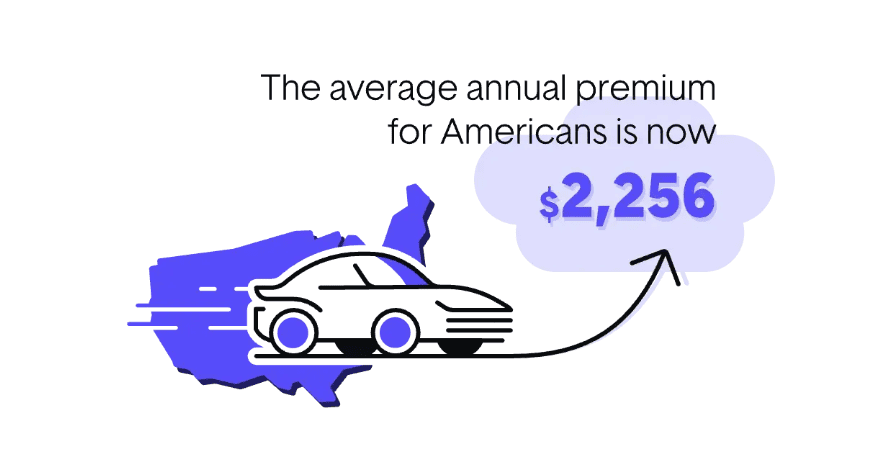
- The average annual car insurance premium for Americans has reached $2,256, highlighting the rising cost of vehicle ownership.
- This figure reflects the typical yearly amount drivers pay for standard auto insurance coverage across the United States.
- Increasing premiums are influenced by factors such as inflation, higher repair costs, and more expensive vehicles.
- The upward trend underscores growing financial pressure on households that rely on personal transportation.
- Insurers are adjusting pricing to account for claims severity, medical costs, and accident frequency.
- Drivers in high-risk areas or with less favorable driving records may pay significantly more than the national average.
 (Reference: The Zebra)
Car Insurance Affordability
- Car insurance premiums now equal 2.6% of median incomes in the U.S.
- Drivers with poor credit pay over 100% more than those with excellent credit.
- Young drivers under 25 pay an average of $258 monthly for full coverage.
- Low-mileage drivers save up to 40% with programs like Allstate Drivewise.
- Older people aged 60 pay $155 monthly for full coverage on average.
- Multi-policy bundling offers 10-15% discounts on premiums.
- Military personnel receive up to 60% off through USAA for deployments.
Cheapest Insurers for Drivers With an Incident
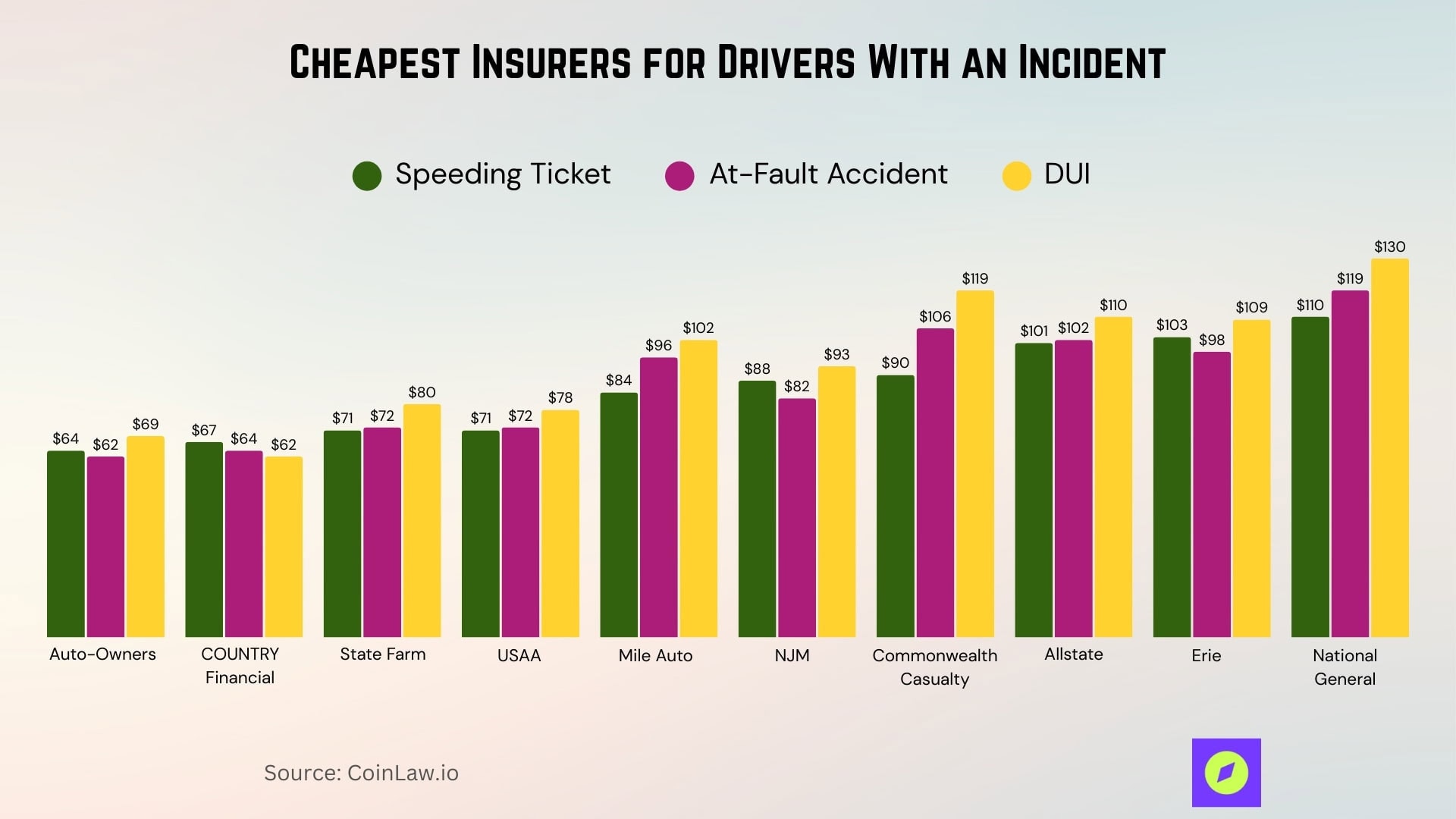
- Auto-Owners offers some of the lowest post-incident premiums, with about $64 after a speeding ticket, $62 after an at-fault accident, and $69 following a DUI.
- COUNTRY Financial is among the most affordable overall, charging roughly $67 (speeding), $64 (at-fault), and just $62 after a DUI.
- Major national providers like State Farm and USAA remain competitively priced, with premiums ranging from about $71 to $80 depending on the violation type.
- Mile Auto shows noticeably higher costs after incidents, rising to around $84 for speeding, $96 for at-fault accidents, and $102 for DUIs.
- Regional insurer NJM maintains mid-range pricing, with rates near $88 (speeding), $82 (at-fault), and $93 (DUI).
- Commonwealth Casualty premiums climb sharply after serious violations, reaching approximately $90 for speeding, $106 for at-fault accidents, and $119 for DUIs.
- Large insurer Allstate charges over the $100 mark for most incidents, at about $101 (speeding), $102 (at-fault), and $110 (DUI).
- Erie Insurance also exceeds $100 for several categories, with around $103 after speeding, $98 after an at-fault accident, and $109 after a DUI.
- National General appears among the most expensive on the list, with premiums of about $110 (speeding), $119 (at-fault), and up to $130 after a DUI.
- Overall, a DUI typically results in the highest premium increases, while speeding tickets tend to produce the lowest increases across insurers.
 (Reference: Quadrant Information Services)
Coverage Insights
- The average state minimum liability premium is $618 annually.
- 1 in 8 U.S. drivers is uninsured, heightening the need for UM coverage.
- PIP mandatory in no-fault states adds $400+ to premiums.
- Liability-only 50/100/50 coverage costs $801 per year.
- The gap insurance market reaches $4.5 billion.
- Rental reimbursement covers up to $35 daily for 30 days.
- Roadside assistance adds $14–$100 annually.
- Comprehensive and collision deductibles are typically $500.
Monthly Car Insurance Cost by Vehicle Type
- Small SUVs average $195/month for full coverage.
- Pickup trucks average $203/month for full coverage.
- Sedans average $220/month for full coverage.
- Electric vehicles average $293/month for full coverage.
- Compact SUVs like the Toyota RAV4 cost $55/month.
- Full-size trucks like the Ford F-Series average $63/month.
- Tesla Model Y EVs cost $183/month.
- Honda Civic sedans average $57/month.
- Chevrolet Silverado pickups average $66/month.
Monthly Car Insurance Costs by Driver Category
- Drivers under 25 average $258/month for full coverage.
- Drivers aged 60+ average $168/month for full coverage.
- Post-at-fault accident full coverage averages $288/month.
- 20-year-olds pay $397/month for full coverage.
- Older people 65+ average $189/month for full coverage.
- Drivers with a recent accident pay $288/month for full coverage.
- 70-year-olds pay $179/month for full coverage.
Key Factors Affecting Premiums
- Drivers under 25 pay up to 2.5x more than middle-aged drivers.
- Urban drivers pay 35% more than rural drivers due to the risks.
- An at-fault accident raises premiums by an average 45%.
- Luxury vehicles cost 25% more to insure than standard models.
- Poor credit scores increase premiums by 71% over excellent credit.
- High-mileage drivers over 20,000 miles pay 12% more.
- Male drivers under 30 pay up to 12% more than females.
- Clean driving records save drivers 40% on premiums.
Technological Influence on Insurance Rates
- Telematics programs offer 10-30% premium discounts for safe drivers.
- AI claims processing reduces settlement time by up to 60%.
- Safety features like emergency braking lower premiums for 73% of equipped drivers.
- Connected vehicle cameras cut claims costs by 50%.
- 64% of global insurance customers use mobile apps.
- Usage-based insurance saves a median of $27/month.
- 60% of policyholders are open to telematics adoption.
Frequently Asked Questions (FAQs)
Personal auto premiums are forecasted to increase by mid-single digits, around 4% nationally.
The combined ratio for personal auto is forecasted at 97.1% in 2026.
The national average for full coverage is $2,256.
Conclusion
The car insurance industry continues to evolve, driven by technology, environmental considerations, and changes in consumer behavior. From the growth of telematics-based policies to the impact of climate change on premium rates, insurers are adapting to new challenges and opportunities. Understanding these trends and leveraging the latest statistics can help consumers make better decisions and insurers stay competitive in a rapidly shifting market.
The post Car Insurance Industry Statistics 2026: Shocking Trends & Growth Data appeared first on CoinLaw.
You May Also Like

Uniswap wins again in ‘scam token’ lawsuit

Will XRP Price Increase In September 2025?