

Know history or risk losing democracy, EDSA veterans warn youth
MANILA, Philippines — “Did we fail you? Did you know we were fighting for something?”
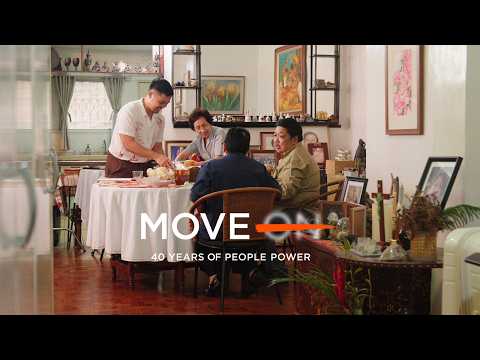
These are the questions veterans of the EDSA People Power Revolution asked Bar Boys: The Musical actor Jerom Canlas in Move On: 40 Years of People Power, Rappler’s People Power 40th anniversary video about the legacy of the four-day historic uprising, from the perspective of the people who were actually there.
The question came after former Rappler senior editor Chito de la Vega and Ateneo de Manila professor Carmel Abao voiced their concerns about the country’s education crisis and the youth’s unfamiliarity with history, especially with another Marcos running the country.
Generational disconnect
Abao sees a new danger 40 years later: a younger generation that lacks a deep understanding of history.
She shared that during the height of the calls against the burial of the late president Ferdinand E. Marcos Sr. at the Libingan ng mga Bayani, some members of the younger generation went as far as saying that the country needs a dictator.
“I just always say, maybe you don’t know what a dictatorship really is. Maybe you should try really experiencing a dictatorship,” Abao recalled saying in response.
Sister Cho Borromeo expressed a similar concern.
“Whenever someone rewrites history and that person wasn’t even born in 1986, my blood really boils. I say, how dare [you]?” she shared.
Meanwhile, De la Vega, a novice reporter during the revolution and an educator now, also observed that the younger generation struggling with comprehension could lose faith in People Power and democracy.
This also led both Dela Vega and Abao to question whether the younger generation sees the importance of living in the democracy that they fought for during People Power, especially with another Marcos running the country.
“Before, it was unimaginable that the Marcoses would come back,” said Dela Vega.
Canlas, representing the Gen Z perspective, offered a candid critique: the older generation may have grown complacent after the first People Power and failed to carry on towards changing vital institutions, like education, in the country.
“If your generation carried on even after EDSA; if it continued stronger, this would not be the state of the nation,” Canlas said.
“[The older generation] did not carry on to change the institutions. We still need education. Free education for state universities came only in 2016. There are still gaps that haven’t been addressed in the last 40 years. And the younger generation is paying the price now,” Canlas added.
He also noted that the historical disconnect happening nowadays about People Power stems from the youth not understanding the events leading to the popular uprising, worsened by disinformation on social media and artificial intelligence-driven narratives.
Canlas emphasized that first-hand accounts are the only way to pierce the digital noise.
“It’s hard to believe something you haven’t actually experienced, unless you’ve talked to people who have truly lived through it,” Canlas said.
“Because today’s youth haven’t lived through it themselves, they search for real accounts to hold on to — ones that aren’t AI-generated, and aren’t altered,” he added.
Borromeo, whose interview during the 38th EDSA anniversary went viral, agreed, shared how youth often approach her saying, “Sister, at last, we were able to hear from someone who was actually there.”
She also called for other EDSA veterans to share more of their stories and experiences: “I think those of us who were there at EDSA, we owe it to our people [too]; to pass on the story. That should be our legacy. And that should be repeated again and again.”
 REUNION MEAL. EDSA veterans and a Gen Z actor reunite to discuss the legacy of the People Power movement over food shared during the revolution. Jire Carreon/Rappler
Change in progress
Despite all these, the veterans and the Gen Z actor agreed on one thing: the revolution was not a single event in February 1986, but a continuous, often struggling, process.
“The change that people want to happen was expected instantly. But during [People Power], the anger had to accumulate first,” Canlas said, reflecting on the events that led to the revolution.
Still, the EDSA veterans see the spirit of People Power in contemporary movements. De la Vega highlighted recent mobilizations against corruption in government flood control projects as a modern iteration of the 1986 revolt’s essence.
“The anger of the people to fight and bring justice to what is happening is still there. And I think, what we learned from EDSA, we can apply now if we want to put an end [to the flood control issue],” he said.
For Borromeo, the revolution remains an unfinished act of faith. She believes that the “seeds” planted years ago are still waiting to bloom.
“I still believe that 1986 EDSA Power is an act of God. And if it is, God will see to it that it will come to a good conclusion. [He did not start this] and then put us in a situation worse than 1986,” Borromeo said in a mix of Filipino and English.
Abao summarized this sentiment in a reflection following the film’s release: “[What] we achieved in February 1986 were the means, not ends,” wrote Abao in a Facebook post.
To her, the 40th anniversary is not just a throwback, but a call to keep moving forward toward social justice and genuine equality. — Gabie Torre/Rappler.com
Quotes are translated in English for brevity.
Gabie Torre is a Rappler volunteer taking up Bachelor of Science in Community Development at the University of the Philippines-Diliman. Currently, she is a member of UP SUPER, an advocacy student organization in UP Diliman that supports persons with disability, and an active volunteer for Greenpeace PH.


You May Also Like

CoreWeave (CRWV) Stock Surges 12% on $8.5B GPU-Backed Financing Deal — Here’s the Full Picture

Bitcoin, Gold, and U.S. Stocks Dive as Trump Pledges to Hit Iran ‘Extremely Hard’




