Bitcoin may be trading nearly 50% below its all-time high, but new data shows institutions, corporations, financial advisors, and even sovereign funds sharply increasedBitcoin may be trading nearly 50% below its all-time high, but new data shows institutions, corporations, financial advisors, and even sovereign funds sharply increased

Bitcoin Adoption Trends in 2025 Sharply Higher

2026/02/25 18:00
5 min read
Bitcoin Adoption Trends in 2025 Sharply Higher

The price action in Bitcoin and the broader crypto markets since October has shown significant weakness.

However, Bitcoin adoption across the board was sharply higher in 2025 from the year prior. As it trades around the $65,000 and is almost 50% off its all-time highs, Bitcoin's recent performance could appear disappointing.

Nevertheless, according to a new analysis by River, the adoption patterns for 2025 offer a far more positive picture.

Despite market difficulties, the research company claims that the spread of the network among institutions, enterprises, financial experts, and even nations has increased during the past year.

The level of institutional bets is one area that has changed significantly. Institutions bought more than 829,000 Bitcoin in 2025, said River. Institutions linked to the government, investment firms, exchange-traded funds (ETFs), and private enterprises were among the top purchasers through 2025.
Bitcoin Adoption Trends in 2025 Sharply Higher

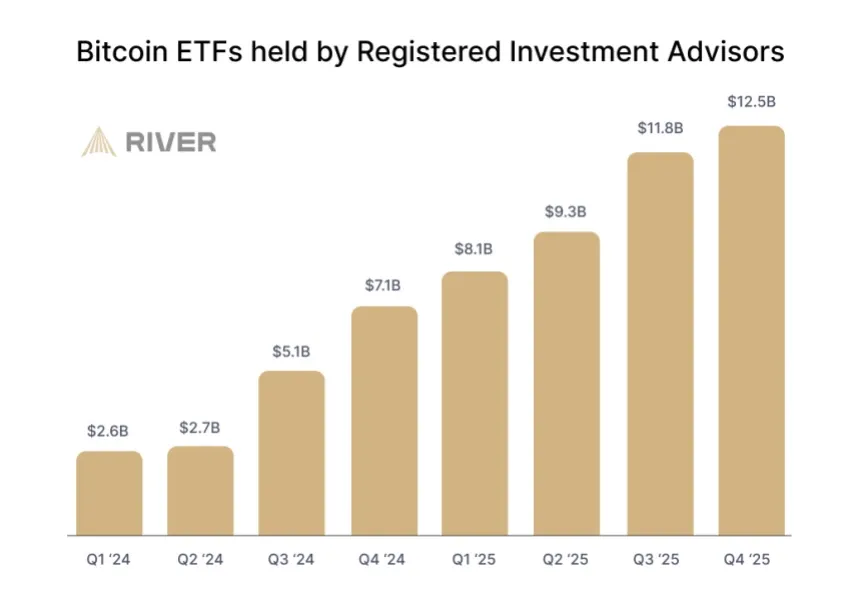
The function of financial consultants as steady buyers has also expanded. The River report showed that over the past eight quarters consecutively, professionals in the field have been increasing their net exposure to Bitcoin, managing client assets that total nearly $146 trillion.

Their participation ramped up in 2024, when spot Bitcoin ETFs were first introduced.

Investment advisers have been pouring about $1.5 billion into Bitcoin ETFs every quarter for the past two years, yet they have never sold any of their holdings.

With 29 out of the top 30 US corporations having some kind of exposure to Bitcoin, adoption is already rather strong among this group. However, the present allocations are modest, averaging only about 0.008% of assets under management.

So, if anything, there is room for improvement.

Traditional banks are getting on board with the asset more and more. Reportedly, Bitcoin-related products are in the works at almost 60% of the top US banks.

Additionally, there was a significant uptick in usage among corporations. Among publicly traded organisations, Bitcoin ownership increased 2.5-fold in 2025, making these companies the year's top net purchasers.

River indicates that many reputable organizations have been discreetly investing smaller amounts of Bitcoin, yet the bulk of this demand has originated from companies holding Bitcoin in their treasuries.

The anticipated adoption of balance sheets is projected to increase across the S&P 500 in the years ahead, as indicated by the business.

A dramatic increase has been seen in the use of merchant services. In 2025, the number of U.S. businesses accepting Bitcoin payments tripled, while worldwide, merchant usage increased by a substantial 74%.

The majority of the expansion is occurring in privately held, smaller companies, according to River, which serves more than 3,000 enterprises in different industries.

Many of these companies choose to keep their Bitcoin plans under wraps.

What About Countries?

An increasing number of countries are now engaging in cryptocurrencies.

In 2025, there was a notable rise in the number of nations adopting Bitcoin, with an increase of five countries. This group included the Czech Republic, Luxembourg, and Saudi Arabia, all of which were highlighted through their sovereign wealth funds.

In addition to government-backed mining projects, direct acquisitions, exposure through ETFs, asset confiscations, charity gifts, and recoveries tied to hacking events, authorities have also amassed Bitcoin via other means.

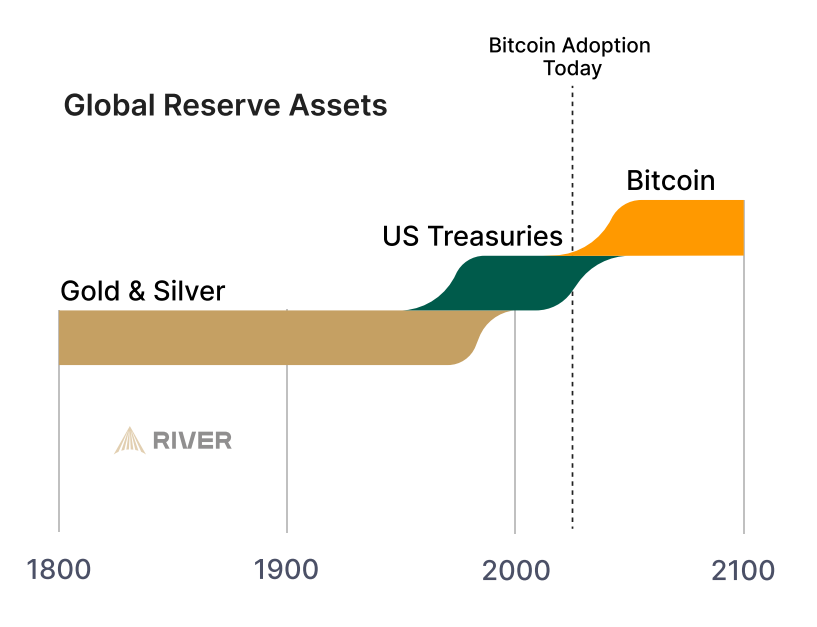
River emphasized that there is a clear gap between adoption rates and pricing outcomes. This growth stage might not manifest as significant price multiples at this moment, but it certainly indicates advancement.

River in the report noted that "We expect that in the coming years, Bitcoin adoption will not only continue its current trend but meaningfully accelerate."
Bitcoin Adoption Trends in 2025 Sharply Higher

Investment advisors have consistently increased their investment in Bitcoin. That is despite the cryptocurrency being set for its fifth consecutive month of declines in February.

But if history is anything to go by, a probable turnaround by April is suggested by the fact that the longest losing run in history lasted six months.

Bitcoin is currently at a critical turning point.

Following the loss of crucial support and movement into range extremes, the market is now presented with a distinct choice: either regain the range highs and redirect momentum upward, or falter and move toward new weekly lows.

The next move from this point is expected to influence Bitcoin's immediate trajectory.


➢ Stay ahead of the curve. Join Blockhead on Telegram today for all the latest in crypto.
+ Follow Blockhead on Google News

Blockcast – Licensed to Shill: How Energy & Geopolitics Are Building a Bitcoin-Driven World, ft. Bitcoin Arabia's Lara Eggimann & Jeff Gorman

The Middle East is poised to become a pivotal hub in the global cryptocurrency ecosystem. Countries within the region are increasingly recognizing the strategic importance of integrating blockchain technology into their economic frameworks, energy markets, and geopolitical strategies, according to Lara Eggimann and Jeff Gorman, co-founders of Bitcoin Arabia, a strategic Bitcoin advisory and ecosystem builder that connects the global Bitcoin industry with the Middle East’s most powerful stakeholders.

Thanks for tuning in! If you enjoyed this episode, please like and subscribe to Blockcast on your favorite podcast platforms like Spotify and Apple.


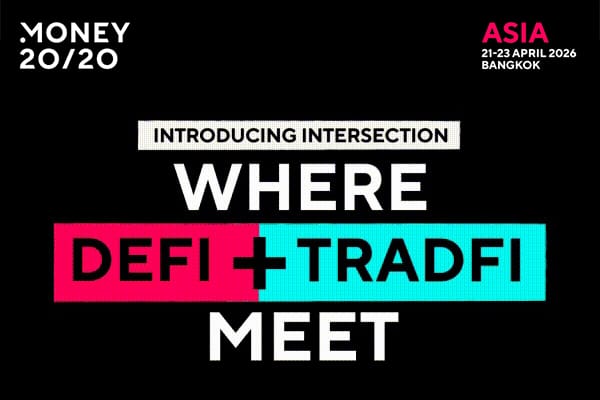
Be at the heart of TradFi–DeFi collaboration at Money20/20 Asia 2026.
Bitcoin Adoption Trends in 2025 Sharply Higher

Are you looking to forge partnerships with banks and fintechs? To expand into new markets across Asia, or to secure funding from top-tier investors? This April, the world of digital assets, blockchain, and Web3 converges with the biggest players in APAC’s financial ecosystem at Money20/20 Asia 2026 and its brand new ‘Intersection’ zone, complete with a dedicated content stage, TradFi-Defi innovator showcase, and curated networking spaces. From traditional banking giants to decentralised innovators, private equity leaders, and cutting-edge fintech disruptors, this is where they meet to forge partnerships, spark dialogue, and shape the future of finance.


Disclaimer: The articles reposted on this site are sourced from public platforms and are provided for informational purposes only. They do not necessarily reflect the views of MEXC. All rights remain with the original authors. If you believe any content infringes on third-party rights, please contact crypto.news@mexc.com for removal. MEXC makes no guarantees regarding the accuracy, completeness, or timeliness of the content and is not responsible for any actions taken based on the information provided. The content does not constitute financial, legal, or other professional advice, nor should it be considered a recommendation or endorsement by MEXC.

You May Also Like

Bitwise CEO: In the next 6 to 12 months, the focus of the crypto field will be on the credit and lending market

Bitwise CEO: In the next 6 to 12 months, the focus of the crypto field will be on the credit and lending market

PANews reported on September 18 that Bitwise CEO Hunter Horsley tweeted that over the next six to 12 months, the focus of the cryptocurrency sector will shift to credit and lending. This sector is expected to experience explosive growth in the next few years. He pointed out that the current cryptocurrency market capitalization is approaching $4 trillion and continues to grow. When people can borrow against cryptocurrency, they will choose to borrow rather than sell. Furthermore, the market capitalization of publicly traded stocks in the United States exceeds $60 trillion. With the tokenization of assets, individuals holding $7,000 worth of stocks will be able to borrow against them on-chain for the first time. Horsley believes that cryptocurrency is redefining capital markets, and this is just the beginning.
Share
PANews2025/09/18 17:00
Nvidia (NVDA) Stock Rises After Q4 Earnings and Guidance Beat – Data Center Revenue Up 75%

Nvidia (NVDA) Stock Rises After Q4 Earnings and Guidance Beat – Data Center Revenue Up 75%

TLDR Nvidia beat Q4 earnings estimates with EPS of $1.62 adjusted vs $1.53 expected Total revenue hit $68.13 billion, up 73% year-over-year Data center revenue
Share
Coincentral2026/02/26 17:12
Summarize Any Stock’s Earnings Call in Seconds Using FMP API

Summarize Any Stock’s Earnings Call in Seconds Using FMP API

Turn lengthy earnings call transcripts into one-page insights using the Financial Modeling Prep APIPhoto by Bich Tran Earnings calls are packed with insights. They tell you how a company performed, what management expects in the future, and what analysts are worried about. The challenge is that these transcripts often stretch across dozens of pages, making it tough to separate the key takeaways from the noise. With the right tools, you don’t need to spend hours reading every line. By combining the Financial Modeling Prep (FMP) API with Groq’s lightning-fast LLMs, you can transform any earnings call into a concise summary in seconds. The FMP API provides reliable access to complete transcripts, while Groq handles the heavy lifting of distilling them into clear, actionable highlights. In this article, we’ll build a Python workflow that brings these two together. You’ll see how to fetch transcripts for any stock, prepare the text, and instantly generate a one-page summary. Whether you’re tracking Apple, NVIDIA, or your favorite growth stock, the process works the same — fast, accurate, and ready whenever you are. Fetching Earnings Transcripts with FMP API The first step is to pull the raw transcript data. FMP makes this simple with dedicated endpoints for earnings calls. If you want the latest transcripts across the market, you can use the stable endpoint /stable/earning-call-transcript-latest. For a specific stock, the v3 endpoint lets you request transcripts by symbol, quarter, and year using the pattern: https://financialmodelingprep.com/api/v3/earning_call_transcript/{symbol}?quarter={q}&year={y}&apikey=YOUR_API_KEY here’s how you can fetch NVIDIA’s transcript for a given quarter: import requestsAPI_KEY = "your_api_key"symbol = "NVDA"quarter = 2year = 2024url = f"https://financialmodelingprep.com/api/v3/earning_call_transcript/{symbol}?quarter={quarter}&year={year}&apikey={API_KEY}"response = requests.get(url)data = response.json()# Inspect the keysprint(data.keys())# Access transcript contentif "content" in data[0]: transcript_text = data[0]["content"] print(transcript_text[:500]) # preview first 500 characters The response typically includes details like the company symbol, quarter, year, and the full transcript text. If you aren’t sure which quarter to query, the “latest transcripts” endpoint is the quickest way to always stay up to date. Cleaning and Preparing Transcript Data Raw transcripts from the API often include long paragraphs, speaker tags, and formatting artifacts. Before sending them to an LLM, it helps to organize the text into a cleaner structure. Most transcripts follow a pattern: prepared remarks from executives first, followed by a Q&A session with analysts. Separating these sections gives better control when prompting the model. In Python, you can parse the transcript and strip out unnecessary characters. A simple way is to split by markers such as “Operator” or “Question-and-Answer.” Once separated, you can create two blocks — Prepared Remarks and Q&A — that will later be summarized independently. This ensures the model handles each section within context and avoids missing important details. Here’s a small example of how you might start preparing the data: import re# Example: using the transcript_text we fetched earliertext = transcript_text# Remove extra spaces and line breaksclean_text = re.sub(r'\s+', ' ', text).strip()# Split sections (this is a heuristic; real-world transcripts vary slightly)if "Question-and-Answer" in clean_text: prepared, qna = clean_text.split("Question-and-Answer", 1)else: prepared, qna = clean_text, ""print("Prepared Remarks Preview:\n", prepared[:500])print("\nQ&A Preview:\n", qna[:500]) With the transcript cleaned and divided, you’re ready to feed it into Groq’s LLM. Chunking may be necessary if the text is very long. A good approach is to break it into segments of a few thousand tokens, summarize each part, and then merge the summaries in a final pass. Summarizing with Groq LLM Now that the transcript is clean and split into Prepared Remarks and Q&A, we’ll use Groq to generate a crisp one-pager. The idea is simple: summarize each section separately (for focus and accuracy), then synthesize a final brief. Prompt design (concise and factual) Use a short, repeatable template that pushes for neutral, investor-ready language: You are an equity research analyst. Summarize the following earnings call sectionfor {symbol} ({quarter} {year}). Be factual and concise.Return:1) TL;DR (3–5 bullets)2) Results vs. guidance (what improved/worsened)3) Forward outlook (specific statements)4) Risks / watch-outs5) Q&A takeaways (if present)Text:<<<{section_text}>>> Python: calling Groq and getting a clean summary Groq provides an OpenAI-compatible API. Set your GROQ_API_KEY and pick a fast, high-quality model (e.g., a Llama-3.1 70B variant). We’ll write a helper to summarize any text block, then run it for both sections and merge. import osimport textwrapimport requestsGROQ_API_KEY = os.environ.get("GROQ_API_KEY") or "your_groq_api_key"GROQ_BASE_URL = "https://api.groq.com/openai/v1" # OpenAI-compatibleMODEL = "llama-3.1-70b" # choose your preferred Groq modeldef call_groq(prompt, temperature=0.2, max_tokens=1200): url = f"{GROQ_BASE_URL}/chat/completions" headers = { "Authorization": f"Bearer {GROQ_API_KEY}", "Content-Type": "application/json", } payload = { "model": MODEL, "messages": [ {"role": "system", "content": "You are a precise, neutral equity research analyst."}, {"role": "user", "content": prompt}, ], "temperature": temperature, "max_tokens": max_tokens, } r = requests.post(url, headers=headers, json=payload, timeout=60) r.raise_for_status() return r.json()["choices"][0]["message"]["content"].strip()def build_prompt(section_text, symbol, quarter, year): template = """ You are an equity research analyst. Summarize the following earnings call section for {symbol} ({quarter} {year}). Be factual and concise. Return: 1) TL;DR (3–5 bullets) 2) Results vs. guidance (what improved/worsened) 3) Forward outlook (specific statements) 4) Risks / watch-outs 5) Q&A takeaways (if present) Text: <<< {section_text} >>> """ return textwrap.dedent(template).format( symbol=symbol, quarter=quarter, year=year, section_text=section_text )def summarize_section(section_text, symbol="NVDA", quarter="Q2", year="2024"): if not section_text or section_text.strip() == "": return "(No content found for this section.)" prompt = build_prompt(section_text, symbol, quarter, year) return call_groq(prompt)# Example usage with the cleaned splits from Section 3prepared_summary = summarize_section(prepared, symbol="NVDA", quarter="Q2", year="2024")qna_summary = summarize_section(qna, symbol="NVDA", quarter="Q2", year="2024")final_one_pager = f"""# {symbol} Earnings One-Pager — {quarter} {year}## Prepared Remarks — Key Points{prepared_summary}## Q&A Highlights{qna_summary}""".strip()print(final_one_pager[:1200]) # preview Tips that keep quality high: Keep temperature low (≈0.2) for factual tone. If a section is extremely long, chunk at ~5–8k tokens, summarize each chunk with the same prompt, then ask the model to merge chunk summaries into one section summary before producing the final one-pager. If you also fetched headline numbers (EPS/revenue, guidance) earlier, prepend them to the prompt as brief context to help the model anchor on the right outcomes. Building the End-to-End Pipeline At this point, we have all the building blocks: the FMP API to fetch transcripts, a cleaning step to structure the data, and Groq LLM to generate concise summaries. The final step is to connect everything into a single workflow that can take any ticker and return a one-page earnings call summary. The flow looks like this: Input a stock ticker (for example, NVDA). Use FMP to fetch the latest transcript. Clean and split the text into Prepared Remarks and Q&A. Send each section to Groq for summarization. Merge the outputs into a neatly formatted earnings one-pager. Here’s how it comes together in Python: def summarize_earnings_call(symbol, quarter, year, api_key, groq_key): # Step 1: Fetch transcript from FMP url = f"https://financialmodelingprep.com/api/v3/earning_call_transcript/{symbol}?quarter={quarter}&year={year}&apikey={api_key}" resp = requests.get(url) resp.raise_for_status() data = resp.json() if not data or "content" not in data[0]: return f"No transcript found for {symbol} {quarter} {year}" text = data[0]["content"] # Step 2: Clean and split clean_text = re.sub(r'\s+', ' ', text).strip() if "Question-and-Answer" in clean_text: prepared, qna = clean_text.split("Question-and-Answer", 1) else: prepared, qna = clean_text, "" # Step 3: Summarize with Groq prepared_summary = summarize_section(prepared, symbol, quarter, year) qna_summary = summarize_section(qna, symbol, quarter, year) # Step 4: Merge into final one-pager return f"""# {symbol} Earnings One-Pager — {quarter} {year}## Prepared Remarks{prepared_summary}## Q&A Highlights{qna_summary}""".strip()# Example runprint(summarize_earnings_call("NVDA", 2, 2024, API_KEY, GROQ_API_KEY)) With this setup, generating a summary becomes as simple as calling one function with a ticker and date. You can run it inside a notebook, integrate it into a research workflow, or even schedule it to trigger after each new earnings release. Free Stock Market API and Financial Statements API... Conclusion Earnings calls no longer need to feel overwhelming. With the Financial Modeling Prep API, you can instantly access any company’s transcript, and with Groq LLM, you can turn that raw text into a sharp, actionable summary in seconds. This pipeline saves hours of reading and ensures you never miss the key results, guidance, or risks hidden in lengthy remarks. Whether you track tech giants like NVIDIA or smaller growth stocks, the process is the same — fast, reliable, and powered by the flexibility of FMP’s data. Summarize Any Stock’s Earnings Call in Seconds Using FMP API was originally published in Coinmonks on Medium, where people are continuing the conversation by highlighting and responding to this story
Share
Medium2025/09/18 14:40