TLDR Bitcoin surged ~7% as speculation grew that Jane Street halted a daily “10 a.m. dump” algorithm after being sued Terraform Labs’ bankruptcy administrator filedTLDR Bitcoin surged ~7% as speculation grew that Jane Street halted a daily “10 a.m. dump” algorithm after being sued Terraform Labs’ bankruptcy administrator filed

Bitcoin (BTC) Price: BTC Jumps 7% the Day After Jane Street Gets Sued — Coincidence?

2026/02/26 14:42
3 min read

TLDR

  • Bitcoin surged ~7% as speculation grew that Jane Street halted a daily “10 a.m. dump” algorithm after being sued
  • Terraform Labs’ bankruptcy administrator filed an 83-page lawsuit against Jane Street on Feb. 23, alleging insider trading tied to the 2022 TerraUSD collapse
  • Bitcoin climbed above $68,000, adding over $170 billion to total crypto market cap
  • The “10 a.m. dump” pattern saw Bitcoin fall in the first hour of U.S. trading in over 60% of sessions since early November
  • Analysts say Bitcoin needs to hold above $64,000 and break $66,535 to sustain the move

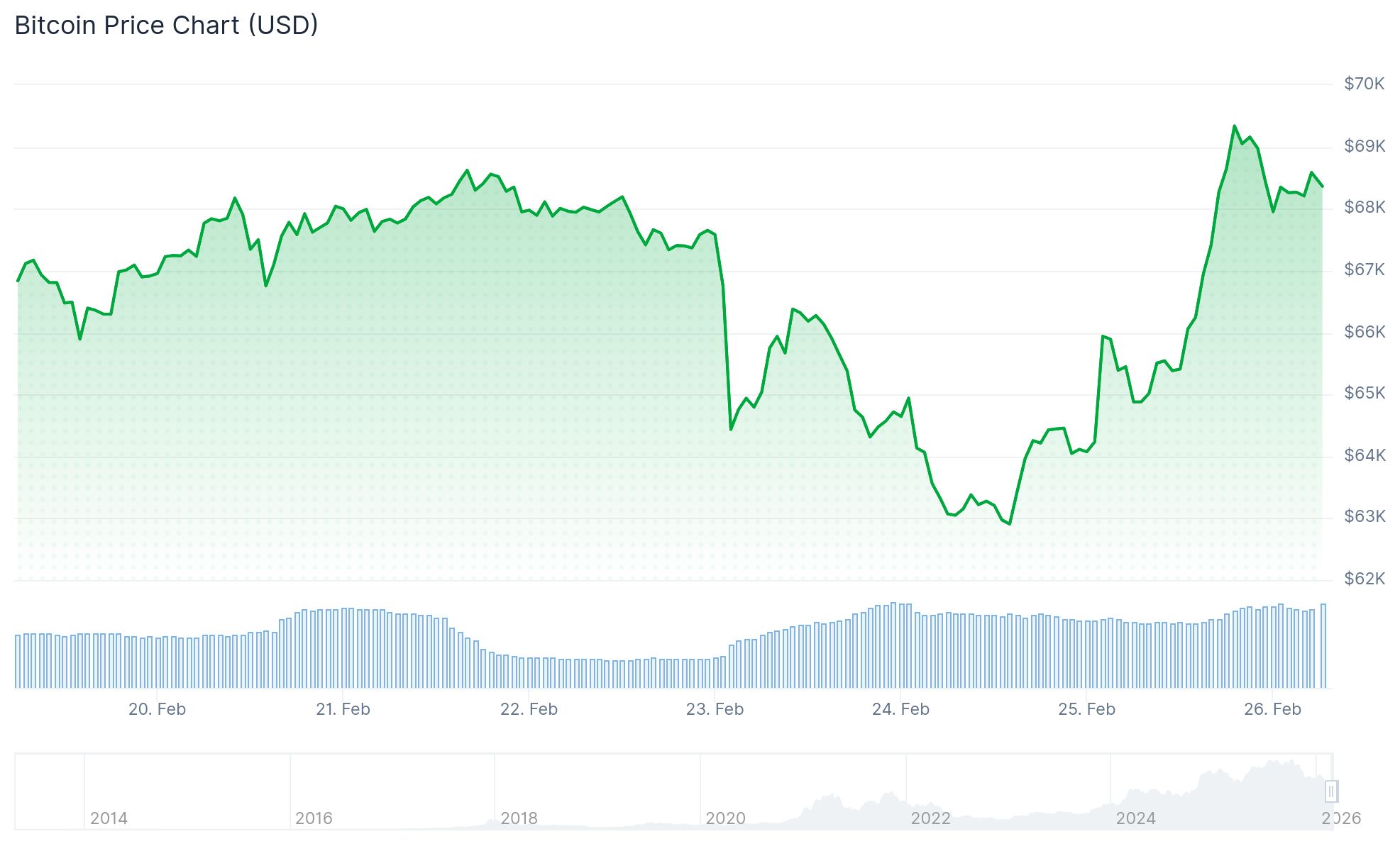
Bitcoin posted one of its strongest single-day gains of the year on Wednesday, rising nearly 7% to above $68,000. The move added more than $170 billion to the total crypto market cap, pushing it to $2.4 trillion.
Bitcoin (BTC) PriceBitcoin (BTC) Price

The rally came as online speculation about trading firm Jane Street went viral. Traders on Crypto X and Reddit had long pointed to a pattern where Bitcoin’s overnight gains disappeared within minutes of the U.S. equity market opening around 10 a.m. Eastern Time.

Since early November, Bitcoin had declined during the first hour of U.S. trading in more than 60% of sessions, often shedding up to 3% in that window. On Dec. 4, it dropped 2.1% within 18 minutes of the S&P 500 opening flat.

The theory was that Jane Street was running an automated algorithm that sold Bitcoin at 10 a.m. daily, suppressing potential rallies and buying back at lower prices.

Investor Mike Alfred added fuel to the story, claiming to have spoken with an internal Jane Street source who said management had ordered an “immediate cessation” of the trading strategy. Alfred wrote that the “10 a.m. algo” had been shut down. CCN reached out to both Alfred and Jane Street but received no response. These claims remain unverified.

Mike Alfred’s unverified claims added fuel to the narrative | Source: X (MikeAlfred)Source: Mike Aldred on X

Jane Street has denied all allegations, calling them “baseless.”

The Lawsuit Behind the Speculation

The renewed scrutiny follows a lawsuit filed Feb. 23 by the bankruptcy administrator of Terraform Labs. The 83-page complaint accuses Jane Street, co-founder Robert Granieri, and two employees of insider trading and market manipulation before the 2022 TerraUSD collapse, which wiped out roughly $40 billion in market value.

The suit alleges confidential, non-public information from Terraform insiders was shared with Jane Street to front-run trades.

Bloomberg ETF analyst Eric Balchunas commented that if consistent sell pressure had stopped, Bitcoin could see a sustained rebound.

Technical Levels to Watch

Analysts noted Bitcoin’s RSI had recently fallen near 30, an oversold level often associated with short-term relief rallies.

Data from CoinMarketCap showed a 95% correlation between Bitcoin and the S&P 500 over the 24-hour period, suggesting macro conditions also played a role. Wall Street rose that session as AI-related concerns eased ahead of Nvidia earnings.

Bitcoin hit a session high of $69,819 before pulling back. Analysts say it must hold above $64,000 and clear resistance at $66,535 to maintain momentum. A failure to do so could see it retest support near $60,074.

Bitcoin had fallen below $63,000 earlier in the week and remains down nearly 50% from its October record highs.

The post Bitcoin (BTC) Price: BTC Jumps 7% the Day After Jane Street Gets Sued — Coincidence? appeared first on CoinCentral.


Market Opportunity
Bitcoin Logo
Bitcoin Price(BTC)
$68,212.96
$68,212.96$68,212.96
+1.19%
USD
Bitcoin (BTC) Live Price Chart
Disclaimer: The articles reposted on this site are sourced from public platforms and are provided for informational purposes only. They do not necessarily reflect the views of MEXC. All rights remain with the original authors. If you believe any content infringes on third-party rights, please contact crypto.news@mexc.com for removal. MEXC makes no guarantees regarding the accuracy, completeness, or timeliness of the content and is not responsible for any actions taken based on the information provided. The content does not constitute financial, legal, or other professional advice, nor should it be considered a recommendation or endorsement by MEXC.

You May Also Like

Bitwise CEO: In the next 6 to 12 months, the focus of the crypto field will be on the credit and lending market

Bitwise CEO: In the next 6 to 12 months, the focus of the crypto field will be on the credit and lending market

PANews reported on September 18 that Bitwise CEO Hunter Horsley tweeted that over the next six to 12 months, the focus of the cryptocurrency sector will shift to credit and lending. This sector is expected to experience explosive growth in the next few years. He pointed out that the current cryptocurrency market capitalization is approaching $4 trillion and continues to grow. When people can borrow against cryptocurrency, they will choose to borrow rather than sell. Furthermore, the market capitalization of publicly traded stocks in the United States exceeds $60 trillion. With the tokenization of assets, individuals holding $7,000 worth of stocks will be able to borrow against them on-chain for the first time. Horsley believes that cryptocurrency is redefining capital markets, and this is just the beginning.
Share
PANews2025/09/18 17:00
Nvidia (NVDA) Stock Rises After Q4 Earnings and Guidance Beat – Data Center Revenue Up 75%

Nvidia (NVDA) Stock Rises After Q4 Earnings and Guidance Beat – Data Center Revenue Up 75%

TLDR Nvidia beat Q4 earnings estimates with EPS of $1.62 adjusted vs $1.53 expected Total revenue hit $68.13 billion, up 73% year-over-year Data center revenue
Share
Coincentral2026/02/26 17:12
Summarize Any Stock’s Earnings Call in Seconds Using FMP API

Summarize Any Stock’s Earnings Call in Seconds Using FMP API

Turn lengthy earnings call transcripts into one-page insights using the Financial Modeling Prep APIPhoto by Bich Tran Earnings calls are packed with insights. They tell you how a company performed, what management expects in the future, and what analysts are worried about. The challenge is that these transcripts often stretch across dozens of pages, making it tough to separate the key takeaways from the noise. With the right tools, you don’t need to spend hours reading every line. By combining the Financial Modeling Prep (FMP) API with Groq’s lightning-fast LLMs, you can transform any earnings call into a concise summary in seconds. The FMP API provides reliable access to complete transcripts, while Groq handles the heavy lifting of distilling them into clear, actionable highlights. In this article, we’ll build a Python workflow that brings these two together. You’ll see how to fetch transcripts for any stock, prepare the text, and instantly generate a one-page summary. Whether you’re tracking Apple, NVIDIA, or your favorite growth stock, the process works the same — fast, accurate, and ready whenever you are. Fetching Earnings Transcripts with FMP API The first step is to pull the raw transcript data. FMP makes this simple with dedicated endpoints for earnings calls. If you want the latest transcripts across the market, you can use the stable endpoint /stable/earning-call-transcript-latest. For a specific stock, the v3 endpoint lets you request transcripts by symbol, quarter, and year using the pattern: https://financialmodelingprep.com/api/v3/earning_call_transcript/{symbol}?quarter={q}&year={y}&apikey=YOUR_API_KEY here’s how you can fetch NVIDIA’s transcript for a given quarter: import requestsAPI_KEY = "your_api_key"symbol = "NVDA"quarter = 2year = 2024url = f"https://financialmodelingprep.com/api/v3/earning_call_transcript/{symbol}?quarter={quarter}&year={year}&apikey={API_KEY}"response = requests.get(url)data = response.json()# Inspect the keysprint(data.keys())# Access transcript contentif "content" in data[0]: transcript_text = data[0]["content"] print(transcript_text[:500]) # preview first 500 characters The response typically includes details like the company symbol, quarter, year, and the full transcript text. If you aren’t sure which quarter to query, the “latest transcripts” endpoint is the quickest way to always stay up to date. Cleaning and Preparing Transcript Data Raw transcripts from the API often include long paragraphs, speaker tags, and formatting artifacts. Before sending them to an LLM, it helps to organize the text into a cleaner structure. Most transcripts follow a pattern: prepared remarks from executives first, followed by a Q&A session with analysts. Separating these sections gives better control when prompting the model. In Python, you can parse the transcript and strip out unnecessary characters. A simple way is to split by markers such as “Operator” or “Question-and-Answer.” Once separated, you can create two blocks — Prepared Remarks and Q&A — that will later be summarized independently. This ensures the model handles each section within context and avoids missing important details. Here’s a small example of how you might start preparing the data: import re# Example: using the transcript_text we fetched earliertext = transcript_text# Remove extra spaces and line breaksclean_text = re.sub(r'\s+', ' ', text).strip()# Split sections (this is a heuristic; real-world transcripts vary slightly)if "Question-and-Answer" in clean_text: prepared, qna = clean_text.split("Question-and-Answer", 1)else: prepared, qna = clean_text, ""print("Prepared Remarks Preview:\n", prepared[:500])print("\nQ&A Preview:\n", qna[:500]) With the transcript cleaned and divided, you’re ready to feed it into Groq’s LLM. Chunking may be necessary if the text is very long. A good approach is to break it into segments of a few thousand tokens, summarize each part, and then merge the summaries in a final pass. Summarizing with Groq LLM Now that the transcript is clean and split into Prepared Remarks and Q&A, we’ll use Groq to generate a crisp one-pager. The idea is simple: summarize each section separately (for focus and accuracy), then synthesize a final brief. Prompt design (concise and factual) Use a short, repeatable template that pushes for neutral, investor-ready language: You are an equity research analyst. Summarize the following earnings call sectionfor {symbol} ({quarter} {year}). Be factual and concise.Return:1) TL;DR (3–5 bullets)2) Results vs. guidance (what improved/worsened)3) Forward outlook (specific statements)4) Risks / watch-outs5) Q&A takeaways (if present)Text:<<<{section_text}>>> Python: calling Groq and getting a clean summary Groq provides an OpenAI-compatible API. Set your GROQ_API_KEY and pick a fast, high-quality model (e.g., a Llama-3.1 70B variant). We’ll write a helper to summarize any text block, then run it for both sections and merge. import osimport textwrapimport requestsGROQ_API_KEY = os.environ.get("GROQ_API_KEY") or "your_groq_api_key"GROQ_BASE_URL = "https://api.groq.com/openai/v1" # OpenAI-compatibleMODEL = "llama-3.1-70b" # choose your preferred Groq modeldef call_groq(prompt, temperature=0.2, max_tokens=1200): url = f"{GROQ_BASE_URL}/chat/completions" headers = { "Authorization": f"Bearer {GROQ_API_KEY}", "Content-Type": "application/json", } payload = { "model": MODEL, "messages": [ {"role": "system", "content": "You are a precise, neutral equity research analyst."}, {"role": "user", "content": prompt}, ], "temperature": temperature, "max_tokens": max_tokens, } r = requests.post(url, headers=headers, json=payload, timeout=60) r.raise_for_status() return r.json()["choices"][0]["message"]["content"].strip()def build_prompt(section_text, symbol, quarter, year): template = """ You are an equity research analyst. Summarize the following earnings call section for {symbol} ({quarter} {year}). Be factual and concise. Return: 1) TL;DR (3–5 bullets) 2) Results vs. guidance (what improved/worsened) 3) Forward outlook (specific statements) 4) Risks / watch-outs 5) Q&A takeaways (if present) Text: <<< {section_text} >>> """ return textwrap.dedent(template).format( symbol=symbol, quarter=quarter, year=year, section_text=section_text )def summarize_section(section_text, symbol="NVDA", quarter="Q2", year="2024"): if not section_text or section_text.strip() == "": return "(No content found for this section.)" prompt = build_prompt(section_text, symbol, quarter, year) return call_groq(prompt)# Example usage with the cleaned splits from Section 3prepared_summary = summarize_section(prepared, symbol="NVDA", quarter="Q2", year="2024")qna_summary = summarize_section(qna, symbol="NVDA", quarter="Q2", year="2024")final_one_pager = f"""# {symbol} Earnings One-Pager — {quarter} {year}## Prepared Remarks — Key Points{prepared_summary}## Q&A Highlights{qna_summary}""".strip()print(final_one_pager[:1200]) # preview Tips that keep quality high: Keep temperature low (≈0.2) for factual tone. If a section is extremely long, chunk at ~5–8k tokens, summarize each chunk with the same prompt, then ask the model to merge chunk summaries into one section summary before producing the final one-pager. If you also fetched headline numbers (EPS/revenue, guidance) earlier, prepend them to the prompt as brief context to help the model anchor on the right outcomes. Building the End-to-End Pipeline At this point, we have all the building blocks: the FMP API to fetch transcripts, a cleaning step to structure the data, and Groq LLM to generate concise summaries. The final step is to connect everything into a single workflow that can take any ticker and return a one-page earnings call summary. The flow looks like this: Input a stock ticker (for example, NVDA). Use FMP to fetch the latest transcript. Clean and split the text into Prepared Remarks and Q&A. Send each section to Groq for summarization. Merge the outputs into a neatly formatted earnings one-pager. Here’s how it comes together in Python: def summarize_earnings_call(symbol, quarter, year, api_key, groq_key): # Step 1: Fetch transcript from FMP url = f"https://financialmodelingprep.com/api/v3/earning_call_transcript/{symbol}?quarter={quarter}&year={year}&apikey={api_key}" resp = requests.get(url) resp.raise_for_status() data = resp.json() if not data or "content" not in data[0]: return f"No transcript found for {symbol} {quarter} {year}" text = data[0]["content"] # Step 2: Clean and split clean_text = re.sub(r'\s+', ' ', text).strip() if "Question-and-Answer" in clean_text: prepared, qna = clean_text.split("Question-and-Answer", 1) else: prepared, qna = clean_text, "" # Step 3: Summarize with Groq prepared_summary = summarize_section(prepared, symbol, quarter, year) qna_summary = summarize_section(qna, symbol, quarter, year) # Step 4: Merge into final one-pager return f"""# {symbol} Earnings One-Pager — {quarter} {year}## Prepared Remarks{prepared_summary}## Q&A Highlights{qna_summary}""".strip()# Example runprint(summarize_earnings_call("NVDA", 2, 2024, API_KEY, GROQ_API_KEY)) With this setup, generating a summary becomes as simple as calling one function with a ticker and date. You can run it inside a notebook, integrate it into a research workflow, or even schedule it to trigger after each new earnings release. Free Stock Market API and Financial Statements API... Conclusion Earnings calls no longer need to feel overwhelming. With the Financial Modeling Prep API, you can instantly access any company’s transcript, and with Groq LLM, you can turn that raw text into a sharp, actionable summary in seconds. This pipeline saves hours of reading and ensures you never miss the key results, guidance, or risks hidden in lengthy remarks. Whether you track tech giants like NVIDIA or smaller growth stocks, the process is the same — fast, reliable, and powered by the flexibility of FMP’s data. Summarize Any Stock’s Earnings Call in Seconds Using FMP API was originally published in Coinmonks on Medium, where people are continuing the conversation by highlighting and responding to this story
Share
Medium2025/09/18 14:40