E Don Kast allows voters to upload polling unit results during elections and provide updates on INEC officers or voting conditions.E Don Kast allows voters to upload polling unit results during elections and provide updates on INEC officers or voting conditions.
The citizen-led platform trying to make Nigeria’s vote collation transparent
For feedback or concerns regarding this content, please contact us at crypto.news@mexc.com
When the Independent National Electoral Commission (INEC), Nigeria’s electoral body, introduced the result viewing portal (IReV) in 2020, the promise was real-time, transparent result collation. The portal was designed to allow citizens to view copies of election results recorded at polling units.
Yet, during the 2023 presidential election, it took INEC four days to declare a winner. Two months after the polls, only 94.68% of polling-unit results had been uploaded.
Results moved from polling units to wards, then to local governments, states, and finally to the national collation centre. Meanwhile, citizens tried to piece together events from videos and screenshots circulating on social media.
That period between voting and the official declaration was marked by an overflow of unstructured information. Vote-counting videos and result sheets circulated widely on social media, fuelling online debate.
E Don Kast, a citizen-led platform that enables voters to compile and upload election results from their polling units in real time, wants to fix this problem.
E Don Kast’s dashboard showing how to upload results. Image: TechCabal
Power to the people
Built in 2025 by Femi Olamijulo, founder of Nexus Engineering and Planning Limited, an urban planning consultancy firm, E Don Kast is an election data platform where results are crowdsourced and transmitted in real-time by voters.
‘E Don Kast,’ derived from Nigerian Pidgin English, loosely translates to ‘a secret that has gone public’ or ‘a cover-up that has been exposed,’ which captures the essence of the platform. Users can flag incidents and provide updates happening from their polling units, such as the late arrival of an election officer.
E Don Kast’s dashboard showing how to report incidents. Image: E Don Kast
Olamijulo’s idea for E Don Kast came from his lived experience in the United States, where election results are transmitted publicly in real time.
In Nigeria, he argued, that level of visibility exists only at polling units and declines as results move up the collation chain. The 2023 general elections reinforced that belief.
“Even if a winner is not declared that [election] night, we can tell who is most likely going to win the election, given all the results gathered so far,” Olamijulo said.
E Don Kast works as a web application that requires no sign-in to upload election results. Anyone present at a polling unit can upload a photo of Form EC8A–the official result sheet–and input the recorded figures.
Once results are uploaded, entries are grouped by polling units, which allows the platform to compare multiple submissions.
“We compare submissions from the same location and show where reports align,” Olamijulo said.
If several users submit matching results, Olamijulo said the system assigns a higher confidence score and displays the figures; otherwise, the system withholds publication until additional entries clarify the pattern. He explained that data uploaded on the platform cannot be altered to prevent abuse.
E Don Kast dashboard showing Gwagwalada LGA results from the February 21 local government election in FCT. Image: TechCabal
E Don Kast also visualises data with maps. It has mapped more than 8,000 wards and 176,000 polling units across Nigeria, enabling uploaded results to appear on an interactive map rather than as rows of numbers, according to Olamijulo.
These geographical boundaries, he argued, make it easier to assess patterns and compare neighbouring units. As users see which polling units have submitted results, patterns begin to emerge, offering an early picture of ward-level outcomes before official collation reaches that stage.
‘We are not INEC’
Although E Don Kast seeks to structure what citizens already document, it operates in the territory INEC has attempted to digitise through IReV.
The IReV portal was designed to host photographed copies of Form EC8A for public viewing, reducing reliance on televised announcements.
However, uploads to IReV were uneven during the 2023 general elections. Some results were delayed, images were blurry or incomplete, and political parties and citizens continued circulating their own tallies on social media.
E Don Kast operates in that same space, but differs in its reliance on multiple citizen uploads and geographical visualisation rather than a single official submission.
Regardless of these distinctions, a natural question is why E Don Kast was not built within INEC’s framework. Olamijulo said attempts to engage public institutions revealed structural bottlenecks.
“One thing that I have seen firsthand is the lack of political will,” he said. He believes independence is necessary for the platform’s credibility. “There’s already an established distrust of the electoral process,” he added.
Embedding E Don Kast within the electoral body could blur its purpose, he noted, adding that the platform is better off as a citizen layer that complements but is independent of the commission.
E Don Kast’s ambition is not to override Nigeria’s electoral body.
“We are not INEC,” Olamijulo said. “We are a citizen platform for people to do instant collation.”
The platform is structuring its operation around existing voter behaviour, including posting results, election updates and vote-counting videos on social media.
Get The Best African Tech Newsletters In Your Inbox
Select your country Nigeria Ghana Kenya South Africa Egypt Morocco Tunisia Algeria Libya Sudan Ethiopia Somalia Djibouti Eritrea Uganda Tanzania Rwanda Burundi Democratic Republic of the Congo Republic of the Congo Central African Republic Chad Cameroon Gabon Equatorial Guinea São Tomé and Príncipe Angola Zambia Zimbabwe Botswana Namibia Lesotho Eswatini Mozambique Madagascar Mauritius Seychelles Comoros Cape Verde Guinea-Bissau Senegal The Gambia Guinea Sierra Leone Liberia Côte d'Ivoire Burkina Faso Mali Niger Benin Togo Other
Select your gender Male Female Others
Subscribe
The road to 2027
E Don Kast faces the inherent risks of operating a crowdsourced platform—chief among them, manipulation, particularly in Nigeria’s politically sensitive environment. Because submissions are anonymous, the system could become a target of coordinated abuse. Olamijulo acknowledged the vulnerability, but said the platform relies on three scoring layers as safeguards.
The first layer is a quality score that assesses image clarity and verifies whether the upload matches a recognisable EC8A form. The second is an anti-abuse score designed to detect duplicate images and coordinated submissions. The third is a consensus score that measures alignment across independent submissions from the same polling unit.
Olamijulo said the platform does not conceal discrepancies. Where submissions differ, the variation remains visible.
E Don Kast debuted on February 21 during by-elections in the Federal Capital Territory, Kano, and Rivers State, a rollout the team described as a stress test.
Olamijulo said the next proving ground will be the governorship elections in Ekiti and Osun states. Each election serves as an opportunity to strengthen the platform’s infrastructure and observe how citizens engage with a structured alternative to social media.
The ultimate milestone, he said, is the 2027 general elections: “That is our full deployment. We are building 12 to 18 months ahead.”
E Don Kast is betting that a structured, transparent approach to result collation can outperform the fragmented flow of figures across social media feeds. The 2027 general elections will be its defining test.
Disclaimer: The articles reposted on this site are sourced from public platforms and are provided for informational purposes only. They do not necessarily reflect the views of MEXC. All rights remain with the original authors. If you believe any content infringes on third-party rights, please contact crypto.news@mexc.com for removal. MEXC makes no guarantees regarding the accuracy, completeness, or timeliness of the content and is not responsible for any actions taken based on the information provided. The content does not constitute financial, legal, or other professional advice, nor should it be considered a recommendation or endorsement by MEXC.


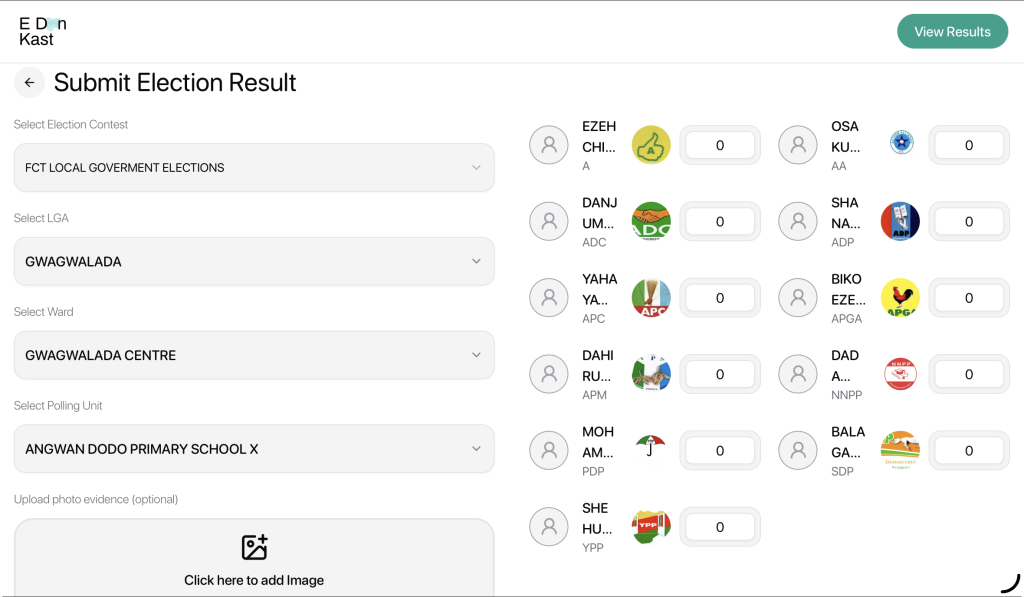 E Don Kast’s dashboard showing how to upload results. Image: TechCabal
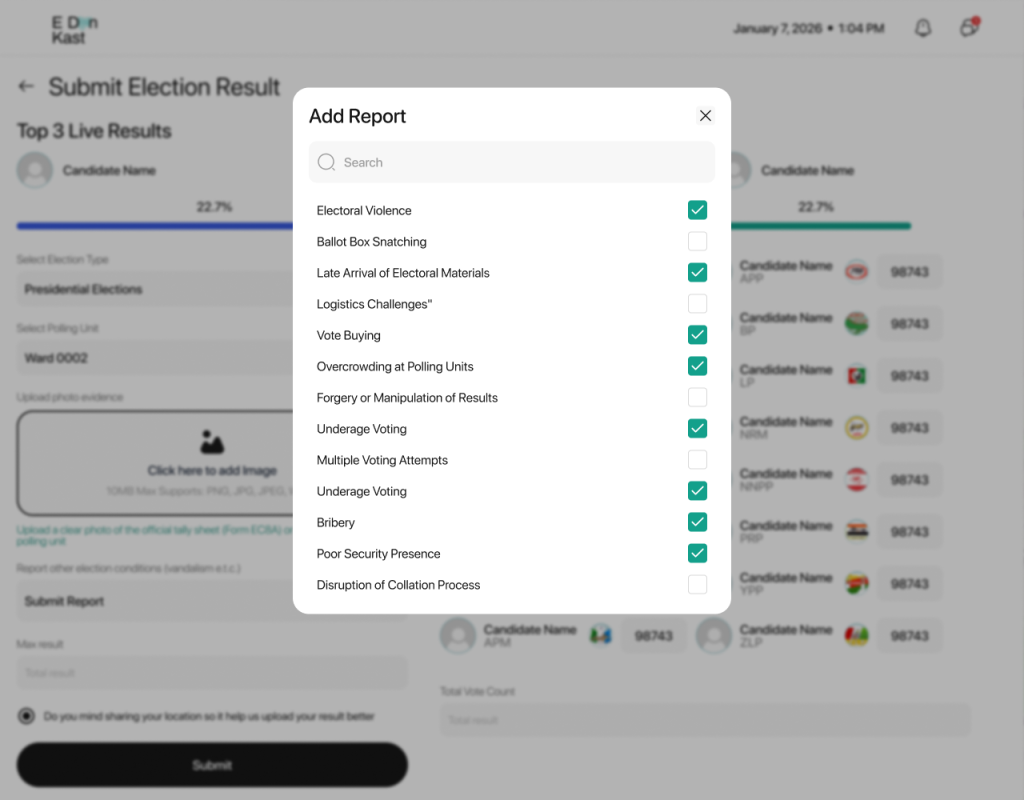 E Don Kast’s dashboard showing how to report incidents. Image: E Don Kast
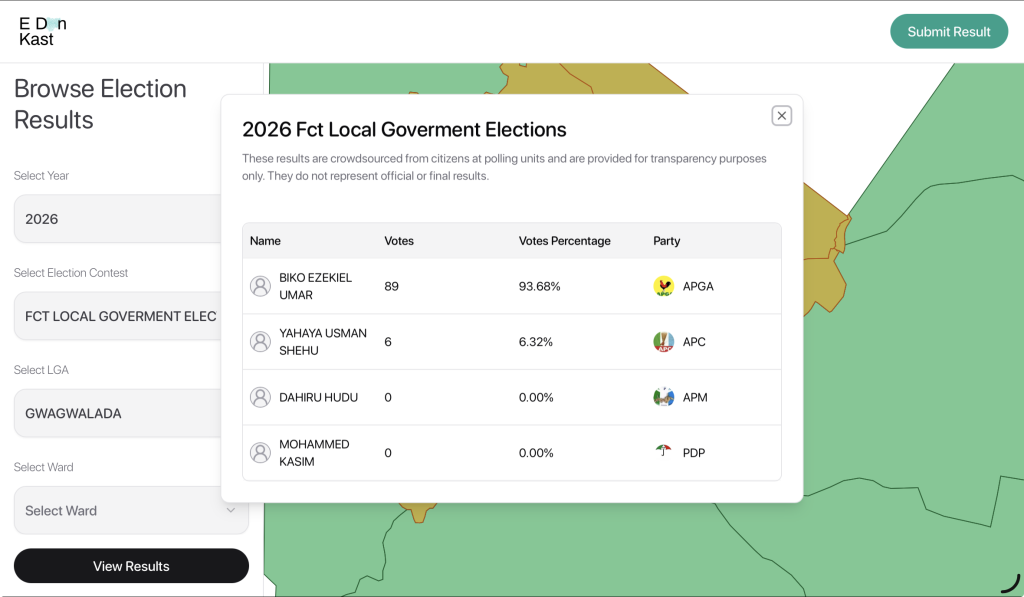 E Don Kast dashboard showing Gwagwalada LGA results from the February 21 local government election in FCT. Image: TechCabal