

Must Read
ORAL ARGUMENTS. In this file photo, then Supreme Court chief justice Maria Lourdes Sereno leads other justices in deliberating the constitutionality of Duterte'ORAL ARGUMENTS. In this file photo, then Supreme Court chief justice Maria Lourdes Sereno leads other justices in deliberating the constitutionality of Duterte'
Highlights: Day 3 of Duterte’s pre-trial
For feedback or concerns regarding this content, please contact us at crypto.news@mexc.com
THE HAGUE, Netherlands – We finally got a preview of the main legal theory of the defense team for former president Rodrigo Duterte: that there is no “causal link” between him and the killings that happened during his term as mayor of Davao and president, that they were random, and that the witnesses against him are tainted.
On Thursday, February 26, when it was the defense team’s turn to explain before the International Criminal Court (ICC) why the case against Duterte should not proceed, counsel Nicholas Kaufman discredited the star witnesses of the prosecution, and stressed that the killing of alleged criminals under Duterte did not show a systematic pattern that could be attributed to him.
Victims’ lawyers were not sold on this legal theory, saying it makes them more confident that the charges will be confirmed. So much so that they’re already preparing for another round of victims’ application when the case moves to trial, according to Kristina Conti an ICC-accredited assistant to counsel.
Here are the highlights of Day 3 of the confirmation of charges hearings at the ICC that end on Friday, February 27.
Random killings?
To win this case of crimes against humanity, the prosecution must prove, among others, that the killings were not random. There could be a thousand killings in a span of a couple of years perpetrated by random criminals across the country, and that could not be attributable to one mastermind.
Kaufman’s theory is that the perceived criminals who were killed are a “subjectively defined subgroup” of the general civilian population. And who defines who a criminal is? It’s the perception of the killer, said Kaufman. “One man’s despicable criminal is another person’s righteous saint,” he said.
“The minute the distinguishing features of the civilian population in question are defined through the application of subjective criteria (29:55) the targeting process becomes completely random,” Kaufman argued.
What he’s saying is that if killers can select and say on their own who becomes the target of the attacks, it’s random, and not a systematic policy.
Neri Colmenares, a human rights lawyer assisting victims, said the court would not be convinced that policemen just woke up in a foul mood one day and randomly selected who to kill.
“No, it was an order. There was a pattern. There was a public vilification of the targets. And secondly, there was an execution of the targets in broad daylight with many witnesses in public plazas and markets as if the perpetrators were never afraid at all of the police,” said Colmenares.
International law expert Ross Tugade also debunked Kaufman’s line as well during the Rappler panel on Thursday. A precedent from the ICC in the case of the former Yugoslavia shows that the multiplicity of deaths, patterns of repeated attacks, temporal and geographical scope, and the mode of attacks together indicate a criminal pattern, said Tugade, also an accredited assistant to counsel at ICC.
Pattern, in this instance, refers to “non-accidental repetitions of a criminal design,” Tugade explained.
Play Video 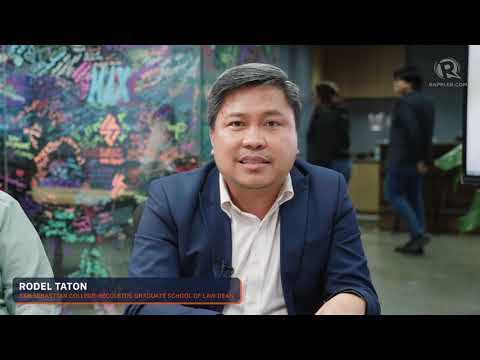
No causal link
Kaufman said that there is no direct link from the “stuff that came out of Rodrigo Duterte’s mouth and the deaths pertinent to the case.”
In Kaufman’s theory, for example, Duterte never said to kill 17-year-old Kian delos Santos.
In the case law of the ICC, which Kaufman cited, one needs to show a direct hand to prove a common plan to kill — such that the perpetrator had “virtual certainty” that the crimes were going to happen because of what he had done.
To use the delos Santos example, did Duterte have “virtual certainty” that by telling policemen to kill, and by allowing a police memo to say neutralize suspects, a 17-year-old boy was going to be killed by three local cops later?
“The answer is an emphatic and resounding no,” Kaufman said.
His reason? Because if Duterte’s list had 4,817 names, “Those who are actually neutralized, dwarfs in comparison, and stands at 248.”
“So, assuming that neutralized actually means killed, which it does not, then there is no virtual certainty attributable to Rodrigo Duterte that death would ensue from this kill list. Rather, a 5% chance,” said Kaufman.
This is what pained the victims.
“Doon nasaktan nga ang mga kaanak ng biktima eh. Kasi parang mini-minimize mo ‘yung pagkamatay ng kanilang kaanak. Sabihin mo, konti lang naman yun ah. Ilang percent lang yun ah. Hindi naman ‘yun attack sa buong populasyon. Sabi namin, grabe naman ‘yun,” said Colmenares.
(That’s where the victims’ families got hurt. It’s like you’re minimizing the death of their loved one. You’ll say that’s just a few, that’s just a small percentage, it’s not an attack on the whole population. We thought, ‘wow this is too much.’)
Discrediting witnesses
Kaufman gave away many details of who some of the insider witnesses could be. We now know for certain that these were death squad witnesses who were granted limited immunity by the court.
That fits the bill of Arturo Lascañas, a self-confessed hitman for the death squad, who we have confirmed was given limited immunity as early as 2021. While limited immunity is not blanket protection, it provides some insurance for the witness, and can be leveraged by the prosecution. The Rome Statute says this is allowed unless it is inconsistent with the spirt of the treaty.
Kaufman said the witnesses’ testimonies should not be given weight because giving confessed murderers a chance not to ever be prosecuted is inconsistent with the ICC’s fight against impunity.
“The most the [prosecution] can do is allege that their cooperating witnesses, who pulled the trigger and whose credibility is about as worthless as a devalued peso, understood that killing is what Duterte would have wanted. Or that they had no choice but to comply because that was what was expected of them by their handlers,” said Kaufman.
At this stage, the judges will look at whether there is substantial grounds to believe that Duterte committed the crimes, before it can move to trial.
Duterte’s former Cabinet members were confident as to believe in Kaufman when the lawyer said “we might as well pack up and go home because Mr. Duterte is simply not guilty.”
Kristina Conti, lawyer for the victims, said she welcomes Day 3 because the arguments finally became more legal, rather than political like on Day 1.
“Tutal uminit na tayo, umandar na yung diesel, ligal na ‘yung argumento. Sana bukas ‘yung closing arguments, bawasan ang demagoguery at hindi masyadong ma-politicize,” said Conti.
(Now that we have heated up, the fuel is on, the arguments are finally legal. I hope tomorrow during the closing arguments, there would be less demagoguery and not too politicized.) – Rappler.com


Disclaimer: The articles reposted on this site are sourced from public platforms and are provided for informational purposes only. They do not necessarily reflect the views of MEXC. All rights remain with the original authors. If you believe any content infringes on third-party rights, please contact crypto.news@mexc.com for removal. MEXC makes no guarantees regarding the accuracy, completeness, or timeliness of the content and is not responsible for any actions taken based on the information provided. The content does not constitute financial, legal, or other professional advice, nor should it be considered a recommendation or endorsement by MEXC.
You May Also Like

X Cashtags Launch Live BTC and TSLA Charts App
The post X Cashtags Launch Live BTC and TSLA Charts App appeared on BitcoinEthereumNews.com. X launched Cashtags on iPhone in the US and Canada, letting users tap
Share
BitcoinEthereumNews2026/04/16 00:35

UK FCA May Exempt Crypto Firms from Key TradFi Rules — What’s at Stake?
The UK’s FCA proposal to exempt crypto firms from certain traditional finance obligations explores rules on consumer duty, operational resilience, financial crime controls, and how complaints in crypto markets should be resolved.
Share
Coinstats2025/09/17 23:28

The Chemistry of UV Resistance: How Titanium Dioxide Protects Against the California Sun
Homeowners considering synthetic boundary systems frequently voice a singular, pervasive concern: “Will the material turn yellow and brittle after a few years in
Share
Techbullion2026/04/02 18:06



