Author: Castle Labs Compiled by AididiaoJP, Foresight News Money markets are at the heart of DeFi, allowing users to gain exposure to specific assets using a variety of strategies. Over time, this vertical has grown in both value locked (TVL) and functionality. With the introduction of new protocols like @MorphoLabs, @0xFluid, @eulerfinance, and @Dolomite_io, the range of functionality available through lending protocols has expanded. In this report, we focus on one of these protocols: Fluid. Fluid has launched several features, the most interesting of which are smart debt and smart collateral. It cannot be regarded as an ordinary lending protocol because it also combines its DEX functionality to provide users with more services. Fluid is showing significant growth in both DEX and lending verticals, with a total market size (in terms of total deposits) exceeding $2.8 billion. Fluid market size, source: Dune, @dknugo Fluid Market Size represents the total deposits in the protocol. This metric was chosen over TVL because debt is a productive asset in the protocol and contributes to exchange liquidity. Overview of Fluid components and how it works This section briefly outlines the components of the Fluid protocol and explains how it operates, with a focus on why it is a capital-efficient protocol. Fluid uses a unified liquidity model where multiple protocols can share liquidity, including the Fluid lending protocol, Fluid Vaults, and DEX. Fluid Lending allows users to provide assets and earn interest. The assets provided here are used throughout the Fluid ecosystem, improving their capital efficiency. It also opens up long-term yield opportunities as the protocol continuously adapts to changes in the borrower and lender market. Fluid Vaults are single-asset, single-liability vaults. These vaults are extremely capital-efficient because they allow for high LTVs (loan-to-value ratios), up to 95% of the collateral value. This number determines a user's borrowing capacity, as opposed to the deposited collateral. Fluid also employs a unique liquidation mechanism that reduces liquidation penalties to as low as 0.1%. The protocol only liquidates the amount necessary to restore a position to a healthy state. Fluid's liquidation process is inspired by the design of Uniswap V3. It categorizes positions by scale or range of their LTV and executes batch liquidations when the collateral value reaches the liquidation price. DEX aggregators then use these batches as liquidity: liquidation penalties translate into discounts for traders when they swap. Fluid DEX earns an additional layer of income for the liquidity layer through transaction fees generated by exchanges, further reducing borrowers' position interest while improving the capital efficiency of the entire protocol. Different DEX aggregators, such as KyberSwap and Paraswap, use Fluid DEX as a liquidity source to obtain deeper liquidity and increase trading volume. On Fluid, users can deposit their collateral into a DEX and earn both lending fees and trading fees, making it a Smart Collateral. If users wish to borrow against their collateral, they can borrow assets or open a Smart Debt Position, making their debt productive. For example, users can borrow from a pool of ETH and USDC/USDT. They can deposit ETH as collateral and borrow USDC/USDT. In exchange, they receive USDC and USDT in their wallets, which they can use as they wish, while the trading fees earned from this liquidity pool are used to reduce their outstanding debt. Fluid's latest progress and expansion Based on trading volume data over the past seven days, Fluid DEX ranks #4, behind only @Uniswap, @Pancakeswap, and @AerodromeFi. Fluid's partnership with Jupiter Lend has launched, a feature that has been in private beta since the beginning of the month, and Fluid DEX Lite has already launched. Additionally, Fluid DEX v2 will be available soon. DEXs ranked by 7-day trading volume. Source: Dune, @hagaetc In addition to this, the protocol also anticipates a token buyback as its annual revenue exceeds $10 million. Fluid recently published a post on its governance forum regarding this, which opened a discussion about the buyback and proposed three approaches. See the different proposed approaches here: https://x.com/0xnoveleader/status/1957867003194053114 Subject to governance approval (after discussion), the buyback will begin on October 1st, with a 6-month evaluation period. Jupiter Lend: Fluid Enters Solana Fluid’s expansion to Solana is in partnership with @JupiterExchange. Jupiter is the largest DEX aggregator on Solana, with a cumulative trading volume of over $970 billion. It is also the leading perpetual contract exchange and staking solution on Solana. The TVL of Solana lending now exceeds $3.5B, with @KaminoFinance being the primary contributor. The lending vertical on Solana offers significant growth potential for Fluid. @jup_lend recently launched its public beta after a few days of private testing. Its TVL has surpassed $250 million, making it the second-largest money market on the Solana blockchain, behind only Kamino. Jupiter Lend, launched in partnership with Fluid, offers similar functionality and efficiencies, with smart collateral and smart debt expected to launch on the platform later this year. Additionally, 50% of the platform's revenue will be allocated to Fluid. Fluid DEX iteration Fluid has already launched its DEX Lite and plans to launch V2 soon. This section will cover both and explain how these iterations will help Fluid grow further. Fluid DEX Lite Fluid DEX Lite launched in August and serves as a credit layer on Fluid, enabling borrowing directly from the Fluid liquidity layer. It has begun providing trading volume services for relevant trading pairs, starting with the USDC-USDT pair. This version of Fluid DEX is extremely gas efficient, reducing the cost of performing swaps by approximately 60% compared to other versions. It was created to capture a larger share of trading volume in the relevant trading pairs, where Fluid is already the dominant protocol. In its first week, Fluid Lite generated over $40 million in trading volume, with initial liquidity of $5 million borrowed from the liquidity layer. Fluid DEX Lite trading volume. Source: Dune, @dknugo Fluid DEX V2 Fluid DEX V1, launched in October 2024, surpassed $10 billion in cumulative trading volume on Ethereum in just 100 days, faster than any other decentralized exchange. To support this growth, Fluid is launching V2, designed with modularity and permissionless scalability in mind, allowing users to create multiple custom strategies. First, V2 will introduce four different types of DEXs within the protocol, two of which are inherited from V1. Fluid will support more DEX types than just these four, with more types being deployable through governance. The two new types introduced are Smart Collateral Range Orders and Smart Debt Range Orders, both of which allow borrowers to help improve their capital efficiency. Smart Collateral Range Orders function similarly to Uniswap V3, allowing users to provide liquidity by depositing collateral within a specific price range while also earning an annualized percentage rate (APR) on the borrowed funds. Smart Debt Range Orders work similarly, allowing users to create range orders by borrowing assets on the debt side and earn an annual percentage rate (APR) on the trade. Additionally, it introduces features like hooks (similar to Uniswap V4) for custom logic and automation, flash accounting to improve fee efficiency for CEX-DEX arbitrage, and on-chain yield accumulation limit orders, which means limit orders can earn annual lending rate (APR) while waiting to be filled. in conclusion Fluid continues to grow and improve by offering a unique set of features to become more capital efficient. Smart Collateral: Collateral deposited on the platform can be used to earn lending interest and transaction fees. Smart Debt: Smart Debt reduces debt by paying off part of it using transaction fees generated by the debt, making the debt borrowed by users productive. Unified Liquidity Layer: Fluid’s unified liquidity layer improves capital efficiency across the ecosystem by providing features such as higher LTV, advanced liquidation mechanisms, and automatic capping for better risk management. Its recent expansion into Solana through its partnership with Jupiter has broadened its market share in the lending category to non-EVM networks. Meanwhile, Fluid DEX Lite and DEX V2 aim to enhance user experience and increase transaction volume on EVM chains. Additionally, DEX V2 is expected to launch on Solana later this year, which will enable Fluid to enter Solana’s lending and exchange verticals.Author: Castle Labs Compiled by AididiaoJP, Foresight News Money markets are at the heart of DeFi, allowing users to gain exposure to specific assets using a variety of strategies. Over time, this vertical has grown in both value locked (TVL) and functionality. With the introduction of new protocols like @MorphoLabs, @0xFluid, @eulerfinance, and @Dolomite_io, the range of functionality available through lending protocols has expanded. In this report, we focus on one of these protocols: Fluid. Fluid has launched several features, the most interesting of which are smart debt and smart collateral. It cannot be regarded as an ordinary lending protocol because it also combines its DEX functionality to provide users with more services. Fluid is showing significant growth in both DEX and lending verticals, with a total market size (in terms of total deposits) exceeding $2.8 billion. Fluid market size, source: Dune, @dknugo Fluid Market Size represents the total deposits in the protocol. This metric was chosen over TVL because debt is a productive asset in the protocol and contributes to exchange liquidity. Overview of Fluid components and how it works This section briefly outlines the components of the Fluid protocol and explains how it operates, with a focus on why it is a capital-efficient protocol. Fluid uses a unified liquidity model where multiple protocols can share liquidity, including the Fluid lending protocol, Fluid Vaults, and DEX. Fluid Lending allows users to provide assets and earn interest. The assets provided here are used throughout the Fluid ecosystem, improving their capital efficiency. It also opens up long-term yield opportunities as the protocol continuously adapts to changes in the borrower and lender market. Fluid Vaults are single-asset, single-liability vaults. These vaults are extremely capital-efficient because they allow for high LTVs (loan-to-value ratios), up to 95% of the collateral value. This number determines a user's borrowing capacity, as opposed to the deposited collateral. Fluid also employs a unique liquidation mechanism that reduces liquidation penalties to as low as 0.1%. The protocol only liquidates the amount necessary to restore a position to a healthy state. Fluid's liquidation process is inspired by the design of Uniswap V3. It categorizes positions by scale or range of their LTV and executes batch liquidations when the collateral value reaches the liquidation price. DEX aggregators then use these batches as liquidity: liquidation penalties translate into discounts for traders when they swap. Fluid DEX earns an additional layer of income for the liquidity layer through transaction fees generated by exchanges, further reducing borrowers' position interest while improving the capital efficiency of the entire protocol. Different DEX aggregators, such as KyberSwap and Paraswap, use Fluid DEX as a liquidity source to obtain deeper liquidity and increase trading volume. On Fluid, users can deposit their collateral into a DEX and earn both lending fees and trading fees, making it a Smart Collateral. If users wish to borrow against their collateral, they can borrow assets or open a Smart Debt Position, making their debt productive. For example, users can borrow from a pool of ETH and USDC/USDT. They can deposit ETH as collateral and borrow USDC/USDT. In exchange, they receive USDC and USDT in their wallets, which they can use as they wish, while the trading fees earned from this liquidity pool are used to reduce their outstanding debt. Fluid's latest progress and expansion Based on trading volume data over the past seven days, Fluid DEX ranks #4, behind only @Uniswap, @Pancakeswap, and @AerodromeFi. Fluid's partnership with Jupiter Lend has launched, a feature that has been in private beta since the beginning of the month, and Fluid DEX Lite has already launched. Additionally, Fluid DEX v2 will be available soon. DEXs ranked by 7-day trading volume. Source: Dune, @hagaetc In addition to this, the protocol also anticipates a token buyback as its annual revenue exceeds $10 million. Fluid recently published a post on its governance forum regarding this, which opened a discussion about the buyback and proposed three approaches. See the different proposed approaches here: https://x.com/0xnoveleader/status/1957867003194053114 Subject to governance approval (after discussion), the buyback will begin on October 1st, with a 6-month evaluation period. Jupiter Lend: Fluid Enters Solana Fluid’s expansion to Solana is in partnership with @JupiterExchange. Jupiter is the largest DEX aggregator on Solana, with a cumulative trading volume of over $970 billion. It is also the leading perpetual contract exchange and staking solution on Solana. The TVL of Solana lending now exceeds $3.5B, with @KaminoFinance being the primary contributor. The lending vertical on Solana offers significant growth potential for Fluid. @jup_lend recently launched its public beta after a few days of private testing. Its TVL has surpassed $250 million, making it the second-largest money market on the Solana blockchain, behind only Kamino. Jupiter Lend, launched in partnership with Fluid, offers similar functionality and efficiencies, with smart collateral and smart debt expected to launch on the platform later this year. Additionally, 50% of the platform's revenue will be allocated to Fluid. Fluid DEX iteration Fluid has already launched its DEX Lite and plans to launch V2 soon. This section will cover both and explain how these iterations will help Fluid grow further. Fluid DEX Lite Fluid DEX Lite launched in August and serves as a credit layer on Fluid, enabling borrowing directly from the Fluid liquidity layer. It has begun providing trading volume services for relevant trading pairs, starting with the USDC-USDT pair. This version of Fluid DEX is extremely gas efficient, reducing the cost of performing swaps by approximately 60% compared to other versions. It was created to capture a larger share of trading volume in the relevant trading pairs, where Fluid is already the dominant protocol. In its first week, Fluid Lite generated over $40 million in trading volume, with initial liquidity of $5 million borrowed from the liquidity layer. Fluid DEX Lite trading volume. Source: Dune, @dknugo Fluid DEX V2 Fluid DEX V1, launched in October 2024, surpassed $10 billion in cumulative trading volume on Ethereum in just 100 days, faster than any other decentralized exchange. To support this growth, Fluid is launching V2, designed with modularity and permissionless scalability in mind, allowing users to create multiple custom strategies. First, V2 will introduce four different types of DEXs within the protocol, two of which are inherited from V1. Fluid will support more DEX types than just these four, with more types being deployable through governance. The two new types introduced are Smart Collateral Range Orders and Smart Debt Range Orders, both of which allow borrowers to help improve their capital efficiency. Smart Collateral Range Orders function similarly to Uniswap V3, allowing users to provide liquidity by depositing collateral within a specific price range while also earning an annualized percentage rate (APR) on the borrowed funds. Smart Debt Range Orders work similarly, allowing users to create range orders by borrowing assets on the debt side and earn an annual percentage rate (APR) on the trade. Additionally, it introduces features like hooks (similar to Uniswap V4) for custom logic and automation, flash accounting to improve fee efficiency for CEX-DEX arbitrage, and on-chain yield accumulation limit orders, which means limit orders can earn annual lending rate (APR) while waiting to be filled. in conclusion Fluid continues to grow and improve by offering a unique set of features to become more capital efficient. Smart Collateral: Collateral deposited on the platform can be used to earn lending interest and transaction fees. Smart Debt: Smart Debt reduces debt by paying off part of it using transaction fees generated by the debt, making the debt borrowed by users productive. Unified Liquidity Layer: Fluid’s unified liquidity layer improves capital efficiency across the ecosystem by providing features such as higher LTV, advanced liquidation mechanisms, and automatic capping for better risk management. Its recent expansion into Solana through its partnership with Jupiter has broadened its market share in the lending category to non-EVM networks. Meanwhile, Fluid DEX Lite and DEX V2 aim to enhance user experience and increase transaction volume on EVM chains. Additionally, DEX V2 is expected to launch on Solana later this year, which will enable Fluid to enter Solana’s lending and exchange verticals.

Fluid: Redefining the capital efficiency benchmark for DeFi lending and trading

2025/09/01 19:00
7 min read
For feedback or concerns regarding this content, please contact us at crypto.news@mexc.com

Author: Castle Labs

Compiled by AididiaoJP, Foresight News

Money markets are at the heart of DeFi, allowing users to gain exposure to specific assets using a variety of strategies. Over time, this vertical has grown in both value locked (TVL) and functionality. With the introduction of new protocols like @MorphoLabs, @0xFluid, @eulerfinance, and @Dolomite_io, the range of functionality available through lending protocols has expanded.

In this report, we focus on one of these protocols: Fluid.

Fluid has launched several features, the most interesting of which are smart debt and smart collateral. It cannot be regarded as an ordinary lending protocol because it also combines its DEX functionality to provide users with more services.

Fluid is showing significant growth in both DEX and lending verticals, with a total market size (in terms of total deposits) exceeding $2.8 billion.
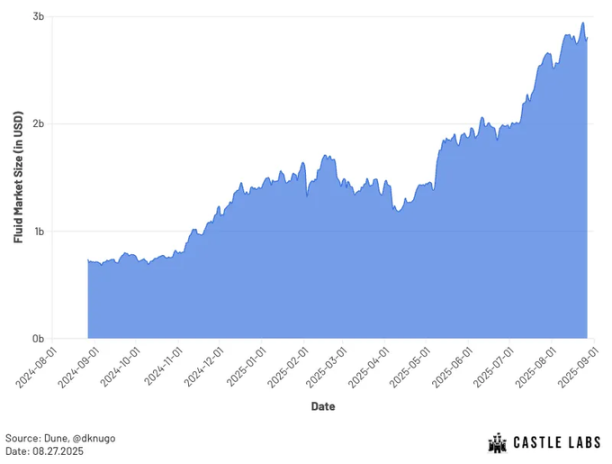
 Fluid market size, source: Dune, @dknugo

Fluid Market Size represents the total deposits in the protocol. This metric was chosen over TVL because debt is a productive asset in the protocol and contributes to exchange liquidity.

Overview of Fluid components and how it works

This section briefly outlines the components of the Fluid protocol and explains how it operates, with a focus on why it is a capital-efficient protocol.

Fluid uses a unified liquidity model where multiple protocols can share liquidity, including the Fluid lending protocol, Fluid Vaults, and DEX.
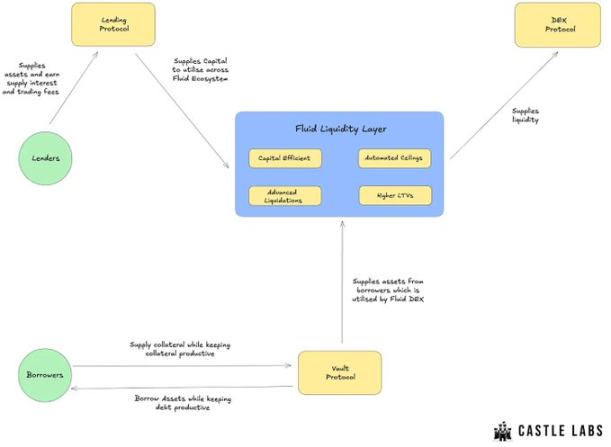
Fluid Lending allows users to provide assets and earn interest. The assets provided here are used throughout the Fluid ecosystem, improving their capital efficiency. It also opens up long-term yield opportunities as the protocol continuously adapts to changes in the borrower and lender market.

Fluid Vaults are single-asset, single-liability vaults. These vaults are extremely capital-efficient because they allow for high LTVs (loan-to-value ratios), up to 95% of the collateral value. This number determines a user's borrowing capacity, as opposed to the deposited collateral.

Fluid also employs a unique liquidation mechanism that reduces liquidation penalties to as low as 0.1%. The protocol only liquidates the amount necessary to restore a position to a healthy state. Fluid's liquidation process is inspired by the design of Uniswap V3. It categorizes positions by scale or range of their LTV and executes batch liquidations when the collateral value reaches the liquidation price. DEX aggregators then use these batches as liquidity: liquidation penalties translate into discounts for traders when they swap.

Fluid DEX earns an additional layer of income for the liquidity layer through transaction fees generated by exchanges, further reducing borrowers' position interest while improving the capital efficiency of the entire protocol. Different DEX aggregators, such as KyberSwap and Paraswap, use Fluid DEX as a liquidity source to obtain deeper liquidity and increase trading volume.

On Fluid, users can deposit their collateral into a DEX and earn both lending fees and trading fees, making it a Smart Collateral.

If users wish to borrow against their collateral, they can borrow assets or open a Smart Debt Position, making their debt productive. For example, users can borrow from a pool of ETH and USDC/USDT. They can deposit ETH as collateral and borrow USDC/USDT. In exchange, they receive USDC and USDT in their wallets, which they can use as they wish, while the trading fees earned from this liquidity pool are used to reduce their outstanding debt.

Fluid's latest progress and expansion

Based on trading volume data over the past seven days, Fluid DEX ranks #4, behind only @Uniswap, @Pancakeswap, and @AerodromeFi. Fluid's partnership with Jupiter Lend has launched, a feature that has been in private beta since the beginning of the month, and Fluid DEX Lite has already launched.

Additionally, Fluid DEX v2 will be available soon.
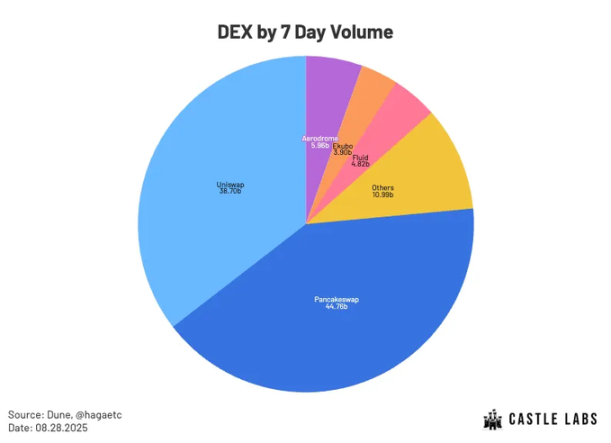
 DEXs ranked by 7-day trading volume. Source: Dune, @hagaetc

In addition to this, the protocol also anticipates a token buyback as its annual revenue exceeds $10 million. Fluid recently published a post on its governance forum regarding this, which opened a discussion about the buyback and proposed three approaches.

See the different proposed approaches here:

Subject to governance approval (after discussion), the buyback will begin on October 1st, with a 6-month evaluation period.

Jupiter Lend: Fluid Enters Solana

Fluid’s expansion to Solana is in partnership with @JupiterExchange.

Jupiter is the largest DEX aggregator on Solana, with a cumulative trading volume of over $970 billion. It is also the leading perpetual contract exchange and staking solution on Solana.

The TVL of Solana lending now exceeds $3.5B, with @KaminoFinance being the primary contributor. The lending vertical on Solana offers significant growth potential for Fluid.
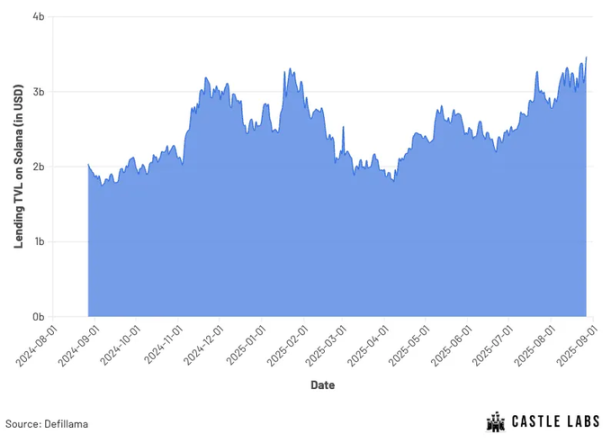
@jup_lend recently launched its public beta after a few days of private testing. Its TVL has surpassed $250 million, making it the second-largest money market on the Solana blockchain, behind only Kamino.
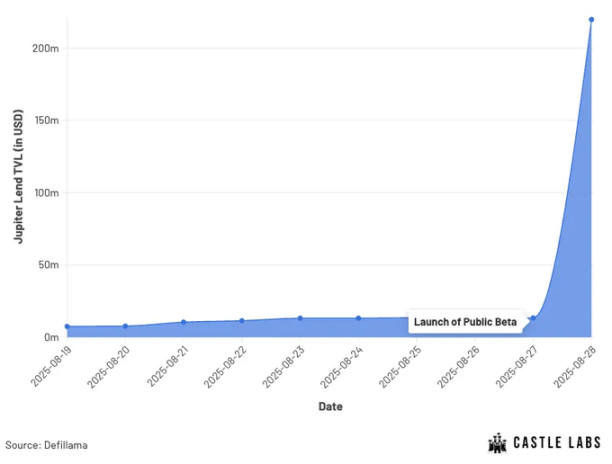
Jupiter Lend, launched in partnership with Fluid, offers similar functionality and efficiencies, with smart collateral and smart debt expected to launch on the platform later this year.

Additionally, 50% of the platform's revenue will be allocated to Fluid.

Fluid DEX iteration

Fluid has already launched its DEX Lite and plans to launch V2 soon. This section will cover both and explain how these iterations will help Fluid grow further.

Fluid DEX Lite

Fluid DEX Lite launched in August and serves as a credit layer on Fluid, enabling borrowing directly from the Fluid liquidity layer. It has begun providing trading volume services for relevant trading pairs, starting with the USDC-USDT pair.

This version of Fluid DEX is extremely gas efficient, reducing the cost of performing swaps by approximately 60% compared to other versions. It was created to capture a larger share of trading volume in the relevant trading pairs, where Fluid is already the dominant protocol.

In its first week, Fluid Lite generated over $40 million in trading volume, with initial liquidity of $5 million borrowed from the liquidity layer.
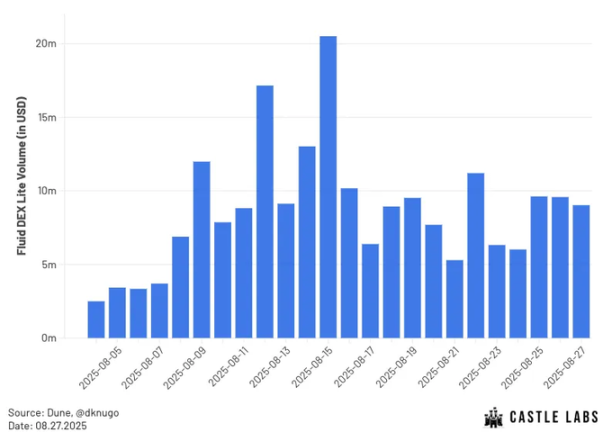
 Fluid DEX Lite trading volume. Source: Dune, @dknugo

Fluid DEX V2

Fluid DEX V1, launched in October 2024, surpassed $10 billion in cumulative trading volume on Ethereum in just 100 days, faster than any other decentralized exchange. To support this growth, Fluid is launching V2, designed with modularity and permissionless scalability in mind, allowing users to create multiple custom strategies.

First, V2 will introduce four different types of DEXs within the protocol, two of which are inherited from V1. Fluid will support more DEX types than just these four, with more types being deployable through governance.
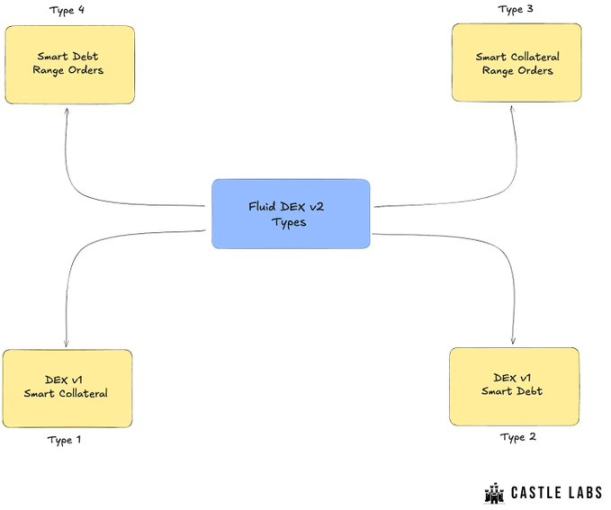
The two new types introduced are Smart Collateral Range Orders and Smart Debt Range Orders, both of which allow borrowers to help improve their capital efficiency.

Smart Collateral Range Orders function similarly to Uniswap V3, allowing users to provide liquidity by depositing collateral within a specific price range while also earning an annualized percentage rate (APR) on the borrowed funds.

Smart Debt Range Orders work similarly, allowing users to create range orders by borrowing assets on the debt side and earn an annual percentage rate (APR) on the trade.

Additionally, it introduces features like hooks (similar to Uniswap V4) for custom logic and automation, flash accounting to improve fee efficiency for CEX-DEX arbitrage, and on-chain yield accumulation limit orders, which means limit orders can earn annual lending rate (APR) while waiting to be filled.

in conclusion

Fluid continues to grow and improve by offering a unique set of features to become more capital efficient.

Smart Collateral: Collateral deposited on the platform can be used to earn lending interest and transaction fees.

Smart Debt: Smart Debt reduces debt by paying off part of it using transaction fees generated by the debt, making the debt borrowed by users productive.

Unified Liquidity Layer: Fluid’s unified liquidity layer improves capital efficiency across the ecosystem by providing features such as higher LTV, advanced liquidation mechanisms, and automatic capping for better risk management.

Its recent expansion into Solana through its partnership with Jupiter has broadened its market share in the lending category to non-EVM networks. Meanwhile, Fluid DEX Lite and DEX V2 aim to enhance user experience and increase transaction volume on EVM chains.

Additionally, DEX V2 is expected to launch on Solana later this year, which will enable Fluid to enter Solana’s lending and exchange verticals.


Market Opportunity
Instadapp Logo
Instadapp Price(FLUID)
$1.6032
$1.6032$1.6032
-2.57%
USD
Instadapp (FLUID) Live Price Chart
Disclaimer: The articles reposted on this site are sourced from public platforms and are provided for informational purposes only. They do not necessarily reflect the views of MEXC. All rights remain with the original authors. If you believe any content infringes on third-party rights, please contact crypto.news@mexc.com for removal. MEXC makes no guarantees regarding the accuracy, completeness, or timeliness of the content and is not responsible for any actions taken based on the information provided. The content does not constitute financial, legal, or other professional advice, nor should it be considered a recommendation or endorsement by MEXC.

You May Also Like

Franklin Templeton CEO Dismisses 50bps Rate Cut Ahead FOMC

Franklin Templeton CEO Dismisses 50bps Rate Cut Ahead FOMC

The post Franklin Templeton CEO Dismisses 50bps Rate Cut Ahead FOMC appeared on BitcoinEthereumNews.com. Franklin Templeton CEO Jenny Johnson has weighed in on whether the Federal Reserve should make a 25 basis points (bps) Fed rate cut or 50 bps cut. This comes ahead of the Fed decision today at today’s FOMC meeting, with the market pricing in a 25 bps cut. Bitcoin and the broader crypto market are currently trading flat ahead of the rate cut decision. Franklin Templeton CEO Weighs In On Potential FOMC Decision In a CNBC interview, Jenny Johnson said that she expects the Fed to make a 25 bps cut today instead of a 50 bps cut. She acknowledged the jobs data, which suggested that the labor market is weakening. However, she noted that this data is backward-looking, indicating that it doesn’t show the current state of the economy. She alluded to the wage growth, which she remarked is an indication of a robust labor market. She added that retail sales are up and that consumers are still spending, despite inflation being sticky at 3%, which makes a case for why the FOMC should opt against a 50-basis-point Fed rate cut. In line with this, the Franklin Templeton CEO said that she would go with a 25 bps rate cut if she were Jerome Powell. She remarked that the Fed still has the October and December FOMC meetings to make further cuts if the incoming data warrants it. Johnson also asserted that the data show a robust economy. However, she noted that there can’t be an argument for no Fed rate cut since Powell already signaled at Jackson Hole that they were likely to lower interest rates at this meeting due to concerns over a weakening labor market. Notably, her comment comes as experts argue for both sides on why the Fed should make a 25 bps cut or…
Share
BitcoinEthereumNews2025/09/18 00:36
Lovable AI’s Astonishing Rise: Anton Osika Reveals Startup Secrets at Bitcoin World Disrupt 2025

Lovable AI’s Astonishing Rise: Anton Osika Reveals Startup Secrets at Bitcoin World Disrupt 2025


BitcoinWorld Lovable AI’s Astonishing Rise: Anton Osika Reveals Startup Secrets at Bitcoin World Disrupt 2025 Are you ready to witness a phenomenon? The world of technology is abuzz with the incredible rise of Lovable AI, a startup that’s not just breaking records but rewriting the rulebook for rapid growth. Imagine creating powerful apps and websites just by speaking to an AI – that’s the magic Lovable brings to the masses. This groundbreaking approach has propelled the company into the spotlight, making it one of the fastest-growing software firms in history. And now, the visionary behind this sensation, co-founder and CEO Anton Osika, is set to share his invaluable insights on the Disrupt Stage at the highly anticipated Bitcoin World Disrupt 2025. If you’re a founder, investor, or tech enthusiast eager to understand the future of innovation, this is an event you cannot afford to miss. Lovable AI’s Meteoric Ascent: Redefining Software Creation In an era where digital transformation is paramount, Lovable AI has emerged as a true game-changer. Its core premise is deceptively simple yet profoundly impactful: democratize software creation. By enabling anyone to build applications and websites through intuitive AI conversations, Lovable is empowering the vast majority of individuals who lack coding skills to transform their ideas into tangible digital products. This mission has resonated globally, leading to unprecedented momentum. The numbers speak for themselves: Achieved an astonishing $100 million Annual Recurring Revenue (ARR) in less than a year. Successfully raised a $200 million Series A funding round, valuing the company at $1.8 billion, led by industry giant Accel. Is currently fielding unsolicited investor offers, pushing its valuation towards an incredible $4 billion. As industry reports suggest, investors are unequivocally “loving Lovable,” and it’s clear why. This isn’t just about impressive financial metrics; it’s about a company that has tapped into a fundamental need, offering a solution that is both innovative and accessible. The rapid scaling of Lovable AI provides a compelling case study for any entrepreneur aiming for similar exponential growth. The Visionary Behind the Hype: Anton Osika’s Journey to Innovation Every groundbreaking company has a driving force, and for Lovable, that force is co-founder and CEO Anton Osika. His journey is as fascinating as his company’s success. A physicist by training, Osika previously contributed to the cutting-edge research at CERN, the European Organization for Nuclear Research. This deep technical background, combined with his entrepreneurial spirit, has been instrumental in Lovable’s rapid ascent. Before Lovable, he honed his skills as a co-founder of Depict.ai and a Founding Engineer at Sana. Based in Stockholm, Osika has masterfully steered Lovable from a nascent idea to a global phenomenon in record time. His leadership embodies a unique blend of profound technical understanding and a keen, consumer-first vision. At Bitcoin World Disrupt 2025, attendees will have the rare opportunity to hear directly from Osika about what it truly takes to build a brand that not only scales at an incredible pace in a fiercely competitive market but also adeptly manages the intense cultural conversations that inevitably accompany such swift and significant success. His insights will be crucial for anyone looking to understand the dynamics of high-growth tech leadership. Unpacking Consumer Tech Innovation at Bitcoin World Disrupt 2025 The 20th anniversary of Bitcoin World is set to be marked by a truly special event: Bitcoin World Disrupt 2025. From October 27–29, Moscone West in San Francisco will transform into the epicenter of innovation, gathering over 10,000 founders, investors, and tech leaders. It’s the ideal platform to explore the future of consumer tech innovation, and Anton Osika’s presence on the Disrupt Stage is a highlight. His session will delve into how Lovable is not just participating in but actively shaping the next wave of consumer-facing technologies. Why is this session particularly relevant for those interested in the future of consumer experiences? Osika’s discussion will go beyond the superficial, offering a deep dive into the strategies that have allowed Lovable to carve out a unique category in a market long thought to be saturated. Attendees will gain a front-row seat to understanding how to identify unmet consumer needs, leverage advanced AI to meet those needs, and build a product that captivates users globally. The event itself promises a rich tapestry of ideas and networking opportunities: For Founders: Sharpen your pitch and connect with potential investors. For Investors: Discover the next breakout startup poised for massive growth. For Innovators: Claim your spot at the forefront of technological advancements. The insights shared regarding consumer tech innovation at this event will be invaluable for anyone looking to navigate the complexities and capitalize on the opportunities within this dynamic sector. Mastering Startup Growth Strategies: A Blueprint for the Future Lovable’s journey isn’t just another startup success story; it’s a meticulously crafted blueprint for effective startup growth strategies in the modern era. Anton Osika’s experience offers a rare glimpse into the practicalities of scaling a business at breakneck speed while maintaining product integrity and managing external pressures. For entrepreneurs and aspiring tech leaders, his talk will serve as a masterclass in several critical areas: Strategy Focus Key Takeaways from Lovable’s Journey Rapid Scaling How to build infrastructure and teams that support exponential user and revenue growth without compromising quality. Product-Market Fit Identifying a significant, underserved market (the 99% who can’t code) and developing a truly innovative solution (AI-powered app creation). Investor Relations Balancing intense investor interest and pressure with a steadfast focus on product development and long-term vision. Category Creation Carving out an entirely new niche by democratizing complex technologies, rather than competing in existing crowded markets. Understanding these startup growth strategies is essential for anyone aiming to build a resilient and impactful consumer experience. Osika’s session will provide actionable insights into how to replicate elements of Lovable’s success, offering guidance on navigating challenges from product development to market penetration and investor management. Conclusion: Seize the Future of Tech The story of Lovable, under the astute leadership of Anton Osika, is a testament to the power of innovative ideas meeting flawless execution. Their remarkable journey from concept to a multi-billion-dollar valuation in record time is a compelling narrative for anyone interested in the future of technology. By democratizing software creation through Lovable AI, they are not just building a company; they are fostering a new generation of creators. His appearance at Bitcoin World Disrupt 2025 is an unmissable opportunity to gain direct insights from a leader who is truly shaping the landscape of consumer tech innovation. Don’t miss this chance to learn about cutting-edge startup growth strategies and secure your front-row seat to the future. Register now and save up to $668 before Regular Bird rates end on September 26. To learn more about the latest AI market trends, explore our article on key developments shaping AI features. This post Lovable AI’s Astonishing Rise: Anton Osika Reveals Startup Secrets at Bitcoin World Disrupt 2025 first appeared on BitcoinWorld.


Share
Coinstats2025/09/17 23:40
The Nationwide Tug-of-War over Prediction Markets

The Nationwide Tug-of-War over Prediction Markets

The post The Nationwide Tug-of-War over Prediction Markets appeared on BitcoinEthereumNews.com. A contentious legal battle in the United States over the classification
Share
BitcoinEthereumNews2026/04/09 17:42

$30,000 in PRL + 15,000 USDT

$30,000 in PRL + 15,000 USDT$30,000 in PRL + 15,000 USDT

Deposit & trade PRL to boost your rewards!

