Just 2 companies create 90% of Ethereum blocks.Just 2 companies create 90% of Ethereum blocks.

Thinking about Ethereum block builder Titan’s monopoly with Flashbots: How chain abstraction can unlock development opportunities?

2024/12/01 15:23

Author: Austin King , Co-founder and CEO of Omni Network

Compiled by: Felix, PANews

Few people know that just two companies create 90% of Ethereum blocks. However, even fewer people know the story behind this monopoly.

Here’s the untold story of Titan, over $40M in hidden profits, and how chain abstraction will usher in even greater opportunities.

beginning

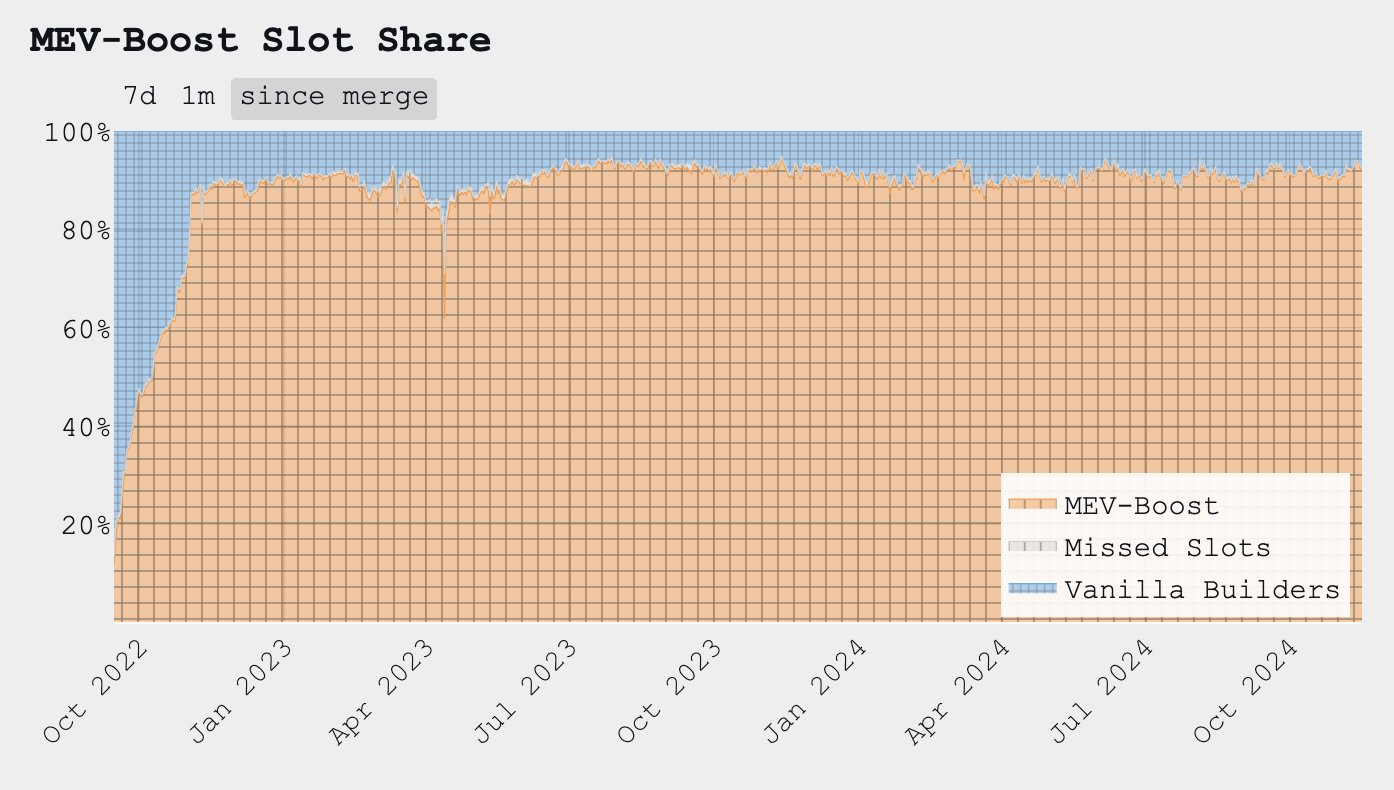
It all started at the end of 2022, when Flashbots created MEV-Boost, a software that allows Ethereum L1 validators to obtain transaction blocks from third parties (called builders, which specialize in MEV extraction), which allows validators to make more money. After this, almost all Ethereum L1 validators quickly started running this software:
Thinking about Ethereum block builder Titan’s monopoly with Flashbots: How chain abstraction can unlock development opportunities?

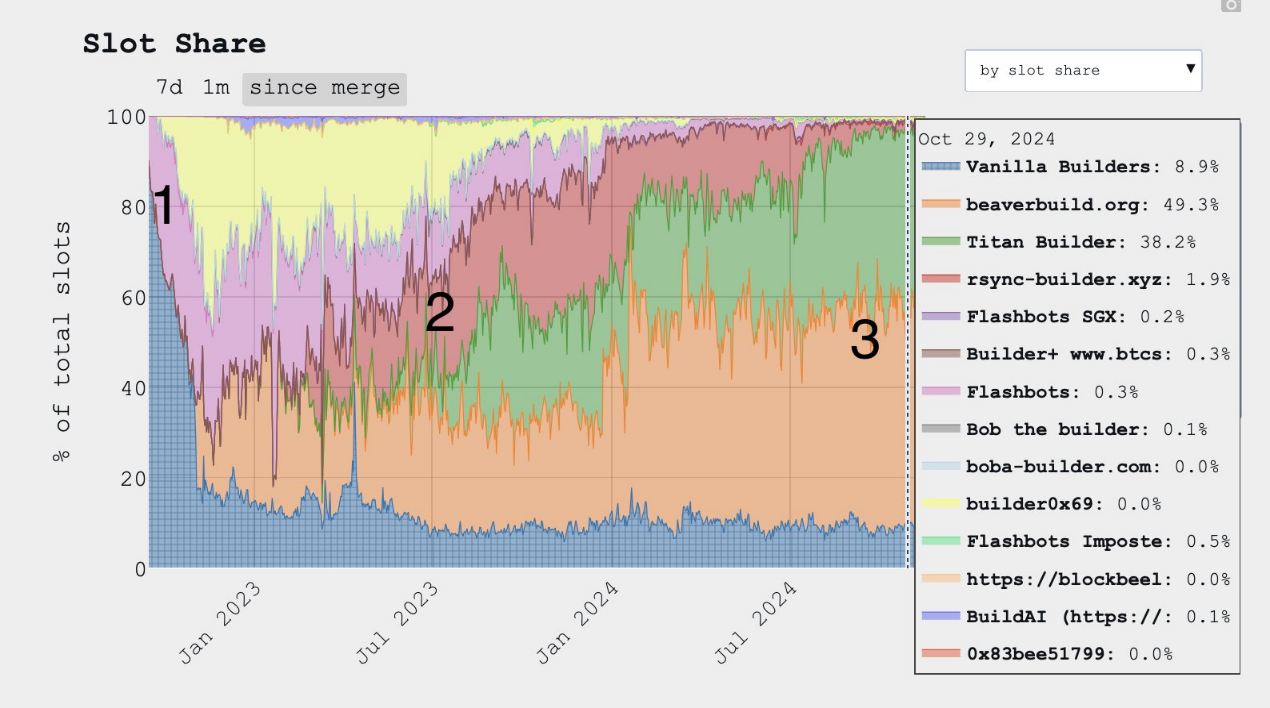
Refer to the picture below, initially (#1) Flashbots (pink) was the only running "Builder", and half a year later fierce competition emerged (#2). Now, there are only 2 important builders (#3): Beaver and Titan.
Thinking about Ethereum block builder Titan’s monopoly with Flashbots: How chain abstraction can unlock development opportunities?

Obviously, a lot of things happened during this period, but one of the most impactful events was when Titan reached an exclusive order flow (EOF) agreement with Banana Gun — who later became a top Telegram trading bot — in April 2023. After this EOF deal occurred, Titan had the opportunity to build more profitable blocks for L1 validators than any other builder, as they had exclusive access to deals that offered higher rewards.

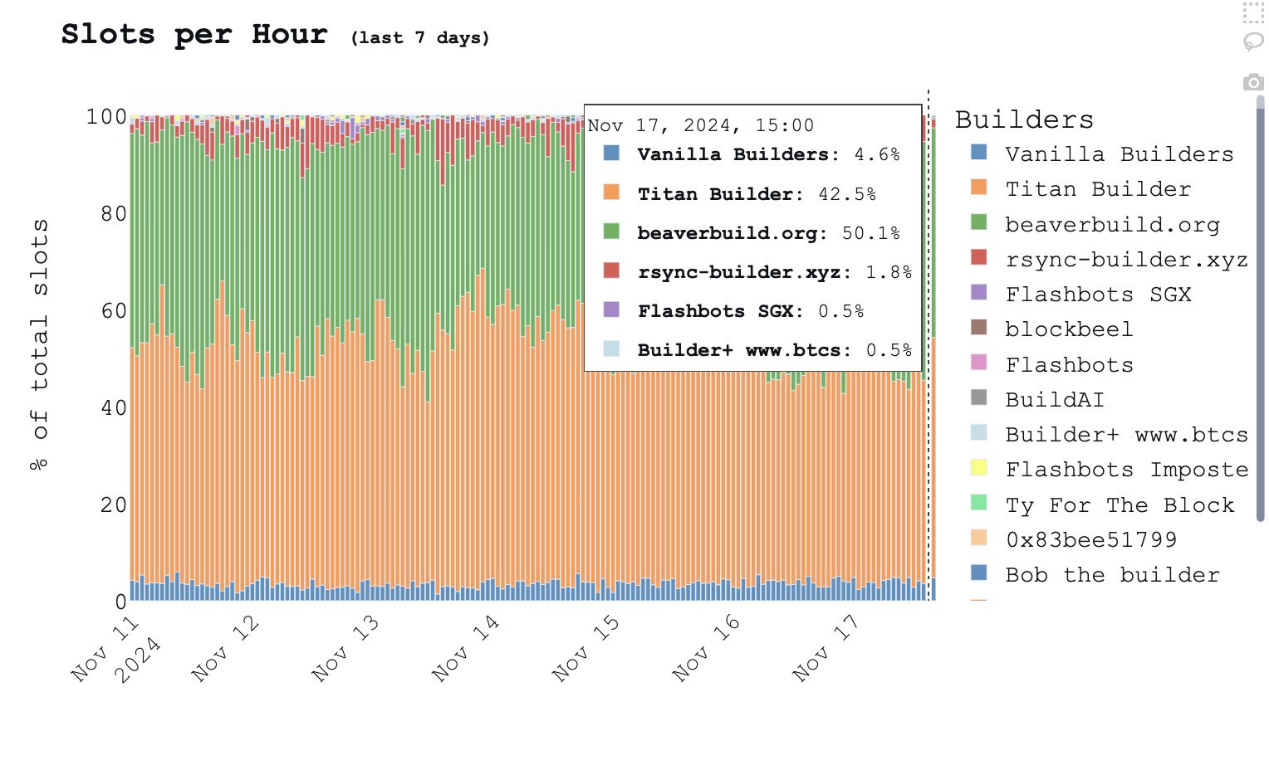
After this, more than 90% of Ethereum L1 transactions came from two companies (Beaver and Titan).
Thinking about Ethereum block builder Titan’s monopoly with Flashbots: How chain abstraction can unlock development opportunities?

Even more interesting are the earnings statistics as of August this year:

Flashbots

  • About 550,000 blocks created
  • Profit 16.7 ETH

Titan

  • About 600,000 blocks created
  • Profit 13,151 ETH

At today's prices, the difference is $44 million.

While this is public data, some interesting questions remain:

  • Why did Banana Gun choose to route its bundled services almost entirely to Titan when it had less than 1% market share?
  • Did Titan strike a multi-million dollar deal with the Banana Gun team at the outset to boost market share?
  • Is Titan promising kickbacks to the Banana Gun team to the detriment of its users?

The specific circumstances are unknown, and perhaps few people know this information.

As co-founder and CEO of Omni Network, why would Austin King take the time to think deeply about such a deal?

Because chain abstraction will unlock greater profit opportunities. The market is rapidly shifting to focus on crypto user experience (users don't think about gas, transaction submission, which chain to trade on, etc.), and the next wave of users will be far less "complex" than today's crypto users. New users will not care how all this happens, and there will be more such opportunities downstream of this abstraction, and each network can obtain a large source of income.

Today, OMNI’s 2 core primitives (EVM + Interop) are destroyed when used. However, few people understand that there is a business opportunity when revenue opportunities in the order flow supply chain are introduced directly into the core model of the token.

Related reading: Vitalik proposed a new concept of block construction, aiming to reconstruct the Ethereum ecosystem?


Disclaimer: The articles reposted on this site are sourced from public platforms and are provided for informational purposes only. They do not necessarily reflect the views of MEXC. All rights remain with the original authors. If you believe any content infringes on third-party rights, please contact service@support.mexc.com for removal. MEXC makes no guarantees regarding the accuracy, completeness, or timeliness of the content and is not responsible for any actions taken based on the information provided. The content does not constitute financial, legal, or other professional advice, nor should it be considered a recommendation or endorsement by MEXC.

You May Also Like

BFX Presale Raises $7.5M as Solana Holds $243 and Avalanche Eyes $1B Treasury — Best Cryptos to Buy in 2025

BFX Presale Raises $7.5M as Solana Holds $243 and Avalanche Eyes $1B Treasury — Best Cryptos to Buy in 2025

BFX presale hits $7.5M with tokens at $0.024 and 30% bonus code BLOCK30, while Solana holds $243 and Avalanche builds a $1B treasury to attract institutions.
Share
Blockchainreporter2025/09/18 01:07
OCC Findings Suggest Major U.S. Banks Restricted Access for Digital Asset Firms Amid Debanking Probe

OCC Findings Suggest Major U.S. Banks Restricted Access for Digital Asset Firms Amid Debanking Probe

The post OCC Findings Suggest Major U.S. Banks Restricted Access for Digital Asset Firms Amid Debanking Probe appeared on BitcoinEthereumNews.com. The Office of the Comptroller of the Currency (OCC) has confirmed that nine major U.S. banks engaged in debanking practices from 2020 to 2023, restricting access for digital asset firms and other sectors. This marks the first official acknowledgment of these policies, which limited services based on customer types, affecting crypto businesses significantly. OCC report highlights inappropriate distinctions by banks like JPMorgan Chase and Bank of America, targeting crypto and high-risk sectors. Nine banks reviewed showed similar policies restricting customer access without objective risk assessments. Impacted industries include digital asset firms, with potential referrals to the Attorney General for unlawful practices. Discover how major U.S. banks’ debanking policies hit crypto firms hard, per OCC’s 2025 report. Learn the implications for digital assets and what regulators are doing next—stay informed on banking risks today! What Are the OCC’s Findings on Banks Debanking Crypto Firms? Banks debanking crypto firms involves major financial institutions limiting or denying services to digital asset businesses based on perceived risks, as detailed in a recent Office of the Comptroller of the Currency (OCC) report. From 2020 to 2023, nine of the largest U.S. banks implemented policies that required escalated reviews or outright restrictions for certain customers, including those in the crypto sector. This practice, now publicly confirmed, underscores ongoing tensions between traditional banking and emerging digital asset industries. How Did These Debanking Practices Affect Digital Asset Companies? The OCC’s six-page report, released on Wednesday, revealed that institutions such as JPMorgan Chase, Bank of America, Citigroup, Wells Fargo, U.S. Bancorp, Capital One, PNC Financial Services Group, Toronto-Dominion Bank, and Bank of Montreal made distinctions among customers that were deemed inappropriate. For digital asset firms, this meant heightened scrutiny or complete denial of banking services, hindering operations in an already volatile market. The regulator noted that these policies spanned…
Share
BitcoinEthereumNews2025/12/11 11:01