Crypto wallets today are strangely forgetful. They track balances, show your latest transactions, maybe store a few addresses in your contacts. But beyond that? Nothing. They don’t recall the choices you made, the risks you took, or the patterns of trust you’ve built over time. In a way, your wallet knows everything you’ve ever done — but remembers nothing in a form that’s useful to you. Now imagine the opposite: a wallet with memory. Not a ledger of raw data, but an interface that surfaces your relationship with the chain. It could remind you: Instead of just being a container for assets, the wallet becomes a kind of cognitive prosthetic — a trusted assistant that helps you navigate decisions based on your own past behavior. The UX Opportunity: Making History Usable The blockchain already has perfect recall. Every transaction, every contract interaction, every governance vote, it’s all there, immutably. The problem isn’t memory; it’s retrieval. For a user, the chain feels like an overwhelming archive instead of a personalized narrative. Designing memory here means curating what matters. Not every transaction is relevant, but patterns are. Which protocols do you return to again and again? Which ones you abandoned after one bad experience? Which wallets you always trust? The UX challenge isn’t building a new database — it’s deciding what kind of memory feels like help rather than surveillance. The Risk: When Memory Becomes Manipulation Memory in UX isn’t neutral. The moment you surface past behavior, you can influence future behavior. Imagine a wallet reminding you That could reinforce power dynamics, entrench biases, or even enable subtle nudges toward certain actors. There’s also the privacy paradox: your wallet remembering your preferences means someone — the wallet provider, the app — is storing and processing that data. Even if it stays local on your device, does it create new risks if compromised? A tool meant to empower could quickly become a profiling machine. The Future: From Amnesia to Agency A memoryful wallet could shift crypto UX from reaction to reflection. Instead of just doing things — sending, staking, swapping — users could see themselves across time — how they’ve grown, what habits define them, and what patterns they might want to break. Done right, this isn’t about creating an AI babysitter for your assets. It’s about making the past actionable in the present. A streak of risky leverage trades might nudge you toward caution. A consistent history of supporting privacy protocols could help you discover new aligned projects. The deeper question is if your wallet remembers you better than you remember yourself, does it start to shape who you become? What if Every Wallet Had a Memory? was originally published in Coinmonks on Medium, where people are continuing the conversation by highlighting and responding to this storyCrypto wallets today are strangely forgetful. They track balances, show your latest transactions, maybe store a few addresses in your contacts. But beyond that? Nothing. They don’t recall the choices you made, the risks you took, or the patterns of trust you’ve built over time. In a way, your wallet knows everything you’ve ever done — but remembers nothing in a form that’s useful to you. Now imagine the opposite: a wallet with memory. Not a ledger of raw data, but an interface that surfaces your relationship with the chain. It could remind you: Instead of just being a container for assets, the wallet becomes a kind of cognitive prosthetic — a trusted assistant that helps you navigate decisions based on your own past behavior. The UX Opportunity: Making History Usable The blockchain already has perfect recall. Every transaction, every contract interaction, every governance vote, it’s all there, immutably. The problem isn’t memory; it’s retrieval. For a user, the chain feels like an overwhelming archive instead of a personalized narrative. Designing memory here means curating what matters. Not every transaction is relevant, but patterns are. Which protocols do you return to again and again? Which ones you abandoned after one bad experience? Which wallets you always trust? The UX challenge isn’t building a new database — it’s deciding what kind of memory feels like help rather than surveillance. The Risk: When Memory Becomes Manipulation Memory in UX isn’t neutral. The moment you surface past behavior, you can influence future behavior. Imagine a wallet reminding you That could reinforce power dynamics, entrench biases, or even enable subtle nudges toward certain actors. There’s also the privacy paradox: your wallet remembering your preferences means someone — the wallet provider, the app — is storing and processing that data. Even if it stays local on your device, does it create new risks if compromised? A tool meant to empower could quickly become a profiling machine. The Future: From Amnesia to Agency A memoryful wallet could shift crypto UX from reaction to reflection. Instead of just doing things — sending, staking, swapping — users could see themselves across time — how they’ve grown, what habits define them, and what patterns they might want to break. Done right, this isn’t about creating an AI babysitter for your assets. It’s about making the past actionable in the present. A streak of risky leverage trades might nudge you toward caution. A consistent history of supporting privacy protocols could help you discover new aligned projects. The deeper question is if your wallet remembers you better than you remember yourself, does it start to shape who you become? What if Every Wallet Had a Memory? was originally published in Coinmonks on Medium, where people are continuing the conversation by highlighting and responding to this story

What if Every Wallet Had a Memory?

2025/09/02 20:45

Crypto wallets today are strangely forgetful. They track balances, show your latest transactions, maybe store a few addresses in your contacts. But beyond that? Nothing.

They don’t recall the choices you made, the risks you took, or the patterns of trust you’ve built over time. In a way, your wallet knows everything you’ve ever done — but remembers nothing in a form that’s useful to you.

Now imagine the opposite: a wallet with memory.

Not a ledger of raw data, but an interface that surfaces your relationship with the chain. It could remind you:

Instead of just being a container for assets, the wallet becomes a kind of cognitive prosthetic — a trusted assistant that helps you navigate decisions based on your own past behavior.

The UX Opportunity: Making History Usable

The blockchain already has perfect recall. Every transaction, every contract interaction, every governance vote, it’s all there, immutably. The problem isn’t memory; it’s retrieval. For a user, the chain feels like an overwhelming archive instead of a personalized narrative.

Designing memory here means curating what matters. Not every transaction is relevant, but patterns are. Which protocols do you return to again and again? Which ones you abandoned after one bad experience? Which wallets you always trust?

The UX challenge isn’t building a new database — it’s deciding what kind of memory feels like help rather than surveillance.

The Risk: When Memory Becomes Manipulation

Memory in UX isn’t neutral. The moment you surface past behavior, you can influence future behavior. Imagine a wallet reminding you

That could reinforce power dynamics, entrench biases, or even enable subtle nudges toward certain actors.

There’s also the privacy paradox: your wallet remembering your preferences means someone — the wallet provider, the app — is storing and processing that data. Even if it stays local on your device, does it create new risks if compromised? A tool meant to empower could quickly become a profiling machine.

The Future: From Amnesia to Agency

A memoryful wallet could shift crypto UX from reaction to reflection. Instead of just doing things — sending, staking, swapping — users could see themselves across time — how they’ve grown, what habits define them, and what patterns they might want to break.

Done right, this isn’t about creating an AI babysitter for your assets. It’s about making the past actionable in the present. A streak of risky leverage trades might nudge you toward caution. A consistent history of supporting privacy protocols could help you discover new aligned projects.

The deeper question is if your wallet remembers you better than you remember yourself, does it start to shape who you become?


What if Every Wallet Had a Memory? was originally published in Coinmonks on Medium, where people are continuing the conversation by highlighting and responding to this story.

Market Opportunity
Ambire Wallet Logo
Ambire Wallet Price(WALLET)
$0.01109
$0.01109$0.01109
-9.02%
USD
Ambire Wallet (WALLET) Live Price Chart
Disclaimer: The articles reposted on this site are sourced from public platforms and are provided for informational purposes only. They do not necessarily reflect the views of MEXC. All rights remain with the original authors. If you believe any content infringes on third-party rights, please contact service@support.mexc.com for removal. MEXC makes no guarantees regarding the accuracy, completeness, or timeliness of the content and is not responsible for any actions taken based on the information provided. The content does not constitute financial, legal, or other professional advice, nor should it be considered a recommendation or endorsement by MEXC.

You May Also Like

A Netflix ‘KPop Demon Hunters’ Short Film Has Been Rated For Release
A Netflix ‘KPop Demon Hunters’ Short Film Has Been Rated For Release

The post A Netflix ‘KPop Demon Hunters’ Short Film Has Been Rated For Release appeared on BitcoinEthereumNews.com. KPop Demon Hunters Netflix Everyone has wondered what may be the next step for KPop Demon Hunters as an IP, given its record-breaking success on Netflix. Now, the answer may be something exactly no one predicted. According to a new filing with the MPA, something called Debut: A KPop Demon Hunters Story has been rated PG by the ratings body. It’s listed alongside some other films, and this is obviously something that has not been publicly announced. A short film could be well, very short, a few minutes, and likely no more than ten. Even that might be pushing it. Using say, Pixar shorts as a reference, most are between 4 and 8 minutes. The original movie is an hour and 36 minutes. The “Debut” in the title indicates some sort of flashback, perhaps to when HUNTR/X first arrived on the scene before they blew up. Previously, director Maggie Kang has commented about how there were more backstory components that were supposed to be in the film that were cut, but hinted those could be explored in a sequel. But perhaps some may be put into a short here. I very much doubt those scenes were fully produced and simply cut, but perhaps they were finished up for this short film here. When would Debut: KPop Demon Hunters theoretically arrive? I’m not sure the other films on the list are much help. Dead of Winter is out in less than two weeks. Mother Mary does not have a release date. Ne Zha 2 came out earlier this year. I’ve only seen news stories saying The Perfect Gamble was supposed to come out in Q1 2025, but I’ve seen no evidence that it actually has. KPop Demon Hunters Netflix It could be sooner rather than later as Netflix looks to capitalize…
Share
BitcoinEthereumNews2025/09/18 02:23
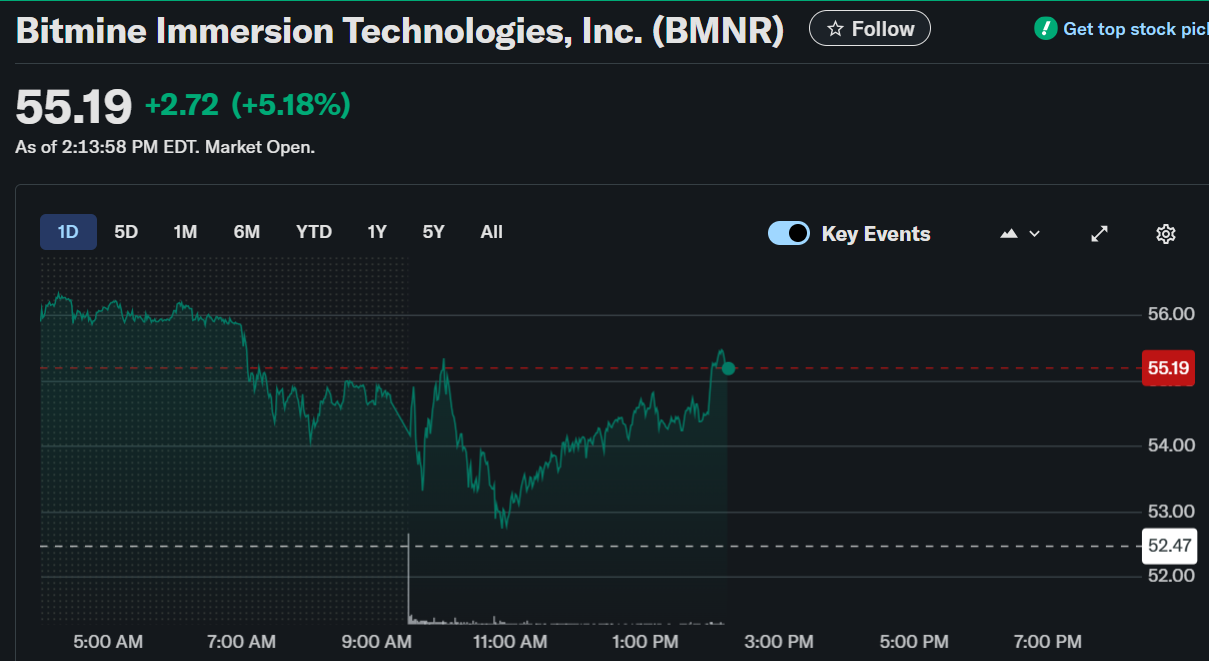
Bitmine Immersion Technologies (BMNR) stock :soars 5% as $13.4B Crypto Treasury Propels Ethereum Supercycle Vision

Bitmine Immersion Technologies (BMNR) stock :soars 5% as $13.4B Crypto Treasury Propels Ethereum Supercycle Vision

TLDR Bitmine surges 5.18% as $13.4B ETH treasury cements crypto dominance. Bitmine’s $12.6B Ethereum trove fuels bold 5% market ownership goal. Bitmine rebounds strong—ETH hoard drives record treasury valuation. Bitmine’s ETH empire grows to 3M coins, powering stock’s sharp rally. With record ETH and cash reserves, Bitmine solidifies crypto supremacy. Bitmine Immersion Technologies closed 5.18% [...] The post Bitmine Immersion Technologies (BMNR) stock :soars 5% as $13.4B Crypto Treasury Propels Ethereum Supercycle Vision appeared first on CoinCentral.
Share
Coincentral2025/10/14 02:40
Headwind Helps Best Wallet Token

Headwind Helps Best Wallet Token

The post Headwind Helps Best Wallet Token appeared on BitcoinEthereumNews.com. Google has announced the launch of a new open-source protocol called Agent Payments Protocol (AP2) in partnership with Coinbase, the Ethereum Foundation, and 60 other organizations. This allows AI agents to make payments on behalf of users using various methods such as real-time bank transfers, credit and debit cards, and, most importantly, stablecoins. Let’s explore in detail what this could mean for the broader cryptocurrency markets, and also highlight a presale crypto (Best Wallet Token) that could explode as a result of this development. Google’s Push for Stablecoins Agent Payments Protocol (AP2) uses digital contracts known as ‘Intent Mandates’ and ‘Verifiable Credentials’ to ensure that AI agents undertake only those payments authorized by the user. Mandates, by the way, are cryptographically signed, tamper-proof digital contracts that act as verifiable proof of a user’s instruction. For example, let’s say you instruct an AI agent to never spend more than $200 in a single transaction. This instruction is written into an Intent Mandate, which serves as a digital contract. Now, whenever the AI agent tries to make a payment, it must present this mandate as proof of authorization, which will then be verified via the AP2 protocol. Alongside this, Google has also launched the A2A x402 extension to accelerate support for the Web3 ecosystem. This production-ready solution enables agent-based crypto payments and will help reshape the growth of cryptocurrency integration within the AP2 protocol. Google’s inclusion of stablecoins in AP2 is a massive vote of confidence in dollar-pegged cryptocurrencies and a huge step toward making them a mainstream payment option. This widens stablecoin usage beyond trading and speculation, positioning them at the center of the consumption economy. The recent enactment of the GENIUS Act in the U.S. gives stablecoins more structure and legal support. Imagine paying for things like data crawls, per-task…
Share
BitcoinEthereumNews2025/09/18 01:27