Anthropic CEO Responds to Pentagon Ban on Military Use
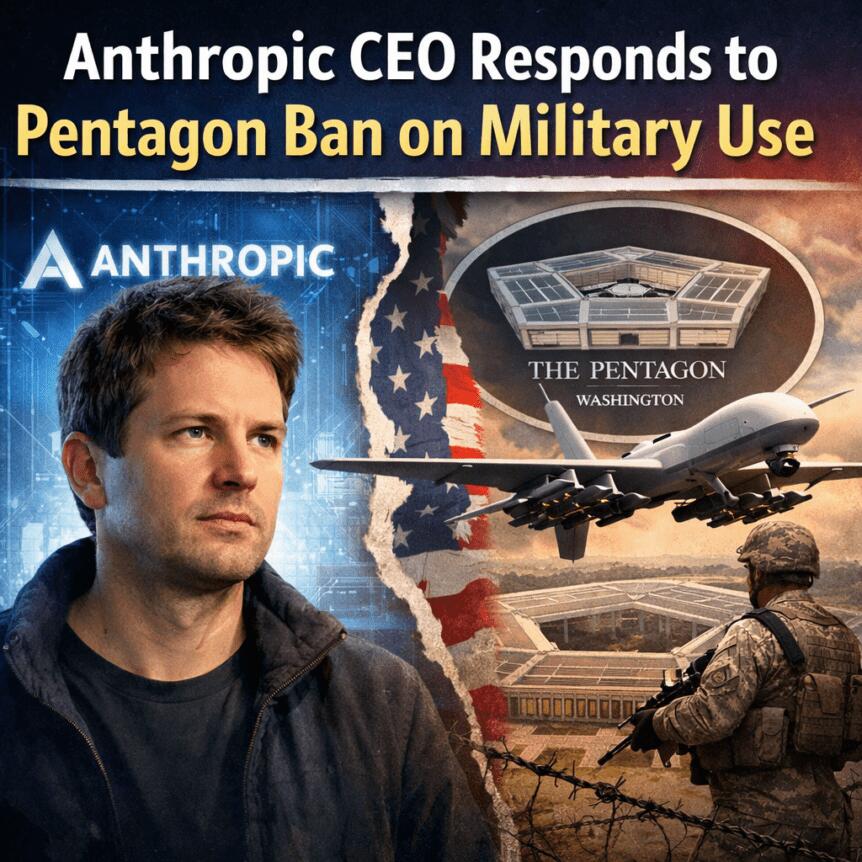
The defense-policy arc surrounding artificial intelligence intensified after the U.S. Department of Defense branded Anthropic as a “supply chain risk,” effectively barring its AI models from defense contracting work. Anthropic’s chief executive, Dario Amodei, pushed back in a CBS News interview on Saturday, saying the company would not support mass domestic surveillance or fully autonomous weapons. He argued that such capabilities undermine core American rights and would cede decision-making on war to machines, a stance that clarifies where the company does and does not intend to operate within the government’s broader AI-use cases.
Key takeaways
- The Defense Department labeled Anthropic a “supply chain risk,” prohibiting its contractors from using Anthropic’s AI models in defense programs, a move Amodei described as unprecedented and punitive.
- Anthropic opposes uses of its AI for mass domestic surveillance and autonomous weapons, stressing that human oversight remains essential for wartime decisions.
- Amodei asserted support for other government use cases for Anthropic’s tech, but drew a firm line around privacy protections and governable warfare capabilities.
- Shortly after the Anthropic designation, rival OpenAI reportedly secured a DoD contract to deploy its AI models across military networks, signaling divergent vendor trajectories in the defense-AI space.
- The development spurred online backlash focused on privacy, civil liberties, and the governance of AI in national security, highlighting a broader debate about responsible AI deployment.
Tickers mentioned:
Sentiment: Neutral
Market context: The episode sits at the intersection of AI governance, defense procurement, and risk appetite among institutional tech providers amid ongoing policy debates.
Market context: National-security policy, privacy considerations, and the reliability of autonomous AI systems continue to shape how tech vendors and defense contractors interact with AI tools in sensitive environments, influencing broader technology and investment sentiment in adjacent sectors.
Why it matters
For the crypto and broader technology communities, the Anthropic episode underscores how policy, governance, and trust shape the adoption of advanced AI tools. If defense agencies tighten controls on specific suppliers, vendors may recalibrate product roadmaps, risk models, and compliance frameworks. The tension between expanding AI capabilities and safeguarding civil liberties resonates beyond defense contracts, influencing how institutional investors weigh exposure to AI-driven platforms, data-processing services, and cloud-native AI workloads used by finance, gaming, and digital-assets sectors.
Amodei’s insistence on guardrails reflects a broader demand for accountability and transparency in AI development. While the industry is racing to deploy more capable models, the conversation about what constitutes acceptable use—especially in surveillance and automated warfare—remains unsettled. This dynamic is not limited to U.S. policy; allied governments are scrutinizing similar questions, which could affect cross-border collaborations, licensing terms, and export controls. In crypto and blockchain ecosystems, where trust, privacy, and governance are already central concerns, any AI policy shift can ripple through on-chain analytics, automated compliance tooling, and decentralized identity applications.
From a market-structuring perspective, the juxtaposition of Anthropic’s stance with OpenAI’s contract win—reported shortly after the DoD announcement—illustrates how different vendors navigate the same regulatory terrain. The public discourse around these developments could influence how investors price risk related to AI-enabled technology providers and the vendors that supply critical infrastructure to government networks. The episode also highlights the role of media narratives in amplifying concerns about mass surveillance and civil liberties, which in turn can affect stakeholder sentiment and regulatory momentum around AI governance.
What to watch next
- Congressional active debate over AI guardrails and privacy protections, with potential legislation affecting domestic surveillance, weapons development, and export controls.
- DoD policy updates or procurement guidelines that clarify how AI suppliers are evaluated for national security risk and how substitutions or risk-mitigation measures are implemented.
- Public responses from Anthropic and OpenAI, detailing how each company plans to address government-use cases, compliance, and risk exposure.
- Moves by other defense contractors and AI vendors to secure or renegotiate DoD contracts, including any shifts in alliance-building with cloud providers and data-handling protocols.
- Broader investor and market reaction to AI governance developments, particularly in sectors reliant on data processing, cloud services, and machine-learning workloads.
Sources & verification
- Anthropic CEO Dario Amodei’s CBS News interview discussing his stance on mass surveillance and autonomous weapons: CBS News interview.
- Official statements around Anthropic being labeled a “Supply-Chain Risk to National Security” by DoD leadership, via public channels linked to DoD policy discussions and contemporaneous coverage: Pete Hegseth X post.
- OpenAI’s defense-contract developments and public discussions about deploying AI models across military networks, as reported by Cointelegraph: OpenAI defense contract coverage.
- Critiques focusing on AI-enabled mass surveillance and civil-liberties concerns referenced in coverage of the broader discourse: Bruce Schneier on AI surveillance.
Policy clash over AI suppliers reverberates through defense tech
Anthropic’s chief executive, Dario Amodei, voiced a clear line during a CBS News interview when asked about the government’s use of the company’s AI models. He described the Defense Department’s decision to deem Anthropic a “supply chain risk” as a historically unprecedented and punitive move, arguing that it reduces a contractor’s operational latitude in a way that could hamper innovation. The core of his objection is straightforward: while the U.S. government seeks to leverage AI across a spectrum of programs, certain applications—particularly mass surveillance and fully autonomous weapons—are off-limits for Anthropic’s technology, at least in its current form.
Amodei was careful to differentiate between acceptable and unacceptable uses. He emphasized that the company supports most government use cases for its AI models, provided those applications do not encroach on civil liberties or place too much decision-making authority in machines. His remarks underscore a crucial distinction in the AI policy debate: the line between enabling powerful automation for defense and preserving human control over potentially lethal outcomes. In his view, the latter principle is fundamental to American values and international norms.
The Defense Department’s labeling of Anthropic has been framed by Amodei as a litmus test for how the U.S. intends to regulate a rapidly evolving technology sector. He argued that current law has not kept pace with AI’s acceleration, calling on Congress to enact guardrails that would constrain the domestic use of AI for surveillance while ensuring that military systems retain a human-in-the-loop design where necessary. The idea of guardrails—intended to provide clear boundaries for developers and users—resonates across tech industries where risk management is a competitive differentiator.
Meanwhile, a contrasting development unfolded in the same week: OpenAI reportedly secured a Department of Defense contract to deploy its AI models across military networks. The timing fueled a broader debate about whether the U.S. government is embracing a multi-vendor approach to AI in defense or whether it’s steering contractors toward a preferred set of suppliers. The OpenAI announcement drew immediate attention, with Sam Altman posting a public statement on X, which added to the scrutiny around how AI tools will be integrated into national-security infrastructure. Critics quickly pointed to privacy and civil-liberties concerns, arguing that expanding surveillance-capable technology in the defense domain risks normalizing intrusive data practices.
Amid the public discourse, industry observers noted that the policy landscape is still unsettled. While some see opportunities for AI to streamline defense operations and improve decision cycles, others worry about overreach, lack of transparency, and the potential for misaligned incentives when commercial AI firms become integral to national-security ecosystems. The juxtaposition of Anthropic’s stance with OpenAI’s contract success serves as a microcosm of broader tensions in AI governance: how to balance innovation, security, and fundamental rights in a world where machine intelligence increasingly underpins critical functions. The story thus far suggests that the path forward will depend not only on technical breakthroughs but also on legislative clarity and regulatory pragmatism that align incentives across the public and private sectors.
As the policy conversation continues, stakeholders in the crypto world—where data privacy, compliance, and trust underpin many ecosystems—will be watching closely. The defense-AI tension reverberates through enterprise technology, cloud services, and analytics pipelines that crypto platforms rely on for risk management, compliance tooling, and real-time data processing. If guardrails emerge with explicit guardrails that constrain surveillance-related uses, the implications could cascade into how AI tools are marketed to regulated sectors, including finance and digital assets, potentially shaping the next wave of AI-enabled infrastructure and governance tools.
Key questions remain: Will Congress deliver concrete legislation that defines acceptable AI use in government programs? How will DoD procurement evolve in response to competing vendor strategies? And how will public sentiment shape corporate risk assessments for AI providers who operate in sensitive domains? The coming months are likely to reveal a more explicit framework for AI policing that could influence both public policy and private innovation, with consequences for developers, contractors, and users across the technology landscape.
This article was originally published as Anthropic CEO Responds to Pentagon Ban on Military Use on Crypto Breaking News – your trusted source for crypto news, Bitcoin news, and blockchain updates.


You May Also Like

USD/CAD Plummets: Greenback Weakness Meets Tame Canadian Inflation Data

Stablecoin Privacy Emerges as Top Barrier to Institutional Blockchain Adoption