

Foreign Exchange Industry Statistics 2026: Who Controls FX Now?
In the world of Forex trading, where the global currency market sees trillions of dollars exchange hands daily, understanding the numbers behind the trade can be just as critical as the trade itself. Forex trading has evolved from a specialized investment opportunity for big banks and financial institutions to a market accessible to retail traders worldwide.
This market continues to expand with unprecedented technological advancements, increased regulatory attention, and diverse market participants from all corners of the globe. Here, we delve into the statistics that define the current state of Forex, offering insights to help traders, investors, and financial enthusiasts navigate this dynamic landscape.
Editor’s Choice
- Daily trading volume averages $9.6 trillion per day in early 2026, sustaining high liquidity.
- US dollar dominates at 89% of trades, the Euro at ~31%, Japanese yen at ~17% of volumes.
- Algorithmic trading accounts for over 92% of Forex transactions amid automation growth.
- Crypto-Forex integration advances as jurisdictions incorporate crypto into FX regulations.
- Asia-Pacific holds ~32% of global Forex volume, bolstering regional influence.
Recent Developments
- MetaTrader 5 holds 62% market share of combined MT4/MT5 trading volume, extending lead over MT4.
- DeFi spot trading volume triples to $80 billion weekly by early year, boosting decentralized alternatives.
- ESG integration rises, with 88% of exchanges embracing sustainability initiatives in operations.
- Broker-FinTech partnerships expand 20% annually, fueling AI and DeFi innovations.
- Advanced risk-management tools usage grows 25%, enhancing volatility protection.
- 62% of broker platforms offer AI-powered market analytics for real-time retail insights.
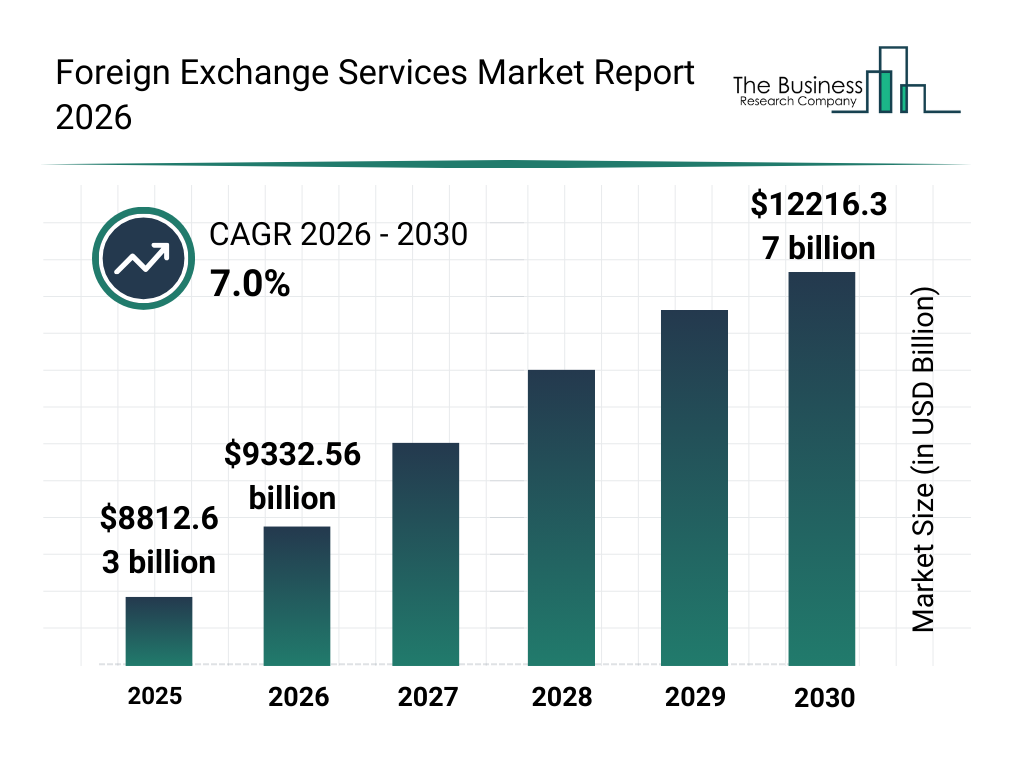
Global Foreign Exchange Services Market Outlook
- The global foreign exchange services market was valued at about $8,812.63 billion in 2025.
- The market is expected to reach around $9,332.56 billion in 2026, showing steady growth.
- Analysts project the market will climb to approximately $12,216.37 billion by 2030.
- The industry is forecast to grow at a 7.0% CAGR from 2026 to 2030.
- The data shows a strong upward trend, with the market adding over $3.4 trillion in value between 2025 and 2030.
- Rising global trade, travel, and cross-border payments continue to drive demand for foreign exchange services.
 (Reference: The Business Research Company)
Revenue and Profitability of Major Forex Brokers
- The top five Forex brokers generate a combined $15 billion in revenue, led by US firms.
- CMC Markets H1 revenue reaches £186.2 million, profit before tax £49.3 million.
- IG Group projects £1.1 billion revenue for the 2026 calendar year.
- eToro achieves $868 million annual revenue and $216 million net profit.
- XM sustains 35% profit margins on expanded $600 million revenue.
- Forex.com parent StoneX FX revenue hits $169.5 million for the half-year.
Regional Breakdown and Market Share
- United Kingdom dominates with 38% of global trading volume from deep liquidity.
- Asia-Pacific surges to 25% share, led by Singapore at 12% and Hong Kong 7%.
- North America claims 19% of turnover fueled by US dollar activity.
- Middle East & Africa contribute 6%, combined with the growth of the UAE and South Africa.
- Latin America forex participation rises 25% YoY, driven by Brazil and Mexico.
- Singapore outpaces Hong Kong by 5% margin as the top Asian center.
- South Africa leads Africa with $2.21 billion daily volumes.
Forex Market Share by Instrument Type
- Forex swaps comprise 42% of total FX turnover for hedging and liquidity.
- Spot forex holds 31%, outright forwards 19%, and others 8% of market activity.
- Spot and outright forwards combined reach 50%, edging out swaps’ dominance.
- FX options turnover doubles, boosting derivative instruments to a key strategic role.
Broader Variety of Market Participants
- Commercial banks dominate with over 80% of Forex capital traded.
- Hedge funds boost FX trading 52% in early-year options volumes.
- Institutional investors control 60% of outstanding FX contracts.
- Corporations hedge $3.3 trillion daily for trade currency risk.
- Retail traders hit a record $37 trillion in monthly CFD volumes.
- Proprietary firms like XTX capture 6.7% market share via HFT.
- Family offices grow 15% in Forex allocation for diversification.
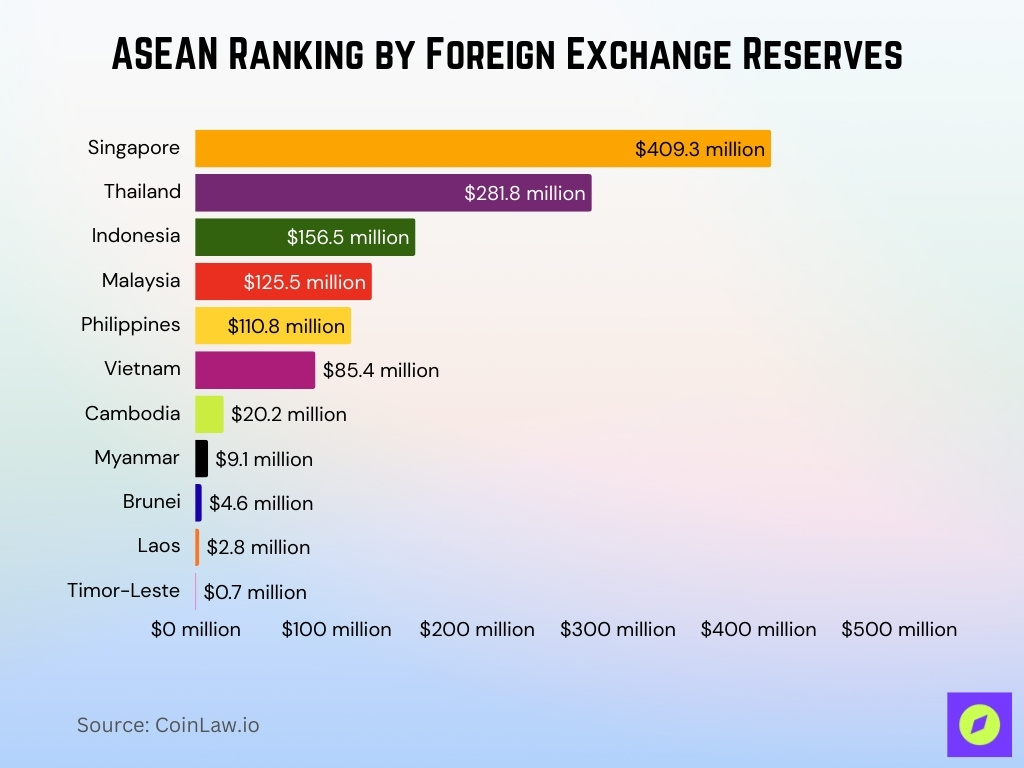
ASEAN Ranking by Foreign Exchange Reserves
- Singapore ranks first with about $409.3 billion in foreign exchange reserves.
- Thailand holds the second position with around $281.8 billion.
- Indonesia stands third with approximately $156.5 billion in reserves.
- Malaysia ranks fourth with about $125.5 billion.
- The Philippines comes fifth with roughly $110.8 billion.
- Vietnam places sixth with around $85.4 billion in reserves.
- Cambodia ranks seventh with about $20.2 billion.
- Myanmar holds eighth place with approximately $9.1 billion.
- Brunei ranks ninth with around $4.6 billion.
- Laos stands tenth with about $2.8 billion in reserves.
- Timor-Leste ranks eleventh with roughly $0.7 billion.
 (Reference: Seasia Stats)
Regulatory and Compliance Developments
- Compliance costs for brokers rise 14-128% under CySEC fee hikes.
- DORA activates in January 2025, enforcing digital resilience for forex firms.
- 80% of Tier-1 brokers deploy automated AML monitoring systems.
- MiCA tightens crypto-Forex KYC and licensing across EU markets.
- CFTC issues $535,000 fines in early enforcement actions.
- CySEC mandates spreads and slippage transparency reporting.
- ASIC upholds 30:1 leverage cap for retail Forex traders.
Forex Turnover by Market Participant
- Reporting dealers drive 46% of total foreign exchange turnover.
- Non-reporting banks account for 24% as key liquidity providers.
- Institutional investors rose to 13% from pension and asset managers.
- Hedge funds and PTFs hold 8% via speculative strategies.
- Retail traders contribute 5% through aggregator platforms.
- Official sector turnover steady at 1%, including central banks.
Impact of Technology and Algorithmic Trading
- Algorithmic trading executes 92% of Forex transactions via automated systems.
- AI tools drive 20% of trades with real-time data analysis precision.
- Machine learning shapes 55% of institutional strategies and decisions.
- 33% of brokers adopt blockchain, enhancing transaction security.
- Retail automated bots usage surges 40% YoY on MetaTrader platforms.
- Trading latency averages 1-10 ms for optimal broker-server proximity.
Frequently Asked Questions (FAQs)
Forex swaps dominate with 47.35% market share.
EUR/USD accounts for 21.2% of total daily forex transactions.
UK captures approximately 38% of global turnover.
Conclusion
The Forex industry is defined by accelerated growth, technological advances, and evolving regulations that shape trading activities for both institutional and retail participants. As the largest and most liquid financial market globally, Forex offers unparalleled opportunities, yet demands precision, knowledge, and adaptability from its traders.
New market participants, coupled with advancements in algorithmic trading and AI, continue to transform the landscape, making Forex more accessible yet more complex than ever. Regulatory changes and technological innovations ensure a balanced ecosystem, promising a future where Forex remains a vital, thriving part of the global financial system.
The post Foreign Exchange Industry Statistics 2026: Who Controls FX Now? appeared first on CoinLaw.
You May Also Like

Solana Hits $4B in Corporate Treasuries as Companies Boost Reserves

Polymarket Prices 86% Odds Of Sub-$80 – Will $83 Break?
