Bitcoin futures demand sinks to 2024 lows: Are institutions exiting?
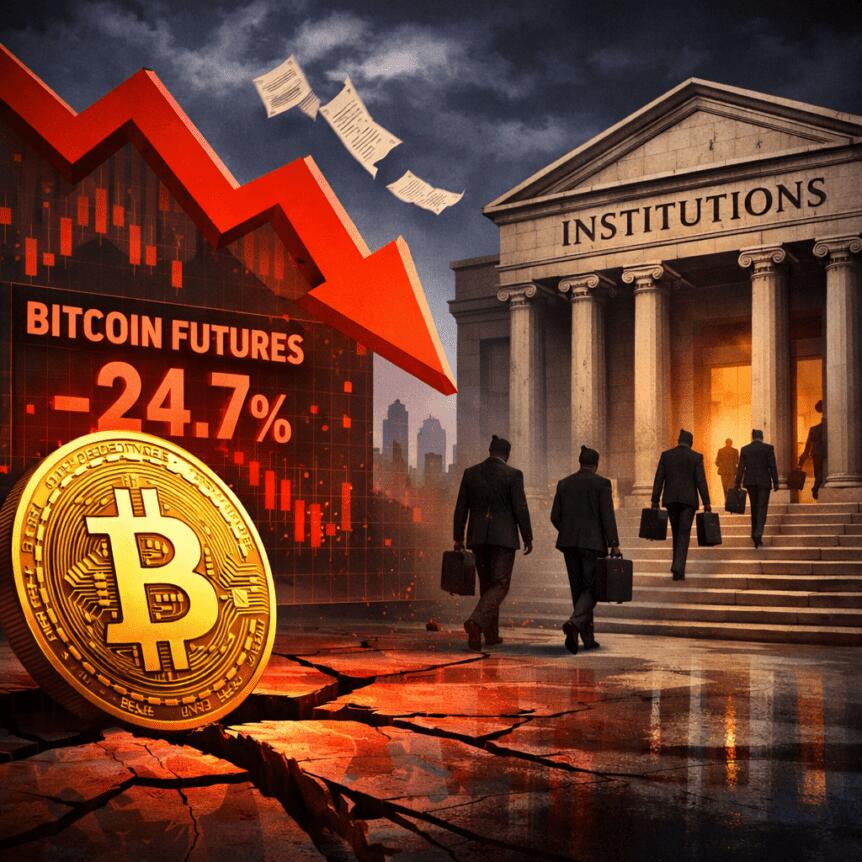
Bitcoin (CRYPTO: BTC) staged a cautious recovery, rising roughly 10% from a Saturday retest near $63,000 as traditional markets moved in a contrasting direction amid geopolitical tensions in the Middle East. The uptick offered a measure of relief for bulls, yet a closer inspection of the derivatives landscape revealed a more tepid appetite for risk among large players. Futures demand deteriorated to levels not seen since 2024, even as other channels indicated ongoing institutional exposure. Across major exchanges, open interest hovered around $32 billion on Sunday, a 20% retreat from a month earlier, signaling that leverage had begun to unwind even as traders remained engaged in the market.
The immediate price action has not resolved the longer-term tug-of-war between bulls and bears. While spot markets showed resilience, the futures market has shown signs of cooling off. The combination of a price rebound and waning futures interest paints a nuanced picture: institutions appear to be staying put, but with less aggressive positioning than in prior cycles. This divergence underscores a broader theme in crypto markets—steadfast core demand from long-term holders and institutions coexists with episodic volatility that tests short-term trading appetite.
The narrative around where institutional capital stands is further complicated by evidence from the options and futures segments. The average activity in Bitcoin futures remains robust in some respects, with notable players continuing to demonstrate an ongoing, if selective, appetite for exposure. Data from market analytics providers illustrate how the market is balancing risk and reward: while price momentum has faded from peak levels, the structural support from large holders and listed companies remains intact. In particular, the presence of significant on-chain holdings by publicly listed companies and steady ETF inflows suggests that institutions continue to anchor demand for Bitcoin even when leverage cools.
Market reaction and key details
The futures landscape shows a divergence between price action and leverage. The Bitcoin futures aggregate open interest on major exchanges declined to $32 billion on Sunday, marking a 20% decrease from the prior month. Even after adjusting for price moves, the measure signals cooling demand for long exposure in the near term. This cooling is not necessarily a retreat by institutions; rather, it may reflect a interim reassessment as market participants wait for clearer catalysts. In parallel, the annualized premium on Bitcoin monthly futures slipped to 2%, the lowest in roughly a year, underscoring a shift away from the exuberant bullish tilt that characterized earlier phases of the cycle.
The premium, or basis rate, for monthly futures has historically tended to run higher than the spot price as a compensation for the longer settlement horizon. A typical neutral range would be roughly 5% to 10%. The fact that the basis has lingered around the 2% level for an extended period—spanning a year that included a 50% rally between April and May 2025—speaks to a market that has not consistently priced in outsized bullish momentum in the near term. This pattern aligns with a broader sentiment shift as investors weigh macro uncertainty and regulatory signals against the asset’s fixed-supply characteristics.
Despite these indicators, Bitcoin’s performance relative to traditional risk-on assets remains mixed. Bitcoin has underperformed Gold and equity indices in certain periods, prompting a recalibration of expectations among risk assets. However, there is still substantial evidence of ongoing institutional involvement. Bitcoin ETFs, for instance, trade in excess of $3 billion daily on average, a metric that highlights persistent demand from some of the world’s largest mutual and pension fund managers. This ETF activity provides a floor of demand that buffers the market against abrupt, full-on selling pressure.
On the on-chain front, publicly listed companies continue to accumulate Bitcoin, reinforcing a structural bid from corporate treasuries. Notable holders include Strategy (MSTR US), MARA Holdings (MARA US), XXI (XXI US), and Metaplanet (MPLTF US). In total, more than $79 billion in Bitcoin sit on-chain with these entities, a level that argues against a wholesale retreat by institutions even if leverage is temporarily resting. Countries such as Bhutan, El Salvador, and the United Arab Emirates have also pursued exposure to Bitcoin, signaling a broader, albeit selective, alignment of public sector and corporate actors with the asset class.
Looking at derivatives more granularly, odds and hedges within the options market portray a resilient backdrop. The put-to-call premium for Bitcoin options has remained relatively tepid, hovering near 0.7, indicating a tilt toward upside bets rather than extensive bearish plays. This dynamic persisted even after a brief uptick in demand for bearish strategies on a single trading day, suggesting that the market did not sustain distress or systemic risk fears despite the recent volatility. The overarching message from the derivatives data is one of guarded resilience: hedging activity remains present, but there is no clear signal of a structural, multi-month downturn.
The breadth of activity in the CME space further strengthens the sense that institutions have not exited the market. Open interest in Bitcoin futures on CME remains a meaningful indicator of institutional engagement, with around $7.5 billion still outstanding—a figure that underscores ongoing activity even as other indicators show cautious positioning. The balance between sell-side pressure and corresponding buy-side commitments continues to hold, implying that the market remains in a state of negotiated risk rather than a wholesale capitulation.
Taken together, the data points paint a picture of a market that is maneuvering through a transitional phase. Prices can still move higher as buyers re-enter on dips, but the persistent ceiling around prior all-time highs and the current fragility of some bullish signals suggest that any advance will likely require new catalysts—be it macro developments, regulatory clarity, or significant ETF inflows—to sustain momentum over the medium term. In this environment, Bitcoin remains a compelling case study in how a fixed-supply asset interacts with diversified institutional demand, market maturity, and evolving governance around digital assets.
- Related: Bitcoin holders show ‘zero panic’ as BTC hits $70K amid Middle East tensions
Market context: The current stretch sits at the intersection of evolving macro dynamics, ETF flows, and a still-developing institutional landscape for digital assets. While price action has improved, the rhythm of hedges, open interest, and basis rates points to a market that is absorbing shocks more gracefully than in earlier cycles, aided by steady on-chain and ETF-backed demand and a continued, selective institutional footprint.
Why it matters
The ongoing interplay between price performance and derivatives signals matters for traders, investors, and builders in the crypto space. A sustained price rally absent corresponding growth in futures open interest would risk overheating risk controls; conversely, a sustained level of open interest alongside a steady price path would indicate durable institutional interest. The presence of large corporate holders and persistent ETF inflows punctuates the story: institutions are not pulling out, even if they are not aggressively leveraging, and this could influence how market participants price risk, allocate capital, and plan for liquidity in stressed conditions.
From a systemic perspective, the divergence between spot strength and derivatives caution underscores a nuanced market maturity. As crypto markets evolve, the willingness of major funds and companies to allocate crypto exposure—through direct balance-sheet purchases, public equity-linked holdings, or ETF participation—shapes a pathway toward broader, steadier adoption. The data also suggest that while the friction points—volatility, basis rates, and short-term momentum—may persist, the underlying demand from institutional layers remains a critical anchor for liquidity and price discovery in a market that still holds a relatively small share of global financial allocations.
What to watch next
- Monitor CME open interest and overall futures activity for the next 2–4 weeks to gauge whether institutions maintain exposure or begin to recalibrate risk after recent volatility.
- Watch Bitcoin’s price action around key support levels (e.g., $60k) to see if the current bounce sustains or falters.
- Track ETF inflows and new listings to assess whether institutional demand seeds a renewed price floor or accelerates upside momentum.
- Observe on-chain accumulation trends by publicly listed companies and major corporate holders for signs of renewed balance-sheet strategy shifts.
- Follow regulatory developments and macro catalysts that could reframe risk sentiment for digital assets and related products.
Sources & verification
- Bitcoin futures aggregate open interest data from CoinGlass showing $32 billion, down 20% from a month prior.
- Bitcoin monthly futures annualized premium data from Laevitas.ch indicating a 2% level—the lowest in a year.
- Information on Bitcoin ETFs trading over $3 billion per day on average and the involvement of large mutual/pension fund managers.
- On-chain and corporate holdings context, including public-company BTC ownership (Strategy/MSTR, MARA, XXI, MPLTF).
- Derivatives signals, including put-to-call premiums near 0.7 on Deribit (source: Laevitas.ch and Deribit data).
This article was originally published as Bitcoin futures demand sinks to 2024 lows: Are institutions exiting? on Crypto Breaking News – your trusted source for crypto news, Bitcoin news, and blockchain updates.


You May Also Like

Dogecoin Price Prediction as Whales Buy 330M DOGE, Pepeto Eyes 100x

SUI Big Problem: Why an All-Time High May Never Come Again