TLDRs; TSMC stock rose 1.13% to $230.98 on Wednesday despite U.S. moves to end its China export waiver. The waiver’s expiration in 2025 means TSMC must seek licenses for restricted equipment shipped to its Nanjing plant. Analysts warn of administrative friction, longer lead times, and higher compliance costs for semiconductor firms in China. Despite headwinds, [...] The post TSMC (TSM) Stock: Holds Steady Despite U.S. Export Control Changes appeared first on CoinCentral.TLDRs; TSMC stock rose 1.13% to $230.98 on Wednesday despite U.S. moves to end its China export waiver. The waiver’s expiration in 2025 means TSMC must seek licenses for restricted equipment shipped to its Nanjing plant. Analysts warn of administrative friction, longer lead times, and higher compliance costs for semiconductor firms in China. Despite headwinds, [...] The post TSMC (TSM) Stock: Holds Steady Despite U.S. Export Control Changes appeared first on CoinCentral.

TSMC (TSM) Stock: Holds Steady Despite U.S. Export Control Changes

TLDRs;

  • TSMC stock rose 1.13% to $230.98 on Wednesday despite U.S. moves to end its China export waiver.
  • The waiver’s expiration in 2025 means TSMC must seek licenses for restricted equipment shipped to its Nanjing plant.
  • Analysts warn of administrative friction, longer lead times, and higher compliance costs for semiconductor firms in China.
  • Despite headwinds, TSMC stock stability shows investor confidence in its dominance in global advanced chip manufacturing.

Taiwan Semiconductor Manufacturing Company (TSM) stock showed resilience on Wednesday, closing up just over 1% despite the latest move from Washington to end its export waiver for China.

The stock climbed to $230.98, gaining 1.13% on Wednesday, and held relatively stable through the trading session even as concerns lingered about the long-term implications of U.S. export policy.

The U.S. Commerce Department announced that TSMC’s validated end user (VEU) waiver, which allowed the company to ship certain restricted semiconductor equipment to its Nanjing, China plant, will expire on December 31, 2025. After this date, the chip giant will need individual licenses for exports, a significant shift from blanket permissions that previously simplified operations.

This policy mirrors actions already taken against Samsung Electronics and SK Hynix, signaling that Washington intends to close what officials describe as “export control loopholes” in advanced technology trade.
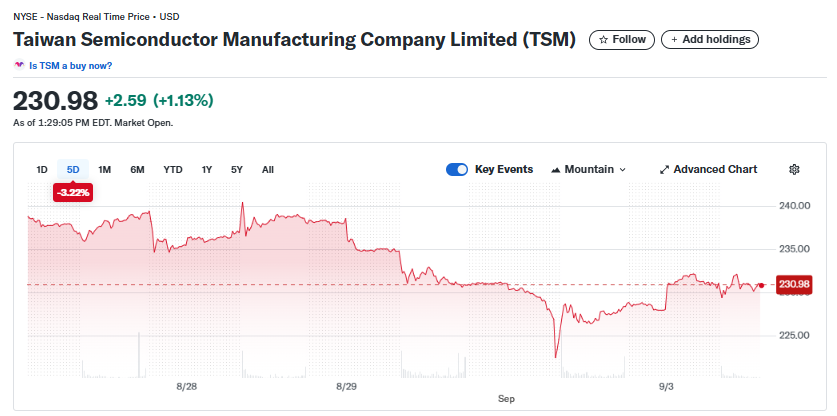
Taiwan Semiconductor Manufacturing Company Limited (TSM)

TSMC’s Stock Performance Shows Stability

Despite geopolitical tensions, TSMC’s share performance highlights investor confidence in its market position. Over the past five trading days, the stock experienced some volatility, dipping late August before rebounding in early September. The 1% surge on Wednesday suggests that investors view the company’s long-term fundamentals as intact.

Market watchers believe the limited impact stems from the relatively small share of revenue tied to its Nanjing facility, which accounts for just a fraction of TSMC’s global output.

Still, the changes could introduce administrative and operational friction, including potentially longer lead times and compliance costs that may affect competitiveness in China.

Export Rules as a Strategic Weapon

Analysts note that the shift from blanket waivers to case-by-case licensing illustrates how bureaucratic processes can serve as policy tools in the U.S.-China tech rivalry. Instead of outright bans, Washington is relying on regulatory hurdles to restrict sensitive technology transfers.

According to estimates, the new system could generate over 1,000 additional license applications annually, creating paperwork burdens for TSMC and its suppliers. While most licenses may still be approved, the uncertainty over timing could disrupt supply chain planning and add hidden costs to doing business in China.

This approach allows the U.S. to maintain leverage without escalating into more aggressive measures that could trigger diplomatic fallout. The strategy reflects Washington’s broader push to control critical supply chains where U.S.-made equipment and components give it global influence.

Broader Geopolitical Context

The export control development follows other headlines surrounding TSMC. Just last month, company CEO C.C. Wei reassured investors that the U.S. government will not seek an equity stake in the firm, despite earlier media speculation tied to CHIPS Act subsidies. That reassurance helped stabilize investor sentiment after shares had briefly fallen in Taipei on related rumors.

Together, these events underline the delicate balance TSMC faces. On one hand, it is expanding globally with new fabs in the U.S. and Japan, strengthening its role in securing advanced chip supply chains. On the other, it must navigate geopolitical headwinds in China, where even small operational exposures can become points of vulnerability.

The post TSMC (TSM) Stock: Holds Steady Despite U.S. Export Control Changes appeared first on CoinCentral.


Market Opportunity
Oasis Logo
Oasis Price(ROSE)
$0.01309
$0.01309$0.01309
-1.50%
USD
Oasis (ROSE) Live Price Chart
Disclaimer: The articles reposted on this site are sourced from public platforms and are provided for informational purposes only. They do not necessarily reflect the views of MEXC. All rights remain with the original authors. If you believe any content infringes on third-party rights, please contact service@support.mexc.com for removal. MEXC makes no guarantees regarding the accuracy, completeness, or timeliness of the content and is not responsible for any actions taken based on the information provided. The content does not constitute financial, legal, or other professional advice, nor should it be considered a recommendation or endorsement by MEXC.

You May Also Like

The Channel Factories We’ve Been Waiting For

The Channel Factories We’ve Been Waiting For

The post The Channel Factories We’ve Been Waiting For appeared on BitcoinEthereumNews.com. Visions of future technology are often prescient about the broad strokes while flubbing the details. The tablets in “2001: A Space Odyssey” do indeed look like iPads, but you never see the astronauts paying for subscriptions or wasting hours on Candy Crush.  Channel factories are one vision that arose early in the history of the Lightning Network to address some challenges that Lightning has faced from the beginning. Despite having grown to become Bitcoin’s most successful layer-2 scaling solution, with instant and low-fee payments, Lightning’s scale is limited by its reliance on payment channels. Although Lightning shifts most transactions off-chain, each payment channel still requires an on-chain transaction to open and (usually) another to close. As adoption grows, pressure on the blockchain grows with it. The need for a more scalable approach to managing channels is clear. Channel factories were supposed to meet this need, but where are they? In 2025, subnetworks are emerging that revive the impetus of channel factories with some new details that vastly increase their potential. They are natively interoperable with Lightning and achieve greater scale by allowing a group of participants to open a shared multisig UTXO and create multiple bilateral channels, which reduces the number of on-chain transactions and improves capital efficiency. Achieving greater scale by reducing complexity, Ark and Spark perform the same function as traditional channel factories with new designs and additional capabilities based on shared UTXOs.  Channel Factories 101 Channel factories have been around since the inception of Lightning. A factory is a multiparty contract where multiple users (not just two, as in a Dryja-Poon channel) cooperatively lock funds in a single multisig UTXO. They can open, close and update channels off-chain without updating the blockchain for each operation. Only when participants leave or the factory dissolves is an on-chain transaction…
Share
BitcoinEthereumNews2025/09/18 00:09
Onyxcoin Price Breakout Coming — Is a 38% Move Next?

Onyxcoin Price Breakout Coming — Is a 38% Move Next?

The post Onyxcoin Price Breakout Coming — Is a 38% Move Next? appeared on BitcoinEthereumNews.com. Onyxcoin price action has entered a tense standoff between bulls
Share
BitcoinEthereumNews2026/01/14 00:33
Buterin pushes Layer 2 interoperability as cornerstone of Ethereum’s future

Buterin pushes Layer 2 interoperability as cornerstone of Ethereum’s future

Ethereum founder, Vitalik Buterin, has unveiled new goals for the Ethereum blockchain today at the Japan Developer Conference. The plan lays out short-term, mid-term, and long-term goals touching on L2 interoperability and faster responsiveness among others. In terms of technology, he said again that he is sure that Layer 2 options are the best way […]
Share
Cryptopolitan2025/09/18 01:15