In un nuovo post su X, la società di analisi on-chain Santiment ha evidenziato come i diversi asset dell’ecosistema Ethereum si confrontano tra loro in termini di concentrazione dell’offerta nei 10 wallet principali. Dal grafico condiviso da Santiment, visibile nell’ultimo post, emerge la tendenza di questo indicatore per otto criptovalute negli ultimi mesi. Secondo i […]In un nuovo post su X, la società di analisi on-chain Santiment ha evidenziato come i diversi asset dell’ecosistema Ethereum si confrontano tra loro in termini di concentrazione dell’offerta nei 10 wallet principali. Dal grafico condiviso da Santiment, visibile nell’ultimo post, emerge la tendenza di questo indicatore per otto criptovalute negli ultimi mesi. Secondo i […]

Dati On-Chain Mostrano che Oltre la Metà dell’Offerta di Ethereum è Detenuta da Soli 10 Indirizzi

In un nuovo post su X, la società di analisi on-chain Santiment ha evidenziato come i diversi asset dell’ecosistema Ethereum si confrontano tra loro in termini di concentrazione dell’offerta nei 10 wallet principali.

Dal grafico condiviso da Santiment, visibile nell’ultimo post, emerge la tendenza di questo indicatore per otto criptovalute negli ultimi mesi.
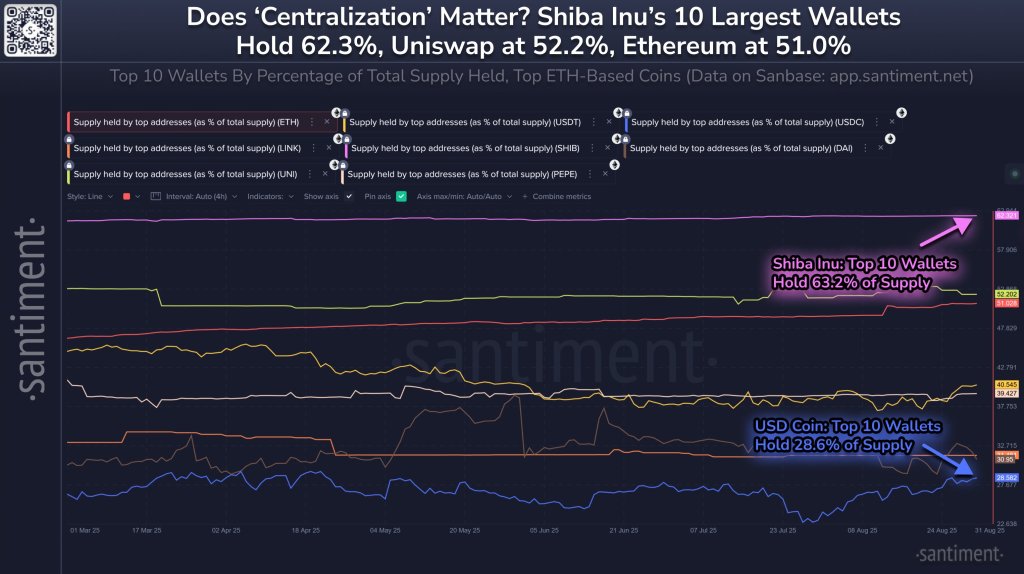
Secondo i dati, il 51% dell’offerta di Ethereum è detenuta dai 10 wallet più grandi della rete. Questo valore è superiore alla maggior parte degli altri token basati su ETH presenti nella lista.

Le due criptovalute che superano Ethereum in questa metrica sono Shiba Inu (SHIB) e Uniswap (UNI). UNI è solo leggermente sopra ETH con il 52,2%, mentre SHIB è molto più concentrato, con il 62,3% della sua offerta nelle mani dei 10 portafogli principali.

In generale, quando l’offerta di una criptovaluta è concentrata in poche mani, questo non è considerato un segnale positivo, perché bastano pochi attori per muovere il mercato.

Rischi della centralizzazione dell’offerta

Oltre agli effetti sul mercato, la centralizzazione dell’offerta può indebolire anche la sicurezza della rete. Ethereum utilizza un meccanismo di consenso chiamato Proof-of-Stake (PoS). In questo sistema, i validatori (“stakers”) devono bloccare una quota di ETH per avere la possibilità di aggiungere il prossimo blocco alla blockchain.

Quanto maggiore è la quota di un validatore, tanto maggiori sono le probabilità di essere scelto. Se un singolo validatore supera il 51% dell’offerta, in teoria potrebbe avere il controllo totale sulla blockchain.

Questo tipo di rischio non esiste su Bitcoin, che utilizza il Proof-of-Work (PoW). Qui i miner competono tra loro con la potenza di calcolo. Anche in PoW, però, se un attore riuscisse a controllare oltre il 51% delle risorse computazionali, potrebbe influenzare la rete a suo piacimento.

Considerando che Ethereum ha solo 10 detentori che controllano il 51% dell’offerta, un attacco coordinato è teoricamente possibile, sebbene le probabilità siano piuttosto basse.

Tuttavia, il fatto che token come ETH, SHIB e UNI siano così concentrati in poche mani è un aspetto da monitorare. Al contrario, alcuni token dell’ecosistema mostrano una distribuzione più equilibrata: USDC (28,6%), DAI (31%) e Chainlink (31,5%), valori più “sani” rispetto a questa metrica.


 

Market Opportunity
Lagrange Logo
Lagrange Price(LA)
$0.31546
$0.31546$0.31546
+2.79%
USD
Lagrange (LA) Live Price Chart
Disclaimer: The articles reposted on this site are sourced from public platforms and are provided for informational purposes only. They do not necessarily reflect the views of MEXC. All rights remain with the original authors. If you believe any content infringes on third-party rights, please contact service@support.mexc.com for removal. MEXC makes no guarantees regarding the accuracy, completeness, or timeliness of the content and is not responsible for any actions taken based on the information provided. The content does not constitute financial, legal, or other professional advice, nor should it be considered a recommendation or endorsement by MEXC.

You May Also Like

The Channel Factories We’ve Been Waiting For

The Channel Factories We’ve Been Waiting For

The post The Channel Factories We’ve Been Waiting For appeared on BitcoinEthereumNews.com. Visions of future technology are often prescient about the broad strokes while flubbing the details. The tablets in “2001: A Space Odyssey” do indeed look like iPads, but you never see the astronauts paying for subscriptions or wasting hours on Candy Crush.  Channel factories are one vision that arose early in the history of the Lightning Network to address some challenges that Lightning has faced from the beginning. Despite having grown to become Bitcoin’s most successful layer-2 scaling solution, with instant and low-fee payments, Lightning’s scale is limited by its reliance on payment channels. Although Lightning shifts most transactions off-chain, each payment channel still requires an on-chain transaction to open and (usually) another to close. As adoption grows, pressure on the blockchain grows with it. The need for a more scalable approach to managing channels is clear. Channel factories were supposed to meet this need, but where are they? In 2025, subnetworks are emerging that revive the impetus of channel factories with some new details that vastly increase their potential. They are natively interoperable with Lightning and achieve greater scale by allowing a group of participants to open a shared multisig UTXO and create multiple bilateral channels, which reduces the number of on-chain transactions and improves capital efficiency. Achieving greater scale by reducing complexity, Ark and Spark perform the same function as traditional channel factories with new designs and additional capabilities based on shared UTXOs.  Channel Factories 101 Channel factories have been around since the inception of Lightning. A factory is a multiparty contract where multiple users (not just two, as in a Dryja-Poon channel) cooperatively lock funds in a single multisig UTXO. They can open, close and update channels off-chain without updating the blockchain for each operation. Only when participants leave or the factory dissolves is an on-chain transaction…
Share
BitcoinEthereumNews2025/09/18 00:09
Gold Hits $3,700 as Sprott’s Wong Says Dollar’s Store-of-Value Crown May Slip

Gold Hits $3,700 as Sprott’s Wong Says Dollar’s Store-of-Value Crown May Slip

The post Gold Hits $3,700 as Sprott’s Wong Says Dollar’s Store-of-Value Crown May Slip appeared on BitcoinEthereumNews.com. Gold is strutting its way into record territory, smashing through $3,700 an ounce Wednesday morning, as Sprott Asset Management strategist Paul Wong says the yellow metal may finally snatch the dollar’s most coveted role: store of value. Wong Warns: Fiscal Dominance Puts U.S. Dollar on Notice, Gold on Top Gold prices eased slightly to $3,678.9 […] Source: https://news.bitcoin.com/gold-hits-3700-as-sprotts-wong-says-dollars-store-of-value-crown-may-slip/
Share
BitcoinEthereumNews2025/09/18 00:33
DeFi Leaders Raise Alarm Over Market Structure Bill’s Shaky Future

DeFi Leaders Raise Alarm Over Market Structure Bill’s Shaky Future

US Senate Postpones Markup of Digital Asset Market Clarity Act Amid Industry Concerns The proposed Digital Asset Market Clarity Act (CLARITY) in the U.S. Senate
Share
Crypto Breaking News2026/01/17 06:20