

Cardano Now Accepted at 137 Spar Stores Across Switzerland
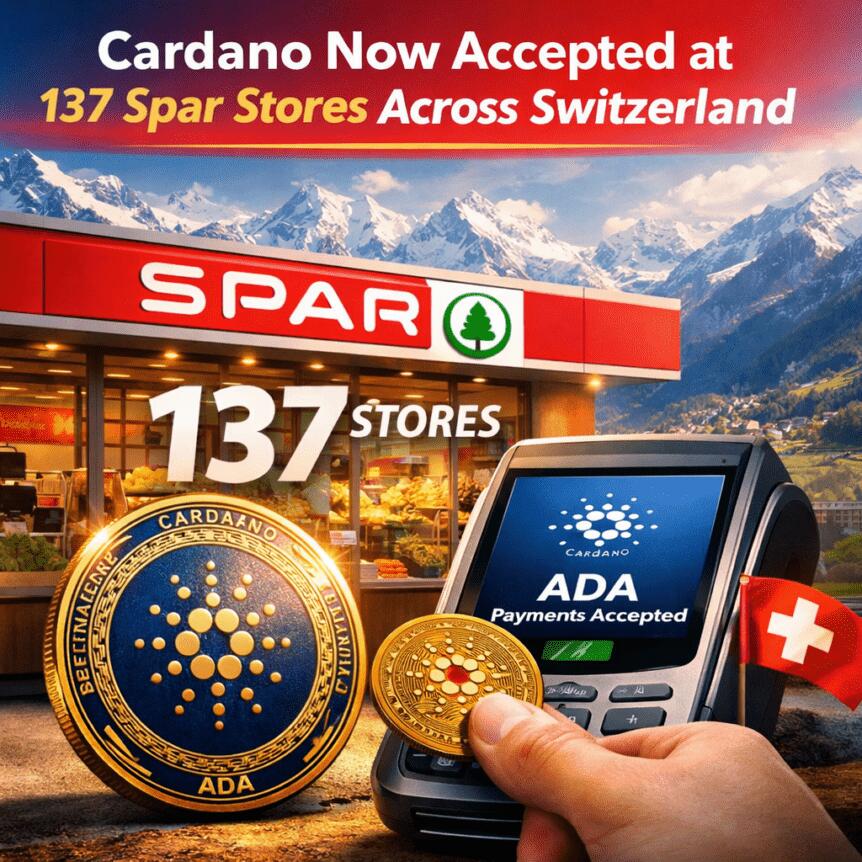
Cardano (CRYPTO: ADA) users can now pay for groceries at Spar stores in 137 locations across Switzerland, following a new Open Crypto Pay integration from Swiss fintech DFX.swiss, announced this Thursday by the Cardano Foundation. The arrangement allows real-time processing and direct wallet-to-wallet settlements for ADA payments, avoiding routing through centralized exchanges. For merchants, the system promises a significant reduction in processing costs—about two-thirds lower than traditional card networks—marking a practical step in Switzerland’s broader exploration of crypto-friendly retail infrastructure. The rollout adds to Spar’s evolving strategy to mix everyday shopping with digital asset conveniences as the country presses ahead with its hub ambitions.
In a broader sense, the move underscores Switzerland’s ambition to become a global hub for crypto and blockchain activity, moving beyond experimental trials toward widespread financial use cases. Open Crypto Pay’s architecture is designed to keep value transfers on-chain between ADA wallets, minimizing friction for consumers and merchants alike. The Cardano Foundation highlighted the initiative as a meaningful milestone in the ongoing maturation of the crypto sector, framing it as a shift in how value moves through society rather than a standalone pilot.
Executives at Spar have signaled that the integration builds on an earlier sweep of crypto payments. In August 2025, Spar rolled out nationwide crypto and stablecoin payments across 100 stores through partnerships with Binance Pay and DFX.swiss, with an objective to scale to about 300 stores. The latest expansion to 137 locations represents a continuation of that program, leveraging ADA and the broader Swiss crypto ecosystem to facilitate practical, everyday use of digital assets at the point of sale. Cardano’s presence in retail is not merely symbolic; it is designed to demonstrate real-time settlement and customer usability in a familiar shopping context.
Cardano Foundation Chief Executive Frederik Gregaard described the milestone as the “beginning of a fundamental shift in how value moves through society,” signaling a transition from experiments to genuine financial transformation. The aspirational framing reflects a broader narrative in which blockchain networks step out of early-stage pilots and into mainstream commerce, with merchants and customers sharing a common, largely seamless digital payment experience. The Cardano Foundation’s social post (via its official X account) underscored the collaboration as a proof point for real-world utility rather than a theoretical construct.
From a technical standpoint, the Open Crypto Pay integration is engineered to process transactions in real time and to enable payments directly from ADA wallets. That direct wallet-to-wallet flow helps avoid routing through centralized exchanges, which in turn can reduce liquidity constraints and settlement times for merchants. The cost advantage cited by Spar—roughly two-thirds lower transaction costs compared with traditional card schemes—could incentivize additional retailers to explore crypto rails as a cost-control measure while expanding consumer options for crypto payments in everyday shopping contexts.
Beyond Spar’s retail commitments, Switzerland’s crypto ambitions dovetail with broader regional momentum. Lugano, a city often cited as a pioneer in integrating digital assets into municipal life, is receiving new support from Tether. On Tuesday, Tether and the city announced a CHF 5 million ($6.4 million) commitment to a second phase of Lugano’s Plan B forum, set to run from 2026 through 2030. The aim is to position Lugano as a global hub for digital asset infrastructure, with ongoing projects focused on policy, infrastructure, and use-case deployments that blend fiat currency with digital assets in public services and commerce.
That momentum is complemented by Lugano’s existing experiments with asset-native payments. Residents can already pay certain municipal fees in Bitcoin (BTC) and USDt (USDT), an approach that integrates digital assets into local governance and services in a tangible way. The town’s efforts are part of a broader Swiss trend toward regulatory clarity and practical usage scenarios for crypto, which includes ongoing discussions about tax information sharing and compliance timelines in the country. The Swiss crypto tax landscape has evolved in recent years, and policy developments continue to influence how institutions and municipalities approach digital assets in everyday life.
Taken together, the Spar ADA rollout and Lugano’s Plan B initiative illustrate how Switzerland is attempting to bridge high-profile blockchain research with concrete commercial and civic applications. The Cardano Foundation’s involvement in Spar’s rollout signals a push to test not just the acceptance of ADA as a payments instrument but also the viability of a broader, open-pay ecosystem that prioritizes on-chain settlement, user control of funds, and cost efficiencies for merchants. If successful, this model could serve as a template for other retailers and municipalities seeking to blend digital assets with real-world value transfer in a regulated, consumer-friendly manner.
Why it matters
Retail adoption of crypto rails in Switzerland highlights a growing appetite among merchants to diversify payment methods beyond traditional card networks. By enabling ADA payments at Spar, the case demonstrates that digital assets can provide tangible benefits—faster settlements, lower fees, and greater control over funds—without sacrificing convenience for shoppers. The direct wallet-to-wallet approach reduces exposure to centralized custodians, potentially improving transparency and security in everyday transactions.
For the Cardano ecosystem, the Spar collaboration provides a real-world reference point for ADA’s utility beyond speculation. The emphasis on real-time processing and on-chain settlement aligns with Cardano’s broader mission of delivering scalable, sustainable blockchain solutions for mainstream use. As regulatory clarity improves and user experience grows more seamless, ADA and other digital assets could increasingly appear in ordinary retail environments, expanding the repertoire of payment choices available to consumers and businesses alike.
From a macro perspective, Switzerland’s ongoing crypto strategy—coupled with Lugano’s municipal experiments—suggests a broader trend toward integrating digital assets into public life. The Lugano funding, alongside ongoing tax and regulatory discussions, underscores a coordinated approach to creating ecosystems that can attract investment, talent, and technology providers while maintaining consumer protections and compliance. If such initiatives gain traction, they could influence how other European cities and regions design their own crypto-friendly frameworks, potentially shaping liquidity flows, user adoption curves, and the pace at which retailers are willing to experiment with digital payments.
What to watch next
- Spare expansion plans: Will Spar scale ADA acceptance from 137 stores toward the previously stated target of 300 locations?
- Regulatory developments in Switzerland: How will tax information-sharing timelines and disclosure rules evolve, and what impact might that have on crypto retail pilots?
- Lugano’s Plan B progress: What concrete milestones arise in Phase II (2026–2030), and how will they shape infrastructure for digital assets in public services?
- Additional retail partners: Which other Swiss retailers or European merchants might adopt Open Crypto Pay or similar wallets-first rails?
Sources & verification
- Official Cardano Foundation announcement and Cardano Foundation blog post detailing ADA acceptance at Spar Switzerland.
- DFX.swiss press materials describing the Open Crypto Pay integration and real-time wallet-to-wallet settlement.
- Spar’s August 2025 rollout of crypto and stablecoin payments across 100 stores via Binance Pay and DFX.swiss, with expansion plans to 300 stores.
- Tether and Lugano Plan B forum funding announcement for CHF 5 million to advance Lugano’s digital asset infrastructure program.
- Public statements on Lugano’s acceptance of BTC and USDT for municipal payments and related coverage of Switzerland’s crypto regulatory developments.
Key figures and next steps
Market reaction and key details
The Swiss initiative continues to attract attention as a testbed for mainstream crypto payments, with Cardano positioning itself as a practical vehicle for real-world value transfer. If the real-time, wallet-based payment model proves scalable and cost-effective, it may encourage broader merchant adoption across retailers and municipal services in Switzerland and beyond.
Why it matters
For users and investors, the expansion of ADA into everyday shopping environments underscores ADA’s potential as a usable digital asset rather than a speculative instrument. For builders and developers, the emphasis on on-chain settlement and merchant economics points to design principles that prioritize user experience and cost efficiency. For policymakers, the evolving landscape offers concrete data points on how digital assets can integrate with regulatory frameworks and public services while maintaining consumer protections.
Tickers mentioned: $ADA, $BTC, $USDT
Sentiment: Neutral
Market context: The push to embed crypto payments in retail and municipal services reflects a wider trend toward asset-native finance and on-chain settlement, compatible with regulatory progress and institutional interest in crypto infrastructure.
What to watch next
- Expansion milestones for Spar’s ADA payments and any new store openings or regional rollouts.
- Regulatory updates on Swiss tax information sharing and compliance requirements for crypto pilots.
- Progress on Lugano’s Plan B Phase II initiatives and how they influence regional crypto ecosystems.
Sources & verification
- Cardano Foundation announcement regarding ADA acceptance at Spar Switzerland.
- DFX.swiss Open Crypto Pay integration details and real-time settlement capabilities.
- Spar’s 2025 rollout news and store expansion plans.
- Tether and Lugano Plan B funding announcement for CHF 5 million.
- Reports on Lugano accepting BTC and USDT for municipal payments and Switzerland’s crypto tax discussions.
Retail rails for ADA in Swiss supermarkets signal broader crypto hub ambitions
Switzerland’s ongoing experimentation with crypto payments at the point of sale is moving beyond isolated pilots toward broader retail adoption. Spar’s 137-store ADA payments rollout, enabled by Open Crypto Pay and anchored by the Cardano Foundation, exemplifies a practical pathway for mainstreaming digital assets in everyday commerce. By delivering real-time settlement and wallet-to-wallet transactions, the initiative reduces dependence on centralized exchanges and cuts transaction costs for merchants—a meaningful consideration as retailers weigh new payment rails in a cost-conscious environment.
The collaboration also ties into Lugano’s broader strategy to become a global hub for digital asset infrastructure, reinforced by a CHF 5 million commitment from Tether to support the Plan B program through 2030. That funding, paired with Lugano’s existing acceptance of BTC and USDT for municipal duties, signals a coordinated effort to blend public governance with cutting-edge payment rails. If these pilots prove sustainable, they could catalyze similar initiatives across Switzerland and the broader European region, encouraging more retailers to pilot crypto-friendly checkout flows and more cities to explore asset-backed services in daily life.
This article was originally published as Cardano Now Accepted at 137 Spar Stores Across Switzerland on Crypto Breaking News – your trusted source for crypto news, Bitcoin news, and blockchain updates.
You May Also Like

OpenVPP accused of falsely advertising cooperation with the US government; SEC commissioner clarifies no involvement

Trump's allegation against Noem would constitute a federal crime: analyst
