

Building a dApp on Base Sepolia? Here’s What Most Web3 Guides Leave Out
Most developers think building a blockchain dApp is about smart contracts and frontend code.
What they miss is the invisible layer that actually determines whether the application works at scale.
The difference between a demo and a production ready decentralised application is not the UI. It is the infrastructure design underneath it. If you understand that layer, you can build confidently on any EVM chain. If you do not, you will eventually hit performance walls, unreliable RPC limits, or painfully slow transaction queries.
Table of Content
- How to Build a Blockchain dApp on Base Sepolia with OnFinality Infrastructure
- Why Base Sepolia Is the Smart Starting Point
- What This dApp Actually Does
- The Architecture Most Tutorials Skip
- The Application Layer: Next.js as the Orchestrator
- The Wallet Layer: Wagmi and MetaMask Integration
- The Indexing Layer: SubQuery for Structured Blockchain Data
- The Infrastructure Layer: OnFinality RPC and Block Propagation
- What Really Happens When a User Connects a Wallet
- Why This Architecture Matters Long Term
- About OnFinality
How to Build a Blockchain dApp on Base Sepolia with OnFinality Infrastructure
Building a blockchain dApp on Base Sepolia with OnFinality is not simply about connecting a wallet to an RPC endpoint. It requires a structured architecture where the application layer, wallet layer, indexing layer, and infrastructure layer each perform a clearly defined role.
Using an OnFinality Base Sepolia RPC endpoint ensures reliable access to blockchain data, consistent transaction propagation, and low latency performance across regions. Combined with structured indexing and modern wallet tooling, this creates a production ready foundation rather than a fragile demo setup.
Why Base Sepolia Is the Smart Starting Point
Base Sepolia is the official testnet for Base, Coinbase’s Ethereum Layer 2 built on the OP Stack. It mirrors real EVM behaviour including block production, gas mechanics, and transaction finality, without requiring real funds.
That matters because you are not building a simulation. You are building against real blockchain conditions. When you move from Base Sepolia to a production EVM network, the architectural logic remains identical. Configuration changes, not structural rewrites.
For developers looking to build a blockchain dApp on Base Sepolia with OnFinality, this environment offers a realistic, cost free testing ground that behaves like mainnet without financial risk.
What This dApp Actually Does
This application is a Next.js Web3 interface connected to Base Sepolia through an OnFinality RPC endpoint. Users interact through MetaMask, authenticate using their existing wallet, and retain full control over private keys.
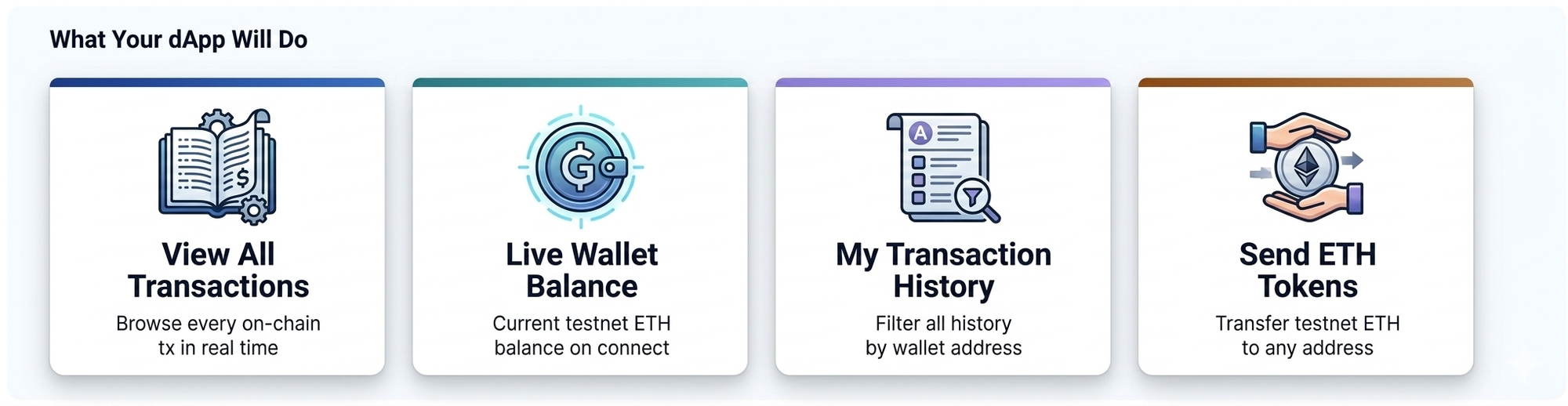
The dApp displays real time Base Sepolia transactions, shows the connected wallet’s live ETH balance, filters indexed transactions by address, and allows users to send testnet ETH to another wallet. Conceptually, it functions as a lightweight block explorer combined with a send interface.
The Architecture Most Tutorials Skip
Scalable decentralised applications rely on layered infrastructure. Each layer performs a specific role and the separation between them is what allows the system to scale.
The Application Layer: Next.js as the Orchestrator
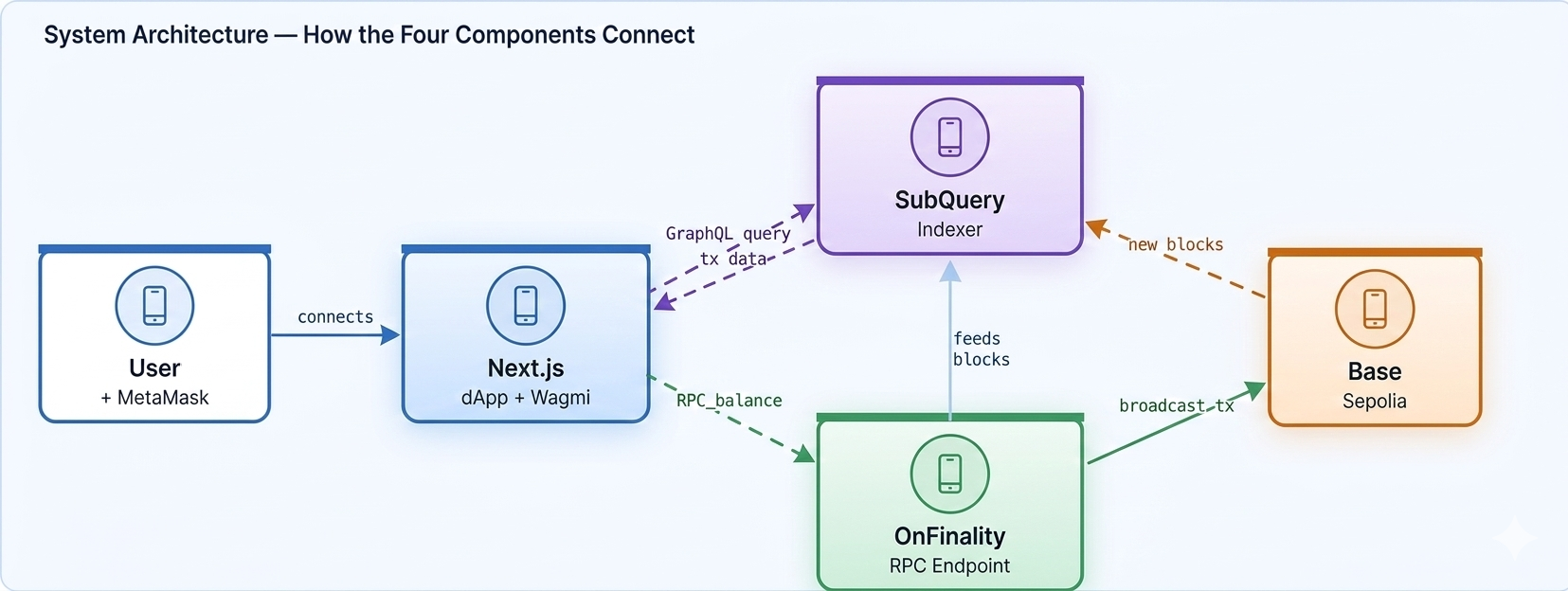
The Next.js frontend renders the interface and coordinates data flow. It manages wallet connection state through Wagmi and sends GraphQL queries to the indexing layer. It never stores private keys and never directly controls funds.
This stateless design improves security and flexibility. The frontend can be updated, audited, or even replaced without impacting user assets.
The Wallet Layer: Wagmi and MetaMask Integration
MetaMask authenticates users and signs transactions locally. Wagmi integrates MetaMask into the React application and manages the wallet lifecycle including connection detection, state management, balance reads, gas estimation, and transaction submission.
Private keys remain inside MetaMask. The application receives only the public address after user approval. This separation ensures that even if your server infrastructure is compromised, user funds remain protected.
The Indexing Layer: SubQuery for Structured Blockchain Data
Without indexing, retrieving transaction history would require scanning blocks sequentially from genesis to locate relevant wallet activity. On an active EVM network, that can mean processing millions of blocks.
SubQuery continuously indexes Base Sepolia blocks and stores structured transaction data in a database accessible via GraphQL. This transforms complex blockchain queries into fast, production ready API responses.
Developers can explore deeper indexing workflows through SubQuery integration with OnFinality RPC endpoints to build analytics dashboards and scalable transaction explorers.
The Infrastructure Layer: OnFinality RPC and Block Propagation
OnFinality provides the RPC endpoint that connects the application to Base Sepolia. Rather than operating your own node, you use a globally distributed shared node cluster designed for performance and reliability.
Within this architecture, OnFinality feeds new blocks to SubQuery to keep the index current, serves wallet balance lookups through RPC calls, and broadcasts signed transactions to Base Sepolia once MetaMask completes local signing.
Public RPC endpoints are frequently rate limited and region constrained. Using an OnFinality Base Sepolia RPC endpoint ensures consistent availability and predictable performance for production ready applications.
For higher throughput applications, explore Managed EVM Nodes on OnFinality to run dedicated infrastructure without operational overhead.

What Really Happens When a User Connects a Wallet
When a user clicks Connect Wallet, Wagmi detects MetaMask and initiates authentication. MetaMask confirms the request and returns the public address.
The application calls the OnFinality RPC endpoint to retrieve the wallet’s ETH balance while simultaneously querying SubQuery for indexed transactions linked to that address. Both responses arrive quickly and the interface renders balance and history together.
When a transaction is submitted, MetaMask signs it locally. The signed payload is sent to OnFinality, which propagates it to Base Sepolia. SubQuery indexes the subsequent block and the transaction automatically appears in the user’s history.
There is no manual synchronization logic. The blockchain progression and indexing process maintain state consistency naturally.
Builders looking to extend automation workflows can also integrate AI Agent AVA within the OnFinality ecosystem to streamline blockchain queries and infrastructure operations.

Why This Architecture Matters Long Term
Understanding how to build a blockchain dApp on Base Sepolia with OnFinality provides a foundation that extends to any EVM compatible network supported by the platform.
Whether deploying to Base mainnet, Ethereum, Polygon, Optimism, or Arbitrum, the architectural principles remain consistent. Configuration changes adapt the network, while the structural design stays intact.
That is the difference between building a demo and building infrastructure ready software.
About OnFinality
OnFinality is a blockchain infrastructure platform that serves hundreds of billions of API requests monthly across more than 130 networks, including Avalanche, BNB Chain, Cosmos, Polkadot, Ethereum, and Polygon. It provides scalable APIs, RPC endpoints, node hosting, and indexing tools to help developers launch and grow blockchain networks efficiently. OnFinality’s mission is to make Web3 infrastructure effortless so developers can focus on building the future of decentralised applications.
App | Website | Twitter | Telegram | LinkedIn | YouTube


You May Also Like

ETH Enters High-Stakes Decision Zone

Metaplanet raises $1.4B to fuel BTC purchases and U.S. subsidiary launch




