Transportation and Logistics: Practical Ways AI Is Improving Efficiency and Customer Experience
A new analysis on CXQuest.com explores how AI is transforming transportation and logistics efficiency while improving customer and employee experiences.
Practical Ways AI Is Improving Transportation and Logistics Efficiency
A customer checks a delivery app at 2:30 PM. The shipment shows “Arriving by 3 PM.”
At 6 PM, the parcel still hasn’t arrived. Customer support has no update. The driver’s route changed twice. The warehouse dispatched the package late. Traffic caused further delays.
From the customer’s perspective, the experience feels simple: a promise was broken.
From the logistics perspective, the problem is deeper. Systems are fragmented. Forecasts are inaccurate. Routes change manually. Exceptions pile up.
This is where artificial intelligence is quietly transforming transportation and logistics.
Across global supply chains, AI now helps companies predict demand, optimize routes, automate warehouses, and manage disruptions in real time. The result is not just operational efficiency. It is better customer experience, stronger employee experience, and more resilient logistics networks.
For CX and EX leaders, the opportunity is clear: AI is no longer a technology upgrade. It is a core experience strategy.
What Is AI-Driven Transport and Logistics Efficiency and Why Should CX Leaders Care?
AI-driven logistics efficiency uses machine learning, predictive analytics, and automation to improve how goods move through supply chains.
For CX leaders, this means more reliable delivery promises, accurate ETAs, proactive communication, and fewer disruptions.
Modern customers expect Amazon-level reliability. They expect visibility, speed, and transparency.
When logistics fails, customer experience fails.
Leading companies now treat logistics intelligence as a core CX capability, not just a supply chain function.
Key Insights
- AI is rapidly becoming core infrastructure in transportation and logistics operations.
- Companies using AI-driven supply chain planning report significant reductions in logistics costs and inventory levels.
- Organizations that align CX, operations, and data teams see faster AI adoption.
How Is AI Improving Transportation and Logistics Today?
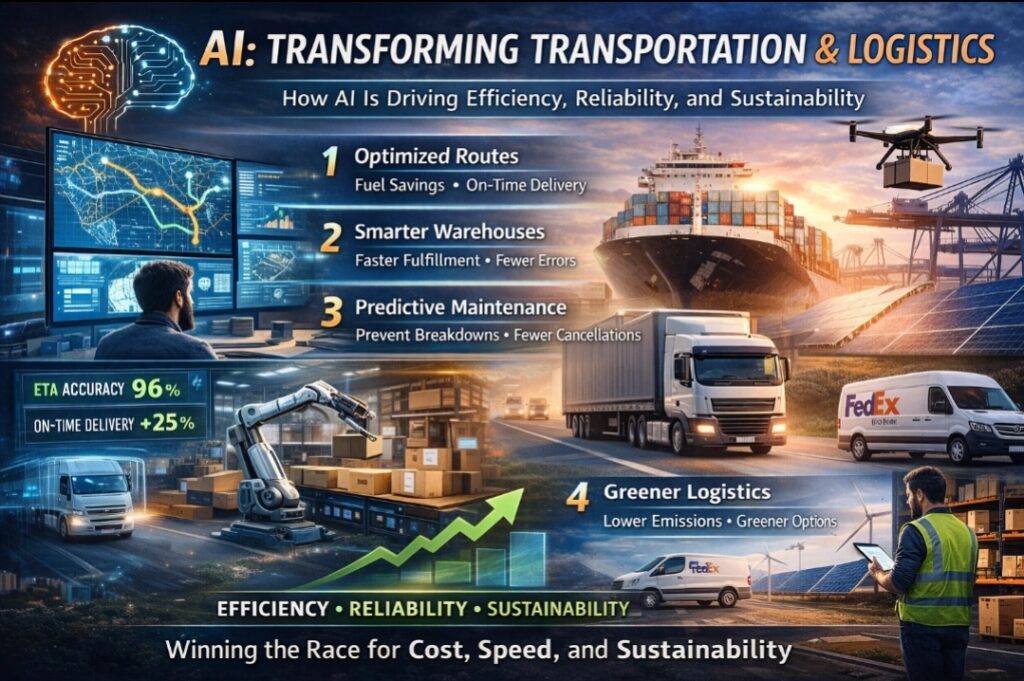
AI improves logistics efficiency in several areas. These include routing, warehousing, forecasting, maintenance, and sustainability planning.
Each use case directly affects CX metrics such as on-time delivery, service reliability, and customer satisfaction.
How Does AI Improve Route Planning and Delivery Optimization?
AI route optimization analyzes real-time traffic, weather, delivery windows, and vehicle capacity to create dynamic delivery plans.
This allows logistics companies to adapt quickly when conditions change.
A well-known example is , which deployed its AI-powered routing platform called .
The system evaluates millions of routing combinations daily.
The results have been dramatic.
- Reduced miles driven across delivery routes
- Lower fuel consumption
- Faster deliveries
- More accurate ETAs
For CX teams, the impact is simple: customers receive deliveries closer to promised times.
How Is AI Transforming Warehousing and Fulfillment?
Warehouses have become one of the most visible areas of AI transformation.
Automation, robotics, and computer vision now support faster order processing and inventory management.
One of the most prominent examples is , which operates large robotic fulfillment centers using technology.
Robots move shelves across warehouse floors while AI systems coordinate picking, sorting, and packaging.
This leads to:
- Faster fulfillment times
- Higher order accuracy
- Lower manual strain on workers
From an EX perspective, warehouse employees spend less time searching for products and more time managing exceptions or complex tasks.
From a CX perspective, orders ship faster and arrive sooner.
How Does Predictive Maintenance Improve Logistics Reliability?
Logistics networks depend on fleets of trucks, aircraft, containers, and handling equipment.
Unexpected equipment failures create delays across supply chains.
AI solves this problem through predictive maintenance.
Sensors installed on vehicles collect data about engine performance, temperature, vibration, and component wear.
Machine learning models analyze this data to detect early signs of failure.
Companies like increasingly use predictive analytics to monitor fleet and infrastructure performance across global networks.
Benefits include:
- Reduced breakdowns
- Lower repair costs
- Fewer shipment delays
For customers, this translates into more reliable delivery commitments.
How Is AI Improving Demand Forecasting and Inventory Planning?
Demand forecasting has historically been one of the most difficult supply chain challenges.
Traditional forecasting relied heavily on historical data and manual spreadsheets.
AI models now analyze multiple signals simultaneously:
- Historical demand
- Seasonality
- Promotions
- Weather
- Economic indicators
- Regional demand patterns
Retailers and logistics providers use these insights to position inventory closer to demand.
This reduces stockouts while minimizing excess inventory.
Companies like increasingly integrate AI forecasting tools into global supply chain planning systems.
For CX teams, the benefit is clear:
Customers see fewer “out of stock” messages and shorter delivery windows.
Transportation and Logistics: How Is Generative AI Changing Logistics Operations?
Generative AI is beginning to influence logistics operations beyond traditional optimization models.
Large language models now support several operational tasks.
Examples include:
- Automating shipment documentation
- Generating customs paperwork
- Summarizing logistics incidents
- Recommending solutions for disruptions
Logistics control towers increasingly use AI assistants to identify anomalies across networks.
For example, systems can detect when weather conditions threaten a shipment lane and suggest alternate routing.
This allows teams to resolve problems before customers even notice them.
How Is AI Supporting Sustainable Logistics?
Sustainability is becoming a strategic priority for global supply chains.
Transportation accounts for a significant portion of global carbon emissions.
AI helps reduce emissions through smarter planning.
Key applications include:
- Route optimization to reduce empty miles
- Load consolidation
- Mode switching from road to rail
- Energy optimization in warehouses
Logistics firms including are exploring AI-based systems to improve network efficiency while advancing sustainability goals.
Customers increasingly prefer brands that demonstrate responsible logistics practices.
AI makes it possible to deliver both efficiency and sustainability.
What Are the Biggest Barriers to AI Adoption in Logistics?
Despite its promise, AI adoption still faces several obstacles.
The most common challenge is data fragmentation.
Logistics organizations often operate multiple systems:
- Transportation management systems
- Warehouse management systems
- telematics platforms
- ERP systems
- customer service tools
If these systems cannot share data easily, AI models cannot deliver accurate insights.
Common Pitfalls
CX and operations leaders frequently encounter these mistakes:
- Investing in AI tools without defining clear business outcomes
- Ignoring data integration challenges
- Underestimating change management
- Treating AI as an IT experiment instead of an operational strategy
Successful organizations treat AI adoption as a transformation program, not a technology project.
What Framework Can CX Leaders Use to Deploy AI in Logistics?
CX leaders can adopt a practical framework that aligns AI initiatives with business outcomes.
The Four-Lens AI Adoption Framework
1. Value Lens
Start with a clear problem.
Examples include:
- Poor ETA accuracy
- High delivery failure rates
- Excess inventory
- Long fulfillment times
Tie each AI use case to measurable KPIs.
2. Data Lens
Evaluate whether the required data exists.
Key sources include:
- telematics data
- shipment tracking systems
- warehouse inventory systems
- customer feedback
Clean, integrated data is essential for reliable AI insights.
3. Experience Lens
Define how AI will improve both customer and employee experiences.
Examples:
- Real-time delivery notifications
- proactive disruption alerts
- automated exception handling
- AI co-pilots for planners
4. Operating Model Lens
Assign ownership for AI initiatives.
Successful companies create cross-functional teams that include:
- CX leaders
- operations leaders
- data scientists
- IT architects
This alignment accelerates adoption and value realization.
Which AI Use Cases Deliver the Fastest Logistics Impact?
Organizations often begin with a few high-impact use cases.
| AI Use Case | Operational Impact | CX Outcome |
|---|---|---|
| Dynamic route optimization | Real-time routing adjustments | More accurate ETAs |
| Predictive maintenance | Reduced vehicle downtime | Fewer delivery delays |
| AI warehouse automation | Faster picking and sorting | Faster order fulfillment |
| Demand forecasting | Improved inventory planning | Reduced stockouts |
| Control tower intelligence | Automated exception detection | Faster customer updates |
| Sustainability optimization | Lower fuel consumption | Greener delivery options |
These use cases generate measurable results within months.
How Should CX Teams Measure AI Success?
AI initiatives should be evaluated using a balanced set of metrics.
Efficiency Metrics
- Cost per shipment
- Fuel consumption per delivery
- Warehouse throughput per labor hour
Service Metrics
- On-time delivery rate
- First-attempt delivery success
- Order accuracy
Experience Metrics
- Customer satisfaction scores
- Net promoter score
- customer service resolution time
Sustainability Metrics
- emissions per shipment
- fuel usage per kilometer
- share of low-carbon transport modes
When tracked together, these metrics reveal how AI affects both operations and experience.
FAQ: AI in Transportation and Logistics
Can small logistics companies benefit from AI?
Yes. Many AI tools are now available as cloud-based platforms. Smaller companies can adopt route optimization, forecasting tools, and telematics analytics without large infrastructure investments.
What data should logistics organizations prioritize?
High-quality operational data is essential. Key data sources include shipment tracking, vehicle telematics, warehouse inventory, and customer service interactions.
Will AI replace logistics workers?
AI is more likely to augment workers than replace them. It reduces repetitive tasks and helps employees focus on problem-solving and exception management.
Can AI help logistics companies meet sustainability goals?
Yes. AI improves load planning, reduces empty miles, and identifies lower-carbon transport options. These improvements significantly reduce emissions.
Why do many AI pilots fail to scale?
Many pilots fail because organizations underestimate integration challenges and change management requirements. Successful initiatives include clear scaling plans from the start.
Actionable Takeaways for CX and EX Leaders
- Map the top logistics pain points affecting customer experience. Identify where AI can reduce delays or errors.
- Launch one focused pilot such as dynamic route optimization in a specific region. Measure impact clearly.
- Integrate logistics data across TMS, WMS, and telematics platforms to support reliable AI models.
- Create cross-functional AI teams that include CX, operations, and technology leaders.
- Invest in training for planners, drivers, and warehouse teams so they understand AI insights.
- Track a balanced scorecard that includes cost, service reliability, customer satisfaction, and sustainability.
- Document early success stories and scale proven AI use cases across the network.
- Treat AI as a long-term capability that compounds efficiency and experience gains over time.
For CX leaders navigating fragmented supply chains and rising customer expectations, AI offers something powerful: predictability in a complex world.
When logistics intelligence improves, promises become reliable.
And when promises become reliable, customer experience becomes unforgettable.
The post Transportation and Logistics: Practical Ways AI Is Improving Efficiency and Customer Experience appeared first on CX Quest.


You May Also Like

South Korea’s Crucial Crackdown: Crypto and Financial Assets Now Scrutinized in Debt Adjustment Reviews

XRP News: Evernorth Reveals Massive Exchange Outflow Ahead of Ripple’s XRP Las Vegas