

Adaptive Capital In Web3: Why Strategy Matters More Than Yield
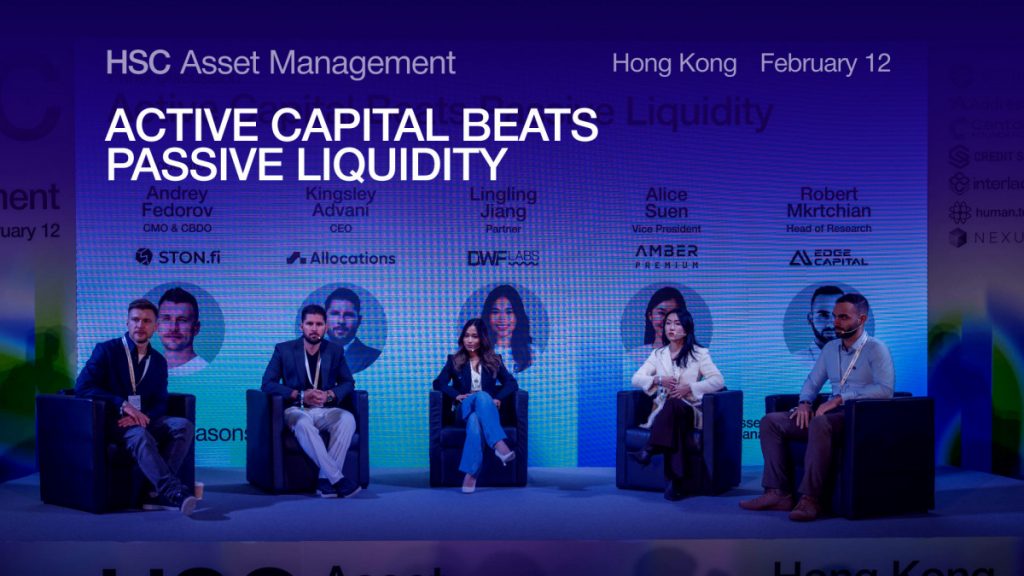
In the Hack Seasons panel of HSC Asset Management, the leaders of STON.fi, Allocations, DWF Labs, Amber Premium, and Edge Capital entered the main question of the digital asset markets. Does active capital really beat passive liquidity?
Concurrence among the panelists was that definitions are important. Passive liquidity is generally considered to be capital invested into the strategies of baseline yield, staking, lending, or stablecoin farming, without active management. Active capital, in its turn, entails active portfolio management, arbitrage, structured products, derivatives, and tactical reallocation across protocols.
However, some speakers reported that most of the strategies are in the middle. Even the yield farming groups with billions of dollars may not rebalance every hour, however, neither do they leave capital unchanged after a year. That difference is not so dichotomous.
What Does “Beating” Actually Mean?
Although the higher returns are usually the headline measure, the panelists have highlighted the risk-adjusted performance as the actual measure. The increase in APY must be higher than the increase in volatility and drawdowns.
It is often mentioned in the discourse that the Sharpe ratio works, the extra amount of return earned per unit risk. Here, active capital can only beat passive liquidity when it enhances risk-adjusted returns, and not nominal yield.
Another definition of outperformance was resiliency throughout the market cycles. Surviving bear market strategies, maintaining capital when the markets are volatile, and dynamic strategies might perform better over time, even though they might be trailing in short bull markets.
Market Conditions Shape Strategy
Strategic effectiveness is moderately accepted by the participants to rely on the market conditions. During bull markets, more arbitrage and tactical opportunities are offered by volatility and new protocol launches. Active capital can take advantage of inefficiency at centralized and decentralized venues.
Passive yield, especially of stablecoins, can be more appealing in sideways markets or lower-volatility markets. Constant income plans can provide better returns (risk-adjusted) as there are more opportunities for risk reduction.
In a bearish situation, risk management will take center stage. Active Managers tend to move to a risk-off position, preferring insured vaults or tokenized Treasury securities or conservative sources of yield. Its aim is no longer outperforming aggressively but capital preservation.
Complexity, Automation, and AI
Another issue that was discussed by the panel was whether strategy complexity can increase returns. The consensus was tentative. The only reason to add layers of leverage, or derivatives, or cross-protocol exposure, is when risk-adjusted returns are going to be better.
The gap between the active and passive approaches is narrowing due to automation and AI. It is now possible to do automatic harvesting, rebalancing, stop-loss triggers, and sentiment monitoring. New AI agents can soon track macro, technical, and on-chain indicators concurrently, allowing them to deploy capital in a more responsive manner without the need to monitor them invariably.
Nonetheless, complexities without disclosure introduce other risks, namely, smart contract risk and counterparty exposure.
The discussion went into regulation. Others claimed that institutional capital needs regulated structures, especially to protect assets as well as comply with the regulatory requirements. Others argued based on the fact that innovation can be realized based on permissionless experimentation because unregulated decentralized platforms can attain great scale.
One hybrid model was the most realistic. Institutional participation would be regulated through gateways, and open DeFi ecosystems would be maintained to maintain innovation and healthy competition.
Active Capital as Ecosystem Builder
Active capital was also conceptualized as ecosystem-shaping besides returns. Liquidity, feedback, and long-term support to protocols are offered by market makers, strategic investors, and interested capital allocators. Passive liquidity is the basis of depth, and active capital is the basis of growth, efficiency, and resilience.
The decision of the panel was delicate. Active capital does not necessarily overcome passive liquidity. It works best when it improves risk-adjusted returns, changes through cycles, and is beneficial in the development of the ecosystem. In the crypto markets, it is not the reason to choose any of them, it is the ability to balance both of them.
The post Adaptive Capital In Web3: Why Strategy Matters More Than Yield appeared first on Metaverse Post.


You May Also Like

Trump Impeachment Odds Surge to 66%

Security Sucks in General Nowadays. Blockchains Just Tend To Have an Immediate Payoff




