

Must Read
NEW IRIANIAN LEADER. Mojtaba Khamenei, the second son of Iran's Supreme Leader Ayatollah Ali Khamenei, visits Hezbollah's office in Tehran, Iran, October 1, 2024NEW IRIANIAN LEADER. Mojtaba Khamenei, the second son of Iran's Supreme Leader Ayatollah Ali Khamenei, visits Hezbollah's office in Tehran, Iran, October 1, 2024
Oil shoots higher, shares skid as Middle East conflict drags on
For feedback or concerns regarding this content, please contact us at crypto.news@mexc.com
SYDNEY, Australia – Share markets nosedived in Asia on Monday, March 9, as the inflationary shock from surging oil prices threatened to raise living costs and possibly interest rates worldwide, while an investor hunger for liquidity kept the US dollar in demand.
Brent LCOc1 soared 23% to $114.36 a barrel, the biggest daily gain since at least 1988, on top of a 28% rise last week. US crude CLc1 shot up a staggering 27% to $115.11, threatening to push gasoline prices sharply higher.
Iran named Mojtaba Khamenei to succeed his father Ali Khamenei as supreme leader, signaling that hardliners remained firmly in charge in Tehran a week into its conflict with the US and Israel.
That was unlikely to be welcomed by US President Donald Trump, who had declared the son “unacceptable.”
With no sign of an end to hostilities in the Middle East and tankers still avoiding the Strait of Hormuz, investors were bracing for a prolonged period of higher energy costs.
“The global economy remains dependent on the concentrated flow of Mideast oil and natural gas through the Strait of Hormuz,” noted Bruce Kasman, chief economist at JPMorgan.
“The near-term scenario is a spike toward $120 per barrel followed by moderation as the conflict subsides,” he added. “But absent a clear and decisive political resolution, Brent crude oil prices are expected to settle at an elevated $80 per barrel through mid-year.”
Such an outcome could cut global economic growth by an annualized 0.6% for the first half of this year and raise consumer prices by an annual rate of 1%, Kasman said.
He cautioned that a broader and sustained conflict could send oil well above $120 a barrel and risk a global recession.
All of this was sobering news for Japan, a major importer of oil and gas, knocking the Nikkei .N225 down 7.5% on top of a 5.5% drop last week.
South Korea’s high-flying market fell closer to earth with a drop of 8.1%, having already shed more than 10% last week.
China is another big oil importer, though it also has a huge stockpile of crude; its blue-chip index .CSI300 fell 2.3%.
China on Monday said inflation had already picked up in February ahead of the current oil spike, with consumer prices rising 1.3% year-on-year. This is not necessarily a negative development, given the country has long struggled with disinflation.
Facing inflation conundrum
The wave of market selling swept over Wall Street as S&P 500 futures ESc1 shed 2.1%, while Nasdaq futures NQc1 dived 2.5%. Over in Europe, EUROSTOXX 50 futures STXEc1 and DAX futures FDXc1 both slid 3.2%, while FTSE futures FFIc1 dropped 1.7%.
In bond markets, the risk of rising inflation outweighed safe-haven considerations, pushing yields higher globally. Yields on 10-year Treasury notes US10YT=RR rose 6 basis points to 4.204%, up from a trough of 3.926% just a week ago.
Interest rate futures 0#FF: slipped as investors feared that higher inflation would make it harder for the Federal Reserve to ease policy, even though disappointing jobs numbers seemed to argue for stimulus.
Data on US consumer prices due Wednesday is forecast to show the annual pace holding at 2.4% in February.
The Fed’s preferred measure of core inflation is out on Friday and is forecast to hold at 3.0%, well above the central bank’s 2% target, and analysts see a risk of an even higher number.
The danger of energy-driven inflation has led markets to wager that the next move in rates from the European Central Bank could be up, possibly as early as June. 0#EURIRPR
For the Bank of England, markets have shifted to pricing just a 40% chance of one more easing, compared with two cuts or more before the Middle East conflict started. 0#GBPIRPR
Nervous investors sought the liquidity of dollars while shunning currencies from countries that are net energy importers, including Japan and much of Europe.
“Asia takes the brunt of the sharp escalation in oil prices, and there are few places to run and hide,” said Vishnu Varathan, head of macro research for Asia ex-Japan at Mizuho.
“The dollar has to be the one outperforming, given Japan and Korea’s exposures here and the sharp pain that can be expected from Brent at $107.”
The dollar added 0.5% to 158.64 yen JPY=EBS, while the euro slipped 0.9% to $1.1514 EUR=EBS. The Australian dollar, often sold as a hedge during periods of market volatility, skidded 0.9% to $0.6964 AUD=D3.
Gold fell 1.8% to $5,075 an ounce XAU=, with dealers speculating that investors were booking profits made on the metal’s long climb to cover losses elsewhere. – Rappler.com
Market Opportunity
ALI Price(ALI)
$0.00153
$0.00153$0.00153
USD
ALI (ALI) Live Price Chart


Disclaimer: The articles reposted on this site are sourced from public platforms and are provided for informational purposes only. They do not necessarily reflect the views of MEXC. All rights remain with the original authors. If you believe any content infringes on third-party rights, please contact crypto.news@mexc.com for removal. MEXC makes no guarantees regarding the accuracy, completeness, or timeliness of the content and is not responsible for any actions taken based on the information provided. The content does not constitute financial, legal, or other professional advice, nor should it be considered a recommendation or endorsement by MEXC.
You May Also Like

The Chemistry of UV Resistance: How Titanium Dioxide Protects Against the California Sun
Homeowners considering synthetic boundary systems frequently voice a singular, pervasive concern: “Will the material turn yellow and brittle after a few years in
Share
Techbullion2026/04/02 18:06
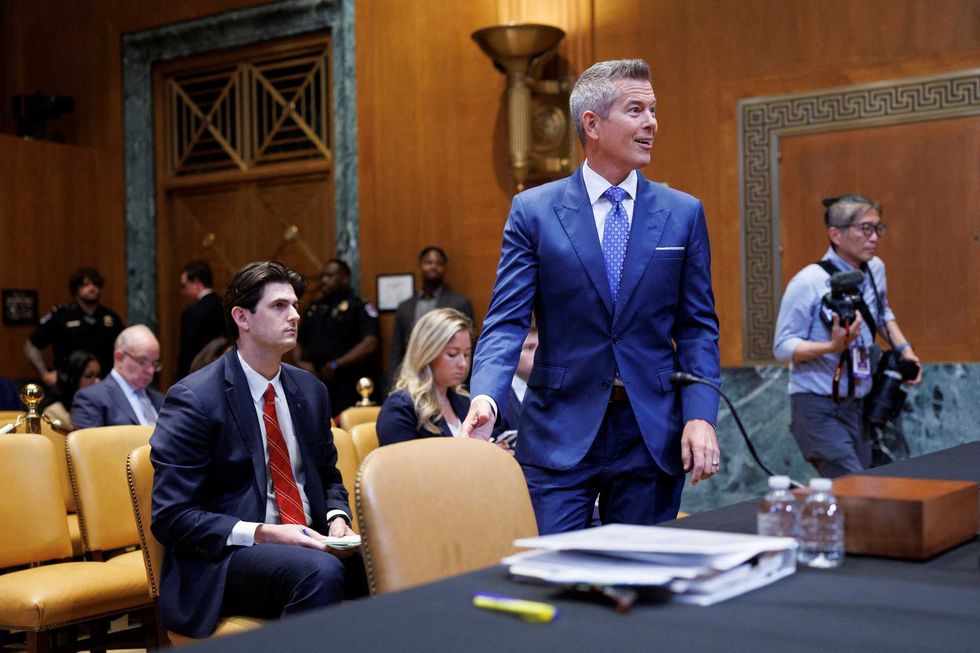
'You are wasting my time': Senator loses patience as Sean Duffy retorts 'Welcome to MAGA'
Another lawmaker could barely stand the way Trump's transportation secretary refused to answer straightforward questions during Capitol Hill testimony on Tuesday
Share
Rawstory2026/05/20 06:22

Google’s new AI agents transform Search into a 24/7 personal information assistant
BitcoinWorld Google’s new AI agents transform Search into a 24/7 personal information assistant At its annual I/O developer conference on May 27, 2026, in Mountain
Share
bitcoinworld2026/05/20 06:00



