

S&P 500 Futures Plunge 2%: Middle East Crisis and Soaring Oil Prices Spark Market Turmoil
BitcoinWorld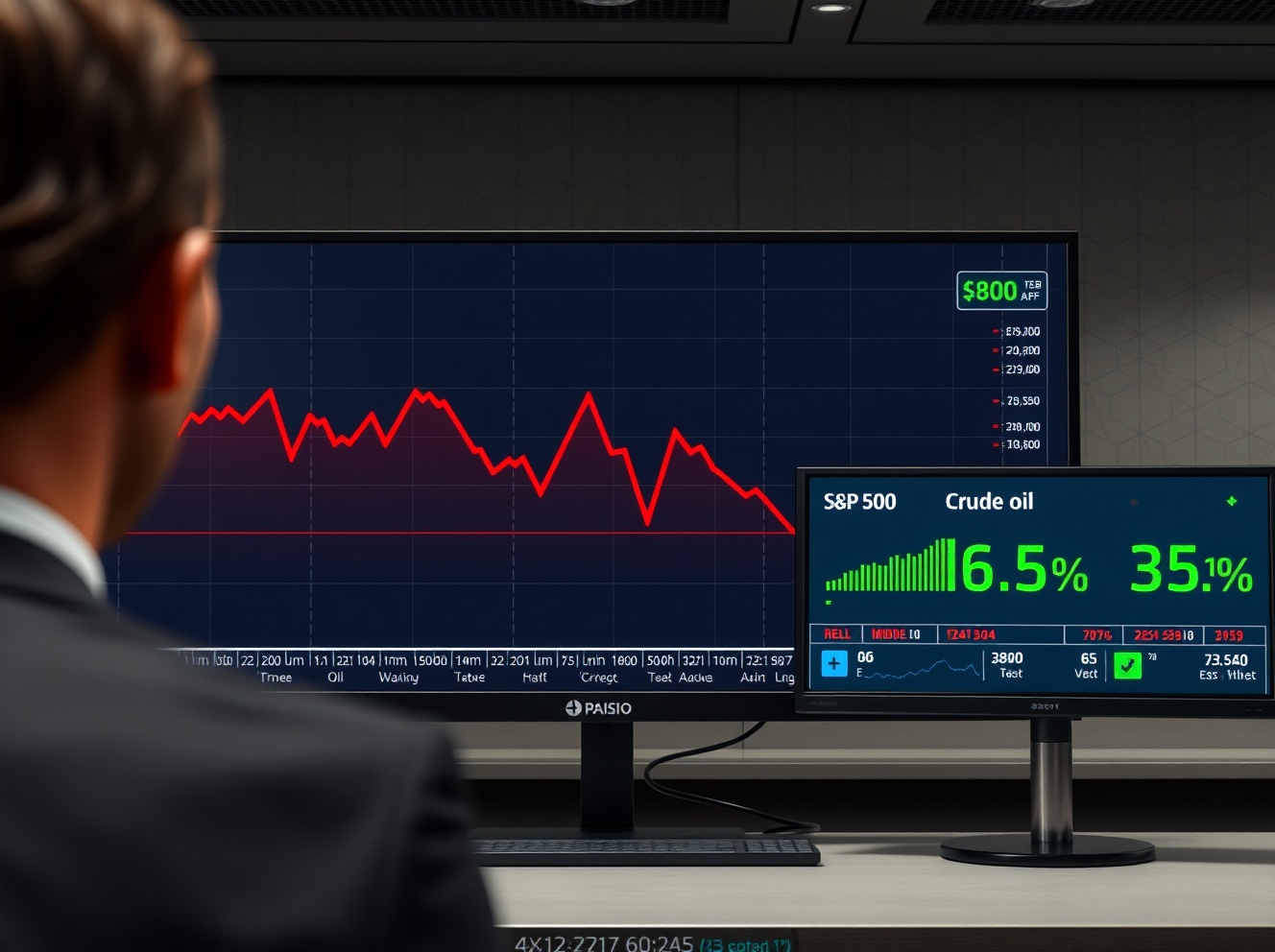
S&P 500 Futures Plunge 2%: Middle East Crisis and Soaring Oil Prices Spark Market Turmoil
NEW YORK, April 10, 2025 — Global financial markets opened the week under severe pressure as S&P 500 futures plunged more than 2% in overnight trading. This significant pre-market decline directly correlates with escalating geopolitical tensions in the Middle East and a concurrent, sharp spike in global crude oil prices. Consequently, investors are bracing for a volatile session, fearing a repeat of past energy-driven market corrections.
S&P 500 Futures Drop Amid Geopolitical Shockwaves
The benchmark S&P 500 futures contract, specifically the E-mini, fell decisively below key technical support levels. This move signals a potent risk-off sentiment sweeping across equity markets. Typically, futures provide a critical glimpse into the expected direction of the cash market at the opening bell. Therefore, a drop of this magnitude in a major index future often precedes widespread selling pressure. Market analysts immediately pointed to two interconnected catalysts: renewed military confrontations in a critical Middle Eastern oil-producing region and the subsequent reaction in energy markets.
Historical data reveals a strong inverse correlation between sharp oil price increases and equity market performance, particularly for indices heavy with industrial and consumer discretionary stocks. For instance, the S&P 500 energy sector may show resilience or gains, but the broader index suffers due to anticipated impacts on corporate costs, consumer spending, and inflation expectations. The current sell-off appears broad-based, affecting technology, automotive, and airline stocks most prominently in pre-market indications.
Expert Analysis on the Futures Plunge
Dr. Anya Sharma, Chief Global Strategist at Meridian Capital, provided context. “A 2% futures move is substantial and reflects a repricing of near-term risk,” she stated. “The mechanism is straightforward: higher oil prices act as a tax on growth. They increase input costs for businesses and reduce disposable income for consumers. The market is swiftly discounting the potential for lower corporate earnings and heightened central bank caution regarding inflation.” This analysis aligns with the immediate market reaction, where bond yields also fell as capital sought safety.
Middle East Tensions Trigger Global Oil Price Surge
The immediate trigger for the market turmoil stems from a significant escalation of hostilities over the weekend. Reports confirmed targeted strikes on key energy infrastructure, disrupting supply routes and raising immediate concerns about crude availability. Brent crude futures, the global benchmark, surged over 8% in early Asian trading, breaching the $95 per barrel mark. Similarly, West Texas Intermediate (WTI) crude followed with comparable gains.
This region accounts for a substantial portion of global seaborne oil trade. Any threat to transit through critical chokepoints sends shockwaves through the commodities complex. The price reaction was exacerbated by already-tight global inventories, which have been declining due to prolonged production discipline by major exporters. The following table illustrates the immediate commodity market impact:
| Commodity | Price Change (%) | Key Price Level |
|---|---|---|
| Brent Crude Oil | +8.2% | $95.40/barrel |
| WTI Crude Oil | +7.9% | $91.80/barrel |
| Gasoline Futures (RBOB) | +6.5% | $2.85/gallon |
| Gold (Safe Haven) | +1.8% | $2,350/ounce |
Furthermore, the volatility index (VIX), often called the market’s “fear gauge,” spiked by over 25%. This indicates traders are pricing in significantly larger expected swings for the S&P 500 in the coming days. Energy analysts warn that sustained prices above $90 per barrel could begin to meaningfully dent global economic growth forecasts, which were already modest.
Historical Context and Potential Market Impacts
This event echoes several historical episodes where Middle East instability roiled financial markets. Notably, the market reactions to the 1990 Gulf War and the 2019 attacks on Saudi Arabian facilities provide relevant parallels. In each case, a sharp, transient spike in oil prices was followed by equity market weakness. However, the duration and depth of the impact depended on the scale and persistence of the supply disruption.
The potential impacts on the real economy and corporate sector are multifaceted:
- Inflation Pressure: Rising energy costs feed directly into higher transportation and production costs, potentially complicating central bank policies aimed at price stability.
- Consumer Sentiment: Higher prices at the gasoline pump can quickly dampen consumer confidence and reduce spending on non-essential goods and services.
- Corporate Margins: Companies with less pricing power may see earnings estimates revised downward as their cost structures deteriorate.
- Sector Rotation: Capital typically flows away from rate-sensitive and high-growth stocks toward defensive sectors like utilities, consumer staples, and, ironically, energy itself.
Market technicians are now closely watching several key support levels for the S&P 500 cash index. A breach below these levels on high volume could signal a deeper corrective phase. Conversely, a rapid de-escalation of tensions could trigger a swift, albeit partial, rebound as shorts are covered.
The Global Ripple Effect
The sell-off was not confined to U.S. markets. Major European and Asian equity indices also opened sharply lower. Japan’s Nikkei 225 fell 1.8%, while Germany’s DAX index dropped 2.1%. Emerging markets, which are often more vulnerable to energy shocks and capital flight, experienced even steeper declines. Concurrently, the U.S. dollar strengthened as a traditional safe-haven currency, adding further pressure on multinational corporations whose overseas earnings are worth less when converted back to dollars.
Conclusion
The dramatic 2% drop in S&P 500 futures serves as a stark reminder of financial markets’ acute sensitivity to geopolitical and commodity shocks. The intertwined dynamics of Middle East tensions and soaring oil prices have created a perfect storm of risk aversion. While the immediate direction of the cash market session will hinge on geopolitical developments and official statements, investors should prepare for elevated volatility. The fundamental question for the market’s medium-term trajectory is whether this event represents a temporary disruption or the beginning of a more sustained period of risk repricing driven by structurally higher energy costs.
FAQs
Q1: What are S&P 500 futures and why do they matter?
S&P 500 futures are financial contracts that allow investors to bet on or hedge against the future value of the S&P 500 index. They trade nearly 24 hours a day and are a crucial indicator of market sentiment and expected direction at the U.S. market open, often reacting to overnight global news.
Q2: How do rising oil prices negatively affect the stock market?
Higher oil prices increase costs for most companies (transportation, manufacturing, plastics) and reduce consumer disposable income (higher gas and heating bills). This can lead to lower corporate profits and slower economic growth, which stock markets discount by lowering equity prices.
Q3: Has this happened before with Middle East tensions?
Yes, historically, geopolitical conflicts in oil-producing regions have frequently led to oil price spikes and stock market declines. Examples include the 1973 oil embargo, the 1990 Gulf War, and the 2019 Abqaiq–Khurais attack. The market impact depends on the perceived threat to long-term supply.
Q4: Which stock sectors are most and least affected by this news?
Sectors most negatively affected typically include airlines, transportation, consumer discretionary, and industrials due to higher fuel and input costs. Sectors that may be less affected or benefit include energy producers, utilities, and certain defensive consumer staples.
Q5: What should investors watch in the coming days?
Key indicators include: 1) The geopolitical situation and any diplomatic developments, 2) The price stability of Brent and WTI crude oil, 3) Official statements from major oil-producing nations regarding supply, 4) U.S. inventory data from the Energy Information Administration (EIA), and 5) Market breadth and volume during the cash equity session.
This post S&P 500 Futures Plunge 2%: Middle East Crisis and Soaring Oil Prices Spark Market Turmoil first appeared on BitcoinWorld.


You May Also Like

Critical USDT0 Response to Drift Hack Exposes Stark Contrast in Stablecoin Security Protocols

Pi Network Testnet Shows Real Progress With Live Payments and Smart Contracts




