U.S. Treasury Secretary Meets El Salvador President Bukele as Crypto Push Continues
Key Insights:
- El Salvador’s crypto agenda received new support from the U.S. during Scott Bessent’s meeting with President Bukele.
- The country softened its Bitcoin Law in 2025 as it was seeking a $1.4 billion IMF loan.
- Bitcoin adoption was still low, with 8% of Salvadorans reporting active use.
U.S. Treasury Secretary Scott Bessent and Salvadoran President Nayib Bukele met in Miami this weekend, bringing El Salvador’s crypto strategy back into the spotlight. The meeting took place during the Summit of the Americas and signaled a more amicable tone from Washington. That change is notable because past responses to El Salvador’s Bitcoin policy in the USA were often negative.
U.S. Treasury Secretary Scott Bessent and Bukele Meet
The meeting marked a major shift in how U.S. officials are discussing El Salvador’s digital asset strategy. After the talks, Scott Bessent praised Bukele’s economic reforms, as well as the attempt to position El Salvador as a digital assets hub. He also said both sides would continue working jointly on strategies to strengthen the hemisphere.
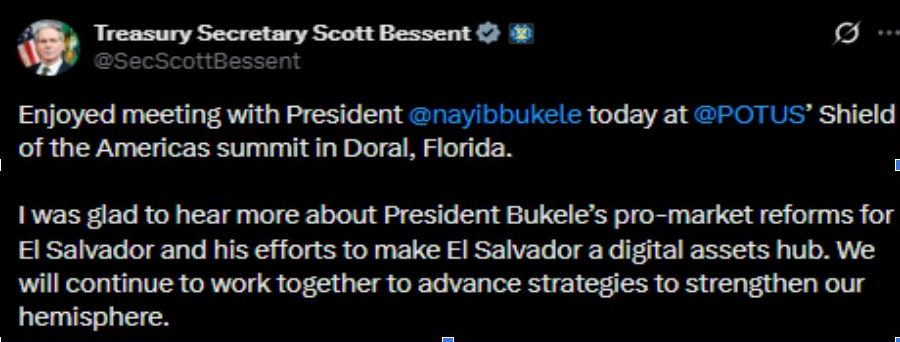 Source: Bessent, X
That message carried weight as relations were once much colder. When El Salvador made Bitcoin legal tender in 2021, the response from major international institutions was sharply negative. The International Monetary Fund, rating agencies, and U.S. officials all voiced concerns about financial stability and policy risk.
At the time, some US lawmakers also proposed legislation linked to potential risks to the American financial system. As a result, Bukele’s Bitcoin agenda frequently seemed more isolated than supported. Now, however, the current US administration’s pro-crypto stance appears to be affecting its foreign policy as well.
El Salvador Already Softened on Bitcoin Policy
Even so, the meeting comes after a major policy adjustment within El Salvador. In the first half of 2025, Bukele’s administration agreed to amend the country’s Bitcoin Law. That move came as the government is facing debt pressure and looking to borrow $1.4 billion from the IMF.
The concession altered a major part of the original Bitcoin plan. El Salvador eliminated Bitcoin’s mandatory legal tender status and established that it would limit the public sector’s direct involvement in crypto-related activities. That shift indicated that the government had to balance its Bitcoin ambitions with financial realities.
This was a big step because El Salvador had developed its international image on the basis of that 2021 legal tender decision. However, the revised framework made clear that the bolder part of the experiment had been scaled back. So, while the country maintained its crypto identity, the legal structure became less aggressive.
Domestic Bitcoin Adoption Remained Weak
The policy revision was also preceded by poor domestic adoption. According to a survey conducted in 2024-2025 by the Public Opinion Institute of the Jesuit Central American University, only 8 out of every 100 Salvadorans reported actively using Bitcoin. That number indicated that widespread popular usage had not taken hold.
This is important as the Bitcoin strategy was offered as a practical tool for the public. It was supposed to improve financial access, support payments, and reduce transaction costs. Instead, the policy’s practical use was limited, despite the global attention it attracted.
That gap has shaped the way the experiment is regarded today. Critics have said the initiative made news abroad but did not achieve deep-rooted local support. In turn, the 2025 changes were viewed as a response to both fiscal pressure and poor adoption by many.
Bitcoin Buying Continues Despite Legal Shift
Still, El Salvador did not completely break away from Bitcoin. Even after amending the law, the government kept on purchasing the asset. That decision suggested the administration still saw Bitcoin as strategically important, even if its role in daily payments weakened.
The Miami meeting is indicative of that new phase. El Salvador is no longer promoting Bitcoin as legal tender. Instead, it is showing its face as a digital asset hub linked to market reforms and investment positioning.
Bessent’s comments are consistent with that new framing. He focused on Bukele’s pro-market agenda and vision for digital assets, rather than consumer Bitcoin usage. As such, the discussion was transformed from public adoption to economic brands and regional fit. In the meantime, Bitcoin traded around $67,500, down 2% over the last 24 hours.
The post U.S. Treasury Secretary Meets El Salvador President Bukele as Crypto Push Continues appeared first on The Market Periodical.


You May Also Like

The Chemistry of UV Resistance: How Titanium Dioxide Protects Against the California Sun

Top Line plans Cebu energy complex to boost storage capacity