

Venezuela: USDT becomes the daily currency amid inflation and the collapse of the bolívar
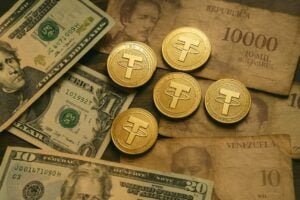
Receipts, rent, and even condominium expenses are increasingly being settled in USDT: Tether’s stablecoin has quickly become the price benchmark in an economy marked by high inflation (estimated around 229% annually, IMF) and strict capital controls. In this context, the bolívar is retreating in daily transactions, while the “digital dollar” is emerging as a practical tool for payment and store of value.
According to the data collected by our editorial team during reports in Caracas and other urban centers between 2023 and 2024, merchants, condominium administrators, and families describe an increasing daily use of USDT to pay for services and small supplies. Industry analysts observe that the combination of foreign currency remittances, high banking costs, and infrastructural issues has accelerated the adoption of stablecoins as an operational tool.
What is changing now: from the neighborhood store to the condominium bulletin board
In large cities as well as in inland areas, price lists in dollars and QR codes for payments in stablecoin are multiplying. The dynamic rests on the need to protect purchasing power and reduce friction in payments within a banking system that is often slow and costly. The result is a “hybrid” dollarization where cash and USDT coexist — with the latter increasingly taking on the role of a unit of account.
Three Prices for the Same Dollar
- Official rate (BCV): formal reference published by the central bank (BCV), used for contracts and administrative procedures.
- Parallel market: reflects demand and supply on cash and incorporates the risk and liquidity spread.
- P2P Price of Stablecoins: the practical value at which USDT circulates on peer-to-peer platforms and networks, often the most liquid for merchants and consumers.
Why the bolívar is retreating
- Protection from value erosion: with inflation in double or triple digits, savings in local currency quickly dwindle.
- Rapid transfers: instant payments via wallet allow settling suppliers and salaries without the usual banking delays.
- Access to remittances: many families receive remittances in dollars; converting them into stablecoins reduces costs and queues.
- Minor regulatory frictions: stablecoins allow, at least in the short term, to mitigate exposure to capital controls.
How merchants and families use stablecoins
- Listings in dollars, with real-time conversion to USDT according to the day’s P2P rate.
- Payments of rent, condominium fees, and domestic work through mobile wallets.
- Use of bolívar or cash dollars, depending on availability.
- Small merchants who prefer QR codes and lightweight wallets to keep costs down.
«With prices constantly changing, cashing out in USDT is the only way to avoid losing margin between morning and evening.» — voice of a local trader
Numbers and Indicators: How Widespread is Adoption
International data places Venezuela among the markets with high crypto adoption. According to the Chainalysis Global Crypto Adoption Index 2025, the country is listed among the economies with significant retail crypto activity during the period considered (report 2025). It should be noted that journalistic reports record daily payments in USDT for basic expenses, from phone top-ups to groceries (as reported by Cointelegraph).
- Retail transactions: prevalence of small-scale payments in stablecoins, particularly on P2P channels.
- “Anchored” prices: numerous listings refer to the P2P price of USDT as the daily value.
- Exchange volumes: consistent levels in local time zones suggest the use of stablecoins for payments, not just for speculative trading.
Rules, Sanctions, and Risks: The Hidden Side of Crypto Dollarization
- Centralized infrastructures: issuers like Tether can freeze funds on flagged addresses, exposing users to operational risks.
- Regulatory volatility: after the commissioning of Sunacrip (crypto regulator) in 2023, the framework remains in flux; regulation on mining and digital payments have undergone episodic tightenings.
- Transaction Taxes: the IGTF applied to foreign currency payments – and, in some cases, also to crypto transactions – reduces the economic advantage for merchants.
- International sanctions: the financial restrictions imposed on Venezuelan entities complicate cross-border payments, pushing towards alternative channels.
- Infrastructure risk: blackouts, unstable connectivity, and interruptions of digital platforms can block revenues and salaries.
- Inclusion: not everyone has access to smartphones or an adequate level of digital literacy, creating new disparities.
Rates and Prices: A Multi-Speed Economy
The coexistence of the official rate, the parallel market, and the P2P price of USDT creates a “three-speed” structure. In the calculation of practical prices, the liquidity of the stablecoin market often makes the P2P rate the most reliable anchor for buyers and sellers. That said, this mechanism, while reducing daily friction, introduces asymmetries between those who have access to digital liquidity and those who remain excluded.
Banks and Companies: The Silent Adaptation
Some economic operators integrate the use of stablecoins in international transactions to mitigate delays and blocks. On the retail side, small and medium-sized merchants adopt wallets that function as a digital cash register, allowing them to receive payments in real-time and settle payments to suppliers with almost instantaneous settlement. Indeed, it is not a uniform adoption: the use of stablecoins is concentrated in supply chains more exposed to imports and remittances.
«We accept USDT for supplies and convert only when necessary to pay utilities: we minimize exposure to the bolívar.» — food industry entrepreneur
What to Expect in the Coming Months
- De facto stabilization: USDT consolidates as an informal unit of account for salaries and rents, even without official reforms.
- Regulatory pressure: potential clarifications on taxation and reporting of crypto transactions, impacting merchants’ margins.
- Rate convergence: if P2P liquidity remains high, the differential with the parallel market rate could decrease during periods of higher currency supply.
- Counterparty risks: more attention to custody, KYC procedures, and issuer blocking policies to avoid fund freezing.
In summary
The use of stablecoins in Venezuela has surpassed the experimental phase, becoming a daily infrastructure for pricing, payments, and savings.
While offering tactical stability in an extremely complex context, this system does not address the structural causes of inflation and the overall fragility of the economic system. Without macroeconomic reforms and clear regulatory certainty, dollarization remains incomplete, shifting the center of payments outside the banking circuit and introducing immediate benefits but also new vulnerabilities.
You May Also Like

Uniswap Price Compression Signals Potential Breakout Toward $5.30

Latam Insights: Paraguay Adds Stringent Crypto Reporting Rules, Argentina Blocks Peso Stablecoin
