Nemo Protocol, a decentralized finance (DeFi) yield platform operating on the Sui blockchain, fell victim to a cyberattack that resulted in $2.4 million in losses just ahead of its scheduled maintenance window on Monday and Tuesday. The security breach was initially detected by PeckShieldAlert on September 8, which reported via X that approximately $2.4 million in USDC had been drained from Nemo’s systems. According to the blockchain security firm’s investigation, the hacker swiftly moved the stolen assets via Circle by bridging USDC on Arbitrum to Ethereum. $6.3M TVL Crashes 75% as Users Flee Nemo Protocol Nemo acknowledged the incident in a subsequent tweet, stating that the protocol had experienced a security breach the previous evening that affected its Market pool. The development team confirmed that an investigation was in progress to identify the root cause of the vulnerability. As a precautionary measure, all smart contract operations were temporarily halted. The attack’s impact was immediately felt. According to DeFiLlama data, Nemo’s total value locked (TVL) collapsed to approximately $1.57 million from over $6.3 million before the breach.Source: DefilLama User withdrawals exceeded $3.8 million worth of USDC and SUI tokens as investors rushed to exit, fearing the exploit’s scope might be more extensive than initially disclosed.Source: DefilLama The breach specifically targeted Nemo’s yield-trading mechanism, which enables users to divide staked assets into Principal Tokens (PTs) and Yield Tokens (YTs) for yield speculation purposes. According to blockchain security auditor CertiK, security risks may arise from multiple sources, including coding errors, blockchain network vulnerabilities, and programming language limitations. Sui Blockchain Security Crisis Contributed to $2.37 Billion DeFi Losses in 2025 Notably, the Nemo security breach marks the third major hack targeting DeFi protocols this month. Earlier in September, Venus protocol lost $13.5 million to attackers, followed by an $8.4 million theft from the Bunni protocol. Similarly, in the Sui ecosystem, the Nemo incident follows another significant breach on the Layer-1 network from earlier this year. On May 22, Cetus Protocol, a prominent decentralized exchange and liquidity provider, suffered a $223 million exploit. The attacker leveraged an arithmetic overflow flaw in a third-party code library to complete the drain within 15 minutes. Moreover, these DeFi-focused attacks are on the rise in 2025. SlowMist’s mid-year analysis revealed that the blockchain sector experienced over $2.37 billion in losses across 121 security incidents during the first half of the year.Source: SlowMist DeFi protocols alone accounted for 76% of these cases, although centralized exchanges recorded higher individual losses. A complementary report from Hacken’s 2025 mid-year security assessment estimated total crypto industry losses at over $3.1 billion within the first six months.Source: Hacken Access control vulnerabilities, including misconfigured wallets and compromised legacy keys, represented 59% of these losses, while DeFi-specific smart contract exploits accounted for $263 million, or roughly 8%. A recent interview between Cryptonews and Mitchell Amador, founder and CEO of Immunefi, highlighted why conventional security methodologies prove inadequate in Web3’s open-source ecosystem. Amador explained that “Traditional audits, being static and pre-launch focused, fail to identify post-deployment vulnerabilities present in dynamic DeFi environments.” He advocated for bug bounty programs as a solution to incentivize ethical hackers, fundamentally restructuring cybersecurity economics to make defensive measures more lucrative than offensive onesNemo Protocol, a decentralized finance (DeFi) yield platform operating on the Sui blockchain, fell victim to a cyberattack that resulted in $2.4 million in losses just ahead of its scheduled maintenance window on Monday and Tuesday. The security breach was initially detected by PeckShieldAlert on September 8, which reported via X that approximately $2.4 million in USDC had been drained from Nemo’s systems. According to the blockchain security firm’s investigation, the hacker swiftly moved the stolen assets via Circle by bridging USDC on Arbitrum to Ethereum. $6.3M TVL Crashes 75% as Users Flee Nemo Protocol Nemo acknowledged the incident in a subsequent tweet, stating that the protocol had experienced a security breach the previous evening that affected its Market pool. The development team confirmed that an investigation was in progress to identify the root cause of the vulnerability. As a precautionary measure, all smart contract operations were temporarily halted. The attack’s impact was immediately felt. According to DeFiLlama data, Nemo’s total value locked (TVL) collapsed to approximately $1.57 million from over $6.3 million before the breach.Source: DefilLama User withdrawals exceeded $3.8 million worth of USDC and SUI tokens as investors rushed to exit, fearing the exploit’s scope might be more extensive than initially disclosed.Source: DefilLama The breach specifically targeted Nemo’s yield-trading mechanism, which enables users to divide staked assets into Principal Tokens (PTs) and Yield Tokens (YTs) for yield speculation purposes. According to blockchain security auditor CertiK, security risks may arise from multiple sources, including coding errors, blockchain network vulnerabilities, and programming language limitations. Sui Blockchain Security Crisis Contributed to $2.37 Billion DeFi Losses in 2025 Notably, the Nemo security breach marks the third major hack targeting DeFi protocols this month. Earlier in September, Venus protocol lost $13.5 million to attackers, followed by an $8.4 million theft from the Bunni protocol. Similarly, in the Sui ecosystem, the Nemo incident follows another significant breach on the Layer-1 network from earlier this year. On May 22, Cetus Protocol, a prominent decentralized exchange and liquidity provider, suffered a $223 million exploit. The attacker leveraged an arithmetic overflow flaw in a third-party code library to complete the drain within 15 minutes. Moreover, these DeFi-focused attacks are on the rise in 2025. SlowMist’s mid-year analysis revealed that the blockchain sector experienced over $2.37 billion in losses across 121 security incidents during the first half of the year.Source: SlowMist DeFi protocols alone accounted for 76% of these cases, although centralized exchanges recorded higher individual losses. A complementary report from Hacken’s 2025 mid-year security assessment estimated total crypto industry losses at over $3.1 billion within the first six months.Source: Hacken Access control vulnerabilities, including misconfigured wallets and compromised legacy keys, represented 59% of these losses, while DeFi-specific smart contract exploits accounted for $263 million, or roughly 8%. A recent interview between Cryptonews and Mitchell Amador, founder and CEO of Immunefi, highlighted why conventional security methodologies prove inadequate in Web3’s open-source ecosystem. Amador explained that “Traditional audits, being static and pre-launch focused, fail to identify post-deployment vulnerabilities present in dynamic DeFi environments.” He advocated for bug bounty programs as a solution to incentivize ethical hackers, fundamentally restructuring cybersecurity economics to make defensive measures more lucrative than offensive ones

Nemo Protocol Loses $2.4M to Hackers on Sui Blockchain Before Planned Maintenance

2025/09/09 00:36
3 min read

Nemo Protocol, a decentralized finance (DeFi) yield platform operating on the Sui blockchain, fell victim to a cyberattack that resulted in $2.4 million in losses just ahead of its scheduled maintenance window on Monday and Tuesday.

The security breach was initially detected by PeckShieldAlert on September 8, which reported via X that approximately $2.4 million in USDC had been drained from Nemo’s systems.

According to the blockchain security firm’s investigation, the hacker swiftly moved the stolen assets via Circle by bridging USDC on Arbitrum to Ethereum.

$6.3M TVL Crashes 75% as Users Flee Nemo Protocol

Nemo acknowledged the incident in a subsequent tweet, stating that the protocol had experienced a security breach the previous evening that affected its Market pool.

The development team confirmed that an investigation was in progress to identify the root cause of the vulnerability.

As a precautionary measure, all smart contract operations were temporarily halted.

The attack’s impact was immediately felt. According to DeFiLlama data, Nemo’s total value locked (TVL) collapsed to approximately $1.57 million from over $6.3 million before the breach.
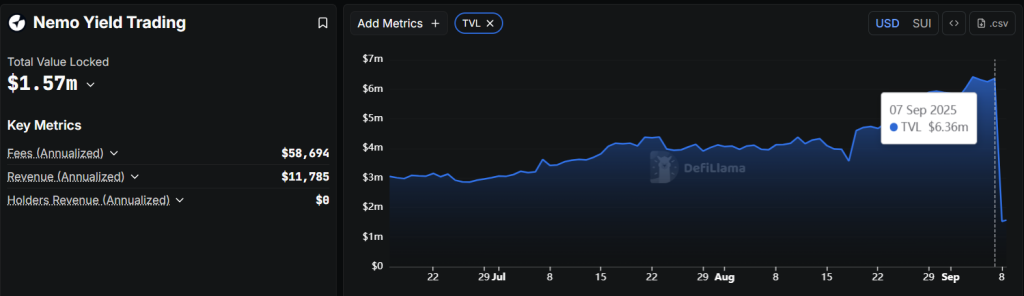
Nemo Protocol Loses $2.4M to Hackers on Sui Blockchain Before Planned MaintenanceSource: DefilLama

User withdrawals exceeded $3.8 million worth of USDC and SUI tokens as investors rushed to exit, fearing the exploit’s scope might be more extensive than initially disclosed.

Nemo Protocol Loses $2.4M to Hackers on Sui Blockchain Before Planned MaintenanceSource: DefilLama

The breach specifically targeted Nemo’s yield-trading mechanism, which enables users to divide staked assets into Principal Tokens (PTs) and Yield Tokens (YTs) for yield speculation purposes.

According to blockchain security auditor CertiK, security risks may arise from multiple sources, including coding errors, blockchain network vulnerabilities, and programming language limitations.

Sui Blockchain Security Crisis Contributed to $2.37 Billion DeFi Losses in 2025

Notably, the Nemo security breach marks the third major hack targeting DeFi protocols this month.

Earlier in September, Venus protocol lost $13.5 million to attackers, followed by an $8.4 million theft from the Bunni protocol.

Similarly, in the Sui ecosystem, the Nemo incident follows another significant breach on the Layer-1 network from earlier this year.

On May 22, Cetus Protocol, a prominent decentralized exchange and liquidity provider, suffered a $223 million exploit.

The attacker leveraged an arithmetic overflow flaw in a third-party code library to complete the drain within 15 minutes.

Moreover, these DeFi-focused attacks are on the rise in 2025.

SlowMist’s mid-year analysis revealed that the blockchain sector experienced over $2.37 billion in losses across 121 security incidents during the first half of the year.

Nemo Protocol Loses $2.4M to Hackers on Sui Blockchain Before Planned MaintenanceSource: SlowMist

DeFi protocols alone accounted for 76% of these cases, although centralized exchanges recorded higher individual losses.

A complementary report from Hacken’s 2025 mid-year security assessment estimated total crypto industry losses at over $3.1 billion within the first six months.

Nemo Protocol Loses $2.4M to Hackers on Sui Blockchain Before Planned MaintenanceSource: Hacken

Access control vulnerabilities, including misconfigured wallets and compromised legacy keys, represented 59% of these losses, while DeFi-specific smart contract exploits accounted for $263 million, or roughly 8%.

A recent interview between Cryptonews and Mitchell Amador, founder and CEO of Immunefi, highlighted why conventional security methodologies prove inadequate in Web3’s open-source ecosystem.

Amador explained that “Traditional audits, being static and pre-launch focused, fail to identify post-deployment vulnerabilities present in dynamic DeFi environments.”

He advocated for bug bounty programs as a solution to incentivize ethical hackers, fundamentally restructuring cybersecurity economics to make defensive measures more lucrative than offensive ones.


Market Opportunity
SUI Logo
SUI Price(SUI)
$0.8863
$0.8863$0.8863
-2.68%
USD
SUI (SUI) Live Price Chart
Disclaimer: The articles reposted on this site are sourced from public platforms and are provided for informational purposes only. They do not necessarily reflect the views of MEXC. All rights remain with the original authors. If you believe any content infringes on third-party rights, please contact crypto.news@mexc.com for removal. MEXC makes no guarantees regarding the accuracy, completeness, or timeliness of the content and is not responsible for any actions taken based on the information provided. The content does not constitute financial, legal, or other professional advice, nor should it be considered a recommendation or endorsement by MEXC.

You May Also Like

UAE supermarket supplies remain stable, despite panic buying

UAE supermarket supplies remain stable, despite panic buying

UAE supermarkets report supplies remain ample and prices are unlikely to rise in the short term, despite fears that the widening regional conflict will cause residents
Share
Agbi2026/03/01 22:54
AUD/USD recovers early losses as US Dollar struggles to extend upside

AUD/USD recovers early losses as US Dollar struggles to extend upside

The post AUD/USD recovers early losses as US Dollar struggles to extend upside appeared on BitcoinEthereumNews.com. AUD/USD recovers its early losses as the US Dollar’s upside move seems to peak out. Investors await the Fed Powell’s speech for fresh cues on the monetary policy outlook. Australia’s Monthly CPI is expectedly to have risen steadily by 2.8%. The AUD/USD pair claws back its early losses and rebounds to near 0.6590 during the European trading session on Monday. The Aussie pair bounces back as the US Dollar (USD) struggles to extend its three-day winning streak, with investors awaiting Federal Reserve (Fed) Chair Jerome Powell’s speech on Tuesday. The US Dollar Index (DXY), which tracks the Greenback’s value against six major currencies, trades marginally lower to near 97.55. The US Dollar traded firmly in the last few days, following the monetary policy announcement by the Fed on Wednesday, in which it reduced interest rates by 25 basis points (bps) to 4.00%-25%. The Fed also signaled two more interest rate cuts in the remainder of the year. On Tuesday, investors will focus on Fed Powell’s speech to get more cues on the monetary policy meeting. Market participants would also like to know about whether the Fed will continue reducing interest rates even as inflationary pressures remain well above the central bank’s target of 2%. Meanwhile, the next trigger for the Australian Dollar (AUD) will be the Monthly Consumer Price Index (CPI) data for August, which will be published on Wednesday. The inflation data is expected to have grown steadily at an annual pace of 2.8%. Signs of inflationary pressures remaining persistent could restrict the Reserve Bank of Australia (RBA) from reduce interest rates further. US Dollar FAQs The US Dollar (USD) is the official currency of the United States of America, and the ‘de facto’ currency of a significant number of other countries where it is found in circulation alongside…
Share
BitcoinEthereumNews2025/09/22 23:57
Vitalik Buterin Says AI Could Fast Track Ethereum 2030 Roadmap

Vitalik Buterin Says AI Could Fast Track Ethereum 2030 Roadmap

TLDR AI built a 700000 line Ethereum client in two weeks Prototype covers 65 roadmap items and syncs with mainnet Buterin calls for more testing and formal verification
Share
Coincentral2026/03/01 23:01