

Oil Prices Drop 7% as Trump Hints at Middle East De-escalation
TLDR
- Brent crude fell 6–7% to around $92 on Tuesday after hitting highs above $119 on Monday
- Trump said the war against Iran was “very complete” and ahead of his 4–5 week timeline
- Iran’s IRGC rejected that framing and threatened to block all regional oil exports
- G7 nations said they were ready to release emergency oil reserves but held off
- Goldman Sachs kept its Brent forecast at $66/barrel for Q4 2026, citing a fluid situation
Oil prices swung wildly this week as conflicting signals from the U.S. and Iran kept energy markets on edge. Brent crude dropped roughly 7% on Tuesday to around $92 a barrel, just one day after surging past $100 for the first time since mid-2022.
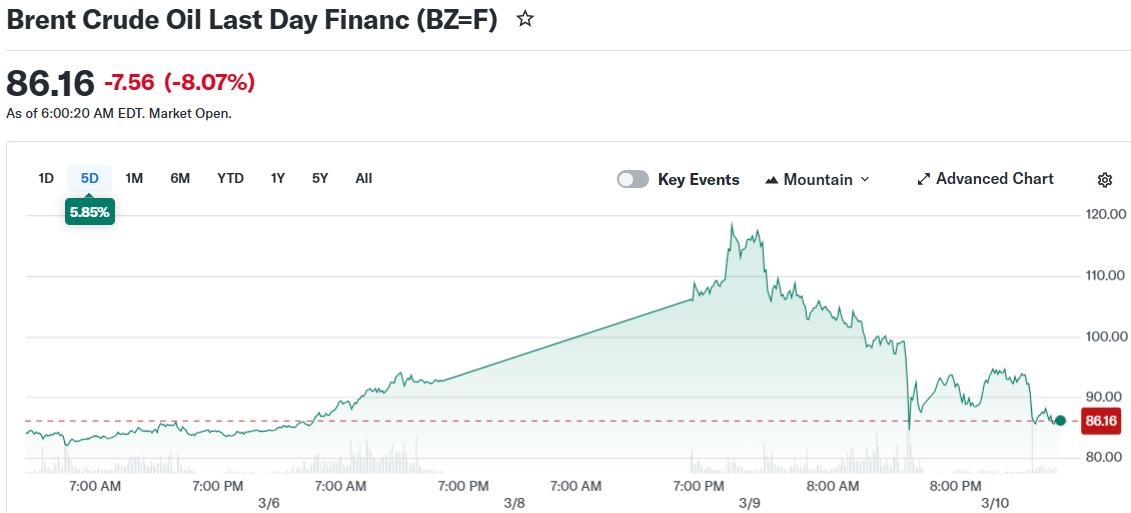 Brent Crude Oil Last Day Financ (BZ=F)
The sharp rise Monday was driven by supply fears. Saudi Arabia and other producers had cut output as the U.S.-Israeli war on Iran expanded, pushing Brent as high as $119.50 and West Texas Intermediate to $119.48. That marked the largest single-day intraday swing on record, according to Dow Jones Market Data.
Russian President Vladimir Putin also spoke with Trump on Monday, sharing proposals for a quick settlement. That added to the de-escalation mood and accelerated the price drop.
But not everyone was ready to call the conflict over.
Iran Pushes Back
Iran’s Foreign Minister Abbas Araghchi separately ruled out any talks with the United States in an interview with PBS News, as reported by the Wall Street Journal.
He pointed out that Murban and Dubai oil grades were still trading above $100 a barrel, suggesting physical supply conditions had not changed much on the ground.
What Governments Are Doing
Trump is also reportedly considering easing oil sanctions on Russia as part of a broader effort to cool prices. Multiple sources confirmed the option is on the table.
Analyst Priyanka Sachdeva of Phillip Nova said the combination of those signals — possible Russian sanctions relief, G7 reserve releases, and Trump’s comments — gave traders enough reason to back off the panic buying.
Goldman Sachs said it was not changing its oil price forecast. The bank still expects Brent at $66 per barrel and WTI at $62 per barrel for the fourth quarter of 2026, citing the fluid nature of the situation.
Iran’s IRGC statement on Tuesday remains the most recent hard signal that the conflict is not winding down.
The post Oil Prices Drop 7% as Trump Hints at Middle East De-escalation appeared first on CoinCentral.


You May Also Like

Citi Warns Bitcoin Is More Vulnerable to Quantum Computing Attacks Than Ethereum

Why Tether’s LemFi Deal Could Transform International Remittances




