

JPMorgan Predicts S&P 500 Could Tumble 10% as Iran Conflict Drives Oil Beyond $100
TLDR
- JPMorgan’s global market intelligence chief adopted a “tactically bearish” stance on American equities Monday
- The S&P 500 would reach approximately 6,270 points if it experiences a 10% pullback from its record high
- Crude oil prices have surged past $100 per barrel amid escalating Iran conflict and targeted strikes on energy facilities
- Morgan Stanley maintains an opposing viewpoint, suggesting markets are approaching the conclusion of a “rolling correction” that began last October
- Commodities traders at JPMorgan cautioned that the current surge in refined petroleum products is only in its early stages
JPMorgan Chase has issued a stark warning that the S&P 500 index could experience a 10% decline from its recent peak as escalating Iran war tensions drive crude oil prices above the critical $100-per-barrel threshold.
Andrew Tyler, who leads JPMorgan’s global market intelligence division, adopted a “tactically bearish” position on American equities Monday. The escalating Middle East military conflict served as his primary justification for the shift.
Should the index decline 10% from its recent peak, the S&P 500 would settle near 6,270 points. This represents roughly 7% beneath Friday’s closing level.
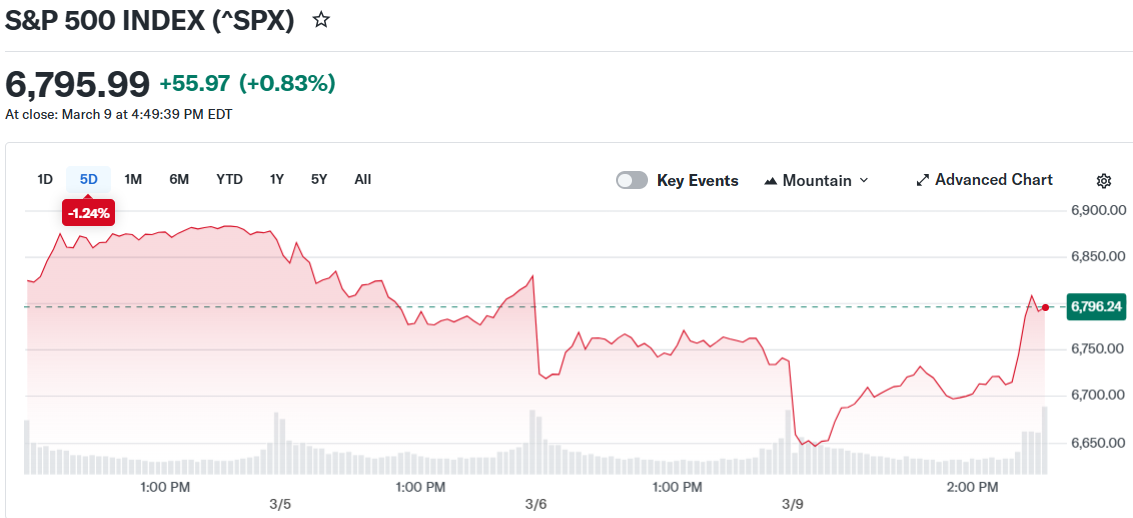 S&P 500 INDEX (^SPX)
JPMorgan’s commodities trading division noted that energy infrastructure has sustained damage on both sides of the escalating conflict. The team characterized this development as establishing a dangerous new precedent and cautioned that the current rally in refined petroleum product prices represents merely the beginning.
Oil breaching the $100-per-barrel mark creates significant pressure points throughout the broader economy. Elevated energy expenses cascade through numerous industrial sectors, potentially compressing corporate profit margins.
Where Morgan Stanley Stands
Not all major Wall Street institutions share JPMorgan’s cautious outlook. Morgan Stanley’s chief investment officer Mike Wilson indicated his firm maintains a bullish perspective on equities for the upcoming six to twelve-month period.
Wilson characterized the market as undergoing a “rolling correction” since last October, with returns remaining essentially flat despite robust earnings performance. His assessment suggests this corrective phase is nearing completion.
The contrasting perspectives from these two financial giants stem from different interpretations of identical market conditions. JPMorgan identifies imminent downside vulnerabilities, whereas Morgan Stanley anticipates the market is approaching stabilization.
What a 10% Drop Would Mean
A 10% pullback in the S&P 500 qualifies as a conventional market correction. Such events occur with regularity and materialized in 2018, 2020, and 2022 before equity markets ultimately rebounded.
For investors with retirement portfolios and mutual fund holdings linked to the benchmark index, a correction of this magnitude would temporarily diminish account balances. Wealth management professionals typically advise maintaining investment positions and resisting emotional selling decisions.
JPMorgan’s cautionary outlook is explicitly connected to the Iran war escalation and deliberate targeting of oil production facilities. The financial institution has not identified any specific domestic economic catalyst.
Crude oil trading above $100 per barrel constrains consumer discretionary spending while elevating operational expenses for corporations. Energy sector companies stand to benefit from elevated pricing, whereas industries including aviation and manufacturing face potential margin compression.
The S&P 500 comprises 500 of America’s largest publicly traded corporations. It ranks among the most extensively monitored equity benchmarks worldwide.
JPMorgan manages $4.8 trillion in assets and stands as one of the planet’s largest financial services organizations. Its market forecasts command significant attention from both institutional portfolio managers and individual investors.
As of Monday’s trading session, the banking giant’s assessment of U.S. equity markets shifted from a neutral posture to tactically bearish, propelled by intensifying Middle Eastern military operations.
The post JPMorgan Predicts S&P 500 Could Tumble 10% as Iran Conflict Drives Oil Beyond $100 appeared first on Blockonomi.


You May Also Like

Thomas Massie spotted strumming a banjo with self-proclaimed antisemite: report

Q2 Market Insights: Bitcoin regains dominance in risk-averse environment, ETFs remain critical to market structure




