Prime Brokers Push Wall Street Access to Prediction Markets: Report
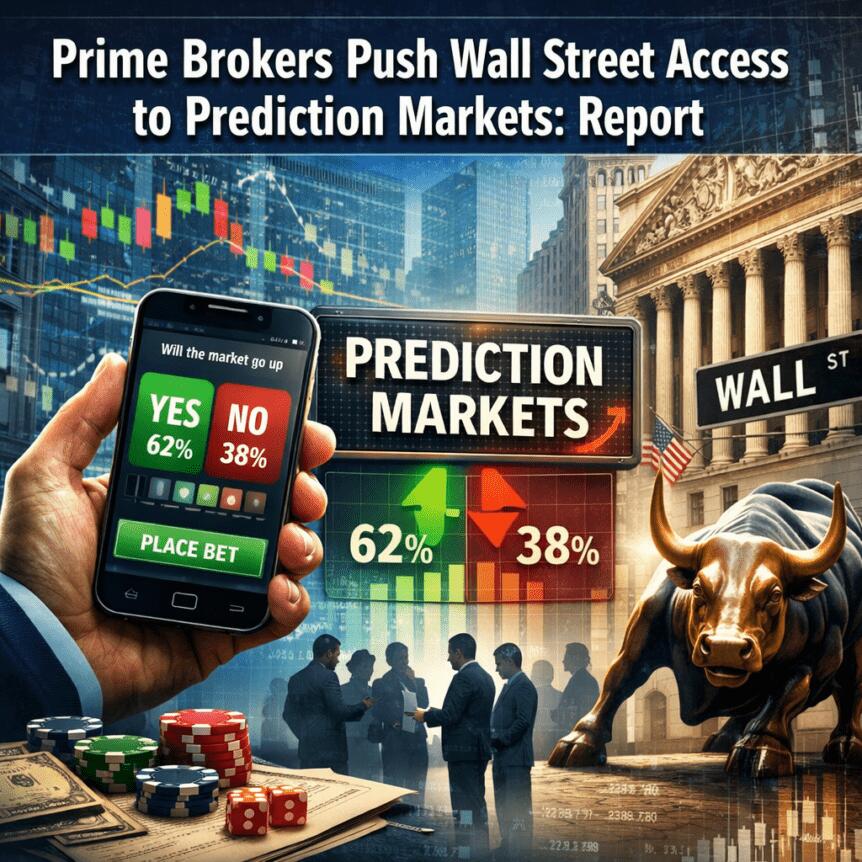
US-based prime brokers are quietly positioning themselves to give hedge funds and large institutions direct access to Kalshi’s prediction markets, a move that signals growing institutional interest in event-based betting markets. A Bloomberg report from March 11, 2026, indicates that Clear Street and Marex Group Plc are both lining up access for their clients in the near term. Clear Street, valued at over $12 billion, is expected to clear Kalshi trades as early as late March, while Marex, with a current valuation around $2.6 billion, plans a staged rollout over the coming months. The development underscores a broader shift as predictively driven markets gain traction among mainstream financial players, even amid regulatory ambiguity surrounding their legality and oversight.
Key takeaways
- Prime brokers plan to enable client access to Kalshi’s prediction markets within weeks, signaling rapid institutional onboarding.
- Kalshi’s leadership frames 2026 as a tipping point for institutional adoption, highlighting the market’s utility as data on future events and hedging tools.
- Hedge funds and other large institutions have begun approaching Kalshi contractors for direct market access, indicating a demand-driven expansion.
- Regulatory uncertainty remains a central hurdle, with debates over whether prediction markets fall under sports-betting rules and concerns about insider trading.
- Industry leaders, including Nasdaq and CME, are calling for clearer rules to support broader US adoption of prediction markets, signaling potential regulatory alignment or pathways forward.
Sentiment: Neutral
Market context: The push by prime brokers sits at the intersection of expanding interest in reputation-based forecasting markets and ongoing regulatory scrutiny. As major exchanges press for clarity, policymakers in the U.S. are weighing how prediction markets should be treated in relation to traditional securities and gaming rules, shaping the pace at which institutions can experiment with these platforms.
Why it matters
The entry of prime brokers into Kalshi’s ecosystem represents more than a new distribution channel. It signals a potential inflection point for prediction markets, where institutions view event outcomes as a tool for hedging risk, benchmarking forecasts, and generating returns. Kalshi’s CEO, in a LinkedIn post, has argued that institutional adoption will accelerate in 2026 as the market’s utility becomes clearer—citing the ability of these markets to provide data on future events and a framework for hedging real-world positions. This perspective aligns with broader industry narratives that such markets can function as a complementary data layer for traditional asset classes and macro strategies.
The practical appeal for institutions is twofold: first, the ability to hedge corporate or portfolio risk using event-based contracts; second, an opportunity to participate in markets that CNBC, CNN, Bloomberg, and Fox increasingly reference alongside conventional tickers. Yet, this enthusiasm exists within a regulatory gray zone, particularly around whether certain prediction market offerings resemble sports betting and how insider information may flow through these platforms. The tension between potential financial utility and compliance risk is a central theme shaping how quickly banks and brokers move from exploration to formalized access.
Industry participants have underscored that regulatory clarity is prerequisites for scalable adoption. Executives from Nasdaq and CME recently urged regulators to establish a clearer framework for prediction markets in the United States, arguing that consistent rules protect investors and foster market integrity. The CFTC has signaled its role in overseeing such markets, while the SEC has indicated it will also be involved in defining the boundaries for these instruments. The convergence of these regulatory positions will heavily influence whether institutional traction continues or stalls as cases and compliance questions proliferate across state and federal levels.
What to watch next
- Kalshi trade launches at Clear Street are expected in late March, with additional brokers like Marex rolling out in the ensuing months.
- Regulatory clarity on the classification of prediction markets—whether they fall under sports-betting or another regulatory category—will shape product design and participant eligibility.
- Key lawsuits and ongoing regulatory actions in the U.S. will test the resilience of prediction markets amid a landscape of diversified enforcement.
- Public statements from major exchanges and regulatory bodies, including updates from the CFTC and SEC, will indicate the pace of broader adoption and potential compliance requirements.
- Institutional hedging strategies using Kalshi and similar platforms may become more visible as fund managers assess risk-off and risk-on environments amid macro volatility.
Sources & verification
- Bloomberg report dated March 11, 2026, detailing prime brokers’ race to give Wall Street access to Kalshi’s prediction markets.
- LinkedIn post by Kalshi CEO Tarek Mansour discussing expected acceleration of institutional adoption in 2026 and the market’s broader utility.
- Reuters coverage of Nasdaq and CME executives calling for clearer rules to support prediction-market adoption in the U.S.
- Statements from the Nasdaq and CME discussions about regulatory alignment, and the CFTC/SEC roles in overseeing the sector.
- Related reporting mentioning Kalshi and Polymarket valuations and potential fundraising coverage in mainstream outlets.
Institutional access to Kalshi’s prediction markets gains momentum
Institutional appetite for prediction markets is expanding as prime brokers gear up to broaden access to Kalshi’s event-led contracts. The Bloomberg report paints a picture of late-March milestones for Clear Street, which is expected to clear the first Kalshi trade soon, and Marex, poised to follow in the coming months. The strategic move signals that major financial intermediaries view prediction markets not as speculative oddities but as components of a diversified risk management toolkit. In this view, there is a push to translate the insights from prediction markets into tradable risk-management signals for complex, multi-asset portfolios.
Kalshi’s leadership has framed 2026 as a turning point, arguing that the utility of prediction markets extends beyond speculation into practical data sources for forecasting and hedging. The company’s CEO, in a LinkedIn post, emphasized that institutional adoption will accelerate as more large players recognize the markets’ potential to quantify futures scenarios and hedge exposures. As he noted, the space is no longer an early-adopter niche but a core pillar of the financial ecosystem, with billions flowing weekly through these markets. This perspective is echoed by mainstream media outlets—CNBC, CNN, Bloomberg, and Fox—who regularly cite Kalshi alongside traditional market indicators, underscoring a shift in perception from novelty to necessity.
Nevertheless, the path forward is not without friction. Clear Street and Marex acknowledge a regulatory gray area surrounding prediction markets, alongside active litigation across the United States related to sports betting and other matters. Industry participants stress the importance of robust governance and clear rules to ensure investor protection and market integrity as adoption scales. The broader regulatory dialogue—pursued by exchanges and oversight bodies alike—aims to delineate permissible activities, address insider-trading concerns, and establish a stable framework within which institutions can transact with confidence.
In parallel, major exchanges have publicly called for regulatory clarity to facilitate US adoption. Nasdaq’s chief executive executive highlighted the need to bring options markets under a familiar rule framework, suggesting that a well-defined construct could enable investors to participate in a predictable regulatory environment. The SEC and CFTC have signaled their respective roles in overseeing emerging prediction-market activity, a development that could unlock more comprehensive product design while ensuring critical guardrails remain intact. The dynamic underscores a broader industry trend: practical finance increasingly sits at the intersection of regulatory alignment and innovative market structures, where data-driven decision-making and risk mitigation converge.
What it means for the market
For traders and investors, the potential mainstreaming of Kalshi and prediction markets offers an additional source of informational signals—complementing traditional data feeds with market-based expectations about future events. It may also prompt portfolio managers to incorporate event-based hedges into strategic plans, especially for scenarios with high impact on sectors or individual holdings. The regulatory dialogue surrounding these markets will be pivotal; a clear, harmonized framework could spur broader participation, elevate liquidity, and reduce friction for institutions seeking to deploy these instruments as part of diversified risk management strategies.
This article was originally published as Prime Brokers Push Wall Street Access to Prediction Markets: Report on Crypto Breaking News – your trusted source for crypto news, Bitcoin news, and blockchain updates.


You May Also Like

PENGU climbs 17%, Market awaits break above $0.0102

XRP Coils at Key Support: Breakout to $1.50 Ahead?