Ethereum co-founder Vitalik Buterin says the network’s clearest value proposition may not be smart contracts or payments, but something more foundational: actingEthereum co-founder Vitalik Buterin says the network’s clearest value proposition may not be smart contracts or payments, but something more foundational: acting

Vitalik Buterin Argues Ethereum’s Biggest Use Case Is Data Availability

2026/03/14 00:00
3 min read
For feedback or concerns regarding this content, please contact us at crypto.news@mexc.com

Ethereum co-founder Vitalik Buterin says the network’s clearest value proposition may not be smart contracts or payments, but something more foundational: acting as a censorship-resistant public data layer. In a post reflecting on conversations at Real World Crypto and related events, Buterin argued that stepping outside “blockchain baggage” makes ETH’s core utility easier to see.

“I was recently at Real World Crypto (that’s crypto as in cryptography) and the associated side events, and one thing that struck me was that it was a clarifying experience in terms of understanding what blockchains are for,” Buterin wrote. “We blockchain people (myself included) often have a tendency to start off from the perspective that we are Ethereum, and therefore we need to go around and find use cases for Ethereum.”

Ethereum’s Core Value Starts With A ‘Public Bulletin Board’

His point was less about defending Ethereum as a brand than re-evaluating it as infrastructure. “For a moment, let us forget that we are ‘the Ethereum community’. Rather, we are maintainers of the Ethereum tool,” he wrote, asking where the network adds value when viewed with “zero attachment to Ethereum specifically.”

The first answer, he said, is “not what you think.” It is “not smart contracts, it’s not even payments,” but what cryptographers call a “public bulletin board”, a publicly readable and writable place to post data blobs. That matters because a range of cryptographic systems, including secure online voting, software and website version control, and certificate revocation, depend on exactly that kind of shared infrastructure.

“This does not require any computation functionality,” Buterin wrote. “In fact, it does not directly require money, though it does indirectly require money, because if you want permissionless anti-spam it has to be economic. The only thing it fundamentally requires is data availability.”

That framing leads directly to Ethereum’s recent scaling work. Buterin highlighted PeerDAS, which he said increased Ethereum’s data availability capacity by 2.3x, with a roadmap to push that another 10x to 100x higher. In his telling, that makes Ethereum increasingly relevant not just for onchain finance, but for a broader class of open, privacy-preserving internet infrastructure.

Payments still matter, but as a secondary layer in the stack. Buterin argued that many systems need value transfer not primarily for commerce, but for anti-spam, sybil resistance, and machine-to-machine coordination. He pointed to Ethereum plus ZK payment channels as a strong design for permissionless APIs, and said ETH can serve as a “natural backstop” for applications that want to resist fake-account abuse without relying on phone numbers or other centralized identity rails.

Smart contracts come after that. Here, Buterin described them as useful for security deposits, for implementing constructs like ZK payment channels, and for managing pointers to “digital objects” tied to socially recognized external entities. Technically, he said, most non-ETH use cases could be handled by treating the chain as a bulletin board and using ZK-SNARKs for computation off-chain. In practice, though, standardizing that model is difficult, and shared execution remains the more interoperable route.

The broader claim is that Ethereum works best when understood as “global shared memory” inside a decentralized software stack. Buterin suggested adoption may still lag that reality because many builders are operating with outdated assumptions from 2020 to 2022, when fees were far higher and scaling looked less mature. Today, he argued, fees are “extremely low,” the roadmap is stronger, and tooling to shield users from fee volatility has improved.

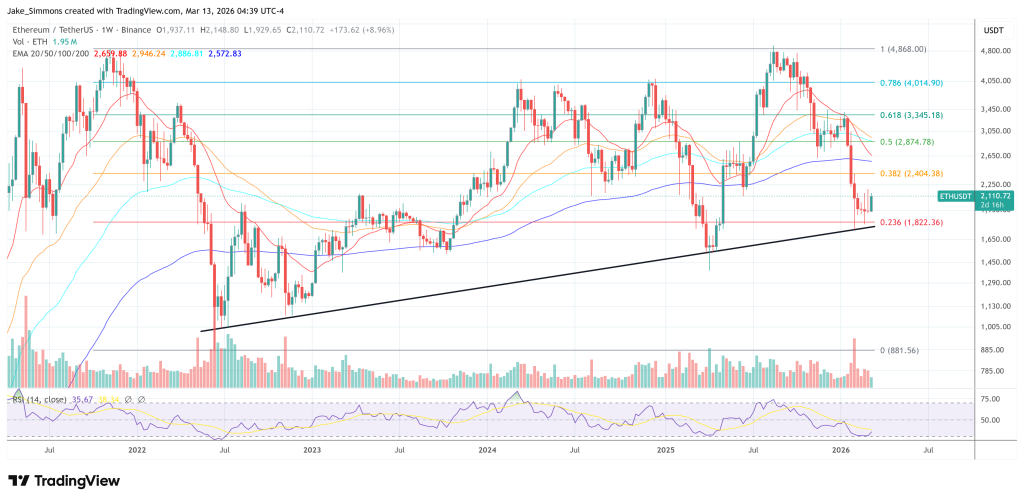
At press time, ETH traded at 2,110.
Ethereum price chart
Market Opportunity
Notcoin Logo
Notcoin Price(NOT)
$0.0004033
$0.0004033$0.0004033
-2.44%
USD
Notcoin (NOT) Live Price Chart
Disclaimer: The articles reposted on this site are sourced from public platforms and are provided for informational purposes only. They do not necessarily reflect the views of MEXC. All rights remain with the original authors. If you believe any content infringes on third-party rights, please contact crypto.news@mexc.com for removal. MEXC makes no guarantees regarding the accuracy, completeness, or timeliness of the content and is not responsible for any actions taken based on the information provided. The content does not constitute financial, legal, or other professional advice, nor should it be considered a recommendation or endorsement by MEXC.

You May Also Like

Bubblemaps: The top five traders in STBL token trading volume are interconnected and have made profits exceeding $10 million

Bubblemaps: The top five traders in STBL token trading volume are interconnected and have made profits exceeding $10 million

PANews reported on September 18th that blockchain analytics platform Bubblemaps published an article on the X platform claiming that Tether co-founder Reeve Collins had just launched a new token, STBL. However, the top five traders are suspiciously interconnected and have profited over $10 million. Collins launched STBL yesterday, a new stablecoin system built around three tokens: USST (stablecoin), YLD (yield token supporting USST), and STBL (governance token). An analysis of the top five traders by STBL trading volume revealed that these five profit-makers received capital injections at the same time. Tracing the source of their funds revealed a clear connection: the funds all came from the same source (injected via Tornado Cash); bots were used to borrow USDC from the Venus Protocol; and the total profit exceeded $10 million. However, there is no evidence that these traders are connected to the core team. In fact, this group of bots has a history of extracting value from other tokens, not just STBL.
Share
PANews2025/09/18 10:09
Ripple pushes urgent XRPL patch — but nodes must trust its new key

Ripple pushes urgent XRPL patch — but nodes must trust its new key

The post Ripple pushes urgent XRPL patch — but nodes must trust its new key appeared on BitcoinEthereumNews.com. Ripple has released its fix for public-facing nodes
Share
BitcoinEthereumNews2026/03/14 03:04
Forward Industries Launches $4B ATM Offering to Expand Solana Treasury

Forward Industries Launches $4B ATM Offering to Expand Solana Treasury

The post Forward Industries Launches $4B ATM Offering to Expand Solana Treasury appeared on BitcoinEthereumNews.com. Forward Industries (FORD), a publicly-traded design and manufacturing firm that’s building out a solana SOL$198.37 treasury, has filed a $4 billion at-the-market (ATM) equity offering program with the SEC. The company will use any funds raised for working capital, business expansion and to bolster its SOL holdings, according to an announcement on Wednesday. The offering gives Forward a flexible way to sell new shares incrementally through Cantor Fitzgerald, the program’s designated agent. This step comes just weeks after Forward completed what it says was the largest Solana-focused treasury raise to date. The company has already acquired over 6.8 million SOL on the back of a $1.65 billion deal to build the crypto treasury. Kyle Samani, Forward’s chairman, called the ATM offering “a flexible and efficient mechanism” to scale the company’s crypto strategy and strengthen its balance sheet. The firm is looking to maximize its SOL-per-share through active treasury management. Data from CoinGecko shows Forward Industries has the largest solana treasury among publicly traded firms, with the runner-up being DeFi Development Corp’s 2.02 million SOL treasury. Forward’s share price fell over 9.5% in early trading to $33.70 on Wednesday. Source: https://www.coindesk.com/business/2025/09/17/forward-industries-launches-usd4b-atm-offering-to-expand-solana-treasury
Share
BitcoinEthereumNews2025/09/18 11:06