Crypto moved to the center of Washington’s latest North Korea sanctions action on March 12, after the US Treasury’s Office of Foreign Assets Control designated Crypto moved to the center of Washington’s latest North Korea sanctions action on March 12, after the US Treasury’s Office of Foreign Assets Control designated

Crypto In Spotlight As OFAC Targets North Korean IT Worker Network

2026/03/14 15:00
3 min read
For feedback or concerns regarding this content, please contact us at crypto.news@mexc.com

Crypto moved to the center of Washington’s latest North Korea sanctions action on March 12, after the US Treasury’s Office of Foreign Assets Control designated six individuals and two entities tied to DPRK-run IT worker schemes. For the digital asset industry, the significance was not only the sanctions themselves, but how explicitly the case framed cryptocurrency as infrastructure for moving illicit revenue across borders.

OFAC Targets North Korean Crypto Network

According to Treasury, the targeted schemes systematically defrauded US businesses and generated nearly $800 million in 2024 for North Korea’s weapons programs. Secretary Scott Bessent described a model in which overseas operatives used fake identities and corporate deception to infiltrate legitimate companies, then turned sensitive access into a second layer of leverage. “Targets American companies through deceptive schemes.” “Treasury will continue to follow the money.”

That framing matters because the case was not presented as a conventional cybercrime story alone. Treasury and Chainalysis both pointed to a blended playbook: fraudulent hiring, wage extraction, financial facilitators, and crypto rails used to convert and move proceeds. Chainalysis called the operations “a sophisticated and growing threat.” It added, in equally direct terms, that “cryptocurrency plays a central role” in moving those funds back to North Korea while evading sanctions.

The clearest crypto-specific detail in the action concerned Nguyen Quang Viet, CEO of Vietnam-based Quangvietdnbg International Services Company Limited. Treasury said Nguyen converted about $2.5 million into cryptocurrency for North Koreans between mid-2023 and mid-2025, including illicit earnings tied to Amnokgang Technology Development Company, a DPRK IT company that manages overseas worker delegations. Treasury also said OFAC’s designations in this case reached facilitators in the DPRK, Vietnam, Laos and Spain, underscoring how geographically dispersed these support networks have become.

Chainalysis said the March 12 action included 21 designated addresses across multiple blockchains. Those addresses spanned Ethereum, Tron and Bitcoin, with seven linked to Amnokgang, two Ethereum addresses tied to Yun Song Guk, one Bitcoin address tied to Hoang Minh Quang, and 11 newly added addresses for previously designated Sim Hyon Sop, a representative of Korea Kwangson Banking Corp.

Treasury’s narrative also showed how the IT-worker pipeline extends beyond software contracting into broader financial enablement. It said Yun had led a group of North Korean freelance IT workers operating out of Boten, Laos since at least 2023 and coordinated several dozen transactions totaling more than $70,000 with Hoang Minh Quang tied to IT services. In a separate strand, Treasury said Do Phi Khanh and Hoang Van Nguyen supported Kim Se Un, including through bank-account access and crypto transactions, while Hoang had also helped procure foreign currency for the regime.

The action lands against a broader backdrop in which North Korea’s crypto footprint has been getting bigger, not smaller. Chainalysis said in its 2026 crypto crime report that North Korea stole more than $2 billion in 2025, its most successful year on record, while value received by sanctioned entities overall surged 694% last year. In that context, the OFAC designations look less like an isolated enforcement step and more like another attempt to squeeze every layer of the DPRK crypto stack, from stolen funds and laundering routes to the labor schemes that generate fresh inflows.

At press time, the total crypto market cap stood at $2.44 trillion.
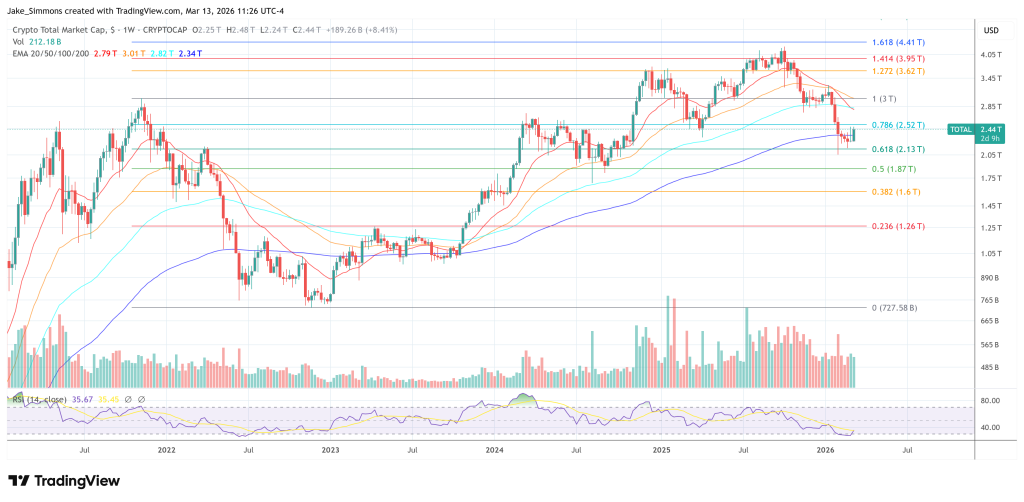
Total crypto market cap
Market Opportunity
Notcoin Logo
Notcoin Price(NOT)
$0.0003844
$0.0003844$0.0003844
-7.01%
USD
Notcoin (NOT) Live Price Chart
Disclaimer: The articles reposted on this site are sourced from public platforms and are provided for informational purposes only. They do not necessarily reflect the views of MEXC. All rights remain with the original authors. If you believe any content infringes on third-party rights, please contact crypto.news@mexc.com for removal. MEXC makes no guarantees regarding the accuracy, completeness, or timeliness of the content and is not responsible for any actions taken based on the information provided. The content does not constitute financial, legal, or other professional advice, nor should it be considered a recommendation or endorsement by MEXC.

You May Also Like

XRP Moves Above $1.40 as Traders Watch Bullish Signals

XRP Moves Above $1.40 as Traders Watch Bullish Signals

The post XRP Moves Above $1.40 as Traders Watch Bullish Signals appeared on BitcoinEthereumNews.com. XRP climbed above $1.40 with $3.5B volume as traders highlight
Share
BitcoinEthereumNews2026/03/14 18:54
Paramount-WBD 2027 movie slate could dominate. Can it sustain?

Paramount-WBD 2027 movie slate could dominate. Can it sustain?

The post Paramount-WBD 2027 movie slate could dominate. Can it sustain? appeared on BitcoinEthereumNews.com. Paramount Skydance CEO David Ellison speaks during
Share
BitcoinEthereumNews2026/03/14 19:06
How is the xStocks tokenized stock market developing?

How is the xStocks tokenized stock market developing?

Author: Heechang Compiled by: TechFlow xStocks offers a tokenized stock service, allowing investors to trade tokenized versions of popular US stocks like Tesla in real time. While still in its early stages, it’s already showing some interesting signs of growth. Observation 1: Trading is concentrated in Tesla (TSLA) As in many emerging markets, trading activity has quickly concentrated on a handful of stocks. Data shows a high concentration of trading volume in the most well-known and volatile stocks, with Tesla being the most prominent example. This concentration is not surprising: liquidity tends to accumulate in assets that retail investors already favor, and early adopters often use familiar high-beta stocks to test new infrastructure. Observation 2: Liquidity decreases on weekends Data shows that on-chain equity trading volume drops to 30% or less of weekday levels over the weekend. Unlike crypto-native assets, which trade seamlessly around the clock, tokenized stocks still inherit the behavioral inertia of traditional market trading hours. Traders appear less willing to trade when reference markets (such as Nasdaq and the New York Stock Exchange) are closed, likely due to concerns about arbitrage, price gaps, and the inability to hedge positions off-chain. Observation 3: Prices move in line with the Nasdaq Another key signal comes from pricing behavior during the initial launch period. Initially, xStocks tokens traded at a significant premium to their Nasdaq counterparts, reflecting market enthusiasm and potential friction in bridging fiat liquidity. However, these premiums gradually diminished over time. Current trading patterns show that the token price is at the upper limit of Tesla's intraday price range and is highly consistent with the Nasdaq reference price. Arbitrageurs appear to be maintaining this price discipline, but there are still small deviations from the intraday highs, indicating some market inefficiencies that may present opportunities and risks for active traders. New opportunities for Korean stock investors? South Korean investors currently hold over $100 billion in US stocks, with trading volume increasing 17-fold since January 2020. Existing infrastructure for South Korean investors to trade US stocks is limited by high fees, long settlement times, and slow cash-out processes, creating opportunities for tokenized or on-chain mirror stocks. As the infrastructure and platforms supporting on-chain US stock markets continue to improve, a new group of South Korean traders will enter the crypto market, which is undoubtedly a huge opportunity.
Share
PANews2025/09/18 08:00