The corporate crypto treasury movement has reached a critical turning point, transitioning from an era of guaranteed premiums to what Coinbase Research calls a “player-versus-player” competitive phase. Public companies now hold over 1 million Bitcoin worth $110 billion, with digital asset treasuries controlling $215 billion across 213 entities. However, new research warns that most participants face potential failure during adverse credit cycles.Source: BitcoinTreasuries Strategy Leads Corporate Crypto Movement Despite Mounting Pressures MicroStrategy, now operating as Strategy Inc, leads the pack with 638,460 BTC after recording $14.05 billion in unrealized gains during Q2 2025. The company’s aggressive accumulation strategy inspired dozens of imitators, but early movers like Strategy enjoyed substantial premiums to net asset value that have since compressed under competitive pressure. The transformation began in 2020 when Michael Saylor’s Strategy pioneered the corporate Bitcoin treasury model using convertible bonds and equity raises. Mining firms like MARA Holdings followed with 52,477 BTC, while newcomers like Jack Mallers’ XXI amassed 43,514 BTC, and Japan’s Metaplanet targeted 210,000 BTC by 2027. However, the space has fundamentally shifted. Nasdaq tightened supervision requirements for digital asset treasuries, demanding shareholder approval for certain transactions. Strategy abandoned its self-imposed 2.5x market-to-net-asset-value threshold for stock sales after funding pressures mounted, while facing multiple class-action lawsuits over business practices. Coinbase Research identifies this transition as moving beyond simple MicroStrategy copycat strategies toward execution-dependent success. The scarcity premium benefiting early adopters has dissipated, forcing companies to differentiate themselves through strategic positioning rather than merely accumulating Bitcoin. Corporate Treasuries Face Structural Vulnerabilities in Rising Rate Environment Earlier last month, Sentora research identified critical flaws in corporate Bitcoin strategies, warning that “idle Bitcoin on a corporate balance sheet is not a scalable strategy in a rising-rate world.” Most Bitcoin treasury companies operate as either unprofitable entities or rely heavily on mark-to-market gains for solvency. The strategy mirrors historical wealth-building through leveraged acquisition of scarce assets, but lacks Bitcoin’s evolution from digital property to yield-generating capital. Unlike real estate, which generates rental income, Bitcoin treasury companies engage in negative-carry trades, borrowing fiat currency to acquire non-yielding assets without adequate risk mitigation mechanisms. Strategy utilizes $3.7 billion in ultra-low coupon convertible bonds and $5.5 billion in perpetual preferred shares to finance acquisitions. Similarly, Metaplanet continues its aggressive accumulation, doubling Bitcoin holdings every 60 days while utilizing zero-interest convertible bonds worth ¥270.36 billion. The company recently finalized its $1.45 billion stock sale to fund massive Bitcoin purchases, issuing 385 million shares with settlement scheduled for September 16. Rising interest rates amplify negative carry effects, while Bitcoin price stagnation over 2-3 years could erode conviction and make equity issuance dilutive. Market Saturation and Regulatory Scrutiny Challenge New Entrants Glassnode analyst James Check has earlier raised concerns over the strategy’s longevity, arguing easy gains have vanished for new entrants as markets mature. BitcoinTreasuries data shows new entities adding BTC holdings at scale are joining every month, but investors increasingly expect clear differentiation beyond basic Bitcoin accumulation. Crypto analyst Ran Neuner claimed many treasury firms operate as exit vehicles for insiders rather than genuine market buyers. Companies often receive crypto contributions from existing holders in exchange for shares that later trade at massive premiums, allowing early contributors to cash out while retail investors pay 2-4x net asset value. The Financial Times reported in August that 154 US-listed companies raised $98.4 billion for crypto purchases in 2025, up dramatically from $33.6 billion raised by 10 companies previously. Just this month, forward Industries raised $1.65 billion for Solana-based treasuries backed by Galaxy Digital and Jump Crypto, while corporate Ethereum holdings reached $28 billion across multiple entities.Source: Coinbase Research Despite being the leading firm, Strategy was recently denied S&P 500 inclusion despite meeting technical criteria, with the index committee expressing concerns over Bitcoin-heavy business models and high volatility risks. The broader movement faces warnings that participants may not survive credit cycles due to structural vulnerabilities in environments with rising interest rates. However, Coinbase Research maintains a constructive outlook for large-cap crypto names that benefit from continued DEX capital flows. Coinbase Research argues that increased competition forces companies beyond simple MicroStrategy copying, potentially driving more strategic capital allocation and sustained buying pressure as firms compete for investor attentionThe corporate crypto treasury movement has reached a critical turning point, transitioning from an era of guaranteed premiums to what Coinbase Research calls a “player-versus-player” competitive phase. Public companies now hold over 1 million Bitcoin worth $110 billion, with digital asset treasuries controlling $215 billion across 213 entities. However, new research warns that most participants face potential failure during adverse credit cycles.Source: BitcoinTreasuries Strategy Leads Corporate Crypto Movement Despite Mounting Pressures MicroStrategy, now operating as Strategy Inc, leads the pack with 638,460 BTC after recording $14.05 billion in unrealized gains during Q2 2025. The company’s aggressive accumulation strategy inspired dozens of imitators, but early movers like Strategy enjoyed substantial premiums to net asset value that have since compressed under competitive pressure. The transformation began in 2020 when Michael Saylor’s Strategy pioneered the corporate Bitcoin treasury model using convertible bonds and equity raises. Mining firms like MARA Holdings followed with 52,477 BTC, while newcomers like Jack Mallers’ XXI amassed 43,514 BTC, and Japan’s Metaplanet targeted 210,000 BTC by 2027. However, the space has fundamentally shifted. Nasdaq tightened supervision requirements for digital asset treasuries, demanding shareholder approval for certain transactions. Strategy abandoned its self-imposed 2.5x market-to-net-asset-value threshold for stock sales after funding pressures mounted, while facing multiple class-action lawsuits over business practices. Coinbase Research identifies this transition as moving beyond simple MicroStrategy copycat strategies toward execution-dependent success. The scarcity premium benefiting early adopters has dissipated, forcing companies to differentiate themselves through strategic positioning rather than merely accumulating Bitcoin. Corporate Treasuries Face Structural Vulnerabilities in Rising Rate Environment Earlier last month, Sentora research identified critical flaws in corporate Bitcoin strategies, warning that “idle Bitcoin on a corporate balance sheet is not a scalable strategy in a rising-rate world.” Most Bitcoin treasury companies operate as either unprofitable entities or rely heavily on mark-to-market gains for solvency. The strategy mirrors historical wealth-building through leveraged acquisition of scarce assets, but lacks Bitcoin’s evolution from digital property to yield-generating capital. Unlike real estate, which generates rental income, Bitcoin treasury companies engage in negative-carry trades, borrowing fiat currency to acquire non-yielding assets without adequate risk mitigation mechanisms. Strategy utilizes $3.7 billion in ultra-low coupon convertible bonds and $5.5 billion in perpetual preferred shares to finance acquisitions. Similarly, Metaplanet continues its aggressive accumulation, doubling Bitcoin holdings every 60 days while utilizing zero-interest convertible bonds worth ¥270.36 billion. The company recently finalized its $1.45 billion stock sale to fund massive Bitcoin purchases, issuing 385 million shares with settlement scheduled for September 16. Rising interest rates amplify negative carry effects, while Bitcoin price stagnation over 2-3 years could erode conviction and make equity issuance dilutive. Market Saturation and Regulatory Scrutiny Challenge New Entrants Glassnode analyst James Check has earlier raised concerns over the strategy’s longevity, arguing easy gains have vanished for new entrants as markets mature. BitcoinTreasuries data shows new entities adding BTC holdings at scale are joining every month, but investors increasingly expect clear differentiation beyond basic Bitcoin accumulation. Crypto analyst Ran Neuner claimed many treasury firms operate as exit vehicles for insiders rather than genuine market buyers. Companies often receive crypto contributions from existing holders in exchange for shares that later trade at massive premiums, allowing early contributors to cash out while retail investors pay 2-4x net asset value. The Financial Times reported in August that 154 US-listed companies raised $98.4 billion for crypto purchases in 2025, up dramatically from $33.6 billion raised by 10 companies previously. Just this month, forward Industries raised $1.65 billion for Solana-based treasuries backed by Galaxy Digital and Jump Crypto, while corporate Ethereum holdings reached $28 billion across multiple entities.Source: Coinbase Research Despite being the leading firm, Strategy was recently denied S&P 500 inclusion despite meeting technical criteria, with the index committee expressing concerns over Bitcoin-heavy business models and high volatility risks. The broader movement faces warnings that participants may not survive credit cycles due to structural vulnerabilities in environments with rising interest rates. However, Coinbase Research maintains a constructive outlook for large-cap crypto names that benefit from continued DEX capital flows. Coinbase Research argues that increased competition forces companies beyond simple MicroStrategy copying, potentially driving more strategic capital allocation and sustained buying pressure as firms compete for investor attention

Crypto Treasury ‘Easy Money’ Era Ends as Companies Enter ‘Player vs Player’ Competition – Good for Investors?

The corporate crypto treasury movement has reached a critical turning point, transitioning from an era of guaranteed premiums to what Coinbase Research calls a “player-versus-player” competitive phase.

Public companies now hold over 1 million Bitcoin worth $110 billion, with digital asset treasuries controlling $215 billion across 213 entities.

However, new research warns that most participants face potential failure during adverse credit cycles.
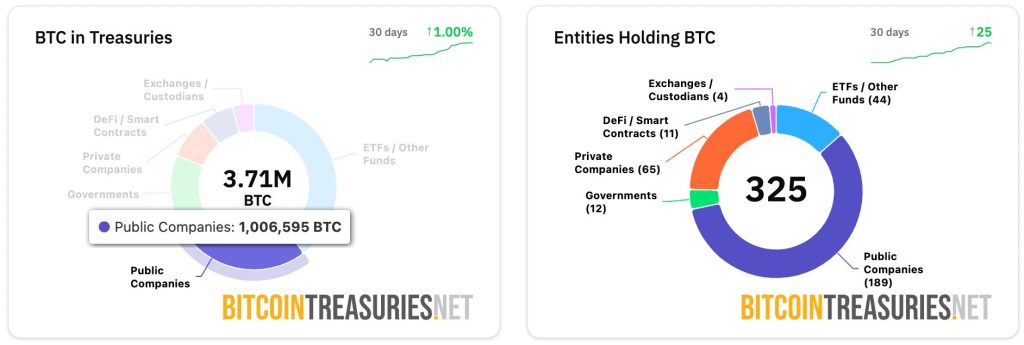
Crypto Treasury 'Easy Money' Era Ends as Companies Enter 'Player vs Player' Competition – Good for Investors?Source: BitcoinTreasuries

Strategy Leads Corporate Crypto Movement Despite Mounting Pressures

MicroStrategy, now operating as Strategy Inc, leads the pack with 638,460 BTC after recording $14.05 billion in unrealized gains during Q2 2025.

The company’s aggressive accumulation strategy inspired dozens of imitators, but early movers like Strategy enjoyed substantial premiums to net asset value that have since compressed under competitive pressure.

The transformation began in 2020 when Michael Saylor’s Strategy pioneered the corporate Bitcoin treasury model using convertible bonds and equity raises.

Mining firms like MARA Holdings followed with 52,477 BTC, while newcomers like Jack Mallers’ XXI amassed 43,514 BTC, and Japan’s Metaplanet targeted 210,000 BTC by 2027.

However, the space has fundamentally shifted. Nasdaq tightened supervision requirements for digital asset treasuries, demanding shareholder approval for certain transactions.

Strategy abandoned its self-imposed 2.5x market-to-net-asset-value threshold for stock sales after funding pressures mounted, while facing multiple class-action lawsuits over business practices.

Coinbase Research identifies this transition as moving beyond simple MicroStrategy copycat strategies toward execution-dependent success.

The scarcity premium benefiting early adopters has dissipated, forcing companies to differentiate themselves through strategic positioning rather than merely accumulating Bitcoin.

Corporate Treasuries Face Structural Vulnerabilities in Rising Rate Environment

Earlier last month, Sentora research identified critical flaws in corporate Bitcoin strategies, warning that “idle Bitcoin on a corporate balance sheet is not a scalable strategy in a rising-rate world.”

Most Bitcoin treasury companies operate as either unprofitable entities or rely heavily on mark-to-market gains for solvency.

The strategy mirrors historical wealth-building through leveraged acquisition of scarce assets, but lacks Bitcoin’s evolution from digital property to yield-generating capital.

Unlike real estate, which generates rental income, Bitcoin treasury companies engage in negative-carry trades, borrowing fiat currency to acquire non-yielding assets without adequate risk mitigation mechanisms.

Strategy utilizes $3.7 billion in ultra-low coupon convertible bonds and $5.5 billion in perpetual preferred shares to finance acquisitions.

Similarly, Metaplanet continues its aggressive accumulation, doubling Bitcoin holdings every 60 days while utilizing zero-interest convertible bonds worth ¥270.36 billion.

The company recently finalized its $1.45 billion stock sale to fund massive Bitcoin purchases, issuing 385 million shares with settlement scheduled for September 16.

Rising interest rates amplify negative carry effects, while Bitcoin price stagnation over 2-3 years could erode conviction and make equity issuance dilutive.

Market Saturation and Regulatory Scrutiny Challenge New Entrants

Glassnode analyst James Check has earlier raised concerns over the strategy’s longevity, arguing easy gains have vanished for new entrants as markets mature.

BitcoinTreasuries data shows new entities adding BTC holdings at scale are joining every month, but investors increasingly expect clear differentiation beyond basic Bitcoin accumulation.

Crypto analyst Ran Neuner claimed many treasury firms operate as exit vehicles for insiders rather than genuine market buyers.

Companies often receive crypto contributions from existing holders in exchange for shares that later trade at massive premiums, allowing early contributors to cash out while retail investors pay 2-4x net asset value.

The Financial Times reported in August that 154 US-listed companies raised $98.4 billion for crypto purchases in 2025, up dramatically from $33.6 billion raised by 10 companies previously.

Just this month, forward Industries raised $1.65 billion for Solana-based treasuries backed by Galaxy Digital and Jump Crypto, while corporate Ethereum holdings reached $28 billion across multiple entities.

Crypto Treasury 'Easy Money' Era Ends as Companies Enter 'Player vs Player' Competition – Good for Investors?Source: Coinbase Research

Despite being the leading firm, Strategy was recently denied S&P 500 inclusion despite meeting technical criteria, with the index committee expressing concerns over Bitcoin-heavy business models and high volatility risks.

The broader movement faces warnings that participants may not survive credit cycles due to structural vulnerabilities in environments with rising interest rates.

However, Coinbase Research maintains a constructive outlook for large-cap crypto names that benefit from continued DEX capital flows.

Coinbase Research argues that increased competition forces companies beyond simple MicroStrategy copying, potentially driving more strategic capital allocation and sustained buying pressure as firms compete for investor attention.


Market Opportunity
ERA Logo
ERA Price(ERA)
$0.2019
$0.2019$0.2019
-12.02%
USD
ERA (ERA) Live Price Chart
Disclaimer: The articles reposted on this site are sourced from public platforms and are provided for informational purposes only. They do not necessarily reflect the views of MEXC. All rights remain with the original authors. If you believe any content infringes on third-party rights, please contact service@support.mexc.com for removal. MEXC makes no guarantees regarding the accuracy, completeness, or timeliness of the content and is not responsible for any actions taken based on the information provided. The content does not constitute financial, legal, or other professional advice, nor should it be considered a recommendation or endorsement by MEXC.

You May Also Like

China Launches Cross-Border QR Code Payment Trial

China Launches Cross-Border QR Code Payment Trial

The post China Launches Cross-Border QR Code Payment Trial appeared on BitcoinEthereumNews.com. Key Points: Main event involves China initiating a cross-border QR code payment trial. Alipay and Ant International are key participants. Impact on financial security and regulatory focus on illicit finance. China’s central bank, led by Deputy Governor Lu Lei, initiated a trial of a unified cross-border QR code payment gateway with Alipay and Ant International as participants. This pilot addresses cross-border fund risks, aiming to enhance financial security amid rising money laundering through digital channels, despite muted crypto market reactions. China’s Cross-Border Payment Gateway Trial with Alipay The trial operation of a unified cross-border QR code payment gateway marks a milestone in China’s financial landscape. Prominent entities such as Alipay and Ant International are at the forefront, participating as the initial institutions in this venture. Lu Lei, Deputy Governor of the People’s Bank of China, highlighted the systemic risks posed by increased cross-border fund flows. Changes are expected in the dynamics of digital transactions, potentially enhancing transaction efficiency while tightening regulations around illicit finance. The initiative underscores China’s commitment to bolstering financial security amidst growing global fund movements. “The scale of cross-border fund flows is expanding, and the frequency is accelerating, providing opportunities for risks such as cross-border money laundering and terrorist financing. Some overseas illegal platforms transfer funds through channels such as virtual currencies and underground banks, creating a ‘resonance’ of risks at home and abroad, posing a challenge to China’s foreign exchange management and financial security.” — Lu Lei, Deputy Governor, People’s Bank of China Bitcoin and Impact of China’s Financial Initiatives Did you know? China’s latest initiative echoes the Payment Connect project of June 2025, furthering real-time cross-boundary remittances and expanding its influence on global financial systems. As of September 17, 2025, Bitcoin (BTC) stands at $115,748.72 with a market cap of $2.31 trillion, showing a 0.97%…
Share
BitcoinEthereumNews2025/09/18 05:28
Zero Knowledge Proof Auction Limits Large Buyers to $50K: Experts Forecast 200x to 10,000x ROI

Zero Knowledge Proof Auction Limits Large Buyers to $50K: Experts Forecast 200x to 10,000x ROI

In most token sales, the fastest and richest participants win. Large buyers jump in early, take most of the supply, and control the market before regular people
Share
LiveBitcoinNews2026/01/19 08:00
IP Hits $11.75, HYPE Climbs to $55, BlockDAG Surpasses Both with $407M Presale Surge!

IP Hits $11.75, HYPE Climbs to $55, BlockDAG Surpasses Both with $407M Presale Surge!

The post IP Hits $11.75, HYPE Climbs to $55, BlockDAG Surpasses Both with $407M Presale Surge! appeared on BitcoinEthereumNews.com. Crypto News 17 September 2025 | 18:00 Discover why BlockDAG’s upcoming Awakening Testnet launch makes it the best crypto to buy today as Story (IP) price jumps to $11.75 and Hyperliquid hits new highs. Recent crypto market numbers show strength but also some limits. The Story (IP) price jump has been sharp, fueled by big buybacks and speculation, yet critics point out that revenue still lags far behind its valuation. The Hyperliquid (HYPE) price looks solid around the mid-$50s after a new all-time high, but questions remain about sustainability once the hype around USDH proposals cools down. So the obvious question is: why chase coins that are either stretched thin or at risk of retracing when you could back a network that’s already proving itself on the ground? That’s where BlockDAG comes in. While other chains are stuck dealing with validator congestion or outages, BlockDAG’s upcoming Awakening Testnet will be stress-testing its EVM-compatible smart chain with real miners before listing. For anyone looking for the best crypto coin to buy, the choice between waiting on fixes or joining live progress feels like an easy one. BlockDAG: Smart Chain Running Before Launch Ethereum continues to wrestle with gas congestion, and Solana is still known for network freezes, yet BlockDAG is already showing a different picture. Its upcoming Awakening Testnet, set to launch on September 25, isn’t just a demo; it’s a live rollout where the chain’s base protocols are being stress-tested with miners connected globally. EVM compatibility is active, account abstraction is built in, and tools like updated vesting contracts and Stratum integration are already functional. Instead of waiting for fixes like other networks, BlockDAG is proving its infrastructure in real time. What makes this even more important is that the technology is operational before the coin even hits exchanges. That…
Share
BitcoinEthereumNews2025/09/18 00:32