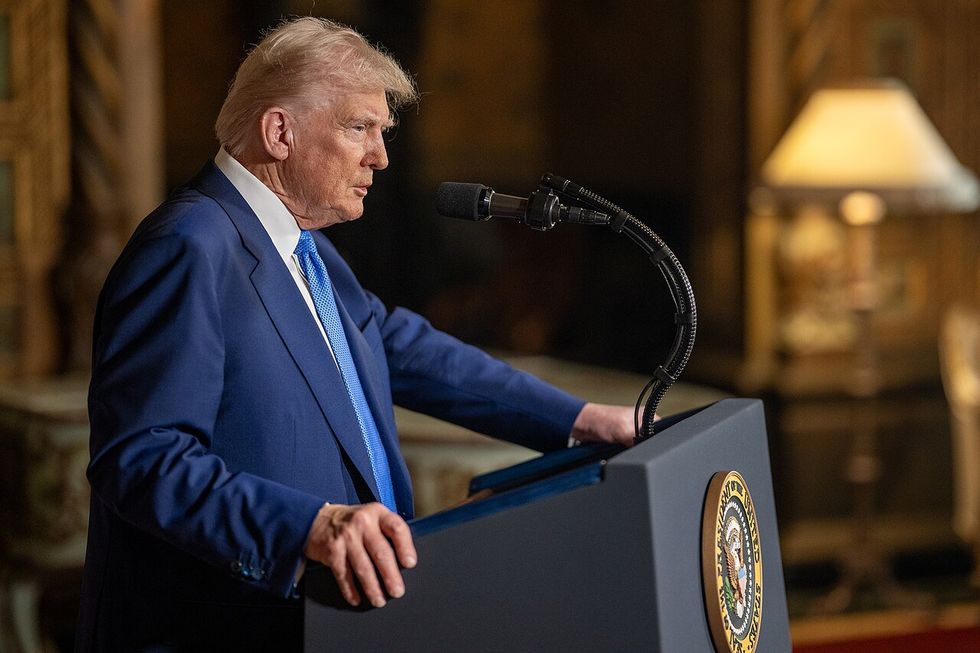
In court documents, the Trump administration maintained that the Pentagon’s blacklisting of Anthropic was legally sound, contesting the company’s major lawsuitsIn court documents, the Trump administration maintained that the Pentagon’s blacklisting of Anthropic was legally sound, contesting the company’s major lawsuits

Trump backs Pentagon ban on Anthropic over national security concerns

2026/03/18 17:10
4 min read
For feedback or concerns regarding this content, please contact us at crypto.news@mexc.com

In court documents filed Tuesday, the Trump administration maintained that the Pentagon’s blacklisting of Anthropic was legally sound, contesting the company’s significant lawsuits. 

The Claude developer initiated two federal lawsuits on Monday, arguing it faced illegal retaliation for advocating for AI safety. It insists that Pentagon officials are using the blacklist to punish it for refusing to drop protections against autonomous weaponization and surveillance, thus violating its First Amendment rights.

On March 3, Defense Secretary Pete Hegseth formally classified Anthropic as a supply chain risk over national security concerns.

Anthropic was blacklisted over national security concerns

In its court filing, the Trump administration noted, “For national security reasons, the terms of service for plaintiff Anthropic PBC’s artificial intelligence (AI) technology have become unacceptable to the Executive Branch. Anthropic concedes the Government’s right not ‘to use Anthropic’s services’ and to ‘transition to other AI providers.’”

It further contended that Anthropic’s First Amendment argument is a stretch and won’t stand up under legal scrutiny. It asserted that its actions were driven solely by national security concerns, not by a desire to punish the company for its AI safety views.

It also claimed that during its talks with the company, Anthropic’s overall attitude led them to second-guess whether it would be a good fit for the Department of Defense.

According to the filing, the Pentagon reportedly became concerned that Anthropic could pose a vulnerability to its defense supply chains. Reportedly, government officials fear the company might pull the plug on its systems in the middle of a conflict if it doesn’t like how the tech is being used.

Anthropic is concerned about giving the government autonomous force

Negotiations have stalled for months over Anthropic’s refusal to lift safety rules that prevent AI from being used in mass surveillance or automated combat. The AI firm has maintained that allowing “any lawful use” as requested by the DoD would go against its core safety principles and increase the risk of misuse of its Claude systems.

So far, anti-war activists have been hailing Anthropic as a hero for resisting the military. However, co-founder and chief executive Dario Amodei recently noted that the AI firm and the government broadly share the same objectives. Margaret Mitchell, an AI researcher and chief ethics scientist at the tech firm Hugging Face, even cautioned, “If people are looking for good guys and bad guys, where a good guy is someone who doesn’t support war, then they’re not going to find that here.”

Amodei also remarked, “Anthropic has much more in common with the Department of War than we have differences.” He shared his concerns about the dangers of AI-made bioweapons and Chinese interference, but he also believes AI companies have a duty to help governments win the tech war against autocracies.

Per his remarks, he’s less worried about AI being used in war and more terrified of a handful of people having the power to launch a massive, mindless, automated drone strike at the push of a button.

At the moment, the executive is balancing a firm “no” on autonomous weapons and domestic surveillance; however, the firm has otherwise been a highly cooperative ally of the US military. Previously, the company altered its AI models for the Department of Defense; they actually built Claude into the government’s most secure, classified networks, including satellite imagery systems, intelligence analysis, modeling and simulation, and operational planning

In its recent lawsuit, it even noted, “Anthropic does not impose the same restrictions on the military’s use of Claude as it does on civilian customers. Claude Gov is less prone to refuse requests that would be prohibited in the civilian context.”

The smartest crypto minds already read our newsletter. Want in? Join them.

Market Opportunity
OFFICIAL TRUMP Logo
OFFICIAL TRUMP Price(TRUMP)
$3.444
$3.444$3.444
-6.96%
USD
OFFICIAL TRUMP (TRUMP) Live Price Chart
Disclaimer: The articles reposted on this site are sourced from public platforms and are provided for informational purposes only. They do not necessarily reflect the views of MEXC. All rights remain with the original authors. If you believe any content infringes on third-party rights, please contact crypto.news@mexc.com for removal. MEXC makes no guarantees regarding the accuracy, completeness, or timeliness of the content and is not responsible for any actions taken based on the information provided. The content does not constitute financial, legal, or other professional advice, nor should it be considered a recommendation or endorsement by MEXC.

You May Also Like

Big News: First U.S. Spot XRP and DOGE ETF by Rex-Osprey Officially Launches: Details

Big News: First U.S. Spot XRP and DOGE ETF by Rex-Osprey Officially Launches: Details

In a landmark development for digital asset investors, REX-Osprey, a collaboration between REX Shares and Osprey Funds, has rolled out the first-ever U.S.-listed exchange-traded funds (ETFs) offering direct spot exposure to Dogecoin (DOGE) and XRP. According to a press release on Businessnewswire, the new products, trading under tickers DOJE and XRPR on the Cboe exchange, mark a significant step in bringing two of the most recognized cryptocurrencies into regulated investment vehicles. Dogecoin Gets Its First ETF The launch of DOJE represents a historic milestone as the first Dogecoin spot ETF in the United States. Once regarded as a meme coin driven by online culture and celebrity endorsements, Dogecoin has since grown into one of the top cryptocurrencies by market capitalization, supported by a highly active global community. Also Read: Massive Breakout Imminent? ‘XRP is Now Where ETH Was in 2017 Right Before Explosion’ By structuring DOGE under the 1940 Act fund framework, REX-Osprey is making the asset more accessible to traditional investors who prefer trading through established brokerage accounts rather than crypto exchanges. Analysts note that this could broaden institutional interest in DOGE, especially as regulatory-compliant exposure options expand. XRP ETF Brings Utility-Focused Crypto Into Spotlight Alongside DOJE, the XRPR ETF provides exposure to XRP, the digital asset powering Ripple’s payments network. XRP has long been associated with fast, low-cost cross-border transactions, a use case that has attracted growing attention from both banks and payment providers. The XRPR fund will hold most of its assets directly in spot XRP, with the remainder invested in XRP-backed exchange-traded products. This hybrid structure aims to provide investors with a liquid and straightforward way to gain exposure to an asset that continues to be at the center of conversations about the future of international payments. Expanding a Growing ETF Lineup The new DOGE and XRP ETFs follow the July debut of the REX-Osprey SOL + Staking ETF (SSK), which became the first U.S.-listed ETF to combine spot Solana exposure with on-chain staking rewards. That fund has already surpassed $275 million in assets under management and recently converted to a Regulated Investment Company (RIC) structure, boosting tax efficiency for investors while keeping its staking benefits intact. According to Greg King, CEO of REX Financial and Osprey Funds, the launch of DOJE and XRPR underscores the firm’s ambition to pioneer regulated investment pathways for digital assets. “ETFs have always been about access,” King said in a statement. “The digital asset revolution is accelerating, and to deliver exposure to leading tokens like Dogecoin and XRP within the protection of the U.S. ETF framework is something we are proud to bring to the market.” What This Means for Crypto Adoption Market watchers suggest that the arrival of DOGE and XRP ETFs could broaden crypto exposure in retirement portfolios, wealth management products, and institutional trading desks. For Dogecoin, this marks a shift from meme-driven volatility to potentially more structured investment flows. For XRP, the ETF comes at a time when analysts, including those at Morgan Stanley, have speculated on its potential to capture a share of the $150 trillion cross-border payments market currently dominated by SWIFT. With these launches, REX-Osprey continues to carve out a niche as one of the leading firms bridging crypto-native assets with the regulated ETF space, setting the stage for broader institutional adoption in the coming years. Also Read: Egrag Crypto: XRP Could be Around $6 or $7 by Mid-November Based on this Analysis The post Big News: First U.S. Spot XRP and DOGE ETF by Rex-Osprey Officially Launches: Details appeared first on 36Crypto.
Share
Coinstats2025/09/18 21:40
Stripe and Paradigm’s Tempo mainnet goes live for machine payments

Stripe and Paradigm’s Tempo mainnet goes live for machine payments

Stripe and Paradigm launch Tempo’s mainnet and the Machine Payment Protocol, targeting high-speed, stablecoin-based payments for AI agents and global enterprises
Share
Crypto.news2026/03/18 21:43
Pi Network Update: PiRC-101 Proposal Could Preserve MacroPi Value

Pi Network Update: PiRC-101 Proposal Could Preserve MacroPi Value

Pi Network Update: PiRC-101 Proposal Could Preserve MacroPi Value The Pi Network community has received a potentially significant development with the introduc
Share
Hokanews2026/03/18 20:52