By Ethan, Odaily Planet Daily In the DeFi world, TVL is a crucial metric—it serves as both a symbol of protocol strength and a barometer of user trust. However, a controversy surrounding the fabrication of $12 billion in Reliable Validation Area (RWA) assets quickly eroded user trust. On September 10, Figure co-founder Mike Cagney took the lead in firing on the X platform, publicly accusing the on-chain data platform DefiLlama of refusing to display its RWA TVL simply because of "insufficient number of fans on social platforms" and questioning the fairness of its "decentralization standard." A few days later, DefiLlama co-founder 0xngmi published a long article titled "The Problem in RWA Metrics" in response, revealing the data anomalies behind Figure's claimed $12 billion scale, pointing out that its on-chain data is unverifiable, the assets lack a real transfer path, and there is even suspicion of evading due diligence. As a result, a full-scale battle for trust over "on-chain verifiability" and "off-chain mapping logic" broke out. Timeline of events: Figure initiated the attack, and DefiLlama responded strongly. The controversy was sparked by a tweet from Figure co-founder Mike Cagney. On September 10th, he announced on the X platform that Figure's home equity line of credit (HELOCs) had been successfully listed on CoinGecko. He also accused DefiLlama of refusing to display Figure's $13 billion TVL on the Provenance Chain. He directly criticized DefiLlama's "censorship logic," even claiming that they denied its inclusion on the list due to "X's insufficient number of followers." (Odaily Note: Mike Cagney's reference to $13 billion here is inconsistent with the $12 billion figure reported in 0xngmi's response later in the article.) About an hour after this statement was made, Provenance Blockchain CEO Anthony Moro (who, judging by the context, appears to have intervened without fully understanding the background) commented on the same thread, expressing strong distrust of the industry data platform DefiLlama: Later, Figure co-founder Mike Cagney added that he understood the development costs of integrating the new L1, but also said that Coingecko and DefiLlama had never asked Figure for fees or tokens to clarify their implication of "paying to be on the list." On September 12, Jon Ma, co-founder and CEO of L1 data dashboard Artemis (also seemingly without full knowledge of the details of the dispute), publicly extended an olive branch. During this period, public opinion clearly favored Figure - many onlookers pointed the finger at DefiLlama's "credibility and neutrality." It wasn't until September 13th that DefiLlama co-founder 0xngmi published a lengthy article titled "The Problem in RWA Metrics," systematically disclosing his due diligence findings and four questions, that the narrative began to reverse. Opinion leaders like ZachXBT then reposted the article in support, emphasizing that "these metrics are not 100% verifiable on-chain," and DefiLlama's position gained wider support. DefiLlama's findings: Data mismatch In the long article "The Problem in RWA Metrics", 0xngmi announced the results of the DefiLlama team's due diligence on Figure, listing multiple anomalies one by one: The scale of assets on the chain is seriously inconsistent with the declared scale Figure claims that the scale of RWA issued on its chain has reached 12 billion US dollars, but the actual assets that can be verified on the chain are only about 5 million US dollars of BTC and 4 million US dollars of ETH. Among them, the 24-hour trading volume of BTC is even only 2,000 US dollars. Insufficient stablecoin supply The total supply of Figure's own stablecoin YLDS is only 20 million. In theory, all RWA transactions should be based on this, but the supply is far from enough to support a transaction volume of US$12 billion. Suspicious asset transfer patterns Most RWA asset transfers are not initiated by the actual asset holders, but rather through other accounts. Many addresses themselves have almost no on-chain interactions and are suspected to be just database mirrors. Lack of on-chain payment traces The vast majority of Figure's loan processes are still completed using fiat currency, and there are almost no corresponding payment and repayment records on the chain. 0xngmi added: “We’re unsure how Figure’s $12 billion in assets are actually being traded. Most holders don’t appear to be using their own keys to transfer these assets — are they simply mirroring their internal databases onto the chain?” Community Statement: DefiLlama Receives Overwhelming Support As the controversy spread, community opinion almost overwhelmingly supported DefiLlama, but in the process, some voices from different perspectives also emerged. ZachXBT (Chain Detective): They bluntly stated that Figure’s actions were “blatant pressure” and made it clear: “No, your company is trying to use indicators that are not 100% verifiable on the chain to publicly pressure participants like DefiLlama who have been proven to be honest.” Conor Grogan (Coinbase Board Member): He directed his criticism at those institutional figures who were lobbied by Figure and who privately questioned DefiLlama when the controversy was still murky. He wrote: "I have received numerous private inquiries from individuals from large cryptocurrency institutions and venture capital firms to contact DefiLlama and our partners. Every one of these people needs to be called out and asked how they can work in this industry if they can't even verify things themselves." Conor's remarks echoed the thoughts of many people: if even basic on-chain verification cannot be completed independently, then the credibility of these institutions in the RWA and DeFi sectors will be greatly reduced. Ian Kane (Head of Partnerships, Midnight Network): A more technical suggestion was made, suggesting that DefiLlama could add a new metric, "active TVL," in addition to the existing TVL tracking, to show the actual transfer rate of RWA over a given period. He gave an example: "For example, two DApps each minted $100 billion in TVL (a total of $200 billion). DApp 1 has $100 billion sitting idle, with perhaps only 2% of its funds flowing, generating $2 billion in active locked value. DApp 2, on the other hand, has 30% of its funds flowing, generating $30 billion in active locked value (15 times that of DApp 1)." In his opinion, such a dimension can not only show the total scale, but also avoid "stagnant or show-off TVL." At the same time, ZachXBT also noticed that Figure co-founder Mike Cagney kept forwarding some "support comments" that were suspected to be automatically generated by AI, and publicly pointed this out, further arousing disgust with Figure's public opinion manipulation. Conclusion: The price of trust has just begun to show The dispute between Figure and DefiLlama may seem like a ranking issue, but it actually hits the core weakness of the RWA track - what exactly is considered an "on-chain asset." The core contradiction of this turmoil is actually on-chain fundamentalism vs. off-chain mapping logic. DefiLlama insists on only counting TVL that can be verified on the chain, adhering to open source adapter logic, and refusing to accept asset data that fails to meet transparency requirements. Figure's model: While assets may exist in the real world, the business logic relies heavily on traditional financial systems, with the on-chain portion merely being a database echo. In other words, users cannot use on-chain transactions to prove the transfer of assets, which conflicts with the "verifiability" standard of DeFi natives. The so-called $12 billion is equal to 0 if it cannot be verified on the chain. In an industry where transparency and verifiability are the bottom line, any attempt to bypass on-chain verification and use database numbers to impersonate on-chain TVL will ultimately undermine user and market trust. This controversy may just be the beginning. Similar issues will continue to arise as more RWA protocols emerge. The industry urgently needs to establish clear and unified verification standards, otherwise "virtual TVL" will continue to expand, becoming the next landmine that erodes trust.By Ethan, Odaily Planet Daily In the DeFi world, TVL is a crucial metric—it serves as both a symbol of protocol strength and a barometer of user trust. However, a controversy surrounding the fabrication of $12 billion in Reliable Validation Area (RWA) assets quickly eroded user trust. On September 10, Figure co-founder Mike Cagney took the lead in firing on the X platform, publicly accusing the on-chain data platform DefiLlama of refusing to display its RWA TVL simply because of "insufficient number of fans on social platforms" and questioning the fairness of its "decentralization standard." A few days later, DefiLlama co-founder 0xngmi published a long article titled "The Problem in RWA Metrics" in response, revealing the data anomalies behind Figure's claimed $12 billion scale, pointing out that its on-chain data is unverifiable, the assets lack a real transfer path, and there is even suspicion of evading due diligence. As a result, a full-scale battle for trust over "on-chain verifiability" and "off-chain mapping logic" broke out. Timeline of events: Figure initiated the attack, and DefiLlama responded strongly. The controversy was sparked by a tweet from Figure co-founder Mike Cagney. On September 10th, he announced on the X platform that Figure's home equity line of credit (HELOCs) had been successfully listed on CoinGecko. He also accused DefiLlama of refusing to display Figure's $13 billion TVL on the Provenance Chain. He directly criticized DefiLlama's "censorship logic," even claiming that they denied its inclusion on the list due to "X's insufficient number of followers." (Odaily Note: Mike Cagney's reference to $13 billion here is inconsistent with the $12 billion figure reported in 0xngmi's response later in the article.) About an hour after this statement was made, Provenance Blockchain CEO Anthony Moro (who, judging by the context, appears to have intervened without fully understanding the background) commented on the same thread, expressing strong distrust of the industry data platform DefiLlama: Later, Figure co-founder Mike Cagney added that he understood the development costs of integrating the new L1, but also said that Coingecko and DefiLlama had never asked Figure for fees or tokens to clarify their implication of "paying to be on the list." On September 12, Jon Ma, co-founder and CEO of L1 data dashboard Artemis (also seemingly without full knowledge of the details of the dispute), publicly extended an olive branch. During this period, public opinion clearly favored Figure - many onlookers pointed the finger at DefiLlama's "credibility and neutrality." It wasn't until September 13th that DefiLlama co-founder 0xngmi published a lengthy article titled "The Problem in RWA Metrics," systematically disclosing his due diligence findings and four questions, that the narrative began to reverse. Opinion leaders like ZachXBT then reposted the article in support, emphasizing that "these metrics are not 100% verifiable on-chain," and DefiLlama's position gained wider support. DefiLlama's findings: Data mismatch In the long article "The Problem in RWA Metrics", 0xngmi announced the results of the DefiLlama team's due diligence on Figure, listing multiple anomalies one by one: The scale of assets on the chain is seriously inconsistent with the declared scale Figure claims that the scale of RWA issued on its chain has reached 12 billion US dollars, but the actual assets that can be verified on the chain are only about 5 million US dollars of BTC and 4 million US dollars of ETH. Among them, the 24-hour trading volume of BTC is even only 2,000 US dollars. Insufficient stablecoin supply The total supply of Figure's own stablecoin YLDS is only 20 million. In theory, all RWA transactions should be based on this, but the supply is far from enough to support a transaction volume of US$12 billion. Suspicious asset transfer patterns Most RWA asset transfers are not initiated by the actual asset holders, but rather through other accounts. Many addresses themselves have almost no on-chain interactions and are suspected to be just database mirrors. Lack of on-chain payment traces The vast majority of Figure's loan processes are still completed using fiat currency, and there are almost no corresponding payment and repayment records on the chain. 0xngmi added: “We’re unsure how Figure’s $12 billion in assets are actually being traded. Most holders don’t appear to be using their own keys to transfer these assets — are they simply mirroring their internal databases onto the chain?” Community Statement: DefiLlama Receives Overwhelming Support As the controversy spread, community opinion almost overwhelmingly supported DefiLlama, but in the process, some voices from different perspectives also emerged. ZachXBT (Chain Detective): They bluntly stated that Figure’s actions were “blatant pressure” and made it clear: “No, your company is trying to use indicators that are not 100% verifiable on the chain to publicly pressure participants like DefiLlama who have been proven to be honest.” Conor Grogan (Coinbase Board Member): He directed his criticism at those institutional figures who were lobbied by Figure and who privately questioned DefiLlama when the controversy was still murky. He wrote: "I have received numerous private inquiries from individuals from large cryptocurrency institutions and venture capital firms to contact DefiLlama and our partners. Every one of these people needs to be called out and asked how they can work in this industry if they can't even verify things themselves." Conor's remarks echoed the thoughts of many people: if even basic on-chain verification cannot be completed independently, then the credibility of these institutions in the RWA and DeFi sectors will be greatly reduced. Ian Kane (Head of Partnerships, Midnight Network): A more technical suggestion was made, suggesting that DefiLlama could add a new metric, "active TVL," in addition to the existing TVL tracking, to show the actual transfer rate of RWA over a given period. He gave an example: "For example, two DApps each minted $100 billion in TVL (a total of $200 billion). DApp 1 has $100 billion sitting idle, with perhaps only 2% of its funds flowing, generating $2 billion in active locked value. DApp 2, on the other hand, has 30% of its funds flowing, generating $30 billion in active locked value (15 times that of DApp 1)." In his opinion, such a dimension can not only show the total scale, but also avoid "stagnant or show-off TVL." At the same time, ZachXBT also noticed that Figure co-founder Mike Cagney kept forwarding some "support comments" that were suspected to be automatically generated by AI, and publicly pointed this out, further arousing disgust with Figure's public opinion manipulation. Conclusion: The price of trust has just begun to show The dispute between Figure and DefiLlama may seem like a ranking issue, but it actually hits the core weakness of the RWA track - what exactly is considered an "on-chain asset." The core contradiction of this turmoil is actually on-chain fundamentalism vs. off-chain mapping logic. DefiLlama insists on only counting TVL that can be verified on the chain, adhering to open source adapter logic, and refusing to accept asset data that fails to meet transparency requirements. Figure's model: While assets may exist in the real world, the business logic relies heavily on traditional financial systems, with the on-chain portion merely being a database echo. In other words, users cannot use on-chain transactions to prove the transfer of assets, which conflicts with the "verifiability" standard of DeFi natives. The so-called $12 billion is equal to 0 if it cannot be verified on the chain. In an industry where transparency and verifiability are the bottom line, any attempt to bypass on-chain verification and use database numbers to impersonate on-chain TVL will ultimately undermine user and market trust. This controversy may just be the beginning. Similar issues will continue to arise as more RWA protocols emerge. The industry urgently needs to establish clear and unified verification standards, otherwise "virtual TVL" will continue to expand, becoming the next landmine that erodes trust.

Figure and DefiLlama’s “RWA Data Falsification” Dispute: What Qualifies as an “On-Chain Asset”?

2025/09/15 07:30

By Ethan, Odaily Planet Daily

In the DeFi world, TVL is a crucial metric—it serves as both a symbol of protocol strength and a barometer of user trust. However, a controversy surrounding the fabrication of $12 billion in Reliable Validation Area (RWA) assets quickly eroded user trust.

On September 10, Figure co-founder Mike Cagney took the lead in firing on the X platform, publicly accusing the on-chain data platform DefiLlama of refusing to display its RWA TVL simply because of "insufficient number of fans on social platforms" and questioning the fairness of its "decentralization standard."

A few days later, DefiLlama co-founder 0xngmi published a long article titled "The Problem in RWA Metrics" in response, revealing the data anomalies behind Figure's claimed $12 billion scale, pointing out that its on-chain data is unverifiable, the assets lack a real transfer path, and there is even suspicion of evading due diligence.

As a result, a full-scale battle for trust over "on-chain verifiability" and "off-chain mapping logic" broke out.

Timeline of events: Figure initiated the attack, and DefiLlama responded strongly.

The controversy was sparked by a tweet from Figure co-founder Mike Cagney.

On September 10th, he announced on the X platform that Figure's home equity line of credit (HELOCs) had been successfully listed on CoinGecko. He also accused DefiLlama of refusing to display Figure's $13 billion TVL on the Provenance Chain. He directly criticized DefiLlama's "censorship logic," even claiming that they denied its inclusion on the list due to "X's insufficient number of followers." (Odaily Note: Mike Cagney's reference to $13 billion here is inconsistent with the $12 billion figure reported in 0xngmi's response later in the article.)

About an hour after this statement was made, Provenance Blockchain CEO Anthony Moro (who, judging by the context, appears to have intervened without fully understanding the background) commented on the same thread, expressing strong distrust of the industry data platform DefiLlama:
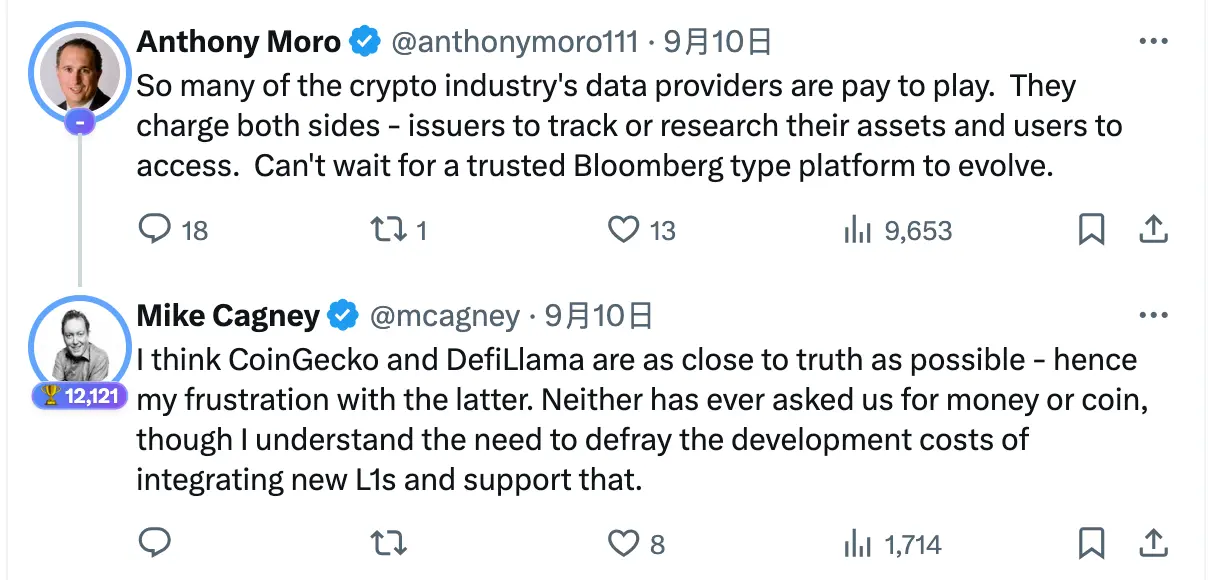
Later, Figure co-founder Mike Cagney added that he understood the development costs of integrating the new L1, but also said that Coingecko and DefiLlama had never asked Figure for fees or tokens to clarify their implication of "paying to be on the list."

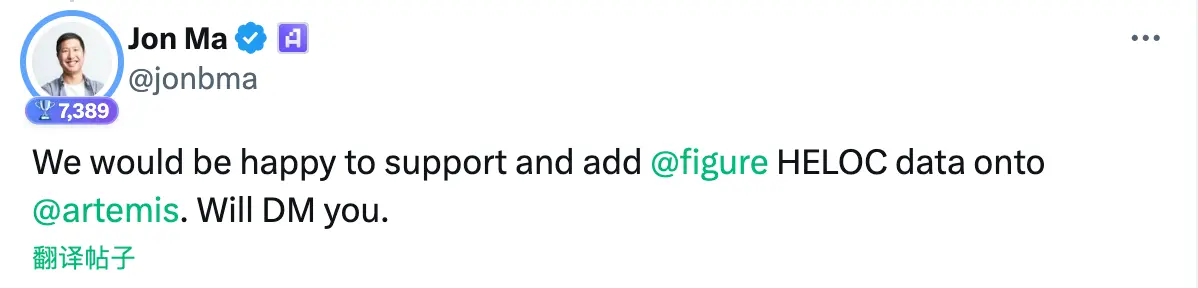
On September 12, Jon Ma, co-founder and CEO of L1 data dashboard Artemis (also seemingly without full knowledge of the details of the dispute), publicly extended an olive branch.
During this period, public opinion clearly favored Figure - many onlookers pointed the finger at DefiLlama's "credibility and neutrality."

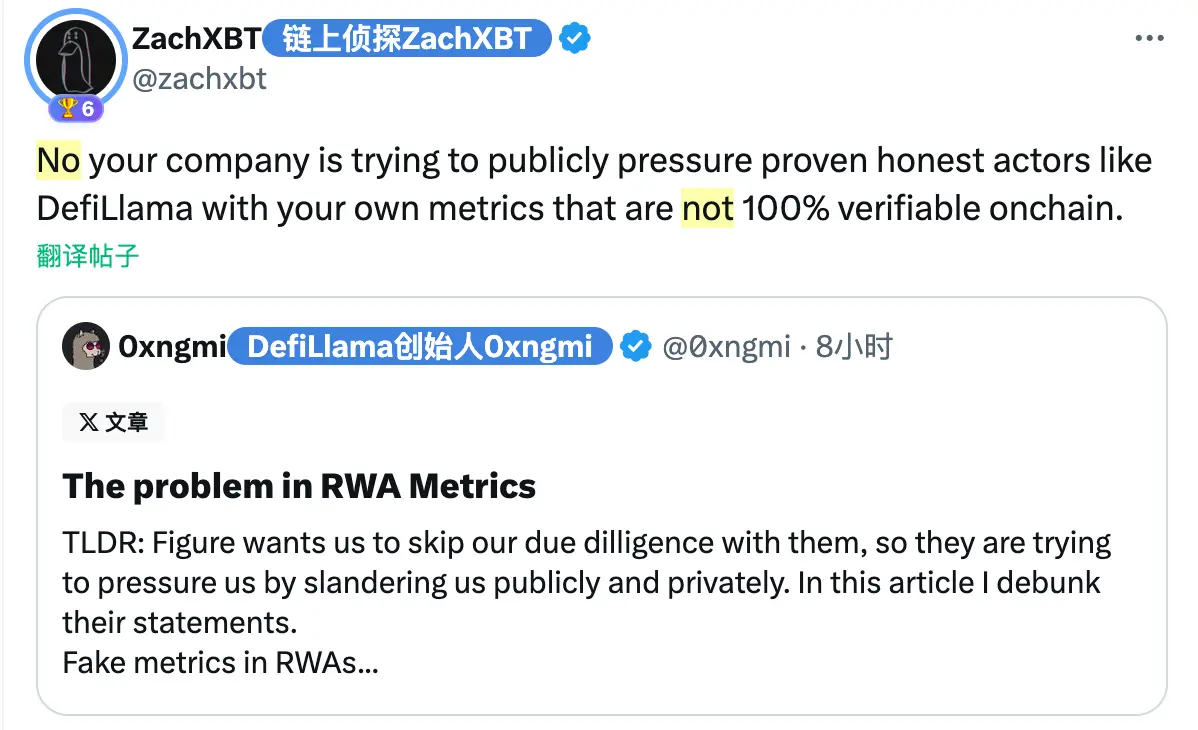
It wasn't until September 13th that DefiLlama co-founder 0xngmi published a lengthy article titled "The Problem in RWA Metrics," systematically disclosing his due diligence findings and four questions, that the narrative began to reverse. Opinion leaders like ZachXBT then reposted the article in support, emphasizing that "these metrics are not 100% verifiable on-chain," and DefiLlama's position gained wider support.
DefiLlama's findings: Data mismatch

In the long article "The Problem in RWA Metrics", 0xngmi announced the results of the DefiLlama team's due diligence on Figure, listing multiple anomalies one by one:

The scale of assets on the chain is seriously inconsistent with the declared scale

Figure claims that the scale of RWA issued on its chain has reached 12 billion US dollars, but the actual assets that can be verified on the chain are only about 5 million US dollars of BTC and 4 million US dollars of ETH. Among them, the 24-hour trading volume of BTC is even only 2,000 US dollars.

Insufficient stablecoin supply

The total supply of Figure's own stablecoin YLDS is only 20 million. In theory, all RWA transactions should be based on this, but the supply is far from enough to support a transaction volume of US$12 billion.

Suspicious asset transfer patterns

Most RWA asset transfers are not initiated by the actual asset holders, but rather through other accounts. Many addresses themselves have almost no on-chain interactions and are suspected to be just database mirrors.

Lack of on-chain payment traces

The vast majority of Figure's loan processes are still completed using fiat currency, and there are almost no corresponding payment and repayment records on the chain.

0xngmi added: “We’re unsure how Figure’s $12 billion in assets are actually being traded. Most holders don’t appear to be using their own keys to transfer these assets — are they simply mirroring their internal databases onto the chain?”

Community Statement: DefiLlama Receives Overwhelming Support

As the controversy spread, community opinion almost overwhelmingly supported DefiLlama, but in the process, some voices from different perspectives also emerged.

ZachXBT (Chain Detective):

They bluntly stated that Figure’s actions were “blatant pressure” and made it clear: “No, your company is trying to use indicators that are not 100% verifiable on the chain to publicly pressure participants like DefiLlama who have been proven to be honest.”

Conor Grogan (Coinbase Board Member):

He directed his criticism at those institutional figures who were lobbied by Figure and who privately questioned DefiLlama when the controversy was still murky. He wrote: "I have received numerous private inquiries from individuals from large cryptocurrency institutions and venture capital firms to contact DefiLlama and our partners. Every one of these people needs to be called out and asked how they can work in this industry if they can't even verify things themselves."

Conor's remarks echoed the thoughts of many people: if even basic on-chain verification cannot be completed independently, then the credibility of these institutions in the RWA and DeFi sectors will be greatly reduced.

Ian Kane (Head of Partnerships, Midnight Network):

A more technical suggestion was made, suggesting that DefiLlama could add a new metric, "active TVL," in addition to the existing TVL tracking, to show the actual transfer rate of RWA over a given period. He gave an example: "For example, two DApps each minted $100 billion in TVL (a total of $200 billion). DApp 1 has $100 billion sitting idle, with perhaps only 2% of its funds flowing, generating $2 billion in active locked value. DApp 2, on the other hand, has 30% of its funds flowing, generating $30 billion in active locked value (15 times that of DApp 1)."

In his opinion, such a dimension can not only show the total scale, but also avoid "stagnant or show-off TVL."

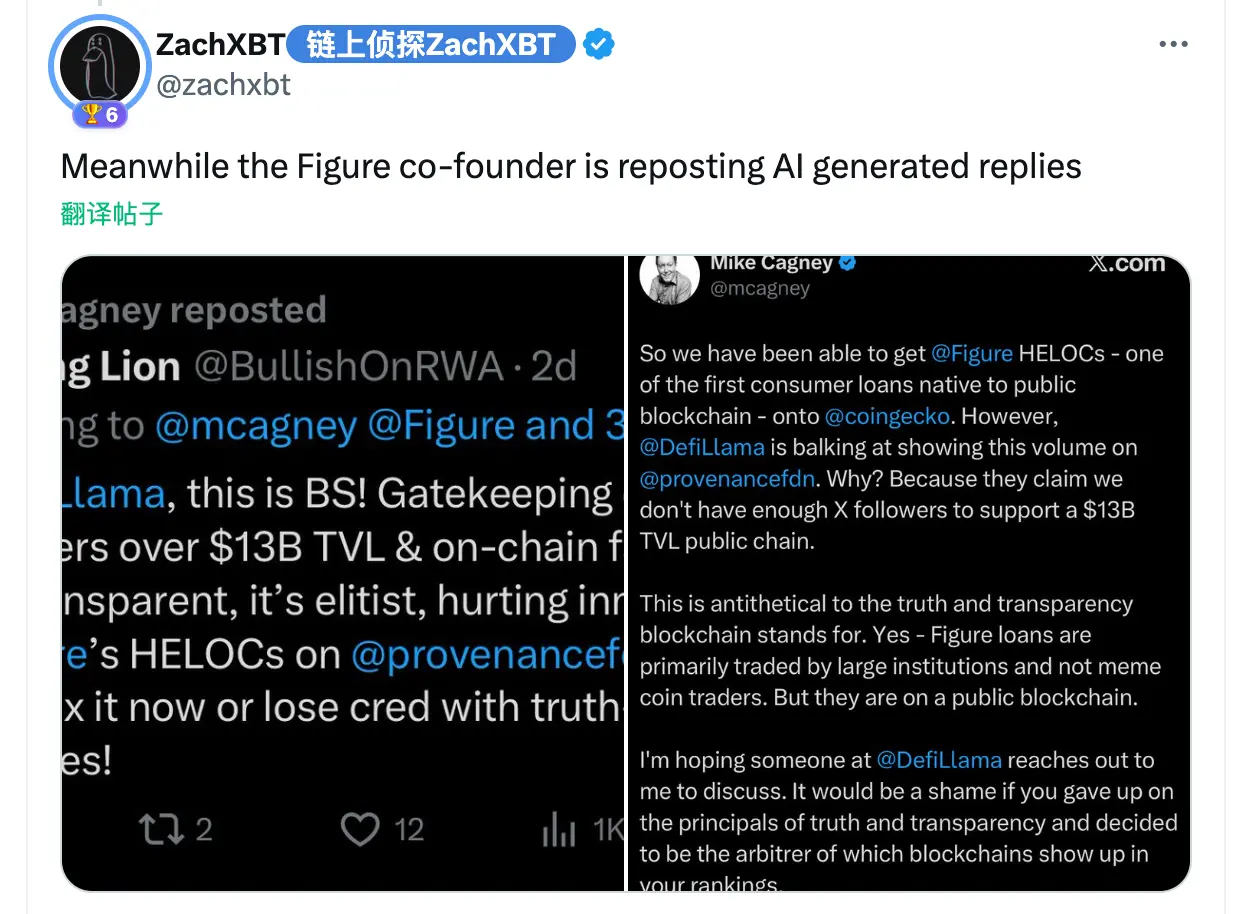
At the same time, ZachXBT also noticed that Figure co-founder Mike Cagney kept forwarding some "support comments" that were suspected to be automatically generated by AI, and publicly pointed this out, further arousing disgust with Figure's public opinion manipulation.
Conclusion: The price of trust has just begun to show

The dispute between Figure and DefiLlama may seem like a ranking issue, but it actually hits the core weakness of the RWA track - what exactly is considered an "on-chain asset."

The core contradiction of this turmoil is actually on-chain fundamentalism vs. off-chain mapping logic.

  • DefiLlama insists on only counting TVL that can be verified on the chain, adhering to open source adapter logic, and refusing to accept asset data that fails to meet transparency requirements.
  • Figure's model: While assets may exist in the real world, the business logic relies heavily on traditional financial systems, with the on-chain portion merely being a database echo. In other words, users cannot use on-chain transactions to prove the transfer of assets, which conflicts with the "verifiability" standard of DeFi natives.

The so-called $12 billion is equal to 0 if it cannot be verified on the chain.

In an industry where transparency and verifiability are the bottom line, any attempt to bypass on-chain verification and use database numbers to impersonate on-chain TVL will ultimately undermine user and market trust.

This controversy may just be the beginning. Similar issues will continue to arise as more RWA protocols emerge. The industry urgently needs to establish clear and unified verification standards, otherwise "virtual TVL" will continue to expand, becoming the next landmine that erodes trust.


Market Opportunity
Threshold Logo
Threshold Price(T)
$0,008756
$0,008756$0,008756
-3,23%
USD
Threshold (T) Live Price Chart
Disclaimer: The articles reposted on this site are sourced from public platforms and are provided for informational purposes only. They do not necessarily reflect the views of MEXC. All rights remain with the original authors. If you believe any content infringes on third-party rights, please contact service@support.mexc.com for removal. MEXC makes no guarantees regarding the accuracy, completeness, or timeliness of the content and is not responsible for any actions taken based on the information provided. The content does not constitute financial, legal, or other professional advice, nor should it be considered a recommendation or endorsement by MEXC.

You May Also Like

Ethereum unveils roadmap focusing on scaling, interoperability, and security at Japan Dev Conference

Ethereum unveils roadmap focusing on scaling, interoperability, and security at Japan Dev Conference

The post Ethereum unveils roadmap focusing on scaling, interoperability, and security at Japan Dev Conference appeared on BitcoinEthereumNews.com. Key Takeaways Ethereum’s new roadmap was presented by Vitalik Buterin at the Japan Dev Conference. Short-term priorities include Layer 1 scaling and raising gas limits to enhance transaction throughput. Vitalik Buterin presented Ethereum’s development roadmap at the Japan Dev Conference today, outlining the blockchain platform’s priorities across multiple timeframes. The short-term goals focus on scaling solutions and increasing Layer 1 gas limits to improve transaction capacity. Mid-term objectives target enhanced cross-Layer 2 interoperability and faster network responsiveness to create a more seamless user experience across different scaling solutions. The long-term vision emphasizes building a secure, simple, quantum-resistant, and formally verified minimalist Ethereum network. This approach aims to future-proof the platform against emerging technological threats while maintaining its core functionality. The roadmap presentation comes as Ethereum continues to compete with other blockchain platforms for market share in the smart contract and decentralized application space. Source: https://cryptobriefing.com/ethereum-roadmap-scaling-interoperability-security-japan/
Share
BitcoinEthereumNews2025/09/18 00:25
CEO Sandeep Nailwal Shared Highlights About RWA on Polygon

CEO Sandeep Nailwal Shared Highlights About RWA on Polygon

The post CEO Sandeep Nailwal Shared Highlights About RWA on Polygon appeared on BitcoinEthereumNews.com. Polygon CEO Sandeep Nailwal highlighted Polygon’s lead in global bonds, Spiko US T-Bill, and Spiko Euro T-Bill. Polygon published an X post to share that its roadmap to GigaGas was still scaling. Sentiments around POL price were last seen to be bearish. Polygon CEO Sandeep Nailwal shared key pointers from the Dune and RWA.xyz report. These pertain to highlights about RWA on Polygon. Simultaneously, Polygon underlined its roadmap towards GigaGas. Sentiments around POL price were last seen fumbling under bearish emotions. Polygon CEO Sandeep Nailwal on Polygon RWA CEO Sandeep Nailwal highlighted three key points from the Dune and RWA.xyz report. The Chief Executive of Polygon maintained that Polygon PoS was hosting RWA TVL worth $1.13 billion across 269 assets plus 2,900 holders. Nailwal confirmed from the report that RWA was happening on Polygon. The Dune and https://t.co/W6WSFlHoQF report on RWA is out and it shows that RWA is happening on Polygon. Here are a few highlights: – Leading in Global Bonds: Polygon holds 62% share of tokenized global bonds (driven by Spiko’s euro MMF and Cashlink euro issues) – Spiko U.S.… — Sandeep | CEO, Polygon Foundation (※,※) (@sandeepnailwal) September 17, 2025 The X post published by Polygon CEO Sandeep Nailwal underlined that the ecosystem was leading in global bonds by holding a 62% share of tokenized global bonds. He further highlighted that Polygon was leading with Spiko US T-Bill at approximately 29% share of TVL along with Ethereum, adding that the ecosystem had more than 50% share in the number of holders. Finally, Sandeep highlighted from the report that there was a strong adoption for Spiko Euro T-Bill with 38% share of TVL. He added that 68% of returns were on Polygon across all the chains. Polygon Roadmap to GigaGas In a different update from Polygon, the community…
Share
BitcoinEthereumNews2025/09/18 01:10
S2 Capital Acquires Ovaltine Apartments, Marking Entry into the Chicago Market

S2 Capital Acquires Ovaltine Apartments, Marking Entry into the Chicago Market

DALLAS, Dec. 22, 2025 /PRNewswire/ — S2 Capital (“S2”), a national vertically integrated real estate investment manager, today announced the acquisition of Ovaltine
Share
AI Journal2025/12/23 12:30