By Felix, PANews Since its creation in 2009, Bitcoin, the first decentralized digital currency, has evolved from a niche experiment into a significant global store of value and settlement network, and has now grown into an asset class valued at approximately $2 trillion. Despite Bitcoin's numerous achievements, new investors eager for higher returns may not be able to achieve the same high returns as early investors at the current high Bitcoin price. Beyond passive asset appreciation, earning income from Bitcoin has become a major market demand. Data shows that over 98% of Bitcoin is currently idle. Unleashing its potential and transforming Bitcoin from a centralized store of value to a distributed internet infrastructure used by billions of people is crucial for its development to reach new heights. Perhaps inspired by the emergence of DeFi on Ethereum, the idea of building DeFi on Bitcoin emerged. Starting with tokenized Bitcoin, Bitcoin has gradually transformed from a static asset to programmable capital. Since the emergence of WBTC in 2019, the market has spawned 50 versions of tokenized Bitcoin across over 20 blockchains. After six years of infrastructure development (from WBTC to transparent, permissionless solutions), the technology has made tremendous strides, including cross-chain protocols, custody solutions, and regulatory frameworks. The current value of tokenized Bitcoin on-chain has reached $40.18 billion. The first "Bitcoin On-Chain Economic Report" was released, and capital is consolidating around three major competitive advantages. As more and more Bitcoin holders switch to other blockchain networks to unlock new features and realize returns, the development of the on-chain Bitcoin economy is gradually moving beyond its "grassroots" experimental stage. However, research on the Bitcoin on-chain economy has yet to form a systematic and organized form. Zeus Network, a Bitcoin infrastructure builder, recently released its inaugural "On-Chain Bitcoin Economy Report." The report comprehensively analyzes the Bitcoin on-chain economy, highlighting the growing importance of blockchain platforms adopting differentiated development strategies based on their respective strengths, leading to a gradual emergence of a survival of the fittest. The "On-Chain Bitcoin Economic Report" shows that the top four blockchains (Base, Ethereum, Stacks, and Solana) will increase by more than 26,000 BTC in 2025, while the bottom five blockchains will lose a total of more than 8,000 BTC. Source: 2025 On - Chain Bitcoin Economy Report ( Zeus Network ) The report mentioned that Bitcoin Capital is currently consolidating around three major competitive advantages: native Bitcoin integration (Stacks), mature user base access (Base), and superior DeFi performance (Solana). Among them, Base, driven by the advantage of Coinbase's user base, achieved a growth rate of 99.83%, providing convenient bridge access to millions of users and a way for institutional clients to deploy Bitcoin. Its outstanding performance shows that mature platforms have significant competitive advantages compared to pure technical solutions. Stacks followed closely behind with a growth rate of 79.65%, indicating a strong market preference for Bitcoin-aligned infrastructure that maintains a closer connection to the base layer while supporting programmability. The head platform effect is also gradually emerging. Compared with the more mature platforms mentioned above, weak participants such as Tron (-541%) and Merlin (-80%) have fallen sharply, which may indicate that the market is consolidating around mature solutions. Notably, Solana achieved a 76.56% growth rate, highlighting the performance advantages of blockchain. Bitcoin holders prioritize practical advantages such as speed, low costs, and robust DeFi functionality when choosing where to effectively deploy their assets. Currently, the Bitcoin tokenization options on the Solana platform have increased from 2 (WBTC and tBTC) in August 2024 to 8 in August 2025, forming a comprehensive ecosystem consisting of 21 projects, covering 4 DEXs (APOLLO, HawkFi, Jupiter and Meteora), 12 DeFi protocols (including btcSOL, Drift, Kamino, Orca and Raydium, etc.), 4 infrastructure projects (Portal/Wormhole, Zeus Network, Threshold) and 1 DAO (MonkeDAO). Among them, APOLLO, as the first Bitcoin on-chain exchange on the Solana platform, plays an important role in expanding the influence of native Bitcoin on Solana. Exchange APOLLO and the re-staking model btcSOL expand user base and application scope Zeus Network, the permissionless Bitcoin infrastructure protocol on the Solana platform, is committed to accelerating the development of Bitcoin's on-chain economy and applications. It not only launched zBTC, the first permissionless Bitcoin on Solana, but also released a series of dApp products, expanding zBTC's user base and application scope. Its role on the Solana platform is becoming increasingly prominent. In March 2025, Zeus Network released APOLLO Mainnet v1, the first Bitcoin on-chain exchange on Solana, designed to provide a seamless, permissionless way to trade and manage assets. As the flagship dApp of the Zeus Network, APOLLO allows Bitcoin holders to trade, exchange, and earn various Bitcoin variants on-chain, unlike centralized platforms, without intermediaries or restrictions. By introducing zBTC, an asset pegged 1:1 to Bitcoin, APOLLO seamlessly integrates Bitcoin liquidity into the Solana ecosystem, providing retail, developer, and institutional investors with a trustless, decentralized solution to unlock Bitcoin's full potential in DeFi. Notably, APOLLO also launched the Earn feature in August, providing users with a way to earn income. On APOLLO Earn, users can choose from lending, liquidity pools, or staking strategies, each integrated with protocols currently supporting zBTC. Going forward, APOLLO will continue to collaborate with DeFi protocols to update Earn and introduce new strategies, providing users with more diverse Bitcoin income options. Following the launch of APOLLO, Zeus Network's second dApp, btcSOL, a restaking model, launched in July, providing Solana users with a convenient, permissionless way to access BTCFi. btcSOL allows holders of SOL or LST-SOL (Solana's liquidity staking token) to stake their tokens and accumulate BTC. The system automatically converts the staked tokens into btcSOL restaking tokens based on a price index, generating on-chain returns that are automatically converted to zBTC. Additionally, btcSOL has partnered with Marinade Finance, a liquidity staking platform on Solana. 5.5% of users' staked SOL will be continuously converted into zBTC, allowing users to steadily increase their Bitcoin exposure without any additional steps. btcSOL v1.5, released on September 9th, also added jupSOL and kySOL. Currently, users can accumulate zBTC (Solana's native Bitcoin) by staking SOL, mSOL, JupSOL, and kySOL. Despite the fierce competition in the Bitcoin tokenization market, Zeus Network has found a differentiated market position through unique design choices and functional positioning. With its technological advantages, strong team and partner network, and the support of the Solana ecosystem, it has the potential to occupy a significant market share in this field. However, like all blockchain projects, Zeus Network faces certain risks and challenges, such as the risk of security vulnerabilities, regulatory uncertainty, market acceptance, and partial dependence on the continued growth and success of the Solana ecosystem. In the future, Zeus Network plans to achieve multi-chain expansion and integrate more blockchain networks in addition to Bitcoin and Solana. In addition, it plans to cultivate a thriving developer community by releasing programming libraries and developer tools, and gradually achieve decentralized governance. Conclusion Bitcoin's transformation into a yield-generating asset is no longer a question of "if," but "when." Not only are institutions creating their own branded, wrapped Bitcoins, but the emergence of permissionless infrastructure also allows any community, protocol, or collective to create a transparent, verifiable representation of Bitcoin tailored to their specific needs. Zeus Network, by innovatively addressing the cross-chain communication issues between Bitcoin and Solana, offers a promising solution for unlocking Bitcoin's enormous potential value. Related Reading: Permissionless Bitcoin on Solana: Zeus Network Launches APOLLO Platform and zBTCBy Felix, PANews Since its creation in 2009, Bitcoin, the first decentralized digital currency, has evolved from a niche experiment into a significant global store of value and settlement network, and has now grown into an asset class valued at approximately $2 trillion. Despite Bitcoin's numerous achievements, new investors eager for higher returns may not be able to achieve the same high returns as early investors at the current high Bitcoin price. Beyond passive asset appreciation, earning income from Bitcoin has become a major market demand. Data shows that over 98% of Bitcoin is currently idle. Unleashing its potential and transforming Bitcoin from a centralized store of value to a distributed internet infrastructure used by billions of people is crucial for its development to reach new heights. Perhaps inspired by the emergence of DeFi on Ethereum, the idea of building DeFi on Bitcoin emerged. Starting with tokenized Bitcoin, Bitcoin has gradually transformed from a static asset to programmable capital. Since the emergence of WBTC in 2019, the market has spawned 50 versions of tokenized Bitcoin across over 20 blockchains. After six years of infrastructure development (from WBTC to transparent, permissionless solutions), the technology has made tremendous strides, including cross-chain protocols, custody solutions, and regulatory frameworks. The current value of tokenized Bitcoin on-chain has reached $40.18 billion. The first "Bitcoin On-Chain Economic Report" was released, and capital is consolidating around three major competitive advantages. As more and more Bitcoin holders switch to other blockchain networks to unlock new features and realize returns, the development of the on-chain Bitcoin economy is gradually moving beyond its "grassroots" experimental stage. However, research on the Bitcoin on-chain economy has yet to form a systematic and organized form. Zeus Network, a Bitcoin infrastructure builder, recently released its inaugural "On-Chain Bitcoin Economy Report." The report comprehensively analyzes the Bitcoin on-chain economy, highlighting the growing importance of blockchain platforms adopting differentiated development strategies based on their respective strengths, leading to a gradual emergence of a survival of the fittest. The "On-Chain Bitcoin Economic Report" shows that the top four blockchains (Base, Ethereum, Stacks, and Solana) will increase by more than 26,000 BTC in 2025, while the bottom five blockchains will lose a total of more than 8,000 BTC. Source: 2025 On - Chain Bitcoin Economy Report ( Zeus Network ) The report mentioned that Bitcoin Capital is currently consolidating around three major competitive advantages: native Bitcoin integration (Stacks), mature user base access (Base), and superior DeFi performance (Solana). Among them, Base, driven by the advantage of Coinbase's user base, achieved a growth rate of 99.83%, providing convenient bridge access to millions of users and a way for institutional clients to deploy Bitcoin. Its outstanding performance shows that mature platforms have significant competitive advantages compared to pure technical solutions. Stacks followed closely behind with a growth rate of 79.65%, indicating a strong market preference for Bitcoin-aligned infrastructure that maintains a closer connection to the base layer while supporting programmability. The head platform effect is also gradually emerging. Compared with the more mature platforms mentioned above, weak participants such as Tron (-541%) and Merlin (-80%) have fallen sharply, which may indicate that the market is consolidating around mature solutions. Notably, Solana achieved a 76.56% growth rate, highlighting the performance advantages of blockchain. Bitcoin holders prioritize practical advantages such as speed, low costs, and robust DeFi functionality when choosing where to effectively deploy their assets. Currently, the Bitcoin tokenization options on the Solana platform have increased from 2 (WBTC and tBTC) in August 2024 to 8 in August 2025, forming a comprehensive ecosystem consisting of 21 projects, covering 4 DEXs (APOLLO, HawkFi, Jupiter and Meteora), 12 DeFi protocols (including btcSOL, Drift, Kamino, Orca and Raydium, etc.), 4 infrastructure projects (Portal/Wormhole, Zeus Network, Threshold) and 1 DAO (MonkeDAO). Among them, APOLLO, as the first Bitcoin on-chain exchange on the Solana platform, plays an important role in expanding the influence of native Bitcoin on Solana. Exchange APOLLO and the re-staking model btcSOL expand user base and application scope Zeus Network, the permissionless Bitcoin infrastructure protocol on the Solana platform, is committed to accelerating the development of Bitcoin's on-chain economy and applications. It not only launched zBTC, the first permissionless Bitcoin on Solana, but also released a series of dApp products, expanding zBTC's user base and application scope. Its role on the Solana platform is becoming increasingly prominent. In March 2025, Zeus Network released APOLLO Mainnet v1, the first Bitcoin on-chain exchange on Solana, designed to provide a seamless, permissionless way to trade and manage assets. As the flagship dApp of the Zeus Network, APOLLO allows Bitcoin holders to trade, exchange, and earn various Bitcoin variants on-chain, unlike centralized platforms, without intermediaries or restrictions. By introducing zBTC, an asset pegged 1:1 to Bitcoin, APOLLO seamlessly integrates Bitcoin liquidity into the Solana ecosystem, providing retail, developer, and institutional investors with a trustless, decentralized solution to unlock Bitcoin's full potential in DeFi. Notably, APOLLO also launched the Earn feature in August, providing users with a way to earn income. On APOLLO Earn, users can choose from lending, liquidity pools, or staking strategies, each integrated with protocols currently supporting zBTC. Going forward, APOLLO will continue to collaborate with DeFi protocols to update Earn and introduce new strategies, providing users with more diverse Bitcoin income options. Following the launch of APOLLO, Zeus Network's second dApp, btcSOL, a restaking model, launched in July, providing Solana users with a convenient, permissionless way to access BTCFi. btcSOL allows holders of SOL or LST-SOL (Solana's liquidity staking token) to stake their tokens and accumulate BTC. The system automatically converts the staked tokens into btcSOL restaking tokens based on a price index, generating on-chain returns that are automatically converted to zBTC. Additionally, btcSOL has partnered with Marinade Finance, a liquidity staking platform on Solana. 5.5% of users' staked SOL will be continuously converted into zBTC, allowing users to steadily increase their Bitcoin exposure without any additional steps. btcSOL v1.5, released on September 9th, also added jupSOL and kySOL. Currently, users can accumulate zBTC (Solana's native Bitcoin) by staking SOL, mSOL, JupSOL, and kySOL. Despite the fierce competition in the Bitcoin tokenization market, Zeus Network has found a differentiated market position through unique design choices and functional positioning. With its technological advantages, strong team and partner network, and the support of the Solana ecosystem, it has the potential to occupy a significant market share in this field. However, like all blockchain projects, Zeus Network faces certain risks and challenges, such as the risk of security vulnerabilities, regulatory uncertainty, market acceptance, and partial dependence on the continued growth and success of the Solana ecosystem. In the future, Zeus Network plans to achieve multi-chain expansion and integrate more blockchain networks in addition to Bitcoin and Solana. In addition, it plans to cultivate a thriving developer community by releasing programming libraries and developer tools, and gradually achieve decentralized governance. Conclusion Bitcoin's transformation into a yield-generating asset is no longer a question of "if," but "when." Not only are institutions creating their own branded, wrapped Bitcoins, but the emergence of permissionless infrastructure also allows any community, protocol, or collective to create a transparent, verifiable representation of Bitcoin tailored to their specific needs. Zeus Network, by innovatively addressing the cross-chain communication issues between Bitcoin and Solana, offers a promising solution for unlocking Bitcoin's enormous potential value. Related Reading: Permissionless Bitcoin on Solana: Zeus Network Launches APOLLO Platform and zBTC

Trillion-dollar market demand: Can the Bitcoin on-chain economy become the next hot narrative?

2025/09/15 16:00

By Felix, PANews

Since its creation in 2009, Bitcoin, the first decentralized digital currency, has evolved from a niche experiment into a significant global store of value and settlement network, and has now grown into an asset class valued at approximately $2 trillion. Despite Bitcoin's numerous achievements, new investors eager for higher returns may not be able to achieve the same high returns as early investors at the current high Bitcoin price.

Beyond passive asset appreciation, earning income from Bitcoin has become a major market demand. Data shows that over 98% of Bitcoin is currently idle. Unleashing its potential and transforming Bitcoin from a centralized store of value to a distributed internet infrastructure used by billions of people is crucial for its development to reach new heights.

Perhaps inspired by the emergence of DeFi on Ethereum, the idea of building DeFi on Bitcoin emerged. Starting with tokenized Bitcoin, Bitcoin has gradually transformed from a static asset to programmable capital. Since the emergence of WBTC in 2019, the market has spawned 50 versions of tokenized Bitcoin across over 20 blockchains. After six years of infrastructure development (from WBTC to transparent, permissionless solutions), the technology has made tremendous strides, including cross-chain protocols, custody solutions, and regulatory frameworks. The current value of tokenized Bitcoin on-chain has reached $40.18 billion.

The first "Bitcoin On-Chain Economic Report" was released, and capital is consolidating around three major competitive advantages.

As more and more Bitcoin holders switch to other blockchain networks to unlock new features and realize returns, the development of the on-chain Bitcoin economy is gradually moving beyond its "grassroots" experimental stage. However, research on the Bitcoin on-chain economy has yet to form a systematic and organized form.

Zeus Network, a Bitcoin infrastructure builder, recently released its inaugural "On-Chain Bitcoin Economy Report." The report comprehensively analyzes the Bitcoin on-chain economy, highlighting the growing importance of blockchain platforms adopting differentiated development strategies based on their respective strengths, leading to a gradual emergence of a survival of the fittest.

The "On-Chain Bitcoin Economic Report" shows that the top four blockchains (Base, Ethereum, Stacks, and Solana) will increase by more than 26,000 BTC in 2025, while the bottom five blockchains will lose a total of more than 8,000 BTC.
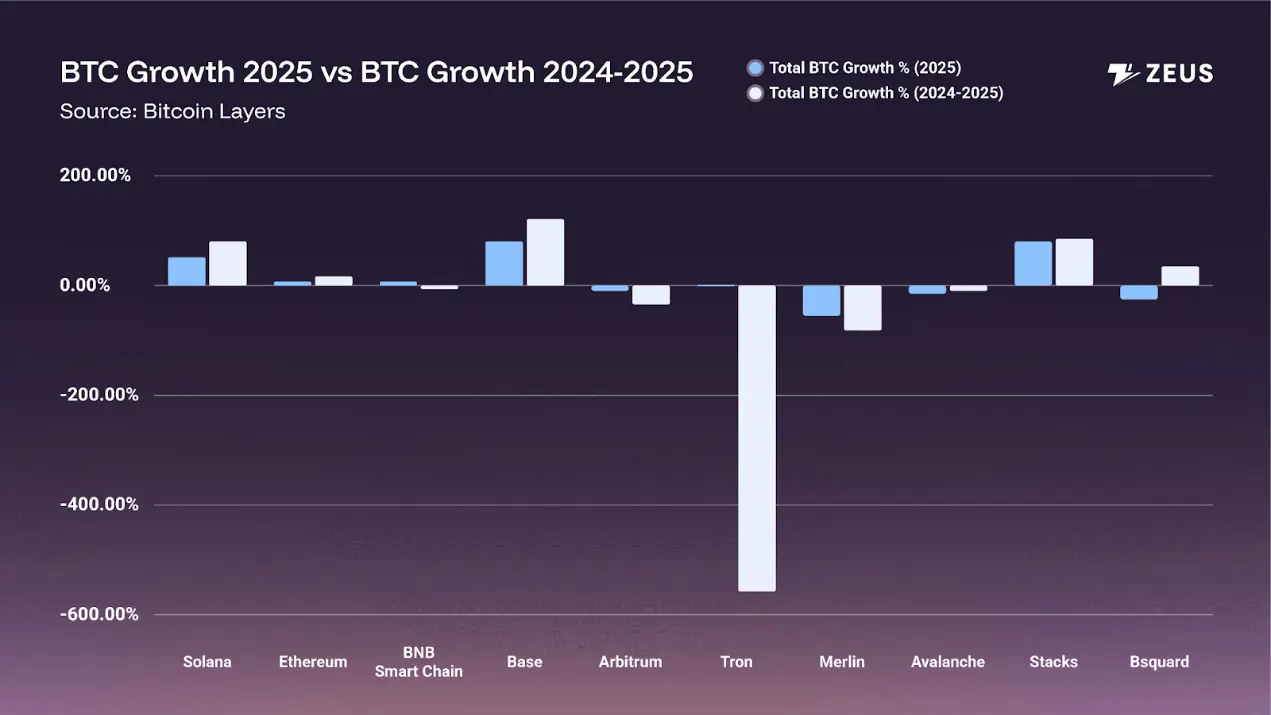
 Source: 2025 On - Chain Bitcoin Economy Report ( Zeus Network )

The report mentioned that Bitcoin Capital is currently consolidating around three major competitive advantages: native Bitcoin integration (Stacks), mature user base access (Base), and superior DeFi performance (Solana).

Among them, Base, driven by the advantage of Coinbase's user base, achieved a growth rate of 99.83%, providing convenient bridge access to millions of users and a way for institutional clients to deploy Bitcoin. Its outstanding performance shows that mature platforms have significant competitive advantages compared to pure technical solutions.

Stacks followed closely behind with a growth rate of 79.65%, indicating a strong market preference for Bitcoin-aligned infrastructure that maintains a closer connection to the base layer while supporting programmability.

The head platform effect is also gradually emerging. Compared with the more mature platforms mentioned above, weak participants such as Tron (-541%) and Merlin (-80%) have fallen sharply, which may indicate that the market is consolidating around mature solutions.

Notably, Solana achieved a 76.56% growth rate, highlighting the performance advantages of blockchain. Bitcoin holders prioritize practical advantages such as speed, low costs, and robust DeFi functionality when choosing where to effectively deploy their assets.

Currently, the Bitcoin tokenization options on the Solana platform have increased from 2 (WBTC and tBTC) in August 2024 to 8 in August 2025, forming a comprehensive ecosystem consisting of 21 projects, covering 4 DEXs (APOLLO, HawkFi, Jupiter and Meteora), 12 DeFi protocols (including btcSOL, Drift, Kamino, Orca and Raydium, etc.), 4 infrastructure projects (Portal/Wormhole, Zeus Network, Threshold) and 1 DAO (MonkeDAO).

Among them, APOLLO, as the first Bitcoin on-chain exchange on the Solana platform, plays an important role in expanding the influence of native Bitcoin on Solana.

Exchange APOLLO and the re-staking model btcSOL expand user base and application scope

Zeus Network, the permissionless Bitcoin infrastructure protocol on the Solana platform, is committed to accelerating the development of Bitcoin's on-chain economy and applications. It not only launched zBTC, the first permissionless Bitcoin on Solana, but also released a series of dApp products, expanding zBTC's user base and application scope. Its role on the Solana platform is becoming increasingly prominent.

In March 2025, Zeus Network released APOLLO Mainnet v1, the first Bitcoin on-chain exchange on Solana, designed to provide a seamless, permissionless way to trade and manage assets.

As the flagship dApp of the Zeus Network, APOLLO allows Bitcoin holders to trade, exchange, and earn various Bitcoin variants on-chain, unlike centralized platforms, without intermediaries or restrictions. By introducing zBTC, an asset pegged 1:1 to Bitcoin, APOLLO seamlessly integrates Bitcoin liquidity into the Solana ecosystem, providing retail, developer, and institutional investors with a trustless, decentralized solution to unlock Bitcoin's full potential in DeFi.

Notably, APOLLO also launched the Earn feature in August, providing users with a way to earn income. On APOLLO Earn, users can choose from lending, liquidity pools, or staking strategies, each integrated with protocols currently supporting zBTC. Going forward, APOLLO will continue to collaborate with DeFi protocols to update Earn and introduce new strategies, providing users with more diverse Bitcoin income options.

Following the launch of APOLLO, Zeus Network's second dApp, btcSOL, a restaking model, launched in July, providing Solana users with a convenient, permissionless way to access BTCFi. btcSOL allows holders of SOL or LST-SOL (Solana's liquidity staking token) to stake their tokens and accumulate BTC. The system automatically converts the staked tokens into btcSOL restaking tokens based on a price index, generating on-chain returns that are automatically converted to zBTC.

Additionally, btcSOL has partnered with Marinade Finance, a liquidity staking platform on Solana. 5.5% of users' staked SOL will be continuously converted into zBTC, allowing users to steadily increase their Bitcoin exposure without any additional steps. btcSOL v1.5, released on September 9th, also added jupSOL and kySOL. Currently, users can accumulate zBTC (Solana's native Bitcoin) by staking SOL, mSOL, JupSOL, and kySOL.

Despite the fierce competition in the Bitcoin tokenization market, Zeus Network has found a differentiated market position through unique design choices and functional positioning. With its technological advantages, strong team and partner network, and the support of the Solana ecosystem, it has the potential to occupy a significant market share in this field.

However, like all blockchain projects, Zeus Network faces certain risks and challenges, such as the risk of security vulnerabilities, regulatory uncertainty, market acceptance, and partial dependence on the continued growth and success of the Solana ecosystem.

In the future, Zeus Network plans to achieve multi-chain expansion and integrate more blockchain networks in addition to Bitcoin and Solana. In addition, it plans to cultivate a thriving developer community by releasing programming libraries and developer tools, and gradually achieve decentralized governance.

Conclusion

Bitcoin's transformation into a yield-generating asset is no longer a question of "if," but "when." Not only are institutions creating their own branded, wrapped Bitcoins, but the emergence of permissionless infrastructure also allows any community, protocol, or collective to create a transparent, verifiable representation of Bitcoin tailored to their specific needs. Zeus Network, by innovatively addressing the cross-chain communication issues between Bitcoin and Solana, offers a promising solution for unlocking Bitcoin's enormous potential value.

Related Reading: Permissionless Bitcoin on Solana: Zeus Network Launches APOLLO Platform and zBTC


Market Opportunity
SIX Logo
SIX Price(SIX)
$0.01145
$0.01145$0.01145
-0.26%
USD
SIX (SIX) Live Price Chart
Disclaimer: The articles reposted on this site are sourced from public platforms and are provided for informational purposes only. They do not necessarily reflect the views of MEXC. All rights remain with the original authors. If you believe any content infringes on third-party rights, please contact service@support.mexc.com for removal. MEXC makes no guarantees regarding the accuracy, completeness, or timeliness of the content and is not responsible for any actions taken based on the information provided. The content does not constitute financial, legal, or other professional advice, nor should it be considered a recommendation or endorsement by MEXC.

You May Also Like

Solana Treasury Stocks: Why Are These Companies Buying Up SOL?

Solana Treasury Stocks: Why Are These Companies Buying Up SOL?

The post Solana Treasury Stocks: Why Are These Companies Buying Up SOL? appeared on BitcoinEthereumNews.com. In 2020, everyone watched Strategy (called Microstrategy back then) scoop up Bitcoin and turn corporate crypto treasuries into a mainstream story. Now, a new wave is forming. And it’s centered on Solana. Dozens of companies are holding SOL as a bet on price. Except they’re not just holding. They’re building what’s being called Solana treasuries or Digital Asset Treasuries (DATs). These aren’t passive vaults. They’re active strategies that stake, earn yield, and tie into the fast-growing Solana ecosystem. Forward Industries, a Nasdaq-listed firm, recently bought more than 6.8 million SOL, making it the world’s largest Solana treasury company. Others like Helius Medical, Upexi, and DeFi Development are following a similar playbook, turning SOL into a centerpiece of their balance sheets. The trend is clear: Solana treasury stocks are emerging as a new class of crypto-exposed equities. And for investors, the question isn’t just who’s buying but why this strategy is spreading so fast. Key highlights: Solana treasuries (DATs) are corporate reserves of SOL designed to earn yield through staking and DeFi. Companies like Forward Industries, Helius Medical, Upexi, and DeFi Development Corp now hold millions of SOL. Public firms collectively own 17.1M SOL (≈$4B), which makes Solana one of the most adopted treasuries. Unlike Bitcoin treasuries, Solana holdings generate 6–8% annual rewards. It makes reserves into productive assets Solana treasury stocks are emerging as a new way for investors to gain indirect exposure to SOL. Risks remain: volatility, regulation, and concentrated holdings. But corporate adoption is growing fast. What is a Solana treasury (DAT)? A Solana treasury, sometimes called a Digital Asset Treasury (DAT), is when a company holds SOL as part of its balance sheet. But unlike Bitcoin treasuries, these usually aren’t just static reserves sitting in cold storage.  The key difference is productivity. SOL can be staked directly…
Share
BitcoinEthereumNews2025/09/21 06:09
Raoul Pal Predicts Bitcoin’s Correlation With ISM Index

Raoul Pal Predicts Bitcoin’s Correlation With ISM Index

The post Raoul Pal Predicts Bitcoin’s Correlation With ISM Index appeared on BitcoinEthereumNews.com. Key Points: Raoul Pal asserts Bitcoin aligns with the ISM Index cycle. Bitcoin’s price peak predicted for 2026 due to market dynamics. Potential Bitcoin price growth if ISM surpasses 60. Raoul Pal, co-founder and CEO of Real Vision, recently stated that Bitcoin’s price movement is now closely linked to the ISM index, anticipating significant impacts. This connection suggests a potential peak in Bitcoin prices by 2026, aligning with macroeconomic cycles and affecting market dynamics for investors globally. Bitcoin Market Projections Aligned with ISM Growth Raoul Pal, co-founder of Real Vision, asserts a strong connection between Bitcoin and the ISM. He suggests that the Treasury’s decision to extend debt maturity from four to five years artificially lengthens Bitcoin’s market cycle. This effectively reshapes investment expectations into a five-year cycle, delaying projections originally due in 2025 to 2026. Pal expects Bitcoin prices could surpass $300,000 should the ISM rise above 60, riding a wave of increased liquidity. This forecast synchronizes with a broader market understanding that Bitcoin trends reflect major macroeconomic cycles. Raoul Pal stated, “Bitcoin goes up as the ISM goes up… If it goes above 60, I mean, those are high prices in Bitcoin. That’s above $300,000, maybe even higher.” Investor sentiment on social platforms shows keen interest in Pal’s theory. The notion of extending cycle expectations to 2026 has prompted significant discussions among traders, with an emphasis on ISM readings as critical triggers. Official statements from Pal emphasize Bitcoin’s leading position relative to ISM metrics. Key Historical ISM Surges Boost Bitcoin Prices Did you know? Historically, when the ISM Index surpassed 60, Bitcoin has experienced significant rallies, such as those in 2017 and 2020–21. Analysts predict a similar surge if current trends continue. According to CoinMarketCap, Bitcoin’s price currently stands at $111,519.43, reflecting a 24-hour change of -1.41%. The…
Share
BitcoinEthereumNews2025/09/25 19:57
Top Altcoin Primed to Grab Market Share from Cardano (ADA) in the Upcoming Q4 Altseason

Top Altcoin Primed to Grab Market Share from Cardano (ADA) in the Upcoming Q4 Altseason

As the cryptocurrency market prepares for the potential of a Q4 altseason, investors are shifting their attention to those tokens that are creating tangible utility within the DeFi market. While Cardano (ADA) has been the long-term smart contract challenger for years, a newer player, Mutuum Finance (MUTM) is creating a buzz with its lending and […]
Share
Cryptopolitan2025/09/19 01:30



