

Gold Just Had Its Worst Week Since 2020 — Here’s Why the War Isn’t Helping
TLDR
- Gold fell over 8% this week, its worst weekly drop since early 2020
- The U.S.-Israel strike on Iran in late February triggered inflation fears, hurting precious metals
- Major central banks, including the Fed and ECB, held rates steady and warned of few cuts ahead
- Silver dropped nearly 10% this week, with analysts flagging its higher sensitivity to dollar strength
- Gold broke below the $4,800–$5,200 range it had held since the war began
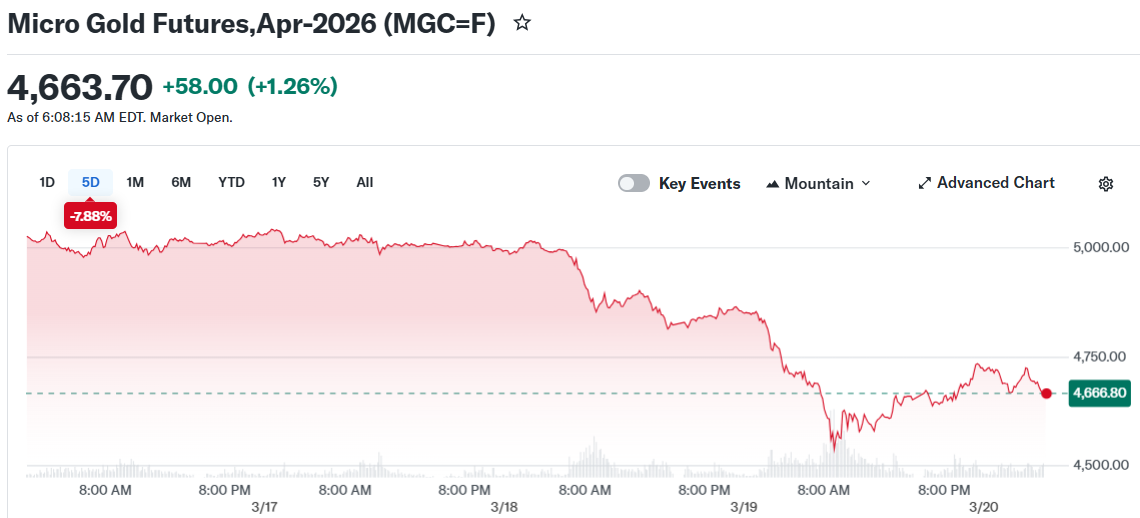
Gold prices bounced back slightly on Friday, but the metal is still on track for its third straight weekly loss. Spot gold rose about 1.4% to $4,715 an ounce, while gold futures climbed around 2.4%.
 Micro Gold Futures,Apr-2026 (MGC=F)
Despite Friday’s small recovery, gold has lost more than 8% this week. That makes it the worst weekly performance for the metal since early 2020.
Gold had been trading in a range between $5,000 and $5,200 since the U.S.-Israel strike on Iran began in late February. This week’s selloff pushed it well below that range.
The conflict has raised concerns about rising energy prices and inflation. Oil prices climbed to near four-year highs this week after strikes hit Middle Eastern energy infrastructure.
Central banks around the world responded to those inflation signals. The Reserve Bank of Australia raised interest rates. The Federal Reserve, European Central Bank, Swiss National Bank, and Bank of Japan all held rates steady.
Each of those banks also warned that rate cuts are unlikely in the near term. That message hit gold hard, since lower rates tend to support the metal.
The Federal Reserve kept rates unchanged on Wednesday and said inflation could rise further. Gold is often seen as a hedge against inflation, but higher rates make yield-bearing assets more attractive by comparison.
A stronger U.S. dollar also weighed on gold. When the dollar rises, gold becomes more expensive for buyers using other currencies, which can reduce demand.
The dollar did pull back on Friday, giving gold some breathing room. Several central banks signaled rate hikes, which boosted their own currencies against the greenback.
Silver Takes a Harder Hit
Silver dropped nearly 10% this week, steeper than gold’s decline. Spot silver rose 0.5% on Friday to $73.14 an ounce, but that only partially offset the weekly losses.
Analysts at OCBC said silver is more exposed to shifts in dollar strength and risk sentiment than gold is. They said they may revise their silver price outlook “modestly lower.”
Silver also faces risk from slower global growth, which could reduce industrial demand. The metal is widely used in solar panels and electrical systems.
Platinum fell 2.9% for the week but rose 2.1% on Friday to around $2,016 an ounce.
What Analysts Are Saying
Nicholas Frappell, global head of institutional markets at ABC Refinery, told Reuters that gold held key technical support levels on a weekly basis.
He said gold could recover toward the $4,800 level where it broke down. He also noted that traders had been positioned to sell rather than buy gold after its underperformance during the conflict.
Spot gold has now declined over 10% since the U.S.-Israel strike on Iran on February 28.
The post Gold Just Had Its Worst Week Since 2020 — Here’s Why the War Isn’t Helping appeared first on CoinCentral.


You May Also Like

Saylor Says Strategy’s Bitcoin Credit Model Is Not A Ponzi Scheme

Bitcoin World Reveals Top 5 Stunning Gainers And Losers




