Talent recruitment is tied to the U.S. election cycle. Trump’s pro-crypto stance and Harris’ evolving attitude have sparked heated discussions, which could drive market-related (GTM) job recruitment.Talent recruitment is tied to the U.S. election cycle. Trump’s pro-crypto stance and Harris’ evolving attitude have sparked heated discussions, which could drive market-related (GTM) job recruitment.

Crypto Industry Recruitment Research Report: DeFi job seekers increase, and marketing positions grow in the Asia-Pacific region

2024/10/29 17:23

Crypto Industry Recruitment Research Report: DeFi job seekers increase, and marketing positions grow in the Asia-Pacific region

Original author: Zackary Skelly (Head of Talent, Dragonfly)

Compiled by: Zen, PANews

Well-known crypto VC Dragonfly Capital analyzes the crypto industry recruitment market every quarter to provide its portfolio companies with insights into job trends, job seeker perceptions, portfolio company activities and forecasts.

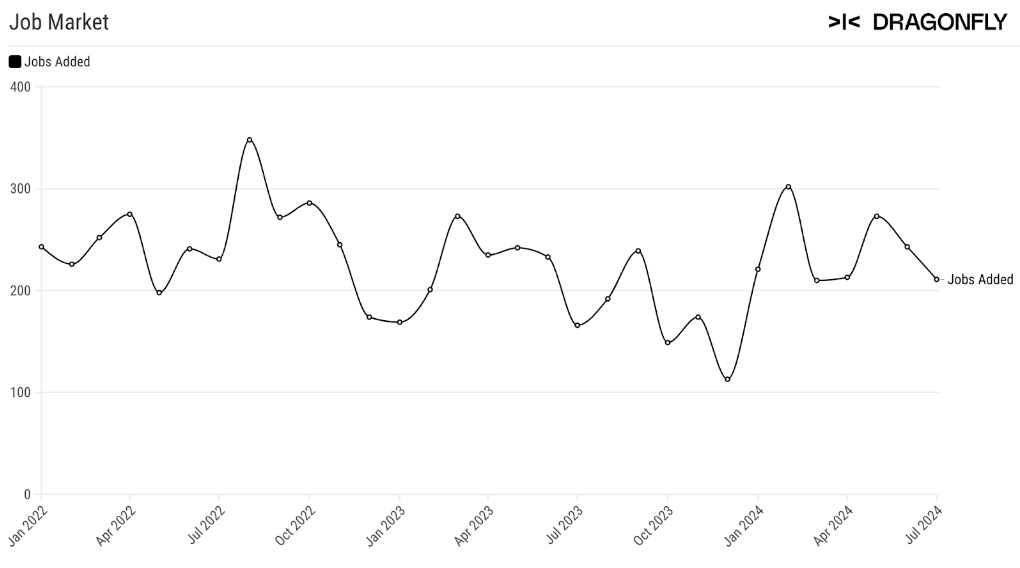
Dragonfly monitors multiple signals when analyzing the market, but "new positions at portfolio companies" best reflects the overall sentiment of the industry. In short, the talent recruitment market in the crypto industry gradually recovered from 2023 until a surge in the first quarter of 2024, but stagnated after entering the second quarter.
Crypto Industry Recruitment Research Report: DeFi job seekers increase, and marketing positions grow in the Asia-Pacific region

Quarterly job changes

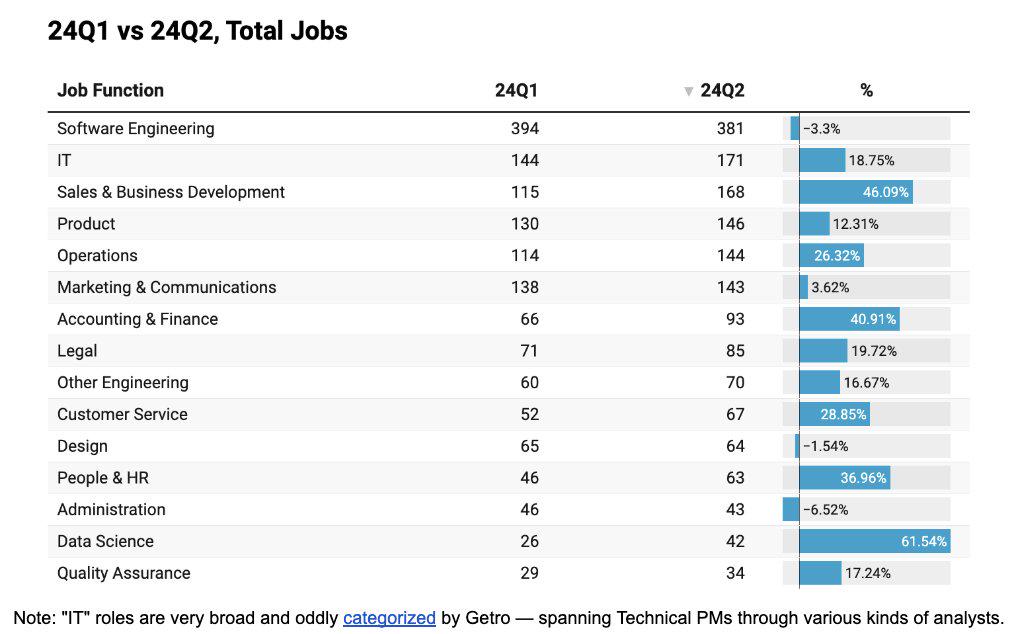
In the second quarter of 2024, engineering and design positions are relatively stable, GTM (GoToMarket) positions surge, and data science positions also grow to a considerable extent. Marketing positions shift to leadership positions.
Crypto Industry Recruitment Research Report: DeFi job seekers increase, and marketing positions grow in the Asia-Pacific region

Year-on-year comparison

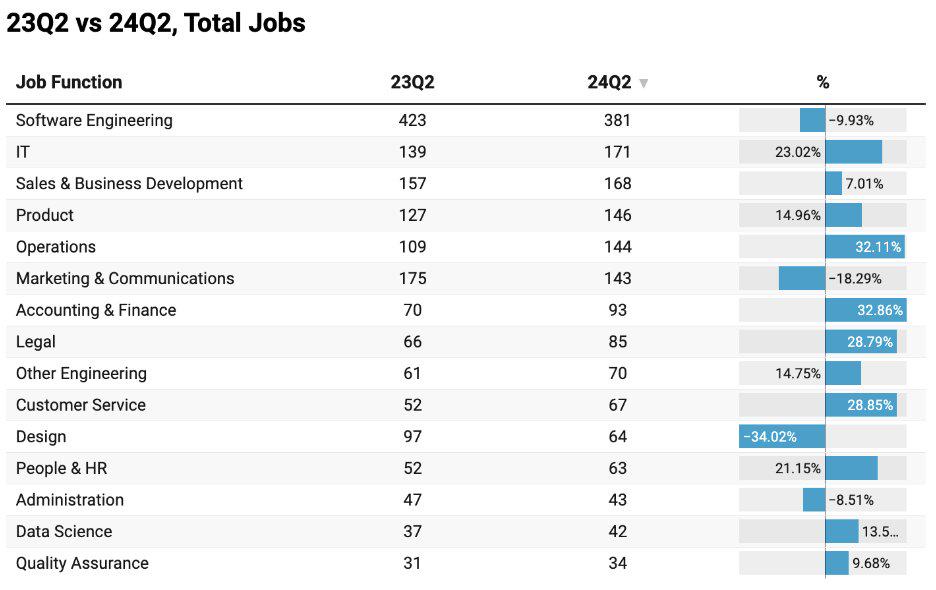
Comparing Q2 2023 to Q2 2024, GTM positions see significant growth, particularly in finance, operations, legal, and customer support.

Engineering positions have become more segmented, Rust language is in high demand, DevRel (Developer Relations) and Protocol Eng (Protocol Engineer) are still popular, while design positions have seen a significant decline.
Crypto Industry Recruitment Research Report: DeFi job seekers increase, and marketing positions grow in the Asia-Pacific region

Job seeker interests

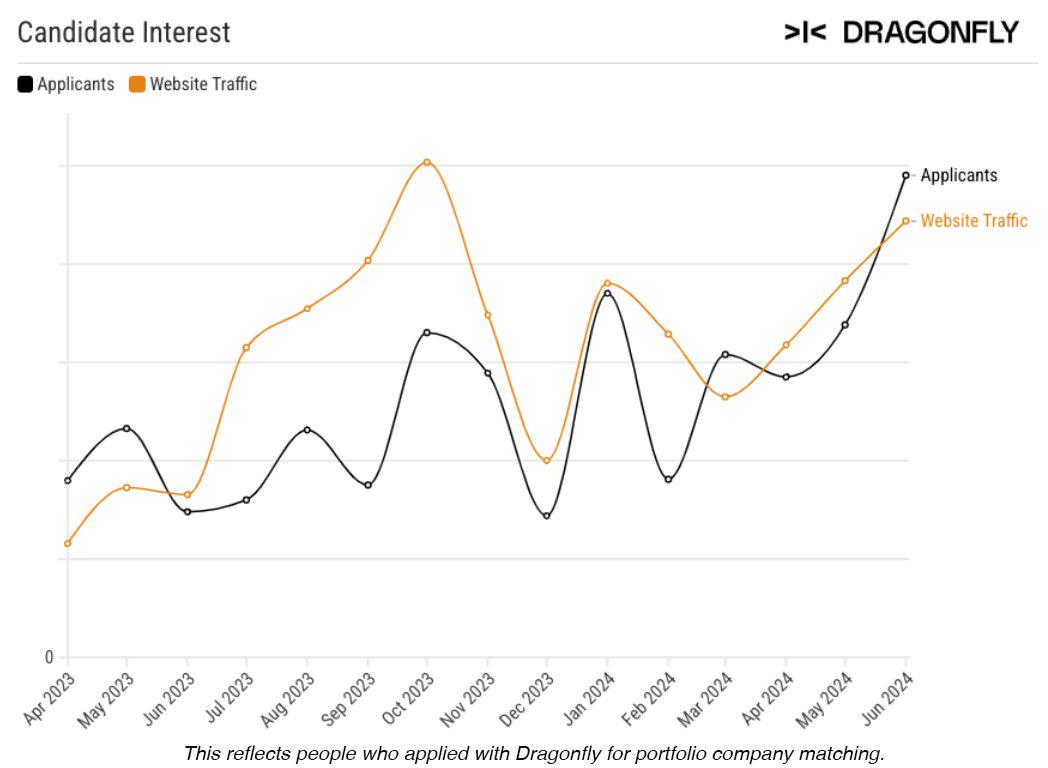
In the second quarter of 2024, more DeFi job seekers appeared in the market, while those who focused on infrastructure construction stayed where they were, looking for product-market fit. Many people are skeptically curious about the combination of AI and encryption - exciting, but the use case is uncertain and seems too advanced.

In addition, zero-knowledge proof (ZK) remains a popular technology type among senior software engineers (Sr SWE).
Crypto Industry Recruitment Research Report: DeFi job seekers increase, and marketing positions grow in the Asia-Pacific region

Evolving priorities, increased scrutiny

Job seekers seek project teams that still have a reliable roadmap after TGE rather than empty "ToTheMoon" slogans, and prefer companies with strong ecosystems and well-known brands. Few job seekers are willing to consider jobs that do not match their personal skills and have unclear job descriptions.

Crypto Burnout and the Openness of Web2

More and more crypto-native job seekers are willing to consider Web2 job opportunities while seeking positions in the crypto industry. Conversely, exchange-traded funds (ETFs) and crypto-friendly US policies have attracted more talent from traditional finance and Web2 fields.

Office model and salary conditions

Remote and hybrid working are still the first choice, but more and more companies are beginning to discuss arranging offline physical offices. In terms of salary expectations, job seekers still have high standards and most are unwilling to compromise.

Several of Dragonfly’s portfolio companies stepped up their hiring efforts in the second quarter, with increased interest in niche, product-focused engineering roles such as front-end development.

GTM hiring has grown in the Asia Pacific region, while engineering positions are expanding in the Europe, Middle East and Africa (EMEA) region. In addition, Layer 1 project parties (Alt L1s) are gaining momentum in hiring.

Recruitment Market Forecast

Hiring is tied to the US election cycle. Trump’s pro-crypto stance and Harris’ evolving attitude have sparked heated discussions, which may drive GTM hiring. Dragonfly expects this trend to continue, and as use cases solidify, job seekers’ sentiment towards the combination of AI and crypto will also shift to excitement.


Market Opportunity
OFFICIAL TRUMP Logo
OFFICIAL TRUMP Price(TRUMP)
$5.114
$5.114$5.114
-0.21%
USD
OFFICIAL TRUMP (TRUMP) Live Price Chart
Disclaimer: The articles reposted on this site are sourced from public platforms and are provided for informational purposes only. They do not necessarily reflect the views of MEXC. All rights remain with the original authors. If you believe any content infringes on third-party rights, please contact service@support.mexc.com for removal. MEXC makes no guarantees regarding the accuracy, completeness, or timeliness of the content and is not responsible for any actions taken based on the information provided. The content does not constitute financial, legal, or other professional advice, nor should it be considered a recommendation or endorsement by MEXC.

You May Also Like

Trump’s Crypto Gains Risk Backlash Post-Presidency, Ethereum Veteran Advises Urgency

Trump’s Crypto Gains Risk Backlash Post-Presidency, Ethereum Veteran Advises Urgency

The post Trump’s Crypto Gains Risk Backlash Post-Presidency, Ethereum Veteran Advises Urgency appeared on BitcoinEthereumNews.com. President Trump’s administration
Share
BitcoinEthereumNews2025/12/21 01:29
China Blocks Nvidia’s RTX Pro 6000D as Local Chips Rise

China Blocks Nvidia’s RTX Pro 6000D as Local Chips Rise

The post China Blocks Nvidia’s RTX Pro 6000D as Local Chips Rise appeared on BitcoinEthereumNews.com. China Blocks Nvidia’s RTX Pro 6000D as Local Chips Rise China’s internet regulator has ordered the country’s biggest technology firms, including Alibaba and ByteDance, to stop purchasing Nvidia’s RTX Pro 6000D GPUs. According to the Financial Times, the move shuts down the last major channel for mass supplies of American chips to the Chinese market. Why Beijing Halted Nvidia Purchases Chinese companies had planned to buy tens of thousands of RTX Pro 6000D accelerators and had already begun testing them in servers. But regulators intervened, halting the purchases and signaling stricter controls than earlier measures placed on Nvidia’s H20 chip. Image: Nvidia An audit compared Huawei and Cambricon processors, along with chips developed by Alibaba and Baidu, against Nvidia’s export-approved products. Regulators concluded that Chinese chips had reached performance levels comparable to the restricted U.S. models. This assessment pushed authorities to advise firms to rely more heavily on domestic processors, further tightening Nvidia’s already limited position in China. China’s Drive Toward Tech Independence The decision highlights Beijing’s focus on import substitution — developing self-sufficient chip production to reduce reliance on U.S. supplies. “The signal is now clear: all attention is focused on building a domestic ecosystem,” said a representative of a leading Chinese tech company. Nvidia had unveiled the RTX Pro 6000D in July 2025 during CEO Jensen Huang’s visit to Beijing, in an attempt to keep a foothold in China after Washington restricted exports of its most advanced chips. But momentum is shifting. Industry sources told the Financial Times that Chinese manufacturers plan to triple AI chip production next year to meet growing demand. They believe “domestic supply will now be sufficient without Nvidia.” What It Means for the Future With Huawei, Cambricon, Alibaba, and Baidu stepping up, China is positioning itself for long-term technological independence. Nvidia, meanwhile, faces…
Share
BitcoinEthereumNews2025/09/18 01:37
Academic Publishing and Fairness: A Game-Theoretic Model of Peer-Review Bias

Academic Publishing and Fairness: A Game-Theoretic Model of Peer-Review Bias

Exploring how biases in the peer-review system impact researchers' choices, showing how principles of fairness relate to the production of scientific knowledge based on topic importance and hardness.
Share
Hackernoon2025/09/17 23:15