Hyperscale Data launched a $100 million Bitcoin treasury strategy while pivoting to AI and digital assets. According to a recent announcement, the Las Vegas-based company will fund the initiative through Montana data center asset sales and equity offerings. Meanwhile, Hyperscale plans to expand its Michigan campus from 30 MW to potentially 340 MW for AI and cloud computing operations. The move positions Bitcoin as a primary treasury reserve, as the company already holds $1.33 million in digital assets, representing 11.9% of its market capitalization, through its mining operations. Treasury Strategy Built on Mining Foundation Hyperscale’s subsidiary Sentinum has operated a Bitcoin mining business for years, creating what CEO William B. Horne called “a foundation of operational expertise in digital assets” that supports the MicroStrategy-style treasury approach. The company currently holds 11.1159 Bitcoin, worth approximately $1.23 million as of September 8, all of which was earned through mining rather than market purchases. Previous announcements revealed an aggressive accumulation timeline, including a September 2 plan to add $20 million in Bitcoin and September 5 reports showing holdings reaching 8.1% of market capitalization. Hyperscale will fund the $100 million program through proceeds from selling Montana data center land leases and power contracts, combined with its at-the-market equity offering. The company announced plans to divest two 10 MW Montana properties to concentrate resources on its Michigan flagship campus. Sentinum built and operates a fully functional data center on a single Montana property, having conducted crypto mining operations since acquiring the lease and power agreements in February 2023. The strategic focus shift allows Hyperscale to direct capital and management attention toward Michigan, where the company expects substantially higher long-term asset values. “This marks a pivotal moment in Hyperscale Data’s evolution,” Horne stated, explaining the company is “building a company anchored in two of the most dynamic forces of our era: artificial intelligence and digital assets.” Notably, the Michigan facility expansion represents a parallel growth strategy, with the current 30 MW capacity advancing to 70 MW over 20 months through the use of natural gas infrastructure, which enables on-site generation. The ultimate expansion goal is 340 MW capacity. However, it is subject to utility agreements, regulatory approvals, and appropriate funding for enterprise AI and cloud clients deploying GPU-based systems. Hyperscale maintains transparency through weekly crypto holdings reports, with recent disclosures showing $101,123.70 in XRP purchases through 33,120 tokens at $3.0533 average price. Corporate Bitcoin Race Enters Competitive Phase Hyperscale’s treasury strategy emerges as corporate Bitcoin adoption reaches over 1 million BTC worth $116 billion across 190 entities, yet faces what Coinbase Research describes as the end of the “easy money” era.Source: BitcoinTreasuries Recent moves have shown intensifying competition, with the Chinese firm CPOP launching a similar $33 million Bitcoin treasury that sparked a 56% stock surge before retreating. UK-based Smarter Web, holding over £200 million in crypto reserves, is also actively seeking acquisition targets to purchase Bitcoin holdings at discount prices as some treasury companies now trade below their Bitcoin asset values. The corporate treasury movement has shifted from guaranteed premiums for early adopters to execution-dependent success as market saturation challenges new entrants. Industry analysts warn that rising interest rates expose structural vulnerabilities in debt-financed Bitcoin strategies, with most participants potentially unable to survive credit cycles. Unlike historical wealth-building through leveraged real estate that generated rental income, Bitcoin produces no cash flow, forcing companies to rely on operational performance or asset appreciation to service acquisition debt. Notably, Hyperscale’s dual approach of combining AI infrastructure development with Bitcoin treasury management may position it differently, potentially benefiting from multiple growth catalysts. However, the strategy also exposes the company to volatility from both cryptocurrency price cycles and capital-intensive data center buildouts in an environment where Capital Group quietly generated $5 billion from Bitcoin treasury investments. The company’s planned divestiture of its subsidiary, Ault Capital Group, in Q1 2026 will position Hyperscale as a focused data center operator and digital asset holder once the separation is completeHyperscale Data launched a $100 million Bitcoin treasury strategy while pivoting to AI and digital assets. According to a recent announcement, the Las Vegas-based company will fund the initiative through Montana data center asset sales and equity offerings. Meanwhile, Hyperscale plans to expand its Michigan campus from 30 MW to potentially 340 MW for AI and cloud computing operations. The move positions Bitcoin as a primary treasury reserve, as the company already holds $1.33 million in digital assets, representing 11.9% of its market capitalization, through its mining operations. Treasury Strategy Built on Mining Foundation Hyperscale’s subsidiary Sentinum has operated a Bitcoin mining business for years, creating what CEO William B. Horne called “a foundation of operational expertise in digital assets” that supports the MicroStrategy-style treasury approach. The company currently holds 11.1159 Bitcoin, worth approximately $1.23 million as of September 8, all of which was earned through mining rather than market purchases. Previous announcements revealed an aggressive accumulation timeline, including a September 2 plan to add $20 million in Bitcoin and September 5 reports showing holdings reaching 8.1% of market capitalization. Hyperscale will fund the $100 million program through proceeds from selling Montana data center land leases and power contracts, combined with its at-the-market equity offering. The company announced plans to divest two 10 MW Montana properties to concentrate resources on its Michigan flagship campus. Sentinum built and operates a fully functional data center on a single Montana property, having conducted crypto mining operations since acquiring the lease and power agreements in February 2023. The strategic focus shift allows Hyperscale to direct capital and management attention toward Michigan, where the company expects substantially higher long-term asset values. “This marks a pivotal moment in Hyperscale Data’s evolution,” Horne stated, explaining the company is “building a company anchored in two of the most dynamic forces of our era: artificial intelligence and digital assets.” Notably, the Michigan facility expansion represents a parallel growth strategy, with the current 30 MW capacity advancing to 70 MW over 20 months through the use of natural gas infrastructure, which enables on-site generation. The ultimate expansion goal is 340 MW capacity. However, it is subject to utility agreements, regulatory approvals, and appropriate funding for enterprise AI and cloud clients deploying GPU-based systems. Hyperscale maintains transparency through weekly crypto holdings reports, with recent disclosures showing $101,123.70 in XRP purchases through 33,120 tokens at $3.0533 average price. Corporate Bitcoin Race Enters Competitive Phase Hyperscale’s treasury strategy emerges as corporate Bitcoin adoption reaches over 1 million BTC worth $116 billion across 190 entities, yet faces what Coinbase Research describes as the end of the “easy money” era.Source: BitcoinTreasuries Recent moves have shown intensifying competition, with the Chinese firm CPOP launching a similar $33 million Bitcoin treasury that sparked a 56% stock surge before retreating. UK-based Smarter Web, holding over £200 million in crypto reserves, is also actively seeking acquisition targets to purchase Bitcoin holdings at discount prices as some treasury companies now trade below their Bitcoin asset values. The corporate treasury movement has shifted from guaranteed premiums for early adopters to execution-dependent success as market saturation challenges new entrants. Industry analysts warn that rising interest rates expose structural vulnerabilities in debt-financed Bitcoin strategies, with most participants potentially unable to survive credit cycles. Unlike historical wealth-building through leveraged real estate that generated rental income, Bitcoin produces no cash flow, forcing companies to rely on operational performance or asset appreciation to service acquisition debt. Notably, Hyperscale’s dual approach of combining AI infrastructure development with Bitcoin treasury management may position it differently, potentially benefiting from multiple growth catalysts. However, the strategy also exposes the company to volatility from both cryptocurrency price cycles and capital-intensive data center buildouts in an environment where Capital Group quietly generated $5 billion from Bitcoin treasury investments. The company’s planned divestiture of its subsidiary, Ault Capital Group, in Q1 2026 will position Hyperscale as a focused data center operator and digital asset holder once the separation is complete

Hyperscale Data Announces $100M Bitcoin Treasury as Company Pivots to AI and Digital Assets

2025/09/15 23:35
4 min read
For feedback or concerns regarding this content, please contact us at crypto.news@mexc.com

Hyperscale Data launched a $100 million Bitcoin treasury strategy while pivoting to AI and digital assets.

According to a recent announcement, the Las Vegas-based company will fund the initiative through Montana data center asset sales and equity offerings.

Meanwhile, Hyperscale plans to expand its Michigan campus from 30 MW to potentially 340 MW for AI and cloud computing operations.

The move positions Bitcoin as a primary treasury reserve, as the company already holds $1.33 million in digital assets, representing 11.9% of its market capitalization, through its mining operations.

Treasury Strategy Built on Mining Foundation

Hyperscale’s subsidiary Sentinum has operated a Bitcoin mining business for years, creating what CEO William B. Horne called “a foundation of operational expertise in digital assets” that supports the MicroStrategy-style treasury approach.

The company currently holds 11.1159 Bitcoin, worth approximately $1.23 million as of September 8, all of which was earned through mining rather than market purchases.

Previous announcements revealed an aggressive accumulation timeline, including a September 2 plan to add $20 million in Bitcoin and September 5 reports showing holdings reaching 8.1% of market capitalization.

Hyperscale will fund the $100 million program through proceeds from selling Montana data center land leases and power contracts, combined with its at-the-market equity offering.

The company announced plans to divest two 10 MW Montana properties to concentrate resources on its Michigan flagship campus.

Sentinum built and operates a fully functional data center on a single Montana property, having conducted crypto mining operations since acquiring the lease and power agreements in February 2023.

The strategic focus shift allows Hyperscale to direct capital and management attention toward Michigan, where the company expects substantially higher long-term asset values.

“This marks a pivotal moment in Hyperscale Data’s evolution,” Horne stated, explaining the company is “building a company anchored in two of the most dynamic forces of our era: artificial intelligence and digital assets.”

Notably, the Michigan facility expansion represents a parallel growth strategy, with the current 30 MW capacity advancing to 70 MW over 20 months through the use of natural gas infrastructure, which enables on-site generation.

The ultimate expansion goal is 340 MW capacity. However, it is subject to utility agreements, regulatory approvals, and appropriate funding for enterprise AI and cloud clients deploying GPU-based systems.

Hyperscale maintains transparency through weekly crypto holdings reports, with recent disclosures showing $101,123.70 in XRP purchases through 33,120 tokens at $3.0533 average price.

Corporate Bitcoin Race Enters Competitive Phase

Hyperscale’s treasury strategy emerges as corporate Bitcoin adoption reaches over 1 million BTC worth $116 billion across 190 entities, yet faces what Coinbase Research describes as the end of the “easy money” era.
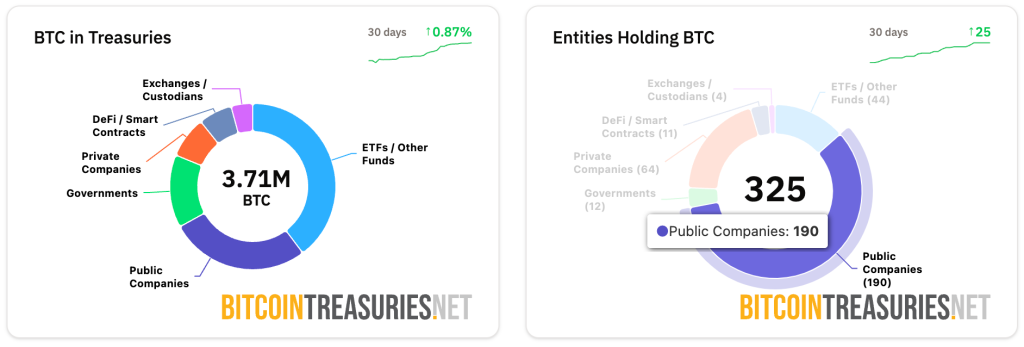
Hyperscale Data Announces $100M Bitcoin Treasury as Company Pivots to AI and Digital AssetsSource: BitcoinTreasuries

Recent moves have shown intensifying competition, with the Chinese firm CPOP launching a similar $33 million Bitcoin treasury that sparked a 56% stock surge before retreating.

UK-based Smarter Web, holding over £200 million in crypto reserves, is also actively seeking acquisition targets to purchase Bitcoin holdings at discount prices as some treasury companies now trade below their Bitcoin asset values.

The corporate treasury movement has shifted from guaranteed premiums for early adopters to execution-dependent success as market saturation challenges new entrants.

Industry analysts warn that rising interest rates expose structural vulnerabilities in debt-financed Bitcoin strategies, with most participants potentially unable to survive credit cycles.

Unlike historical wealth-building through leveraged real estate that generated rental income, Bitcoin produces no cash flow, forcing companies to rely on operational performance or asset appreciation to service acquisition debt.

Notably, Hyperscale’s dual approach of combining AI infrastructure development with Bitcoin treasury management may position it differently, potentially benefiting from multiple growth catalysts.

However, the strategy also exposes the company to volatility from both cryptocurrency price cycles and capital-intensive data center buildouts in an environment where Capital Group quietly generated $5 billion from Bitcoin treasury investments.

The company’s planned divestiture of its subsidiary, Ault Capital Group, in Q1 2026 will position Hyperscale as a focused data center operator and digital asset holder once the separation is complete.

Market Opportunity
null Logo
null Price(null)
--
----
USD
null (null) Live Price Chart
Disclaimer: The articles reposted on this site are sourced from public platforms and are provided for informational purposes only. They do not necessarily reflect the views of MEXC. All rights remain with the original authors. If you believe any content infringes on third-party rights, please contact crypto.news@mexc.com for removal. MEXC makes no guarantees regarding the accuracy, completeness, or timeliness of the content and is not responsible for any actions taken based on the information provided. The content does not constitute financial, legal, or other professional advice, nor should it be considered a recommendation or endorsement by MEXC.

You May Also Like

The Channel Factories We’ve Been Waiting For

The Channel Factories We’ve Been Waiting For

The post The Channel Factories We’ve Been Waiting For appeared on BitcoinEthereumNews.com. Visions of future technology are often prescient about the broad strokes while flubbing the details. The tablets in “2001: A Space Odyssey” do indeed look like iPads, but you never see the astronauts paying for subscriptions or wasting hours on Candy Crush.  Channel factories are one vision that arose early in the history of the Lightning Network to address some challenges that Lightning has faced from the beginning. Despite having grown to become Bitcoin’s most successful layer-2 scaling solution, with instant and low-fee payments, Lightning’s scale is limited by its reliance on payment channels. Although Lightning shifts most transactions off-chain, each payment channel still requires an on-chain transaction to open and (usually) another to close. As adoption grows, pressure on the blockchain grows with it. The need for a more scalable approach to managing channels is clear. Channel factories were supposed to meet this need, but where are they? In 2025, subnetworks are emerging that revive the impetus of channel factories with some new details that vastly increase their potential. They are natively interoperable with Lightning and achieve greater scale by allowing a group of participants to open a shared multisig UTXO and create multiple bilateral channels, which reduces the number of on-chain transactions and improves capital efficiency. Achieving greater scale by reducing complexity, Ark and Spark perform the same function as traditional channel factories with new designs and additional capabilities based on shared UTXOs.  Channel Factories 101 Channel factories have been around since the inception of Lightning. A factory is a multiparty contract where multiple users (not just two, as in a Dryja-Poon channel) cooperatively lock funds in a single multisig UTXO. They can open, close and update channels off-chain without updating the blockchain for each operation. Only when participants leave or the factory dissolves is an on-chain transaction…
Share
BitcoinEthereumNews2025/09/18 00:09
US Prosecutors Seek $327K Crypto Forfeiture Over Romance Scam

US Prosecutors Seek $327K Crypto Forfeiture Over Romance Scam

The post US Prosecutors Seek $327K Crypto Forfeiture Over Romance Scam appeared on BitcoinEthereumNews.com. In brief The Massachusetts District of the U.S. Attorney
Share
BitcoinEthereumNews2026/03/03 06:20
Pump.fun: Can $1.8mln whale buying help PUMP target $0.0022?

Pump.fun: Can $1.8mln whale buying help PUMP target $0.0022?

The post Pump.fun: Can $1.8mln whale buying help PUMP target $0.0022? appeared on BitcoinEthereumNews.com. Since reaching $0.0016, Pump.fun has shown upward momentum
Share
BitcoinEthereumNews2026/03/03 06:01