JPMorgan reports Bitcoin ETFs saw net inflows while gold ETFs lost $11B in March. MARA sold 15,133 BTC for $1.1B, GameStop deployed BTC covered calls, and DavidJPMorgan reports Bitcoin ETFs saw net inflows while gold ETFs lost $11B in March. MARA sold 15,133 BTC for $1.1B, GameStop deployed BTC covered calls, and David

Crypto News March 27: Bitcoin Beats Gold in Iran Crisis, MARA Sells $1.1B BTC, Sacks Exits

2026/03/27 11:19
4 min read
For feedback or concerns regarding this content, please contact us at crypto.news@mexc.com

Bitcoin outperformed gold during the Iran conflict according to JPMorgan data released March 26, even as the Fear & Greed Index plunged to 13 and corporate holders MARA and GameStop made billion-dollar strategic pivots with their BTC treasuries.

Bitcoin Held Up Better Than Gold During Iran Crisis, JPMorgan Says

JPMorgan Managing Director Nikolaos Panigirtzoglou reported that gold ETFs lost roughly $11 billion in outflows during the first three weeks of March 2026, while Bitcoin ETFs recorded net inflows over the same period. Gold fell approximately 15% month-to-date; Bitcoin gained roughly 7%.

“Bitcoin has held up better than gold and silver during the Iran war period, drawing net inflows as precious-metal ETFs faced withdrawals,” Panigirtzoglou wrote in a research note compiled by PA News Lab. “Gold ETFs saw nearly $11 billion in outflows in the first three weeks of March, while bitcoin funds have continued to attract net inflows.”

The finding challenges the long-held assumption that gold is the dominant safe-haven asset during geopolitical crises. Trump postponed Iran strikes to April 6, citing “substantive negotiations,” but the damage to gold’s narrative was already visible in the flow data.

Despite this macro outperformance, Bitcoin traded at $68,686 on March 27, down 3.11% over 24 hours, with a market cap of $1.37 trillion and trading volume of $50.23 billion. The Fear & Greed Index sat at 13, deep in “Extreme Fear” territory, a level that historically signals panic-driven positioning among retail traders.
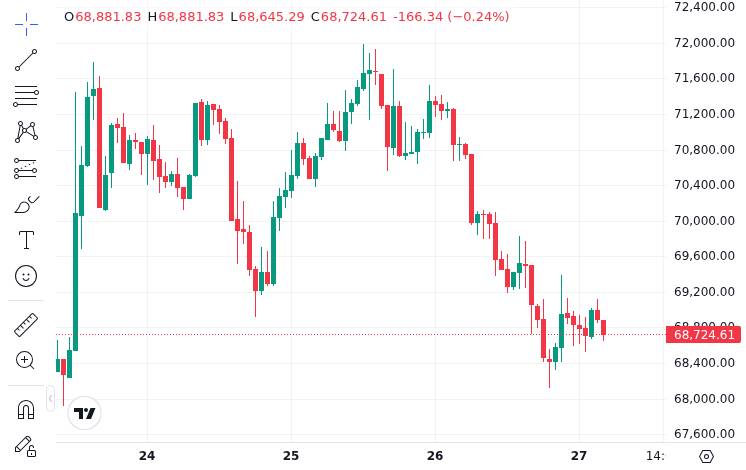
CoinMarketCap price chart for Bitcoin on March 27, 2026CoinMarketCap visual captured from https://coinmarketcap.com/currencies/bitcoin/. Source: CoinMarketCap

The paradox is notable: Bitcoin is outperforming gold on a macro flow basis while sentiment indicators flash extreme fear. That disconnect suggests institutional capital is treating BTC differently than retail traders, a dynamic that has preceded sharp reversals in past cycles.

MARA Sells $1.1B in Bitcoin; GameStop Pivots to Covered Calls

MARA Holdings sold 15,133 BTC for approximately $1.1 billion between March 4 and March 25, using the proceeds to repurchase $1.0 billion in face value of convertible notes at roughly a 9% discount. The trade captured approximately $88 million in value. MARA retains 38,689 BTC on its balance sheet.

The sale represents a deliberate deleveraging move, not a loss of conviction. By buying back debt at a discount, MARA reduced its future obligations while maintaining one of the largest corporate Bitcoin positions in the industry.

GameStop took the opposite approach. The company pledged 4,709 of its 4,710 BTC to Coinbase as collateral for an OTC covered call options strategy, with strike prices set between $105,000 and $110,000. Its BTC holdings are now recorded as a $368.3 million receivable, carrying a $59.7 million unrealized loss.

The contrast between the two strategies is significant. MARA is actively reducing leverage. GameStop is monetizing idle holdings by collecting options premiums. Both represent a shift away from passive “buy and hold” toward active corporate treasury management, a maturation that mirrors how traditional finance treats reserve assets.

This institutional recalibration comes at a time when liquidation cascades have punished overleveraged positions across the market. The companies’ moves suggest a growing preference for capital efficiency over simple accumulation.

David Sacks Exits White House; UK Sanctions $19.9B Crypto Marketplace

David Sacks stepped down as White House AI and crypto czar after exhausting his 130-day special government employee term. He will transition to co-chair the President’s Council of Advisors on Science and Technology (PCAST) alongside Michael Kratsios. No replacement AI or crypto czar has been announced.

Sacks’ departure leaves stablecoin and market structure legislation incomplete, creating a policy vacuum at a critical moment for the industry. The absence of a dedicated crypto policy lead in the White House raises questions about the timeline for regulatory clarity that institutional participants have been waiting for.

On the enforcement side, the UK government became the first country to sanction Xinbi, a Chinese-language crypto marketplace that processed $19.9 billion in transactions between 2021 and 2025. The platform was linked to Southeast Asian scam centers. The UK also sanctioned Legend Innovation Co, the operator of Cambodia’s #8 Park compound with capacity for 20,000 trafficked workers, along with two officials, Thet Li and Hu Xiaowei.

In DeFi security, the Moonwell governance attack demonstrated how cheaply protocols can be targeted. An attacker spent approximately $1,800 to acquire 40 million MFAM governance tokens, then attempted to seize over $1.08 million in user funds within roughly 11 minutes. Separately, Resolv Labs recovered about 57% of illegally minted USR tokens, removing 46 million of 80 million from circulation.

The $1,800-to-$1.08 million ratio in the Moonwell attack underscores a persistent vulnerability in token-weighted governance models, where low-liquidity governance tokens can be weaponized at minimal cost.

Disclaimer: This article is for informational purposes only and does not constitute financial or investment advice. Cryptocurrency and digital asset markets carry significant risk. Always do your own research before making decisions.


Market Opportunity
Bitcoin Logo
Bitcoin Price(BTC)
$68,406.21
$68,406.21$68,406.21
-0.98%
USD
Bitcoin (BTC) Live Price Chart
Disclaimer: The articles reposted on this site are sourced from public platforms and are provided for informational purposes only. They do not necessarily reflect the views of MEXC. All rights remain with the original authors. If you believe any content infringes on third-party rights, please contact crypto.news@mexc.com for removal. MEXC makes no guarantees regarding the accuracy, completeness, or timeliness of the content and is not responsible for any actions taken based on the information provided. The content does not constitute financial, legal, or other professional advice, nor should it be considered a recommendation or endorsement by MEXC.

You May Also Like

Revolutionary: CME SOL XRP Futures Options Set to Transform Crypto Trading

Revolutionary: CME SOL XRP Futures Options Set to Transform Crypto Trading

BitcoinWorld Revolutionary: CME SOL XRP Futures Options Set to Transform Crypto Trading Exciting news is rippling through the cryptocurrency world! The U.S. Chicago Mercantile Exchange (CME), a titan in traditional finance, is reportedly planning to launch CME SOL XRP futures options. This significant development, initially reported by Walter Bloomberg, marks a pivotal moment for institutional involvement in the altcoin market. It signals a new era for how Solana (SOL) and Ripple (XRP) might be traded, potentially opening doors to broader adoption and increased market maturity. What Does the Launch of CME SOL XRP Futures Mean for Crypto? When an institution like CME, known for its rigorous standards and vast trading volume, enters a new market, it brings a wave of legitimacy. The introduction of CME SOL XRP futures options indicates a growing acceptance of these digital assets within mainstream finance. This move could fundamentally change how investors perceive and interact with SOL and XRP. Futures options are financial derivatives that give traders the right, but not the obligation, to buy or sell an underlying asset at a specific price on or before a certain date. For SOL and XRP, this means: Enhanced Price Discovery: More participants and trading volume can lead to more efficient and accurate pricing. Institutional Access: It provides regulated avenues for large institutional investors to gain exposure to SOL and XRP without directly owning the underlying assets. Risk Management: Traders can use these options to hedge against potential price fluctuations in their existing SOL and XRP holdings. Why Are SOL and XRP Chosen for CME SOL XRP Futures? The selection of Solana (SOL) and Ripple (XRP) for these new futures options is not arbitrary. Both cryptocurrencies hold significant positions in the market and offer distinct value propositions: Solana (SOL): Known for its high-performance blockchain, offering fast transaction speeds and low costs. Its robust ecosystem supports numerous decentralized applications (dApps), NFTs, and DeFi projects, attracting considerable developer and user interest. Ripple (XRP): Primarily focused on facilitating fast, low-cost international payments for financial institutions. Despite ongoing regulatory discussions, XRP maintains a strong market presence and a dedicated community, highlighting its potential for cross-border transactions. Their substantial market capitalization and existing liquidity make them attractive candidates for institutional-grade derivative products. This choice reflects a strategic assessment by CME of assets that can sustain significant trading interest and volume. Navigating the Landscape: Opportunities and Considerations for CME SOL XRP Futures The introduction of CME SOL XRP futures options presents a wealth of opportunities, yet it also comes with important considerations. On the opportunity front, we can expect increased liquidity, which benefits all market participants by making it easier to buy and sell without significant price impact. Moreover, it could attract new capital from traditional financial players who prefer regulated products. However, traders and investors should also consider the implications: Market Volatility: While derivatives can offer hedging, they can also amplify market movements. Regulatory Clarity: The regulatory landscape for cryptocurrencies, particularly for XRP, continues to evolve. CME’s move might encourage further clarity but also means ongoing scrutiny. Learning Curve: Understanding futures options requires a certain level of financial literacy, which new entrants to the crypto market may need to develop. These products offer sophisticated tools for managing exposure and speculating on price movements, but they demand a careful approach. What’s Next for the Crypto Market with CME SOL XRP Futures? The reported launch of CME SOL XRP futures options is more than just a new product offering; it represents a significant milestone in the ongoing convergence of traditional finance and the digital asset space. It underscores the growing maturity of the cryptocurrency market and its increasing integration into global financial systems. As institutional interest continues to surge, we can anticipate further innovation and a broader range of regulated products for other altcoins. This development is poised to offer sophisticated tools for investors and traders, potentially stabilizing market dynamics while simultaneously introducing new avenues for growth and investment. The crypto market is evolving rapidly, and CME’s latest initiative is a clear indicator of this exciting trajectory. To learn more about the latest crypto market trends, explore our article on key developments shaping the cryptocurrency market institutional adoption. Frequently Asked Questions (FAQs) What is the Chicago Mercantile Exchange (CME)? The CME is one of the world’s largest and most diverse derivatives marketplaces, offering a wide range of futures and options products across various asset classes, including equities, commodities, and now, expanding into specific cryptocurrencies. What are futures options in the context of SOL and XRP? Futures options for SOL and XRP are financial contracts that give the holder the right, but not the obligation, to buy or sell SOL or XRP futures contracts at a predetermined price on or before a specific date. They allow for hedging and speculation on price movements. Why are Solana (SOL) and Ripple (XRP) chosen for these new options? SOL and XRP were likely chosen due to their significant market capitalization, established liquidity, and distinct use cases within the crypto ecosystem, making them attractive for institutional-grade derivative products. How might CME SOL XRP futures options affect the prices of SOL and XRP? The introduction of these options could lead to increased liquidity and institutional participation, potentially influencing price discovery and stability. However, like all derivatives, they can also contribute to market volatility. When are these CME SOL XRP futures options expected to launch? While Walter Bloomberg reported CME’s plans, an official launch date has not yet been publicly announced by CME. Market participants should monitor official CME channels for updates. If you found this article insightful, please consider sharing it with your network! Help us spread the word about the exciting developments in the crypto space by sharing this article on your social media platforms. This post Revolutionary: CME SOL XRP Futures Options Set to Transform Crypto Trading first appeared on BitcoinWorld.
Share
Coinstats2025/09/18 00:45
Swap xStocks Tokens Instantly on StealthEX

Swap xStocks Tokens Instantly on StealthEX

Discover 10 xStocks tokenized stock tokens — TSLAX, NVDAX, SPYX & more — now available to swap for 2,000+ cryptos on StealthEX. No registration required. The post
Share
Stealthex2026/03/27 14:40
UK Targets Southeast Asian Crypto Networks with Major Sanctions

UK Targets Southeast Asian Crypto Networks with Major Sanctions

The post UK Targets Southeast Asian Crypto Networks with Major Sanctions appeared on BitcoinEthereumNews.com. In a bold strategy to tackle crypto-enabled scams,
Share
BitcoinEthereumNews2026/03/27 14:22