5 Best Ethereum API Providers for 2026
Ethereum remains the most developer-heavy blockchain in Web3, processing roughly 1.7 million transactions per day and anchoring the majority of DeFi value, NFT activity, and Layer 2 settlement. For developers building on top of it, the choice of API provider shapes everything from how fast a product ships to how reliably it runs at scale.
But “Ethereum API” means different things depending on what you are building. A trading bot needs the lowest possible RPC latency. A portfolio tracker needs enriched wallet data and market prices. A compliance tool needs verified contract ABIs and detailed transaction histories. No single provider covers every use case equally well, which is why developers often combine two or more services in production.
This guide breaks down five providers worth considering in 2026, each approaching the problem from a different angle. We skipped CoinMarketCap and CoinGecko intentionally; both are solid market-data sources, but neither offers the wallet-level or node-level Ethereum integration that the providers below do.
At a Glance
Before diving into each provider, here is a side-by-side snapshot of what matters most when evaluating an Ethereum API.
| CoinStats API | Alchemy | Moralis | QuickNode | Etherscan API | |
|---|---|---|---|---|---|
| Primary focus | Market data + wallet tracking + portfolio analytics | Managed node infra + developer tooling | Pre-enriched Web3 data APIs | High-speed RPC + marketplace add-ons | Explorer-grade Ethereum data |
| Ethereum wallet data | Yes (balances, txs, ERC-20s, multi-chain in one call) | Via RPC + enhanced transfer APIs | Yes (decoded, enriched, cross-chain) | Via RPC + token/NFT add-ons | Yes (account, transfer, token endpoints) |
| Market/price data | 20,000+ coins across 200+ exchanges | Limited | Yes (block-level price updates from DEX pools) | Via third-party marketplace add-ons | ETH price + historical network stats |
| Chains supported | 120+ | ~50+ | 20+ EVM chains + Solana | 70+ | 60+ (EVM only) |
| Free tier | Yes | 30M compute units/month | Yes | 50M API credits | 5 calls/sec |
| SOC 2 certified | N/A | No (as of 2025) | Type II | Type II | N/A |
1. CoinStats API
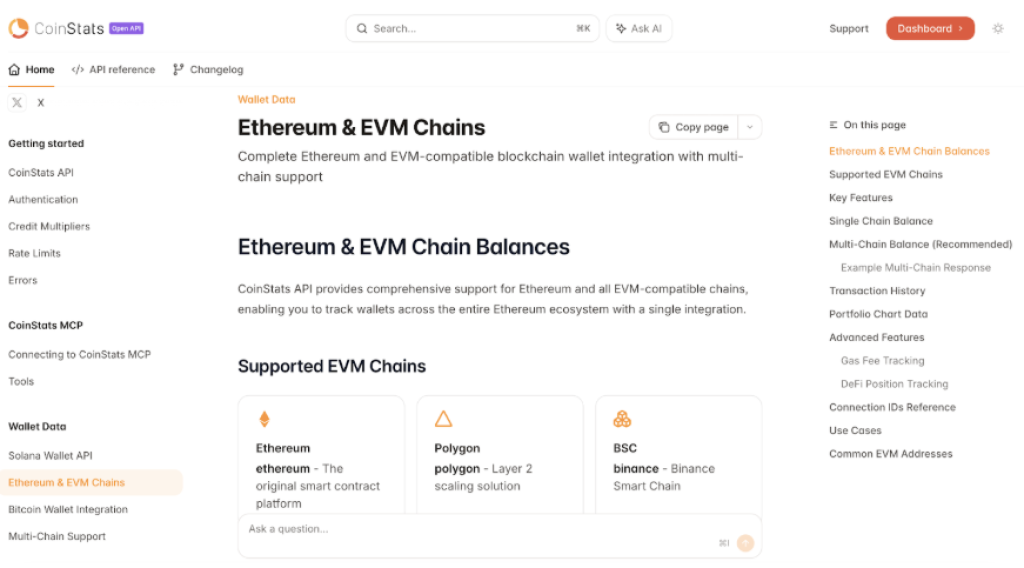
Many Ethereum API providers specialize in either raw blockchain access (RPC nodes, JSON-RPC methods) or aggregated market data (prices, volumes, market caps). CoinStats attempts to cover both categories in a single platform, along with portfolio analytics and wallet tracking.
The company built its reputation as a portfolio tracker supporting 20,000+ coins, 300+ wallet and exchange integrations, and 120+ blockchains. The Public API opens all of that aggregated data to developers through RESTful endpoints authenticated with a single API key.
What the Ethereum integration looks like in practice. (Full EVM docs here.) A GET request to /wallet/balance with connectionId=ethereum returns the full token inventory of any Ethereum address: native ETH balance, every ERC-20 token detected, current USD prices, 24-hour price changes, and ranking metadata. If you need a cross-chain picture, the /wallet/balances?networks=all endpoint pulls balances across Ethereum, Polygon, BNB Chain, Arbitrum, Optimism, Avalanche, Base, Fantom, and other EVM networks in a single call. Transaction histories follow the same structure: one endpoint, one response format, regardless of chain.
Market data coverage. The /coins endpoint covers essentially any cryptocurrency with at least ~$50K in liquidity, pulling unified data from 200+ exchanges. Developers get real-time prices, market caps, volumes, metadata, and historical charts without needing to normalize feeds from multiple vendors.
Portfolio analytics. Instead of rebuilding portfolio logic from scratch, developers can pull data that users already manage inside CoinStats: total portfolio value, holdings breakdown, P/L charts, and allocation trends over time. This is accessed through a ShareToken-authenticated endpoint and supports use cases like backtesting against actual holdings, running risk metrics, or embedding a live portfolio widget in a custom app.
CoinStats also ships a Model Context Protocol (MCP) server, letting AI assistants and coding IDEs call its endpoints as tools. The MCP uses the same API key as the REST API, so there is no separate setup required.
Getting started: Sign up at openapi.coinstats.app for a free API key. Documentation lives at coinstats.app/api-docs, with dedicated pages for Ethereum/EVM wallets, Solana, Bitcoin, portfolio access, and MCP configuration. Support runs through Telegram and email.
2. Alchemy
If CoinStats sits at the intersection of market data and wallet tracking, Alchemy sits squarely in the managed-infrastructure camp. Founded in 2017, the platform started as a way to give developers Ethereum node access without running full nodes themselves. It has since grown into a broad developer-tooling ecosystem covering around 50+ blockchains.
The core product is the Alchemy Supernode: JSON-RPC access to Ethereum mainnet and testnets over HTTP and WebSocket, backed by distributed, fault-tolerant infrastructure across multiple regions. What sets Alchemy apart from a plain RPC provider is the layer of enhanced APIs built on top.
The Transfers API (alchemy_getAssetTransfers) simplifies transaction-history queries that would otherwise require complex log filtering. The Notify API delivers real-time webhooks when an address receives funds, a transaction gets mined, or a pending transaction drops from the mempool. The Transact API handles reliable transaction submission with Mempool monitoring and MEV protection on certain chains. Dedicated NFT endpoints cover metadata, ownership, and collection analytics.
On pricing, Alchemy uses a compute-unit (CU) model. A basic call like eth_blockNumber costs around 10 CUs; heavier methods like eth_call consume 26 CUs or more. The free plan includes 30 million CUs per month. Pay As You Go starts at $49/month and bills at roughly $0.45 per million CUs for the first 300M CUs, dropping to $0.40/M after that. Enterprise pricing is negotiated. The CU model gives flexibility, but it also means monthly costs depend on the specific mix of methods your app calls, which can make budgeting less predictable at high scale.
Alchemy has powered a significant share of top Ethereum applications and is commonly used by teams that want managed node access, enhanced APIs (especially real-time webhooks), and a built-in developer dashboard.
3. Moralis
Moralis approaches the problem from the opposite end of the stack. Rather than handing developers raw RPC access and expecting them to index, decode, and normalize everything themselves, Moralis delivers pre-processed, enriched blockchain data through high-level REST APIs. The idea is to reduce the infrastructure work required before a developer can start building product features.
The API suite is organized by domain. The Wallet API returns decoded balances, transaction histories, NFTs, and on-chain activity for any address across supported chains. The Token API covers balances, transfers, metadata, and liquidity data. The NFT API provides ownership records, collection analytics, metadata, and transfer histories at scale. The Price API updates every single block by reading directly from DEX liquidity pools, so even freshly listed or low-cap tokens are covered immediately. Newer additions include a DeFi API for protocol pools, positions, and yields, plus Moralis Streams for webhook-based real-time event monitoring.
The platform supports Ethereum and a broad set of EVM-compatible chains (Polygon, BNB Chain, Arbitrum, Avalanche, Base, Optimism, and others), along with Solana.
Moralis states that its APIs cut development time by roughly 80% compared to building the same data layer in-house. Notable clients include MetaMask, Blockchain.com, and Opera. SOC 2 Type II and ISO 27001 certifications add relevance for teams with compliance requirements.
On pricing, Moralis uses a compute-unit system where the average API request consumes about 72 CUs. A free tier is available, and paid plans are billed annually with pricing that scales by CU consumption. Enterprise plans with dedicated support and custom limits are available for high-volume users.
Moralis is worth evaluating for teams that want wallet, token, NFT, and price data delivered in structured JSON without running their own indexing pipeline.
4. QuickNode
Where Moralis optimizes for data enrichment, QuickNode optimizes for raw speed. The platform is a blockchain infrastructure provider built around low-latency RPC access, supporting 70+ blockchains and handling over 200 billion API calls per month by its own count.
For Ethereum, QuickNode provides access to mainnet, Sepolia, and Hoodi testnets over HTTP and WebSocket. All endpoints include full archive data with no pruning by default. The global network routes each request to the nearest available data center automatically, and benchmarks consistently place QuickNode among the fastest Ethereum RPC providers, with response times 2-3x quicker than some competitors in head-to-head tests. Enterprise clients can access 500+ requests per second under a 99.99% uptime SLA.
Beyond raw RPC, QuickNode differentiates with its Marketplace: a library of add-ons that extend the base infrastructure. These include NFT and ERC-20 token APIs, one-click webhook setup for smart-contract events, IPFS decentralized storage, third-party pricing APIs (like the Noves long-tail pricing add-on), and a GraphQL interface for query-based data retrieval. This modular approach lets developers start with basic node access and bolt on additional capabilities as their project grows.
QuickNode holds SOC 1 Type 2, SOC 2 Type 2, and ISO 27001 certifications, giving it one of the broadest compliance portfolios among RPC providers.
On pricing, QuickNode uses an API-credit model. The free Discover plan includes 50 million API credits. Paid tiers run from Build at $49/month through Scale at $299/month and Business at $900/month, each with higher credit allocations and rate limits. Overages on paid plans cost $10 per million API credits, though enterprise agreements can negotiate that figure down. Crypto payments are accepted on all paid plans.
QuickNode tends to fit well with latency-critical applications: trading bots, MEV strategies, real-time DeFi front-ends, and projects where milliseconds of RPC response time directly affect outcomes.
5. Etherscan API
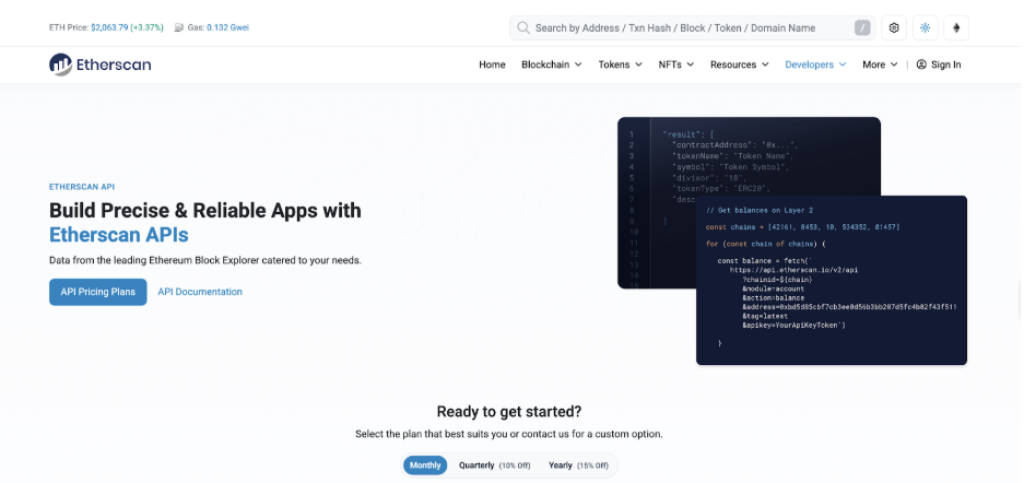
Etherscan fills a different role than the other providers on this list. It is not a node provider, not a market-data aggregator, and not a Web3 development platform. It is the Ethereum block explorer, and its API gives developers programmatic access to the same Ethereum-specific data that has made Etherscan a default reference point for the ecosystem since 2015.
The API covers accounts (balances, transaction lists, internal transactions, ERC-20/ERC-721/ERC-1155 transfers), contracts (verified source code, ABI retrieval), transactions (execution status, receipt data), blocks, event logs, gas pricing, and network statistics. The statistics endpoints are particularly valuable and not commonly found elsewhere: daily new Ethereum addresses, historical mining difficulty, chain size over time, network gas utilization, and daily ETH price history.
Etherscan API V2, launched in late 2025, unified 60+ EVM chains under a single account and API key. Developers switch between Ethereum, BNB Smart Chain, Arbitrum, Base, Optimism, and other networks by changing a chainid parameter. No separate registrations, no extra keys.
The verified-contract database is also notable. Etherscan is the de facto standard for contract source-code access on Ethereum. If your application needs to fetch a contract’s ABI, display its source code, or verify deployment details, Etherscan is where most of the ecosystem looks first.
On pricing, the free tier allows up to 5 calls per second with access to roughly 90% of supported chains (a late-2025 adjustment reduced free-tier chain coverage by about 10% to manage infrastructure costs). Paid plans start with a Lite tier at 25% of the standard Pro price, then scale through Pro at approximately $199/month and Premium at $399/month with up to 30 calls per second and dedicated support.
Etherscan tends to suit compliance tools, accounting platforms, contract-verification workflows, and applications that need deep Ethereum-native analytics rather than multi-chain breadth.
Choosing the Right Provider (or Combination)
Picking a single “best” Ethereum API for every situation is not realistic. The five providers above serve fundamentally different needs.
If your app is data-first (portfolio trackers, analytics dashboards, market-data aggregators), CoinStats API or Moralis will likely get you to production faster because they deliver enriched, structured data rather than raw blockchain output. CoinStats covers more ground on market data (20,000+ coins, 200+ exchanges) and portfolio analytics; Moralis focuses more on decoded on-chain data and NFT-specific endpoints.
If your app is infrastructure-first (dApps, DeFi protocols, trading bots), Alchemy or QuickNode provide the managed node access and low-level RPC methods your smart-contract interactions require. Alchemy focuses more on developer tooling and webhooks; QuickNode focuses more on raw speed and holds the broadest compliance certifications of the two.
If your app needs Ethereum-specific depth (contract verification, gas analytics, network health monitoring), Etherscan API is the only provider on this list purpose-built for that niche.
Many production setups combine two providers. A common pattern is pairing a node/RPC provider (Alchemy or QuickNode) for smart-contract interactions with a data provider (CoinStats or Moralis) for market prices, wallet balances, and portfolio features. All five offer free tiers, so testing the fit before committing is straightforward.
The post 5 Best Ethereum API Providers for 2026 appeared first on CaptainAltcoin.


You May Also Like

Why Bitcoin Price Could Be Forming A Consolidation Structure Around $80,000
Solana Price is Hanging on a Thread as Crypto Fear and Greed Index Falls